My Brother’s Keeper by Tim Powers
Posted in Fantasy, My ParSec reviews, Reviews published in ParSec at 12:00 on 12 June 2024
Head of Zeus, 2023, 309 p. Reviewed for ParSec 9.
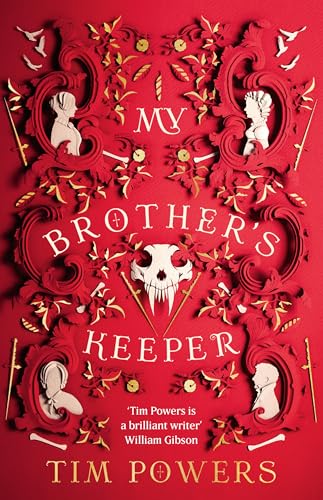 The Yorkshire Moors make an ideal setting for tales of the uncanny. A thin place. Remote, wild, desolate, atmospheric, and above all, wuthering. A world beyond the world. It is easy to imagine strange goings on, mysterious creatures, ghosts, hidden menace, inhabiting the landscape. But we don’t have to. The Brontë sisters (well, Emily) already did. And now, so too has Tim Powers in a story whose central focus is on the Brontë family and Emily’s dog, Keeper, but also incorporates the author’s usual injections of weird. In particular here we have boggarts, gytrashes, barguests, (the latter two being essentially the same thing,) werewolves, a temple on the moors to the Roman goddess Minerva, double-bladed knives called dioscuri, an ancient creature with latent potency buried inside Haworth Church under a slab with an Ogham inscription. Not to mention clandestine human organisations known as the Oblique and the Huberti.
The prologue sees Branwell Brontë inveigling Emily and Anne along to a cave where they all leave smears of blood on the rocks. This acts as a primer for the subsequent plot, a debt to be called in. (I note again the prevalence of blood in these sorts of invocation.) Later, in his time in London, Branwell is bitten by a dog and more recently pricked by a dioscuri. Emily too has been bitten, though escaped the knife. But both are marked.
Their father Patrick’s great-grandfather, Hugh Brunty, had been on a boat crossing to Ireland when a child stowaway was found whom the crew said was a devil and wanted to throw overboard. Hugh saved the boy, who received the name Welsh (his believed origin,) and adopted him. Welsh was a spirit and possessed Hugh, and later his son, but in the next generation Patrick’s father resisted possession, and with the help of his dog killed Welsh’s body but not its spirit. When Patrick (now Brontë) came to England the spirit followed him. It is to keep any such demons at bay that Patrick fires his gun at Haworth Church every morning.
Emily’s embroilment comes when, near a ruin called Ponden Kirk, she saves a man named Alcuin Curzon from a werewolf. He is one of the Huberti, working to prevent the Oblique reuniting the two halves of their biune god (one half being Welsh and the other the thing under the slab.) Emily in this tale is the strongest of the Brontë siblings, and along with Keeper, whose ghost doppelgänger manifests itself when times are needful, is instrumental in the resolution.
Powers has form with incorporating literary figures in his work. Previous books of his have featured Lord Byron, the Rossettis, and William Ashbless, a poet of his own invention (with James Blaylock.) How much this convinces may depend on the reader’s knowledge of those characters’ backgrounds but in My Brother’s Keeper there is too little of the Brontës as Brontës. It could of course be argued that in the context of the story Powers had little room for this, but while mention is made of the sisters’ initial book of poetry, the manuscript of Wuthering Heights being at a publisher and Branwell’s tendency to see himself as his fictional creation Northangerland, only once do we see the sisters sit down to write. (Branwell’s attempts to do so are depicted as futile, counterproductive and tainted by possession.) That the sisters’ work exists is, however, essential to the way Powers resolves the story and he gives us a supernatural – and also literal – explanation for the disease then called consumption, which in real life was to take both Emily and Anne.
All that aside; as a fantasy the novel is gripping and very well written, as is customary with Powers. Certainly not a chore to read.
Pedant’s corner:- “an uncharacteristic howel” (howl,) “toward he parsonage” (the parsonage,) “in that that wilderness” (only one ‘that’ required,) “none of the Oblique order were very eager” (none … was eager,) “‘has strived’” (I’m sure Emily Brontë would have said ‘has striven’,) ditto “‘a different route than the one’” (‘a different route from the one’,) “keeper had laid down beside her” (had lain down,) “off of” (it’s just ‘off’ no ‘of’,) “the paralysis had been had been some consequence” (no need for that second ‘had been’.) “‘Where’s your crows?’” (‘Where are your crows?’,) “straps on this shoulders” (on his shoulders,) specactles (spectacles,) metioned (mentioned,) “and laid down between their boots” (lay down.)
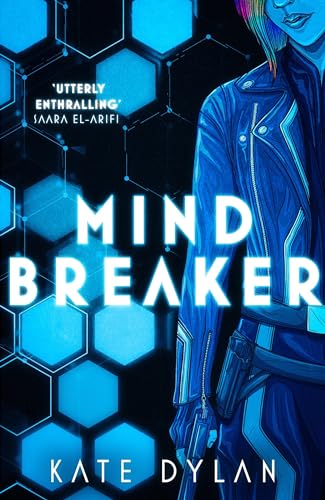 In the aftermath of a nuclear war Indra was brought up in the Order, a religious sect fanatically opposed to technology, whose members are marked out by a crescent moon branded on one cheek. Despite (or because of) this indoctrination she was fascinated by computers which led her to befriend Nyx, who calls her God Girl. One night they were caught in a radioactive storm and, because of her brand, refused shelter till it was too late, unless they had radical medical intervention. Her mother refused to countenance anything so ungodly as nanite repair therapy but her father okayed it, at the cost of rejection from the sect. Nyx was fine but Indra’s rare susceptibility to acute onsite nanite rejection meant the treatment did not work. The Glindell Corporation offered her a way out through Neural Transcendence, the process of uploading a human mind to an artificial drive, a MindDrive housed in a titanium shell.
 In 2255 humanity has recovered from the ravages of climate change on Earth and extended into the Solar System. Earth is dominant, with a stranglehold on the Lunar Consortium’s expansionary plans and its helium-3 extraction exports via control of the supply of nitrogen needed as a buffer gas. However, schemes are in hand for Earth to mine the gas giants for helium-3 to fuel a nuclear fusion engine which will cut journey times across the Solar System from decades to years. A third group called Conservers does not wish to deplete the Solar System’s resources but has sent out the Shadow, a ship powered by solar sails, to the Oort Cloud to investigate the possibility of Planet Nine orbiting there.
 In the aftermath of an extremely virulent virus called the Whispers, which may or not have been man-made, optimised humans (Opts) such as Cassie White are widely held to have had something to do with it and subject to prejudice as a result. Somewhere around the same time there was also an AI war after which the Chinese People’s Republic was replaced by the New Chinese Republic (NCR.)
 This is the author’s first collection of stories, twenty-one in all, plus one poem. Sixteen of them were culled from appearances in a variety of outlets over the past ten years, five are making their first appearance in print. The contents range in genre over SF, fantasy, myth and horror, with stories sometimes crossing over their borders.
 ParSec 9 has been published and can be purchased