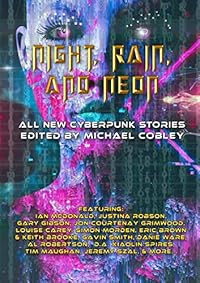
Night, Rain, And Neon edited by Michael Cobley
Posted in My ParSec reviews, Reading Reviewed, Reviews published in ParSec, Science Fiction at 12:00 on 22 April 2023
A New Cyberpunk Anthology, NewCon Press, 2022, 315 p. Reviewed for ParSec 4.
Is it really nearly forty years since “the sky was the colour of television” as that famous opening line of William Gibson’s Neuromancer had it? For those of us old enough to have felt that particular jolt to the SF-verse it can be hard to remember those all-but pre-digital days. In his introduction to this anthology Michael Cobley reminds us that most of the visions of the cyberpunk pioneers have now become embedded in everyday life as he argues that the sub-genre has never been so relevant. This book is intended to address for the modern age the question cyberpunk always has; how does humanity adapt and change when its perceptions are retooled by technology? Do we accept becoming something else or try to remain stubbornly human? That last is something the best SF has always interrogated and illustrated. Cyberpunk’s edge is that it tends to do this at a more immediate, visceral level rather than a philosophical one.
Though there are few explicit homages here – Al Robertson references “a blank television, tuned to a dead channel,” Jon Courtenay Grimwood mentions the “sky above the street” (though in Neuromancer I recall it was “the sky above the port”) and has someone wearing mirrorshades – we have numerous paraphernalia or tropes generally associated with cyberpunk: neural jacks; implants; VR environments; scuzzy, run-down neighbourhoods; dismal weather – grey skies, rain: the sun never seems to shine in cyberpunk – and criminal activities. Society’s underbelly appears an enduring preoccupation. Many of these stories feature imbalances of power and/or the relative impunity of money. Some have high body counts, displaying an implicitly casual attitude to human life: in these particular cyberpunk futures life tends to the harsh and brutish and may be short. The stories are frequently told in the first person, present tense preferred, and typically conveyed in prose with brief, terse sentences. Many without a verb. One, Callum McSorley’s Forever in Scotland, where anti-ageing treatments (and therefore living forever) are banned, is written in Glaswegian and all the more effective for it.
So what can cyberpunk still offer us? Among other things; a virus gradually eating away a cyborg operative from toe to head but whose contract means he will be transferred to a digital existence to pay off the debt forever; five colourful superheroes called The Fianna designed to protect Ireland from The Threat, (a threat which seems to be people in boats;) AI driven buses crashing more often than they should and whose city’s systems blame everything but the buses, an impossibility leading to an investigation of their operator, QuickMind; a world where the rich can buy anything – even the use of another (poorer) person’s body – and one of them searches for the ultimate thrill, transfer into the mind of a top predator; brain implants, personalised in the mind as an entity called Ena, steering the narrator’s decisions, not all of which are intuitive; the ability to feel and cause remote sensation, six thousand miles apart; a hit man wondering if the game is worth the candle; a woman who’d been in a motor-cycle crash waking up to find herself with a brain implant giving her commands – with menaces; a VR addict who overdoses but is then hired by a VR entity who wants her to create new flavours digitally; an undercover agent trying to unionise AIs; a neo-Nazi rampant world where the good guys track one down to a VR dive house and ensure a condign punishment; a memory doctor allowing cycling through a series of altered memories to pick the most convenient, or believable; a contractor extracting a nine-year-old boy from a guarded convoy in what appears to be a kidnapping because the boy has been bred to usher in an AI to rule the world; AR personae being used to track down a murderer operating in the phase interstices of a series of spaceships plying the solar system; the facility for people’s consciousnesses to be temporarily transferred to proxy bodies – for a fee – permitting multiple opportunities to commit crime and escape the consequences, or pinning them on an innocent party, but raising the question as to how prison can be made to work under such circumstances.
None of the ideas is startlingly new and any of these tales could easily have been found in SF short story outlets over recent years. Which is only to say that cyberpunk is now firmly part of the SF writer’s toolbox, to be called upon as and when necessary.
The overall impression the book gives though is that it is not technology that is the enemy: it is other people; and what they are willing to do with and for that technology.
Pedant’s corner:- Except for the first page of a story odd numbered pages are without numbering until it kicks in at page 289. Otherwise; “All the monstrous growths …. branching of sub-tentacles of itself” (of themselves,) “where he’d been stood” (standing.) “Itsay laid back from the effort” (lay back,) “down to the staff stood around someone lying on a gurney” (standing around.) “‘Which one of us gets to live.’” (is a question so ought to have a question mark,) “reaches its crescendo “ (no; the crescendo reaches its climax,) “the The Threat” (has one ‘the’ too many?) “Rewiding Centre” (elsewhere, Rewilding,) “moments before they are aware of here” (aware of her,) “she had pretended to him …….that she were as robust as she’d ever been” (that she was as robust,) “the buses’ robotic voice” (the bus’s robotic voice,) “the buses’ story” (bus’s.) “The bus’ voice changed” (bus’s,) sprung (sprang,) curb (kerb,) bannister (x 2, banister,) staunchin (stanchin,) “pouring over” (poring over,) “in the class above one called us” (once called us,) “this many smells and strangers and squeezed into a tight, suffocating space” (all squeezed into.) “Neon it flickers across” (Neon light flickers,) “be apart of” (apart = separate, the context was “a part of” = ‘belonging to’. ‘Apart of’ appeared twice more when ‘a part of’ was the sense,) “there’s plenty of secrets” (there are plenty of secrets,) “but it’s not until the Lynx that I’d realised” (but it wasn’t until the Lynx that I realised,) “head over to large booth” (a large booth.) “The girl with terrible teeth we’d seen yesterday” (needs its syntax cleaning up,) “like putting your tongue a livewire” (on a live wire,) “the sniffily guy says” (x2, sniffly.) “If I walk away, I’d be an outcast” (it’s a prediction; so, ‘I’ll be an outcast’.) “The intensity of the heartbeats are stronger” (is stronger.) “I think I felt a finger” (rest of narration is present tense, ‘I think I feel’.) Ditto “My own body felt” (feels,) amoung (among.) “Some were already sobbing” (Some are.) “The masked groups scrambles away” (scramble away.) “The crowd roars their approval” (its approval.) “A series of firm, stony nods come from” (a series ….. comes from,) “The unbearably guilt” (unbearable,) “all with an invested interest” (the phrase is ‘vested interest’,) “laying down” (lying down.) “She could any-fucking-where” (She could be any-fucking-where,) “no license” (licence,) targetters (targeters.) “The headache couches in wait” (crouches makes more sense,) “lay down on the floor” (x 3; lie down,) “lay down” (again; lie down) “she can’t see what is says” (what it says,) “struggles to breath (breathe.) “‘I’m not going to lie you though’” (to lie to you,) “very still-human offal” (very human-still offal?) “other than they’re preferred pronouns” (their.) “The first SUV in the convoy was also its roof” (also on its roof,) “the Bofor’s” (Bofors,) needs-must (needs must,) “over head” (overhead,) “as lot calmer” (as a lot calmer,) “your parent’s security folks” (parents’,) scooedg (????) Shambles’ (Shambles’s,) “strafed across as tiny spot” (as a tiny spot.) “Bit Nico preferred the offensive” (‘But Nico preferred’ makes more sense.) “Murdere was expecting him” (Murder, or, Murderer.) “There was a silver scar across the back of each of his knuckles, and remembered what it was like” (and he remembered,) “more people that could reasonably be accounted for” (more people than could reasonably.) “Where they just circling the block” (Were they,) “closing against towards the ankles” (closing again,) “the all the possible outcomes” (one ‘the’ too many,) “‘you’ll always outbid by someone’” (you’ll always be outbid,) “couldn’t name to it” (couldn’t put a name to it,) “rode passed” (rode past.) “‘Better that I’d give most’” (‘Better than I’d give most’ makes more sense,) ithe (the,) “the ships holographic interface” (ship’s,) Praxiteles’ (Praxiteles’s.) “The others low murmuring becoming a howl” (others’.) “The glyphs was so beautifully complex” (the glyphs were,) Stobbs’ (several times, Stobbs’s,) Stobb’s (Stobbs’s,) an unneeded paragraph indent, “opened its maw wide and swallowed” (a maw is a stomach, not a mouth,) “artifact back into place” (my dictionary has artifact as a alternative spelling but artefact is more true to the word’s roots.) “‘I don’t think it’s that it’s a stretch to say’” (one ‘it’s’ too many,) fit (fitted,) H2O (H2O,) missing comma before direct speech, “they use clone for skin grafts” (use to clone for skin grafts,) “as ugly grin crept” (as an ugly grin.) “‘You’ll be surprised that you can concoct with stuff’” (what you can concoct,) “at the insect’s crawling underneath” (insects.) “He kissed her daughter” (his daughter,) SUV’s (SUVs,) “wanted to setup show” (set up shop.) “‘I could give a toss’” (couldn’t give a toss,) extraneous quotation marks, “Jean Paul” (elsewhere Jean-Paul,) missing quotation marks, “without getting whet” (??? The context did not imply ‘wet’,) “Where they alive or dead?” (Were they,) “promises to investment” (of investment,) “untouched by violence of decay” (violence or decay,) “handy work” (handiwork,) “the engine’s stays hot” (engine,) two sized too big” (two sizes too big,) “It was her sisters” (sister’s,) “but had not taste” (had no taste,) “several meters in every direction” (metres,) “knowing already that they find” (what they’d find.) “The first thing that stuck them” (struck them,) “pulled out small glass container” (a small glass container.) “She felt Jean-Paul silent horror” (Jean-Paul’s.) “He pointed at a finger in the corner” (‘at a figure’ makes more sense.) “It was about to get whet.” (????) “a years’ worth” (year’s worth,) “in the Bosses hand” (Boss’s hand.) “A dip attached to her arm” (a drip,) “dress gown” (dressing gown,) “her sisters’ eyes” (sister’s,) “like I was at the helm of ship” (of a ship,) “from whatever set of thoughts looking at” (thoughts she was looking at.) “The only thing I can control are my reactions” (The only thing I can control is my reactions,) a missing full stop at the end of a sentence, whinging (I prefer the spelling whingeing – without the ‘e,’ I, being Scots, would otherwise read this as rhyming with singing; compare ‘hinging’ [= hanging in Scots] with ‘hingeing’, British English does make this distinction between singing and singeing.)