Archives » ParSec 15

The History of the World by Simon Morden 

NewCon Press, 2025, 139 p. Reviewed for ParSec 15.

Some while ago sentient ramship UNDSP-14 CORBYN had passed through a human-colonised star system but ignored all its inhabitants’ attempts at communication. However, they exerted themselves to sending after him their one and only light speed ship, the Great Honour, utilizing a D-jump mechanism Corbyn did not have, which folded space to make the distance between two points negligible. Corbyn’s ship had resilience, though, and the Great Honour hadn’t, so was falling apart when it caught up.  Corbyn rescued crew member PurLeeDah and salvaged the D-Jump. Now, at her request, he is returning PurLeeDah to her home system but they are travelling at 0.9999999999c and need to dump velocity by innumerable small collisions to below 0.8c in order then to decelerate “as God and Heinlein intended.” This means transiting the system above its ecliptic for twenty (subjective) seconds, jumping back and doing it again and again, thousands of times, each time making a spectacular light show in the planet’s sky, shedding blue Cherenkov radiation. No wonder the inhabitants, who have, in the many relativistic centuries since launching the Great Honour, regressed to pre-industrial levels, come to call Corbyn the Travelling God as he moves from what they call the Gates of Heaven to Exaltation. It also means PurLeeDah has spent most of the interim in suspended animation.

As time goes by the condition of the cold sleep system deteriorates and Corbyn offers PurLeeDah the possibility of seeking out other star systems, possibly more evolved and able to slow them down more easily, but she declines, wanting to see her own planet again. To slow down more quickly, Corbyn takes a risk.

The overall story is told in nine sections as Corbyn drops in velocity to 0.999999999c, 0.98c, 0.95c, 0.92c, 0.85c, Orbital Velocity, and Stationary (with respect to the planet,) each section beginning with what is happening on Corbyn before giving us a snapshot of the life of humans on the planet as they slowly develop civilisation again, their worship of the Travelling God evolves and the time taken for each transit gradually increases. In effect Morden has put together eight otherwise unconnected stories of the History of the World (PurLeeDah’s world) by using an inventive framing device. (If you were paying attention you may have noticed there were only eight – not nine – velocities mentioned above. The ninth is a valedictory chapter.) Each of the eight stories is peopled with believable characters in convincing scenarios.

I did idly wonder if Morden has read Brian Aldiss’s short story Heresies of the Huge God, with which this has some thematic similarities: but it is of course as possible that he has not. The resemblances are only incidental in any case. Not that it matters. Morden has written a very good novella indeed, a story to show that Science Fiction still has life in it. And we all stand on someone’s shoulders.

The following did not appear in the published review.

Pedant’s corner:- “And he and her had had rationalized” (he and she had rationalised.)  “The only way he knew … were the stars” (the only way … was the stars,) dove (dived,) “The chase to over too soon” (to be over too soon,) “in his own prophesy” (the noun is ‘prophecy’, prophesy is the verb,) “lay of the land” (it wasn’t a song; ‘lie of the land’,) “Berengas’ abacus beads” (several instances of Berengas’; Berengas’s,) prophesies (prophecies,) “calculations were only be done by” (‘were only done by’ or ‘were only to be done by’,) “he did recognized this” (recognise) “one of which were” (None of which was,) “Stratos’ face” (Stratos’s,) “taller than a few stories” (storeys, please,) “no sign anything resembling” (no sign of anything.) “Neither of them were in the first flush of youth” (Neither of them was in…,) “‘more advanced that I am’” (advanced than I am.) “ ‘It is semi-rigid inflatable boat’” (It is a semi-rigid inflatable boat,) “holding on edges” (holding onto edges,) “there would be hole there now” (there would be a hole there now.) In the “About the Author”; published in three months of each other” (published within three months of each other.)


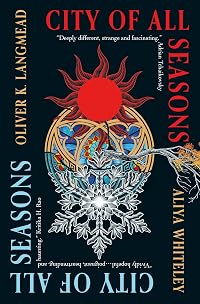
City of All Seasons by Oliver K Langmead and Aliya Whiteley

Titan Books, 2025, 288 p. Reviewed for ParSec 15.

Ever since something known as the weatherbomb hit it, cutting it off from its past and erasing some of its inhabitants, Jamie Pike’s Fairharbour has been a city enveloped in everlasting winter. All contact between its island and the mainland has been severed, any expeditions sent out over the frozen wastes of the sea never heard from again. Black-clad officers called Doormen patrol the streets enforcing order, sealing entrances and windows to keep heat inside buildings. Jamie spends a lot of his time tinkering in the workshop of his vanished uncle by marriage, Pawel, a mechanical whizz, and watching what remains of the work of his grandmother Carmen, a famous film-maker.

By contrast, after the weatherbomb, Esther Pike has lived in a Fairharbour bathed in perpetual summer, with sunlight a relentless presence. In her Fairharbour too, an authoritarian regime, The Fenestration, exerts power, forever cutting holes in the walls of buildings. She, too, strains against the restricted life of her city.

With this premise of a city with a doubled character, City of All Seasons has a superficial similarity to China Miéville’s The City and the City but is in the end much more interesting than his novel (which was really only a murder mystery with an unusual setting.)

Both Jamie and Esther wonder what has become of the other and of their lost family members but both have encounters with the city’s mayor, a curious apparition always dressed in a diving suit yet who seems to be able to bridge the divide between the two manifestations of the sundered city. Their two stories are told in strictly alternating first person narratives as their interconnections begin to mount.

One of those connections lies via an atypical Tarot deck, three of whose cards are involved in the exchanges between the winter and summer city. Illustrations of those, The Two of Fish, The Stage, and the Nine of Smiles, preface three of the book’s four sections.

To plot, though. Jamie catches a glimpse of greenery and begins to wonder if there is another existence just out of reach. He constructs a kaleidoscope from some glass fragments, wing mirrors and a tube, and leaves it where he hopes it might be found by Esther.

The story delves into Jamie and Esther’s past lives and of their family before the split (crucially their uncles Jan and Remi were forever unable to share) while also gradually revealing the lore and customs of the city. In this, the tale of the city’s emblem, the smiling knight, assumes significant importance. In an old interview with Carmen she told of this as her inspiration for an intended film about a man who uses his death for the benefit of the city and prophesies, “‘When I die; it will be spectacular.’”

Also prophetic are a suit worn by her, black on one side, white on the other, slashed diagonally from right collarbone to left ribcage, and a two-handed saw made by Pawel. All of this comes together in the city’s Lavender Theatre, the source of the divide.

Though there is a slight imbalance between the two strands Langmead and Whiteley let their tale unfold at just the right pace, the similarities and differences between the situations of Jamie and Esther counterpointing and emphasising each other, the influence of their extended family to the past and future gradually becoming clearer in this well-written and characterful novel elegantly resolved.

One final note. Very few fantasy novels have as a plot point the construction and subsequent playing of a glass harmonica. A pleasing touch.

The following did not appear in the published review.

Pedant’s corner:-  “the orchestral pit” (usually ‘the orchestra pit’,) “to keep him a state of permanent uncertainty” (to keep him in a state of,) “crow’s feet” (crows’ feet,) “but Fairharbour’s artist population were never meant to” (Fairharbour’s artist population was never meant to.) Descendent (Descendant,) Esther has dyslexia [“the alphabet still runs away, even now”] but she is narrating half of this story with no apparent difficulty. “Hardly a shard of its enormous windows remain” (Hardly a shard … remains,) “one less eyesore” (one fewer eyesore,) “none of the Fenestration guards … have spotted” (none … has spotted,) “with nine people stood upon it” (standing upon it; there were more instances of ‘stood’ for ‘standing’,) a single opening quote mark at the beginning of a piece of direct speech; all other such marks are double. “The fishing fleet are out already” (The fishing fleet is out.)  “The crowd of Doormen part around him” (The crowd … parts around him,) “golden candelabras” (candelabra is already plural,) a new sentence without an initial capital letter, focussed (focused – used later,) “at the far end of the lawn were a large group” (was a large group,) “I dove” (I dived,) “-together, intense,” (- together, intense,) a missing comma before a piece of direct speech. “It lays open on the wooden bench” (It lies open.) “The rippling of all the droplets dripping from the ceiling distort it” (The rippling …. distorts it,) “at the peripheral of the city” (at the periphery.) “They put her hands to her throat” (‘They put their hands to her throat’ makes more sense,) “they sweat” (‘the sweat,) “untameable enormity” (it wasn’t a terrible thing, just a large one; so ‘untameable size’ or ‘untameable extent’,) fit (fitted.)

ParSec 15 Update

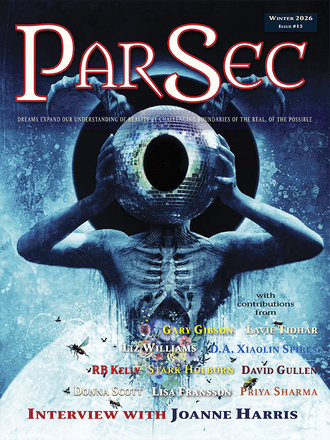
ParSec 15 is indeed live and I now have my copy.

I found it does contain my reviews of City of All Seasons by Oliver K Langmead and Aliya Whiteley along with The History of the World by Simon Morden but not that of Project Hanuman by Stewart Hotston.

I have four other reviews there though:-

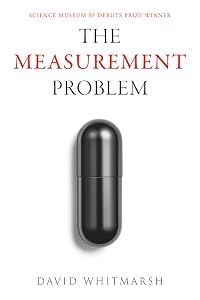
The Measurement Problem by David Whitmarsh,

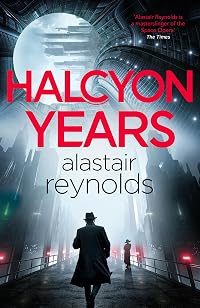
Halcyon Years by Alastair Reynolds,

Exiles by Mason Coile,

plus Solstice by Ruth Aylett and Greg Michaelson.

ParSec 15 is Live

Or at least it ought to be.

The publication date was yesterday.

I’ve not accessed my copy yet but this one should contain my reviews of:-

City of All Seasons by Oliver K Langmead and Aliya Whiteley

The History of the World by Simon Morden

Project Hanuman by Stewart Hotston

Those reviews will appear here in due course.

Another Review

Yes, they come thick and fast. This one will be for ParSec 15.


It’s The History of the World by Simon Morden. I can’t find a cover for it at the moment, though.


Amazingly it’s actually Science Fiction. Sometimes recently  it has seemed as if the publishing of SF had dried up.

free hit counter script