Archives » Mohsin Hamid

The Reluctant Fundamentalist by Mohsin Hamid

Penguin, 2008, 213 p.

This novel, Hamid’s first, is excellently written and has an unusual narrative style. It comprises one side of a conversation between a native of Lahore, the reluctant fundamentalist of the title, and an increasingly uneasy USian tourist (whose words we do not actually read, only the narrator’s response to them.)

That narrator is Changez. He approaches his conversation partner (whom he recognised as what he calls an American by his bearing) telling him not to frightened by his beard as he is a “lover of America,” and then proceeds to monopolise the discussion through a meal at the café in Lahore where they meet and the walk back to the American’s hotel afterwards. What unfolds over the two hundred pages is Changez’s adult life story and its connections to the United States in which he completed his higher education and found his first job.

His experience of the US is at first favourable, the campus at Princeton beautiful, his non-USian peers apparently the brightest and best, but expected to contribute back to the system which had chosen them so carefully. Changez blended in (as much as he could) took that job with Underwood Samson, valuing companies, and even made friends with a group who went on holiday to Greece together, especially with one of them, a girl named Erica, whose former boyfriend Chris, dead of cancer, complicates their relationship. At work he is told by a coworker to, “Focus on the fundamentals.” Underwood Samson’s guiding principle. He feels a misfit but his boss has confidence in him.

While he was in Greece the September 11th attacks changed everything. On return he is separated from his group at immigration, strip searched, interrogated. From then on he is no longer just another inhabitant, able to get on with his life freely, his mere appearance calling forth comments or abuse. His relationship with Erica is not affected but she is fragile, Chris’s death has broken something within her, which he cannot fix, which no-one can fix. Her feelings for Chris constitute nostalgia, in the old sense, that of pain.

Changez reflects to his audience of one (but also therefore to us as readers) that September 11th had impelled the US to look back – to the certainties of World War 2 – rather than forward and begins to doubt there a place for him there. His work stagnates and the situation of people like him is compared by a Chilean businessman while he is in that country on work business to the janissaries of the Ottoman Empire, plucked from home to serve their imperial masters.

This calling out of the actions of the US in the international sphere, in particular its treatment of Afghanistan and Pakistan, is only made explicit near the end. Changez tells his companion, whom by now we suspect may be a CIA agent, that America was engaged only in posturing, unwilling to reflect on the shared pain that united it with its attackers, retreating into myths of its own difference, assumptions of its own superiority, acting out those beliefs in the world, rocking the entire planet by its tantrums. He says such an America must be stopped, for its own interests as well as those of others.

All this is beautifully rendered on the page. The prose has the rhythm of a conversation, the digressions, the observations. The ending is left open to the reader’s interpretation.

Pedant’s corner:- Written in USian. “For all intents and purposes” (to all intents and purposes,) enormity (used in the sense of huge rather than its true meaning of monstrous.)
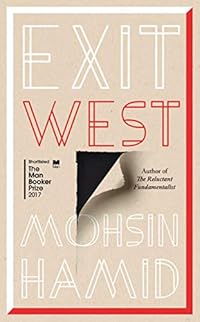
Exit West by Mohsin Hamid

Hamish Hamilton, 2017, 233 p. Another of the novels on this year’s BSFA Award shortlist.

 Exit West cover

In an unnamed Middle-Eastern city on the threshold of becoming embroiled in an insurrection, Saeed and Nadia meet while attending evening class. Despite wearing a black robe that covers her from toe to neck she tells him, “I don’t pray,” and on their first coffee together answers his question about the reason for her attire by saying, “So men don’t fuck with me.” As their relationship develops mysterious black doors are meanwhile beginning to appear at various locations on Earth, allowing people to move from place to place without traversing the ground, air, or sea between.

The relationship between Seed and Nadia becomes closer but when given the opportunity Saeed says he doesn’t want to have sex till they are married. Nadia’s response is pithy. To have Nadia as the less repressed of the two (she was independent enough to live in her own flat and had taken a previous lover,) to be the unreligious one of the pair, is a neat touch by Hamid. History has its own way with them, though, as the insurgents take over the city and life becomes repressive and dangerous. On Saeed’s mother’s death Nadia moves into his family’s apartment. They keep a fake marriage certificate in case of inquiries.

The militants are only ever in the background – though they do give Hamid the chance to convey the flavour of their impact – but they provide the impulse for our lovers to take a chance on escaping via a black door. The doors are essentially a fantasy element. How they work is never gone into, they just appear and do their, effectively magical, work.

Nadia and Saeed first alight on the Greek island of Mykonos, confined to a refugee camp, then later another door transports them to a plush but otherwise unoccupied London flat. Soon the flat fills up with more migrants through the door, unrest at the incomers builds up in the UK and the neighbourhood becomes ghettoised and a microcosm of the wider immigrant experience.

It is perhaps a flaw that Hamid doesn’t quite fully explore this strange new world where borders have been for all practical purposes abolished – and I suspect he is far too sanguine about the political accommodation the British state makes with the migrants, one which, in any case Saeed and Nadia eschew by taking another door to the US. Hamid’s main interest lies in portraying the migrant experience through the arc of Nadia and Saeed’s love affair, the strains their uncertain existence puts on the relationship between. Hamid also does a lot of telling rather than showing, but that is not uncommon among writers more celebrated than he is.

Hamid makes the point that migration is a trauma for the individual, “When we migrate, we murder from our lives those we leave behind,” and that, “We are all children who lose our parents ….. and we too will be lost by those who come after us and love us, and this loss unites humanity.” Then again, “Everyone migrates, even if we stay in the same houses our whole lives, because we can’t help it. We are all migrants through time.” (This is why nostalgia, a yearning for a lost golden age, is such a pernicious emotion.)

Despite Exit West’s nomination for the BSFA Award, nothing in Hamid’s treatment betokens Science Fiction. This is really a mainstream novel (albeit a good mainstream novel) with an SF idea bolted on. The black doors are not necessary for the plot to work and the implications of easier transit between countries are rather skated over.

All three nominees I’ve read so far are lacking in some regards. I really don’t know which novel to place first; only the one I won’t.

Pedant’s corner:- legs akimbo (legs cannot be placed on hips; at least not on the same body’s hips,) fit (fitted.)

BSFA Awards for 2017

The shortlists for the BSFA Awards for last year went live while I was traipsing about down south.

They are:-

Best Novel

Nina Allan – The Rift (Titan Books)

Anne Charnock – Dreams Before the Start of Time (47North)

Mohsin Hamid – Exit West (Hamish Hamilton)

Ann Leckie – Provenance (Orbit)

I have read the Leckie (and will post a review on Saturday.) Two others are in hand.

Best Shorter Fiction

Anne Charnock – The Enclave (NewCon Press)

Elaine Cuyegkeng – These Constellations Will Be Yours (Strange Horizons)

Greg Egan – Uncanny Valley (Tor.com)

Geoff Nelder – Angular Size (in ‘SFerics 2017’ edited by Roz Clarke and Rosie Oliver, Createspace Independent Publishing Platform)

Tade Thompson – The Murders of Molly Southbourne (Tor.com)

I’ve read none of these so far.

Best Non-Fiction

Paul Kincaid – Iain M. Banks (University of Illinois Press)

Juliet E McKenna – The Myth of Meritocracy and the Reality of the Leaky Pipe and Other Obstacles in Science Fiction & Fantasy (in ‘Gender Identity and Sexuality in Current Fantasy and Science Fiction’ edited by Francesca T Barbini, Luna Press)

Adam Roberts – Wells at the World’s End 2017 blog posts (Wells at the World’s End blog)

Shadow Clarke Award jurors – The 2017 Shadow Clarke Award blog (The Anglia Ruskin Centre for Science Fiction and Fantasy). The 2017 Shadow Clarke jurors are: Nina Allan, Maureen Kincaid Speller, Victoria Hoyle, Vajra Chandrasekera, Nick Hubble, Paul Kincaid, Jonathan McCalmont, Megan AM.

Vandana Singh – The Unthinkability of Climate Change: Thoughts on Amitav Ghosh’s The Great Derangement (Strange Horizons)

Best Artwork

Geneva Benton – Sundown Towns (cover for Fiyah Magazine #3)

Jim Burns – Cover for ‘The Ion Raider’ by Ian Whates (NewCon Press)

Galen Dara – Illustration for ‘These Constellations Will Be Yours’ by Elaine Cuyegkeng (Strange Horizons)

Chris Moore – Cover for ‘The Memoirist’ by Neil Williamson (NewCon Press)

Victo Ngai – Illustration for ‘Waiting on a Bright Moon’ by JY Yang (Tor.com)

Marcin Wolski – Cover for ‘2084’ edited by George Sandison (Unsung Stories)

free hit counter script