Posted in Fantasy, Horror, Reading Reviewed at 12:00 on 10 September 2016
Harper, 2015, 526 p plus 1 p Reading Group Questions, 6 p photos of Detroit taken during Beukes’s research and 7 p author interview.
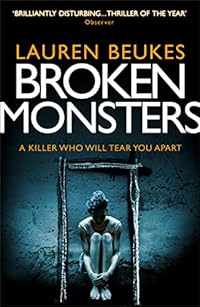
Detective Gabriella Stirling-Versado becomes OIC of a bizarre murder case (where half the body of a young teenage boy has been joined to half that of a deer) by virtue of being first on the scene. The story is narrated from several viewpoints each rendered in an urgent stripped down present tense. Some tension is lost by the fact that one of these is that of the murderer but there is no doubt throughout that Beukes is in control. All the viewpoints are compelling and Gabi’s relationship with her daughter, Layla is particularly neatly drawn as, in turn, is her friendship with schoolmate Cas. Along the way Beukes addresses issues of the prevalence, and misuse, of social media, and of sexual harassment.
The circumstances of the murder and the hints that chalk outlines of doors drawn on walls presage occult events notwithstanding, this is a straight enough police procedural thriller until the supernatural elements impinge in force at the climax. This for me was where the novel broke down. It is difficult to register my misgivings without spoilers but the details of the way in which those forces manifest and gain power were beyond my ability to sustain suspension of disbelief.
My main complaint, though, is that any hint of the supernatural is a cop-out. History has shown humans are cruel enough to each other. There is no necessity for an external force to make them so. Buekes can write well – brilliantly even – but I would contend that it is a failure of the imagination rather than its triumph to posit influences beyond humanity as causal factors in demented behaviours.
Pedant’s corner:- jerry-rigged (jury-rigged,) “sounds fraught with meaning that don’t have anything to do with her” (with meaning that doesn’t – or; with meanings that don’t,) peering through the grill of an oversized hockey helmet (grille,) “where the skin of the worlds are permeable (the skin is – or; the skins are,) the lay of the land (lie,) a cluster of party people are standing (a cluster is,) the back of his hands are (the back is – or; the backs are,) lay low (lie.) He’s was trying to help. (He was,) and realises her and mistake (realises her mistake,) “she’s terrified that if she opens Gabi’s all her secrets will come flying out,” (opens Gabi’s what?) “A scattering of neon highlighter markers stand out,” (a scattering stands out.)
Plus points for “ten years’ time” though.
No Comments »
Posted in Fantasy, Reading Reviewed, Science Fiction at 12:00 on 9 December 2013
Harper Collins 2013, 391 p
Harper Curtis walks up to young girl Kirby Mazrachi in July 1974 in order to give her a toy pony made of plastic. She is one of the girls he sees shine and feels compelled to murder. The pony is a calling card of sorts. The next chapter we are with Harper in Chicago’s Hooverville in November 1931 where by a set of somewhat improbable circumstances Harper injures his leg, kills a blind woman and gains the key to a mysterious house. Subsequent chapters flit between different times as we follow both Kirby in her placement as an assistant to Chicago Sun-Times reporter Dan Velasquez and Harper’s murders of various Shining Girls (and other incidental victims) in the intervening years, leaving an item taken from another on or near each girl’s body. Kirby herself almost died as one of Harper’s victims and is obsessed with tracking him down.
Nothwithstanding the shifts in time, the novel is told in the present tense. Most often the viewpoint is that of Harper or Kirby but occasionally other characters are given the task of carrying the story. As far as Harper is concerned it’s all the present anyway.
Beukes’s characterisation is excellent, the interplay between Kirby and Dan and other Sun-Times workers well handled, as is her relationship with her mother. Harper is of course a far from sympathetic character but as a First World War veteran and depression era product is convincing. He does adapt to travelling to the future a trifle easily, however. There is one point at which we are taken briefly to the Century of Progress Exposition (held in Chicago in 1933-4) – I have the second poster shown in the link on one of my walls.) I couldn’t make up my mind if this was merely to show off Beukes’s research as apart from underlining Harper’s callousness it did not contribute much to the story.
The time travel seems to be a function of the mysterious house and/or those caught up in Harper’s murderous activities. It is this aspect of the novel which I found a little unsatisfactory. Like the ability in Audrey Niffenegger’s The Time Traveler’s Wife there is no rationale for Harper being able to travel in time. This tumbles the story into fantasy. As a crime/thriller novel it works perfectly though.
The Shining Girls seems to have been a breakthrough novel for Beukes, introducing her to a wider audience than for her two previous novels, both with fantastical elements. Her prose flows beautifully and she certainly knows how to gain and hold the reader. The Shining Girls is without doubt well written and tightly plotted and may well garner Beukes awards, the time loops hang together but I must admit I was more intrigued by her previous novel, Zoo City.
No Comments »
Posted in Andrew Crumey, Eric Brown, Orhan Pamuk, Other fiction, Reading Reviewed, Science Fiction at 12:00 on 31 December 2012
I don’t usually do end of year round-ups – mostly because most folk write theirs before Christmas and that offends my sensibilities. The year ends on 31st Dec, not before.
Whatever, I looked through all the fiction books I read this year and found twelve that stood out. In order of reading they were:-
PfITZ by Andrew Crumey
Zoo City by Lauren Beukes
The Master and Margarita by Mikhail Bulgakov
The Song of Achilles by Madeline Miller
The Kings of Eternity by Eric Brown
the Tiger’s Wife by Téa Obreht
And The Land Lay Still by James Robertson
The Museum of Innocence by Orhan Pamuk
Redemption in Indigo by Karen Lord
New Model Army by Adam Roberts
Galileo’s Dream by Kim Stanley Robinson
D’Alembert’s Principle by Andrew Crumey
That’s four by women and eight by men, which is a pretty high strike rate for the distaff side compared to my fiction reading as a whole, 12:45 – is that shockingly low or a reflection of publishing? Four were SF, eight not; though that ratio alters if you count the fantastical – the Lord, the Obreht, the Bulgakov, and the Crumeys which feature stories from a city made up within one of the two. Only the Robertson and the Pamuk lie wholly within the realm of the naturalistic.
I don’t propose to rank the twelve in any way.
No Comments »
Posted in Reading Reviewed, Science Fiction at 12:00 on 26 June 2012
Angry Robot, 2009, 314p.
Like Beukesâs second novel Zoo City – a nominee for the BSFA Award last year – Moxyland, her first, is set in South Africa, which does add an unusual flavour; but whereas in Zoo City that seemed an important element Moxyland could really be set anywhere. It is almost a 1984 in reverse; it is not the state so much as corporations that exert power. How 21st century. How timely.
In Moxyland not only the conversations but also the wider narrative are in a stripped down demotic (eg a vid chat sesh.) This adds to immediacy and the sense of future shock but takes a little getting used to. In this regard the multiple viewpoints employed to tell the story add to the dislocatory effect.
In its totally phone-connected, over-surveilled society where semi-cyborg police dogs called Aitos make your average Alsatian look like a tame poodle and mobile phones are the conduit for everday transactions but are fitted with âdefusersâ to administer taser-like electric shocks as a public order or restraint mechanism, to be âdisconnectâ is a punishment, to be switched off an act of resistance intrepretable as terrorism. Not that there arenât terrorists aroundâ¦.
The plot circles round the insidious nature of totalitarianism, the illusion that free agency is possible, that you matter.
The Moxyland of the title is a throwaway, an online game for children, heavily moderated. Adults do access it but any player can be denounced anonymously as such an illicit user. While the game is mentioned (we are shown one of the characters playing it) it really has no part in the plot and as such is rather too obvious a metaphor for the wider society of the novel.
Moxyland is a hyped-up, near future, thriller light, seeped in creeping paranoia – but where they really are out to get you – or at least get you to conform – but the characters donât quite breathe as they might. The many viewpoints donât help with this, even when we see the same events from differing perspectives. It was Beukesâs first novel though, and still an interesting read; a good pointer to the more polished tale she gave us in Zoo City.
No Comments »
Posted in BSFA, BSFA Awards, My Interzone Reviews, Reading Reviewed, Science Fiction at 22:00 on 5 March 2011
The latest BSFA mailing dropped onto my doormat today.
As well as the usual review magazine, Vector, which (unusually, since I’m normally slow at catching up with the latest thing) contains reviews of three books I’ve already read – Hannu Rajaniemi’s The Quantum Thief which I reviewed for Interzone, Ken MacLeod’s The Restoration Game and Ian McDonald’s The Dervish House – the envelope also spilled forth the A4 magazine of those short stories on the ballot for the BSFA Awards for 2010 and an A5 booklet published as a memorial to Robert Holdstock.
Apart from the book reviews this edition of Vector is a special Stephen Baxter issue.
Much of my reading for March is now more or less scheduled. As well as the short stories mentioned above, I have one more of the five novels shortlisted in the BSFA Award novel category in my to be read pile. I’ve just finished Paolo Bagicalupi’s The Windup Girl – review to come. For my thoughts on Ken MacLeod’s The Restoration Game and Ian McDonald’s The Dervish House see previous posts. Tricia Sullivan’s Lightborn awaits. Only Lauren Beukes’s Zoo City will escape my attention.
In addition Interzone has sent me Dominic Green’s Smallworld to review by the end of March. Busy, busy.
No Comments »