Archives » Jules Verne

Under the Glacier by Halldór Laxness

Vintage, 2005, 242 p, plus xii p Introduction by Susan Sontag. Translated from the Icelandic Kristnihald Undir Jökli (Helgafell, Reykjavík, 1968) by Magnus Magnusson. First published in English as Christianity at Glacier (Helgafell, Reykjavík, 1972.)

In her introduction – which, as is usually the best approach with them, ought to be left until after reading the text – Susan Sontag states that novels that proceed largely through dialogue, or are relentlessly jocular or didactic, those whose characters do little but muse to themselves or debate with someone else, or are initiated into secret knowledge, those with characters having supernatural qualities or contain imaginary geography are – despite the long history of the picaresque tale and the many classic stories which exemplify these things – considered innovative, ultra-literary or bizarre, and are given labels to signify their outlier status

Science fiction

Tale, fable, allegory

Philosophical novel

Dream novel

Visionary novel

Literature of fantasy

Wisdom lit

Spoof

Sexual turn-on

and that “convention dictates we slot many of the last centuries’ perdurable literary achievements into one or another of them.” She concludes that thought with, “The only novel I know that fits into all of them is Under the Glacier.”

Our unnamed narrator has been tasked by the Bishop of Reykjavík to journey to the Snæfells glacier to investigate the situation there, where the local pastor Jón Jónsson, known as Prímus (he fixes stoves,) has taken no salary for twenty years. There are rumours the church has been boarded up, the pastor is living with a woman not his wife and he has allowed a corpse to be interred in the glacier.

This is the same glacier to which Jules Verne sent his adventurers under the influence of Árni Saknússemm and the leadership of Professor Lidenbrock to start their journey to the centre of the Earth. Laxness implicitly critiques Verne’s piece of cultural appropriation. The locals at Snæfells do consider the spot to be the world’s centre and have little consideration for the outside world.

The text is in the form of the emissary’s report and during it he only ever refers to himself as the undersigned or the Emissary of the Bishop, soon shortened to Embi. Dialogue is laid out as if in the text of a play and without punctuation otherwise.

Embi, the undersigned, is confused by life at Snæfells. None of his interlocutors seems to give him a straight answer, they talk to him as if he is the bishop and generally are only obliquely forthcoming.

His attitude is that, “‘I was just sent here like any other ass to make inquiries about things that don’t concern me at all and that I don’t care about at all.’”

There is a fair amount of philosophising. A shepherd called Saknússemm II tells Embi, “Of all the creatures that man kills for his amusement there is only one that he kills out of hatred – other men. Man hates nothing so much as himself.”

Pastor Jón says, “‘History is always entirely different to what has happened….. The greater the care with which you explain a fact, the more nonsensical a fable you fish out of the chaos….. The difference between a novelist and a historian is this: that the former tells lies deliberately and for the fun of it; the historian tells lies in his simplicity and imagines he is telling the truth.’”

Dr Godman Sýngmann has a robust take on religion, “‘The Christians without ceremony stole from the Jews their national literature and added to it a piece of Greek overtime work they call the New Testament, which is mostly a distortion of the Old Testament, and, what’s more, an anti-Semitic book. My motto is, leave the Jews alone. Those who deck themselves out in stolen gods are not viable.’”

Embi is particularly baffled by the information that Sýngmann (when he dies) has four widows but was not a bigamist.

In a diversion on skuas the narrator indulges in a little meta-textual teasing. “All birds fly better than aeroplanes if they can fly at all. All birds are perhaps a little wrong, because an absolute once-and-for-all formula for a bird has never been found, just as all novels are bad because the correct formula for a novel has never been found.”

At one point we are told that Prince Polo biscuits are the only gastronomical delicacy that Icelanders have allowed themselves since they became a wealthy nation.

A woman named Úa, who may be the pastor’s wife (or may not,) turns up. She has travelled the world and is of the opinion that “‘Americans are children. Children believe in guns and gunmen. One hundred forty-seven gunshots in children’s television a week. In children’s films there have to be child murders.’” She spends her time knitting sea-mittens as she thinks the world requires them.

She also says, “‘In our society the rules about love are made either by castrated men or impotent greybeards who lived in caves and ate moss-campion roots.’”

Under the Glacier has no plot as such, the concepts discussed within it are sometimes abstruse, the conclusion is illusory.

It is utterly memorable.

Pedant’s corner:- In her Introduction Susan Sontag slightly mischaracterises Science Fiction as always featuring a male protagonist. That is certainly no longer true and wasn’t in 2004 when she wrote it. Dr Godman Syngmann (in the text it’s Sýngmann,) La Vie de Henry Brulard (it’s La Vie de Henri Brulard.) Otherwise; “All birds are perhaps a little wrong” (All birds is perhaps a little wrong?)
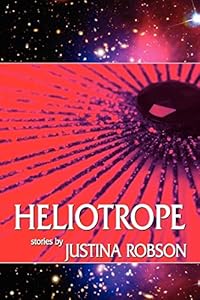

Heliotrope by Justina Robson

Stories. Ticonderoga Publications, 2011, 345 p, including vi p Introduction by Adam Roberts and i p Acknowledgements.

 Heliotrope cover

The lead story Heliotrope is all that has surfaced from the author’s “Massively Unpublishable First Fantasy Epic” and at times the writing betrays its inexperienced origin. In it an artist finishing her apprenticeship is given by her ageing tutor the task of encapsulating the essence of dance master Jalaeka who inspires widespread devotion and can float. He can also drain his followers dry.

The McGuffin in Body of Evidence is a device which lets the wearer know what everyone is really thinking when they are speaking. Our heroine finds this even more excruciating when she meets another person trialling the device.

The Adventurers’ League was first published in an anthology dedicated to the style of Jules Verne. Voyager Lone Star Isol has returned from interstellar space in a manner suggesting it has been able to return faster than the speed of light. The journalist narrator Riba, is sent to investigate. Isol is one of the Forged people and there is the possibility of a war between them and Original humans. Riba is pushed off a transatlantic helium airship to fall oceanward. He is saved from death by the actions of an immense tentacled creature, which turns out to be a floating organism on which he meets avatars of Jules Verne, Captain Nemo, Sinbad, the Mermaid Silene, Ahab, and Sir David Attenborough, Forged people anxious to avoid war. The story has a fair degree of intrusive information dumping.

The Girl Hero’s Mirror Says He’s Not the One is set in Robson’s Mappa Mundi universe. The Girl Hero is sent to assassinate a poet who her mirror assures her will not the one to kill her. Biut he does have a device that resets internal software.

In The Bull Leapers a woman whose husband is in Knossos for an archæological dig encounters three Greeks who practice the old art of bull-leaping. They are also in touch with the Labyrinth, to where they take her for the story’s transforming episode.

Deadhead is narrated by Lois, a fourteen year-old girl. Her six years older sister Clem has Asperger’s and Lois always resents having to looking after her. She and their mother come to a better understanding after Clem communes with a dead horse’s head.

Erie Lackawanna Song starts off at the Hoboken ferry terminal with a man looking at the derelict Erie Lackawanna jetty next door. His journey across the river takes a different turn from usual when his nodding and sometimes speaking acquaintance, Claire Glick, asks him to look at a phial of liquid she has taken from work. It contains a substance that can rewrite brain synapses.

Cracklegrackle sees a man helped by one of the Forged (one who can “see” at all wavelengths) to find his daughter, kidnapped on Mars some time before, on Jupiter, much changed.

In No Man’s Island, on the day she finds she has not got the job at CERN she longed for Mariann Harris consoles herself with her discovery of traces of an alien spaceship having used an Alcbierre warp drive. Meanwhile her husband embarrasses himself with a customer of the shop where he works. Both find solace with their dog, Bing.

Robson’s first published story, Trésor, is understated horror wherein a prostitute has been waiting for her mark.

The Seventh Series is a mythical set of yoga exercises Davey is writing into a computer game. Then he finds that there is a video of that title and goes searching for its origin. The explanation at the story’s end is rather mundane though.

The Little Bear is one of the few SF stories to address the fact that time travel is also space travel and vice-versa. Ronson examines this through a series of vignettes set in different time-lines but with the same characters, each lamenting the human loss they incurred when an experiment involving the teleportation of a bottle of wine changed their world.

In Legolas Does the Dishes an inmate of a mental hospital envisages that the man who doe sthe dishes in the institution is Legolas from Tolkien’s Hobbit universe. Her viewpoint is emphasised when she tells us, “I don’t need to say what might happen if you got a shard in your eye and started to see the world through another lens. Who knows what might be revealed?” It is left open as to whether she is deluded or he really is Legolas.

Dreadnought is the intelligence of a spaceship as mediated through its units which can not exist without a human host.

An Unremarkable Man is the tale of two supernatural women trying to be ordinary, a Viscus Diabolique and the ensuing trade with a non-descript man who materialises from nowhere.

A Dream of Mars is suffered nightly by our narrator who was sent to recover the remains of the dead from a downed cable car in the Martian New South Face Woodlands and destroy the human created Bigfoot who had been intended as a tourist attraction only to form a bond with him instead.

Pedant’s corner:- In Adam Roberts’ Introduction “and both, well, Forged stories” (are both, well, Forged stories,) “of of” (only one ‘of’ required,) “but a tale that understand … are” (understands,) “ontological speaking” (ontologically speaking.) “But another of saying” (But another way of saying,) “knows whats I’m talking about” (what,) “I think that it what her” (that is what her,) a missing full stop, “as a way” (is a way.) “On the contrary the story does is” (what the story does is,) “amply demonstrates” (demonstrated.) Otherwise; “whilst others both showed some degree of chestnut” (both?) Elys’ (x 4, Elys’s.) “‘She dare not breathe’” (the rest of this segment is written in the past tense; ‘dared not’,) bringing her skin up to his awake and. He pinned her down,” (no full stop and subsequent capital needed.) “The paint is so thick that is has” (that it has,) “and Elys’ stops making a noise” (Elys,) “dare not” (again, past tense, dared not,) “like a the funnel” (one or other article, not both,) “sent his Abacand him the time” (either ‘sent his Abacand’, or, ‘sent him’ the time, not both,) “together with in increasing lawlessness” (no ‘in’,) “Jules Verne was a Frenchman of the twentieth century” (only barely; he died in 1905,) “that that” (only one ‘that’ needed,) “your media group have been advocating” (has been advocating,) fit (fitted.) “None of them are interested” (is interested,) “and in just in time to” (and is just in time to,) “its rotor whir softly” (‘its rotors whir’, or, ‘its rotor whirs’,) “I could help but take a sharp breath” (I couldn’t help but, Minos’ (Minos’s,) “It’s comfort” (Its.) “Bishop figure it was for his benefit” (figured,) claimes (claims,) “and sings” (the rest is in past tense, so ‘sang’,) scaned (scanned,) “I dare not” (again past tense; dared,) Mars’ (Mars’s.) “‘Their names is what they are” (Their names are what they are.) “‘and its real, external’” (it’s,) ““Let’s start looking’ Bishop said” (“Let’s start looking,” Bishop said,) iat (at,) “Part sof a” (Parts of a.) “‘may I see it?’” (May,) “much me readily” (much more readily,) “even as it wasn’t part of his concern” (‘even if it wasn’t’ makes more sense,) “all the questions that were hunting him” (haunting him makes more sese,) withy (with,) coudln’t (couldn’t,) “he he” (only one ‘he’ needed,) “those involved Forged” (those involved are Forged,) “less seconds” (fewer seconds,) “for the a regular payment” ( no ‘a’ needed.) “None of them were talking” (None of them was talking,) “(CGPS)was” ((CGPS) was,) a new paragraph taken in the middle of a line when a piece of dialogue is opened (x 2,) “watched the their chosen object” (no ‘the’ I think,) “ ‘still signs himself off “ A Friend of Your Father’s” as if’” (off “A Friend…..) “They stared at the offended item” (the offending item,) Legolas’ (Legolas’s.) “‘I want to see him again,’ She rubbed” (I want to see him again.” She rubbed,) Saclides’ (Saclides’s,) “Laura said ordered a double espresso” (is missing a comma between said and ordered.) “The main criteria is” (the main criterion is,) “the meatl struts of the nearest tower groans and creaks” (the metal struts … groan and creak,) Mars’ (Mars’s,) Raditech were set to lose (Raditech was set to lose.) In the Acknowledgements; Crwther (Crowther.)

Science Fiction: a Literary History Edited by Roger Luckhurst

British Library, 2016, 254 p (including 2 p Preface by Adam Roberts, 3 p Introduction by Roger Luckhurst, 2 p Notes on Contributors, 1 p Picture Credits and 18 p Index.

Science Fiction: a Literary History cover

Adam Roberts’s Preface notes SF’s relative ubiquity in today’s world and praises this book as as compact and exhaustive an introduction to the subject as you will find. Roger Luckhurst’s Introduction, by way of reference to Jorge Luis Borges’s short story The Garden of Forking Paths (which presaged many-worlds theory by a considerable time,) acknowledges the impossibility of summing up SF in such a short space as a single book but hopes it will provide pointers to newcomers to the genre and to old hands alike.

The overall approach is more or less chronological. Chapter 11 sees Arthur B Evans tackle early forms of SF in The Beginnings. Roger Luckhurst himself covers the transition From Scientific Romance to Science Fiction in Chapter 2. The Utopian Prospects of 1900-49 are considered by Caroline Edwards in Chapter 32. There is some overlap in time here with Mark Bould’s Chapter 43, Pulp SF and its Others, 1918-39. Malisa Kurtz examines immediate post-war SF in Chapter 54, After the War. Chapter 65 has Rob Latham look at The New Wave ‘Revolution’. Chapter 7’s voyage From the New Wave into the Twenty-First Century6 is undertaken by Sherryl Vint. Gerry Canavan brings us up to date with Chapter 8, New Paradigms, After 2001. Each Chapter is repletely referenced and has a list of “What to Read Next” at its end. Imagine my satisfaction when finding I had read most – if not all – of the relevant recommendations. Plus I am in the process of ticking off another right now.

Perhaps the most interesting part (because the most remote) was Chapter 1 wherein Evans identifies many instances of SF or proto-SF from before 1900 and exemplifies two of its fundamental attributes at that time; diversion (imagination) and didacticism (cognition) – or, as Jules Verne’s editor/publisher Pierre-Jules Hetzel put it, instruction that entertains and entertainment that instructs. Well before the twentieth century subterranean or interplanetary adventure became well established – along with time travel – and u- and dystopias have always abounded. It is noted that early interplanetary spaces were modelled on colonial spaces – Space Opera and Star Wars your origins lie here. Indeed the colonial adventure (King Solomon’s Mines etc) can be considered as SF. Examples of the genre emanating from outwith the anglo- or francophone spheres are given due note, including SF works from pre-revolutionary Russia, Africa, Asia, Latin America – and also by black US writers – of which I was not previously aware.

The New Wave chapter laments that “unique talents” such as R A Lafferty, D G Compton, David R Bunch and Edgar Pangborn are little read these days. In one of those omissions Luckhurst acknowledged would occur discussion of one of my favourites from the time, Richard Cowper, is absent.

For anyone wishing to acquaint themselves with the genre this is an admirable place to start. It also provides potential new avenues for aficionados to pursue.

Pedant’s corner:- 1“by adding this own critical observations” (his own,) “the series of six novels … are set” (the series is set.) “But all is not perfect.” (But not all is perfect,) Cerillas’ (Cerillas’s.) 2“Has strengthened African-American will and prepared them for an international liberation movement” (“them” is the wrong pronoun here but to avoid it the whole sentence needs recasting.) “An imperial cabal of … plot to undermine the ..” (a cabal plots.) “As the new intake are given” (the new intake is given,.) “Slovakia’s defence strategy, and the novel’s SF element, employs the technique of…” (notwithstanding the parenthetical commas that “and” requires a plural noun; so, employ the technique.) 3“a series of coups weaken the fascist grip” (a series weakens the grip.) “The expedition… encounter” (the expedition encounters.) 4”from embracing the ‘the divine right of machines’” (omit the “the” before the quote,) “as the scientific elite have developed…” (the scientific elite has developed,) “the dark side of the Moon” (every side of the Moon is dark, for 14 days out of 28; I believe the “far side” was intended.) 5fit (fitted,) New Worlds’ (New Worlds’s.) 6ascendency (ascendancy,) a missing full stop, “between this world and the our present” (either “our” or “the”, not both,) “thus rejected earlier version of speculative genres” (versions of,) “it was posed to become” (poised to become.)

The Seventh Miss Hatfield by Anna Caltabiano.

Gollancz, 2014, 270 p. Reviewed for Interzone 254, Sep-Oct 2014.

 The Seventh Miss Hatfield cover

In 1954 an eleven year old girl named Cynthia carries a wrongly delivered parcel to its correct destination across the road. There she meets Miss Hatfield, who has a collection of portraits and antiques plus a strange clock with unusual intervals marking its dial. Miss Hatfield gives Cynthia a glass of lemonade into which she has poured the last drop of liquid from a vial. Within a few pages – bare minutes of conversation, and no change of scene – Cynthia has become a fully grown woman. The physics of this transformation, the chemistry required, its energetics, are all not so much skimmed over or ignored as seemingly unconsidered. The process is only a means for Caltabiano to propel her narrator into the story she wishes to tell. It does of course also signal Cynthia’s altered reality.

Miss Hatfield tells Cynthia the fateful drop was the last remnant of a bottle filled from a mysterious lake stumbled upon by Juan Ponce de León on his first voyage to Florida. The liquid confers immortality on its drinkers. The Misses Hatfield have been employing it to recruit new versions of themselves ever since it came into their hands. Moreover they use the strange clock – which an early Miss Hatfield just happened upon – to navigate time. Miss Hatfield informs her new protégée time is not a river, but a lake; existing all at once. Quite why a clock would then be a suitable device to use to sail on it is odd. Moreover, how it actually manages to achieve this feat is never divulged. Again, it just happens.

Cynthia accepts the actions of Miss Hatfield, plus her subsequent demands to go to 1904 to steal a portrait, indeed begins to think of herself as Rebecca Hatfield, the seventh such, amazingly readily. In no time at all, corsetted and long-skirted, she is rushing off through carless streets to the house of Charles Beauford, who fortuitously takes her for his niece Margaret. There she meets his son Henley who, despite knowing she cannot be his cousin, plays along with the deception. The seventh Miss Hatfield has something of a charmed life, it seems.

This is fine as far as it goes but here the story gets bogged down as Caltabiano’s over-arching fantasy becomes somewhat lost amid the details of the burgeoning relationship between Henley and his “cousin.” True, every so often the new Miss Hatfield (she forgets her past life all too easily) remembers she is supposed to be stealing the painting and also experiences a growing sense of wrongness associated with being out of time but this is all diluted by the routines of daily life in a well-to-do Edwardian household and a preponderance of “playful” dialogue. Even the appearance of the Porter sisters, Christine and Eliza (the first of whom and Henley are effectively promised to each other, the second is by far the most interesting character in the book) does not give Rebecca a quick way back to her own time – or later. Cynthia/Rebecca/Margaret also has a very modern idea of servants’ individuality and sense of self but is annoyingly gauche. Her discovery of what the reader sees as links between the Misses Hatfield and the elder Mr Beauford does not give her pause about her sponsor’s motives.

The book is adorned with a cleverly designed Escheresque cover and the accompanying promotional blurb makes much of Caltabiano’s youth. That earns no free pass here; but Caltabiano can write – even if she occasionally employs awkward sentence constructions and lacks quite the necessary feel for the detail of late nineteenth/early twentieth century speech and mores. In their trip to the country, Henley drives the automobile himself. Families like his had chauffeurs for such tasks. And I doubt that, once the car had broken down, an unmarried man and woman at that time (cousins or not) would be allowed to sleep in the same space – even if it was a barn.

There are other details which niggled. Except in the most unusual circumstances would her assumed persona as Mr Beauford’s sister’s daughter still have his surname? The sixth Miss Hatfield refers to being shown a photo sometime in the early 1840s. So early? Eliza mentions that ever since reading Jules Verne she has wondered about the possibility of time travel. (Oh dear. Unless this is an altered universe in which Verne actually wrote any such stories.) The women take part at a burial. In 1904?

Caltabiano’s story of time-crossed love is never entirely convincing, the book’s resolution a touch rushed, the supposed poignancy of the epilogue not fully earned by the preceding pages and the speculative content comes down to trappings. There are two more novels to come, though.

Pedant’s corner:- goodnight for good night, Tu scies nunquam finem. (Since in Latin verbs are placed at the end of a sentence should this not be Nunquam finem scies?)

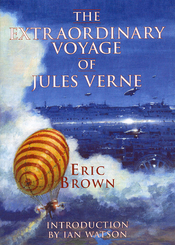
The Extraordinary Voyage of Jules Verne by Eric Brown

PS Publishing, 2005, 137 p, plus iv p of introduction by Ian Watson.

The Extraordinary Voyage of Jules Verne cover

This handsomely produced novella was published to coincide with the centenary of Verne’s death in 2005. In that sense I’ve come to it about ten years too late. Part pastiche of Verne, part typical Eric Brown fare, this is an entertaining diversion, in which Verne is wheeched by means of a time-portal off to the Upper Cretaceous and the far future in a time machine which has the unfortunate drawback of leeching power from the sun and so causing Earth to freeze. Here too are a megalomaniac dictator, along with his nubile antagonist, not to mention ant-like interstellar aliens and strange gadgets. These adventures spark in Verne ideas he will later incorporate into fiction. What’s not to like? While there may be no profound points here – but neither were there in Verne’s fictions – what there is is an engaging adventure story with nods to the work of one of SF’s founding fathers.

Pedant’s corner:- gasses (gases,) panatela (panatella,) “hoves” as a present tense (heaves,) had take its toll on his reason (taken.)

Off to a Comet

Below is a video of the approach by the Rosetta spacecraft to comet Churyumov-Gerasimenko as posted on Astronomy Picture of the Day, 11/8/14.

The ambition of this mission is simply mind-boggling.

What weird things comets are though. Not quite what Jules Verne imagined I think.

10 Forgotten Fantastical Novels You Should Read Immediately

At least according to this website.

The list is:-

Phantastes by George MacDonald
Masters of Atlantis by Charles Portis
Looking for the General by Warren Miller
Doom by William Gerhardie
That Hideous Strength by C.S. Lewis
Lud in the Mist by Hope Mirlees
The Boats of the Glen Carrig by William Hope Hodgson
All Hallows’ Eve by Charles Williams
The Great Dark by Mark Twain
The Fabulous Baron Munchausen and The Fabulous World of Jules Verne, two films by Czech director, animator, and special effects genius Karel Zeman

Well, one of these entries isn’t a novel at all but two films – so that breaks the criterion straight away – the Lewis is surely not forgotten (I have an as yet unread copy on the tbr pile,) the Mirlees and the Hope Hodgson are regularly cited as fantasy classics. Make of that what you will.

Since Fantasy isn’t really my thing I’ve not actually read any of these titles though. Could any of these potentially change my reading habits?

free hit counter script