Archives » John Banville

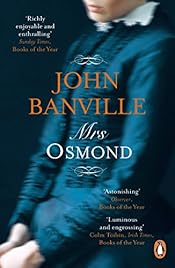
Mrs Osmond by John Banville

Penguin, 2018, 380 p.

Against her husband’s express wishes Mrs Isabel Osmond has travelled from her home in Rome to the death bed of her cousin at Gardencourt in England, thus shaming Mr Osmond (in his eyes) before the world. He is accustomed to being the controlling power in the marriage – and in life indeed, brooking no gainsaying of his opinions. His overbearing nature even affects his sister, Countess Gemini, though she is married herself. The cousin concerned, Ralph Touchett, had bestowed half his fortune on Isabel, a bequest his part in which up until recently she had not been aware. It was that fortune, though, which had caused Gilbert Osmond to court and marry her.

For Isabel the marriage is now over. On the point of her leaving Italy, Countess Gemini had revealed to her the true relationship between Gilbert and Selena Merle, the woman who had introduced them to each other, and the murky circumstances surrounding the death of Gilbert’s first wife and the birth of his daughter Pansy. Now she means to make her own way in the world with the benefit of her bequest.

I usually like Banville’s novels but there was something about the telling of this one which did not appeal to me. It seemed overwritten, executed with a sort of fussy precision, as if he had not merely set his book in late-Victorian/Edwardian times but was trying to replicate the style of an author from that era; Edith Wharton perhaps, or Henry James (neither of whom I have read – though I have seen some film adaptations.) Then I remembered the epigraph is from James – The Portrait of a Lady to be precise. It was not until after I had finished this novel that I checked and indeed Banville has here written a sequel to that book, presumably in James’s style, since he has said James is one of his influences.

Knowledge of The Portrait of a Lady is not required in order to read Mrs Osmond, (after all I had none.) Banville’s novel can stand perfectly well on its own. His depiction of character is superb as usual, his evocation of the times convincing, but I am left to wonder how much of what is unveiled here was in James’s book and how much is due to Banville’s fertile author’s mind. I will say, though, that the experience will not make me rush to read from James’s oeuvre.

From the thought Isabel had of crowds in the Louvre “scurrying from one masterpiece to the next” giving her “the impression of one of those grand lycées of which the French were so self-satisfiedly proud, wherein on the morning of yet another national insurrection, the pupils had murdered their monitors,” I gather that Banville, too, has noticed the French penchant for revolution, for taking to the streets. (I call it their national sport.)

Pedant’s corner:- “‘That would be young Mr Touchett. Henrietta spoke of him to me’” (Mr Touchett had already been referred to earlier in the same conversation, so the latter sentence is superfluous,) “my frail bark struck upon the rocks” (barque, that would be,) quitted (several times, quit; though of course Isabel is USian so no doubt would have said or thought ‘quitted’,) tête-a-têtes (the plural of head-to-head surely ought to be heads-to-head? têtes-a-tête.)


The Infinities by John Banville

Picador, 2009, 300 p.

This typically quixotic Banville novel unfolds over one day in paradise, or at least in a house called Arden, in which have gathered the Godley family; Adam and his wife Helen to attend the death bed of his father (also Adam, a famous physicist,) along with his sister Petra and mother Ursula who live there, as do housekeeper Ivy Blount, scion of the ancient family who owned the land the house was built on, and Duffy the gardener. In the morning Petra’s not-quite-lover Roddy Wagstaffe arrives, and later in the day appears the mysterious Benny Grace.

This may seem a crabbed setting but many writers choose to examine the world in microcosm. In this case an elevated perspective is provided by the characters’ interactions being observed via the thoughts of an almost omniscient narrator, the god Hermes, musing on the condition of the gods and humans, though the narrative occasionally shifts into the consciousness of Old Adam, or Petra. And its discourse travels wide.

In his younger days the elder Adam developed the theory of ours existing in the midst of multiple intertwined worlds. For this is an altered history, one where it was a man called Schrösteinberg who posited an anticipant cat, J Robert Oppenheimer “failed to build the bomb he boasted so much of,” Sweden is a belligerent power, “gentle” Cesare Borgia was a peacemaker and patron of natural sciences and the arts, and, thanks to cold fusion, founded on the Science of Adam’s “notorious” Brahma equations, the greater part of the world’s energy is derived from brine. This is all slipped in as background, not emphasised as it would be in the conventional Science Fictional style.

As narrator, Hermes tells us that all immortals want to die; “that is well known.” Humans, of course, wish the opposite. The gods also “love to eavesdrop on the secrets of others.” In the case of Hermes’s father, Zeus, a presence in the house, he is ever hankering after his favourite activity; not eavesdropping, but insinuating himself in one guise or another – usually their husband’s – into the beds of mortal females in the vain hope of having them begin to love him. So that Zeus can do just that with Helen, Hermes is made by him to hold back dawn for an hour and to make young Adam sleepless, rising to roam the house. Helen passes her experience off as a dream. Zeus’s hope of thereby making himself more human fails, as ever. However it seems the gods – Hermes included – cannot resist interfering in the humans’ affairs.

The complicated web of relationships within the household is laid out in various two-handed conversations. Each of the characters is flawed in some way, each lost in their own preoccupations.

Hermes tells us the older Adam has an affinity with words but “sought to cleave exclusively to numbers, figures, concrete symbols,” but, “even he, like me, mistook sometimes the manifestation for the essence. Because for both of us this essence is essentially inessential, when it comes to the business of making manifest. For me, the gods; for him, the infinities.” For Hermes, “Words are so friendly, so accommodating, so loosely adaptable, not like numbers, with their tiresome insistence on meaning only what they mean and nothing more.”

The above gives the flavour of Banville’s style here. It is not the language of the best seller. It is consciously literary and Banville’s prose is thought through, his descriptions to the point and words carefully chosen. Banville has a wide vocabulary. The book is peppered with uncommon words – imbricated, streels, chanticleers, squinny, horrent, parousia, chlamys, suggestum, lentors, finical, paresis. In this context it was good to see that fine Scots (and presumably Irish) word, skelp, employed judiciously.

Old Adam looks back on his life, his former wife Dorothy, the woman physicist whose name he can’t recall but thinks is Ilse, his meetings with Benny Grace and that character’s supposed mother, Madame Mac. He remembers “the great instauration, after we had exposed the relativity hoax and showed up Planck’s constant for what it really is,” when he “posited the celebrated chronotron … for an exquisite concept, time’s primal particle.” The book is not short of concepts to chew on.

Naturally, given its prime narrator, Banville scatters the novel with allusions to the old gods and myths. At his bedside Benny Grace says to old Adam, “Still the black hair, the noble profile. The original Adam.” Old Adam reflects that “Saints are monsters, as we know, and as for the gods – well.”

But in fiction it is human dilemmas we wish to read about in order to find out about the condition of this strange species of which we are a constituent. Within this small compass of bodies Banville gives us misapprehensions, fears, despair, concupiscence, hope and acceptance as well as touching on the usual literary flavours of love, sex and death. The Infinities is about life.

Pedant’s corner:- “opens its maw to eat cities whole” (does this convey the sense that a maw is a stomach?) “Should I open my eyes? Should I open my eyes.” (I’m not sure why that sentence is repeated nor why its repeat has no question mark.) “I have never been any good in dealing with people” (it’s usually ‘any good at’,) “perfectly oblivious of” (it’s usually ‘oblivious to’,) “[after we had] showed up” (shown up.) “There is only a few of us that understand” (congratulations for ‘there is only a few of us’ but it ought to be followed by ‘who understand’,) “wile away the day” (while away,) French doors” (French doors,) “he say quietly” (he says.) “I had always a crick in my neck when he is about” (either ‘I have always’ or, ‘when he was about’,) “When the object of one’s baffled regard were these minute brand-new beings” (when the object … was these brand-new beings,) “sat at the end of” (seated, or, sitting.)

Nina Allan’s List

This is Nina Allan’s response to the BBC’s list of 100 Books that shaped our world.

As usual the ones in bold I have read. (18. 19 if John Banville’s Shroud and Eclipse count as two.) Some others are on my tbr pile.

Borka: the Adventures of a Goose with No Feathers by John Burningham

Charlie and the Chocolate Factory by Roald Dahl

Stig of the Dump by Clive King

Charlotte Sometimes by Penelope Farmer

Thursday’s Child by Noel Streatfield

‘Adventure’ series by Willard Price

The Ogre Downstairs by Diana Wynne Jones

Carrie’s War by Nina Bawden

Jane Eyre by Charlotte Bronte

The Time Machine by H. G. Wells

‘UNEXA’ series by Hugh Walters

Wuthering Heights by Emily Bronte

‘Changes’ trilogy by Peter Dickinson

‘Tripods’ trilogy by John Christopher

The Dolls’ House by Rumer Godden

The Chrysalids by John Wyndham

Watership Down by Richard Adams

The Magician’s Nephew by C. S. Lewis

My Cousin Rachel by Daphne Du Maurier

All Quiet on the Western Front by Erich Maria Remarque

A Passage to India by E. M. Forster

The Old Wives’ Tale by Arnold Bennett

Nineteen Eighty-Four by George Orwell

Jude the Obscure by Thomas Hardy

Pavane by Keith Roberts

Roadside Picnic by Arkady and Boris Strugatsky

The Waste Land by T. S. Eliot

Ariel by Sylvia Plath

The Grass is Singing by Doris Lessing

Wide Sargasso Sea by Jean Rhys

The Drought by J. G. Ballard

Doctor Zhivago by Boris Pasternak

Anna Karenina by Leo Tolstoy

The Search for Christa T. by Christa Wolf

The Idiot by Fyodor Dostoevsky

Doktor Faustus by Thomas Mann

Ada by Vladimir Nabokov

The Turn of the Screw by Henry James

Picnic at Hanging Rock by Joan Lindsay

The Book and the Brotherhood by Iris Murdoch

Strangers on a Train by Patricia Highsmith

The Affirmation by Christopher Priest

Midnight Sun by Ramsey Campbell

Ghost Story by Peter Straub

The Brimstone Wedding by Barbara Vine

The Course of the Heart by M. John Harrison

Enduring Love by Ian McEwan

The Blind Assassin by Margaret Atwood

Personality by Andrew O’Hagan

House of Leaves by Mark Z. Danielewski

The Gunslinger by Stephen King

The Iron Dragon’s Daughter by Michael Swanwick

The Fifth Head of Cerberus by Gene Wolfe

Shroud/Eclipse by John Banville

My Tango with Barbara Strozzi by Russell Hoban

The Green Man by Kingsley Amis

The Sheltering Sky by Paul Bowles

Cloud Atlas by David Mitchell

Beyond Black by Hilary Mantel

Shriek: an afterword by Jeff VanderMeer

Austerlitz by W. G. Sebald

Darkmans by Nicola Barker

Glister by John Burnside

The Good Soldier by Ford Madox Ford

The Kills by Richard House

A Russian Novel by Emmanuel Carrère

The Third Reich by Roberto Bolano

The Dry Salvages by Caitlin R. Kiernan

In the Shape of a Boar by Lawrence Norfolk

The Lazarus Project by Aleksandar Hemon

The Accidental by Ali Smith

Happy Like Murderers by Gordon Burn

F by Daniel Kehlmann

Straggletaggle by J. M. McDermott

The Lost Daughter by Elena Ferrante

What is Not Yours is Not Yours by Helen Oyeyemi

The Loser by Thomas Bernhard

The Peppered Moth by Margaret Drabble

All Those Vanished Engines by Paul Park

Sorcerer of the Wildeeps by Kai Ashante Wilson

The Infatuations by Javier Marias

Outline by Rachel Cusk

A Separation by Katie Kitamura

Satin Island by Tom McCarthy

Carthage by Joyce Carol Oates

This is Memorial Device by David Keenan

The Sellout by Paul Beatty

Death of a Murderer by Rupert Thomson

Lanark by Alasdair Gray

Falling Man by Don DeLillo

Dept of Speculation by Jenny Offill

Reservoir 13 by Jon McGregor

Attrib. by Eley Williams

Berg by Ann Quin

When I Hit You by Meena Kandasamy

Munich Airport by Greg Baxter

Caroline’s Bikini by Kirsty Gunn

Die, My Love by Ariana Harwicz

The Sing of the Shore by Lucy Wood

Flights by Olga Tokarczuk

Eclipse by John Banville

Picador, 2010, 218 p. First published in 2000.

Eclipse cover

Actor Alexander Cleave (the same Cleave who would reappear in Banville’s later Shroud and Ancient Light, it seems I have read this sequence of Banville books out of publication order) has retired from the stage and gone back to his childhood home. It is somewhat rundown, but holds memories in nearly every room. In it Cleave hears faint sounds and imagines it might be haunted – in fact sees his father one day in a doorway. But it turns out Quirke, the solicitor charged with its care, and his fifteen year-old daughter, Lily, who has been taken on ostensibly as a housekeeper, are living in some of the vacant rooms.

The narrative is almost all Cleave’s musings and remembrances – there is very little dialogue in the novel – yet despite there not being much in the way of plot (the only significant occurrence in the book occurs off the page) Banville readily manages to hold the attention. There is something almost liquid in his sentences, each is perfectly constructed and the word choices are usually immaculate.

The eclipse of the title is both actual (that of 1999 takes place during the course of the novel) but also metaphorical. That significant occurrence is, though, foreshadowed when Cleave says, ‘I have the feeling, the conviction, I can’t rid myself of it, that something has happened, something dreadful, and I haven’t taken sufficient notice, haven’t paid due regard, because I don’t know what it is.’

This is a portrait of a man who has glided through life apparently without it really touching him or he it, only approaching animation when pretending, on the stage, to be someone else, but in the end faced with that “something dreadful” about which nothing can be done. Most lives have at least one of those.

Pedant’s corner:- “outside of me” (outside me ,) “door hinges squeak tinily” (tinily? In a small way? I don’t think so. Tinnily makes more sense,) duffel coat (duffle coat is the British spelling) “carrying in one hand that seemed a trident” (what seemed a trident,) accordeon (accordion, several instances,) slips-ons (slip-ons,) “and Quirke he came forward” (doesn’t need the “he”.)

Best of 2017

Fifteen novels make it onto this year’s list of the best I’ve read in the calendar year. In order of reading they were:-

The Amazing Adventures of Kavalier and Clay by Michael Chabon
His Bloody Project by Graeme Macrae Burnet
A Man Lies Dreaming by Lavie Tidhar
The Panopticon by Jenni Fagan
The Stornoway Way by Kevin MacNeil
The Sea Road by Margaret Elphinstone
The Untouchable by John Banville
Swastika Night by Katherine Burdekin writing as Murray Constantine
Spaceman of Bohemia by Jaroslav Kalfař
The Power by Naomi Alderman
Imagined Corners by Willa Muir
This is Memorial Device by David Keenan
The Underground Railroad by Colson Whitehead
Kalpa Imperial by Angélica Gorodischer
Psychoraag by Suhayl Saadi

That’s six by women and nine by men. Six were SF or Fantasy, counting in The Underground Railroad, (seven if the Michael Chabon is included,) seven were by Scottish authors.

Ancient Light by John Banville

Viking, 2012, 253 p. Borrowed from a threatened library.

 Ancient Light cover

Ten years after the suicide of his daughter Cass, Alex Cleave is looking back over his life and especially at his first love – and first sexual partner – the twenty years senior to him mother of his childhood friend, Billy. Apart from one mention towards the book’s end the woman concerned, since Alex failed to discover (or else to remember) her name, is only ever described in the narrative as Mrs Gray. This tends to give the relationship, which is otherwise described in the most intimate terms, a certain distance, though it was intensively felt by the young Alex, and in the older’s remembrance. The worldliness of ageing, the weariness, is, however, reflected in the sentence, “what is a life but a gradual shipwreck?” but nevertheless, for Cleave, “Other people’s motives, their desiderata and anathemas, are a mystery to me. My own are too.”

As always Banville’s writing is exquisite and the unusual affair would certainly have been enough to sustain a novel on its own but things take an odd turn when Cleave, a retired stage actor, is offered the lead part in a film portraying the life of Axel Vander, whom readers of Banville’s earlier book Shroud will know was the man with whom Cass spent the last weeks before her suicide. This authorial knowingness is emphasised by the casual dropping of names of now all but forgotten writers or film stars – most of whom I had to look up (Walter Pater? Betty Hutton?) – in which context the thought, “If I were to believe that a certain confluence of events was a special and unique phenomenon outside the ordinary flow of happenstance I would have to accept – as I do not – that there is a transcendent process at work above, or behind, or within, commonplace reality,” a metafictional statement which lays bare the artificiality of what we are reading. Yet it all feels visceral, real. Banville’s interest in things scientific (early works of his focused on Copernicus, Kepler and Newton) is demonstrated by a chance encounter with a stranger in a hotel bar which leads to Cleave being told, “light…. takes time… to reach your eyes, and so it is that everywhere we look, everywhere, we are looking into the past,” an endeavour in which our narrator is all too involved.

Yet the past is not all it seems. Mrs Gray’s motives for the affair, Cleave’s recollections of it – memories are, after all, constructions as much as anything – are seen in a new light when towards the novel’s end Cleave once more meets her daughter.

A puff on the book’s front cover says, “Did it even need to be as tremendous as this?” Well, no. It didn’t need to be. But it is.

Pedant’s corner:- ‘at first I could not make head or tail of it’ (head nor tail,) wiling away the empty hours (whiling,) glary? “I had never been thus close up” (this,) “every aurate woman” (an aurate is a salt of auric acid!! I presume Banville meant golden or “having an aura”.) “Why does anyone do anything.” (is missing a “?” at the sentence end,) “Cass’s presence in Liguria [- paragraph break -] Cass’s presence in Liguria was the first link…” (I merely note this cæsura,) “had no hat, or umbrella” (nor umbrella,) “I had to leap up, like a leaping salmon” (do we need that “leaping”?)

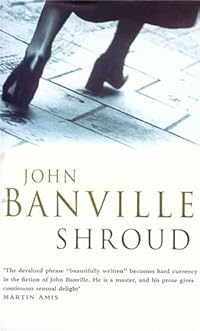
Shroud by John Banville

Picador, 2002, 416 p. (Borrowed from a threatened library.)

 Shroud cover

Axel Vander, an elderly academic on the east coast of the US, one-eyed and gammy-legged due to an unfortunate incident many years before, is contacted by a young woman who says she knows the secret of his past. They both travel to neutral ground, Turin, to meet. She is Catherine Cleave, called Cass. Somewhat precipitately, a sexual relationship begins between them. Though predominantly Vander’s story, even before their first encounter the narrative switches between their two viewpoints, his in first person, Cass’s in third.

His secret is that in the dark times of the early 1940s “Vander” (we never learn his “real” name) took on the identity of a childhood friend after that friend died and identity became something potentially dangerous. As a result, “Mendacity is second, no, is first nature to me. All my life I have lied …. to escape, to be loved, for placement and power. I lied to lie.”

Cass isn’t a simple blackmailer though quite why she seeks Vander out, or becomes his lover, remains obscure. And in the end it avails her nothing. She hears voices, as she suffers from Mandelbaum’s syndrome, a complex condition encompassing depression and delusion. She knows all about the Turin Shroud, which she wants them to visit together. (“He said he knew about fakes.”) Is there just a touch of the “too knowing” about this? Did Banville choose Turin for his setting only because of the Shroud – an obvious metaphor for the identity “Vander” has been wearing for most of a lifetime?

But Vander also compares himself to Harlequin, an inexplicable creature with no relationship with other human beings, and says, “I am an old leopard, my spots go all the way through.” His excuse for taking up with Cass is, “She was my last chance to be me,” asking rhetorically, “Is not love the mirror of burnished gold in which we contemplate our shining selves?” Then again, “There is not a sincere bone in the entire body of my text.”

When he professes to love Cass and tells Kristina Kovacs, his fellow academic and former one night stand, that he is willing to let her go, she replies, “Oh Axel, only someone incapable of love could love so selflessly.” A tale of contradictions, then, and of deceptions, revealed and unrevealed.

Be warned that Banville is fond of the obscure word or two. I hadn’t previously come across apocatastasis (restoration to the original or primordial condition) and pococurantish (demonstrating a tendency toward indifference.)

Pedant’s corner:- “the glass is clear” (The bottle banks have this wrong. Except when it is frosted, all glass is clear – even coloured glass: Banville meant colourless.)

Murder by the Book by Eric Brown

Crème de la Crime, 2013, 218 p.

After a myriad of SF books and stories this is the author’s first foray into straight detective fiction. I don’t read very much in the crime genre but this one worked for me. Partly that was the result of the old-fashioned, and welcome, feel of the story, which can be read as an homage to the golden age of detective fiction.

We are in the 1950s. Donald Langham is a writer of detective stories with a good relationship with his patrician agent, the florid of speech Charles Elder, and an unstated affection for Elder’s more than competent secretary Maria Dupré, the daughter of a French diplomat. The murders of the title have started before the narrative does but we do not learn this till later. The first crime we read about is the blackmailing of Elder for gross indecency with a rent boy. Before he settled down to writing Langham had previous experience of detecting so he offers to investigate and find the blackmailer. Things do not go easily and it is not long before Maria has to make a contribution to the endeavour. Meanwhile it emerges that writers of detective stories are dying or being murdered in ways that nag at Langham’s mind. The plot bowls along, with plenty twists and turns and the narrative incorporates both the camaraderie and the resentments of crime writers.

Keen observers of Brown’s previous works will notice certain resonances in the text, especially in the nascent and building relationship between Langham and Maria, which at times has more than a feel of Brown’s “Starship Seasons” quartet of novellas, among others.

In an article in the Guardian Review on Saturday 8th March John Banville identified an “unacknowledged but vital ingredient of a really satisfying whodunnit: cosiness.” In setting his book in the 1950s Brown has caught that cosiness perfectly. It is, after all, the function of the detective story to set the world to rights.

There is at least one more Langham and Dupré novel to come. I’m looking forward to it.

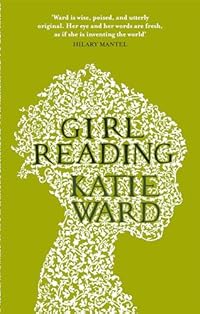
Girl Reading by Katie Ward

Virago, 2012, 342 p

A young girl brought up in a 14th century foundling hospital in Siena is asked to be the model for the Virgin Mary in a painting of the Annunciation. A mute Dutch serving maid accidentally inspires her master to paint her in the act of reading. The completion of a portrait of her dead lesbian lover reconciles a reclusive countess to her loss. One of a pair of identical twin women, a medium, comes to the other, a photographer’s widow now running the business, for a set of cartes de visite. A fifteen year old girl who fancies she is in love with an unmarried artist ten years her senior tries to impress him by painting a picture of her hostess. An MP’s assistant whose personal life has just become uncertain allows her photograph to be taken in a wine bar. A career woman in 2060 misses her family.

Apart from being within the covers of the one book what do all these seven different novella length stories whose settings are spread in time over 600 years have in common? This is presented as a novel so we are presumably being invited to make connections in a way that a book set out as a story collection would not invite. Yet, stylistically, thematically and in plot terms, there is no overt connection between them – except that they all feature images of female literacy. The potted précis given above are, by the way, the least of what each novella conveys.

Each is a slice of life, fully imagined. Every character in them is sympathetically portrayed, feels real. Ward’s control is impressive, she rarely puts a word wrong. (I did wonder however if the phrase “the exception that proves the rule” was really in use in 14th century Italy.)

The last – which was the least convincing in its setting (being a reader of SF I would say that) – tries to force the issue as it features a device known as Sibil (Sensory Immersion Bioscript Interface Locus) which can make its users feel the stories behind the genesis of six images. Those six happen to be the ones we have just read about.

There are, of course, similarities here not only to David Mitchell’s Cloud Atlas in that within the book there is more than one tale with settings in eras spread from the past to the future but also, in its referencing of paintings, to John Banville’s Athena.

Ward’s seven tales have a stylistic quirk in that all of the dialogue is rendered in plain text, not in quotation marks, and is only distinguishable from its surroundings by context and tone. This could be a disaster in the wrong hands – even when conventionally rendered, back and forth dialogue can be tricky for some authors to set down clearly enough – but is never a problem here. Another commonality is that the meat of a tale is sometimes prefaced by an earlier incident in its subjects’ lives.

There could, of course, have been a practical reason for the book’s unusual structure. The conventional wisdom is that short story collections don’t sell. Well if you dress them up as a single novel that problem evaporates.

Such a cynical view would be less than kind. Girl Reading is excellent stuff. It serves as a warning “hard formats are the only ones that survive in the long run,” and a reminder of the importance of physical objects, especially the book. Well, all bibliophiles will agree to that.

Addendum:- A note on the paintings which inspired Ward is here along with links to the images.

The Worms Can Carry Me To Heaven by Alan Warner

Jonathan Cape, 2006, 390p.

The Worms Can Carry Me To Heaven cover

Warner has been known principally for stories featuring women, eg Morvern Callar and The Sopranos, or with Scottish settings, The Man Who Walks. The Worms Can Carry Me To Heaven represents a departure, a different focus. None of its themes nor concerns could be considered narrowly Scottish.

A man is told by his doctor he has The Condition, which is nowadays not an inevitable death sentence. The novel is constructed from his activities of the next few weeks and his memories of the women he has known. (Not as many women as he once planned.)

There are striking stylistic and narrative echoes of other authors; William Boyd’s Ordinary Thunderstorms and John Banville’s The Sea, The Sea but more particularly of JG Ballard. This tendency was clinched on page 94 when a sentence was begun with the word already – a typically Ballardian usage. Reflecting this there is a Science Fictional tone to some of the language. A winter festival of gift giving is known as Three Kings, an area of construction and development is Phases Zones 1 and 2, a train destination is Kilometre 4. The Heaven in the title may be the local cemetery, which is mentioned several times.

As with Ballard and earlier Warner novels the tone is dry and distanced, hence none of the characters entirely springs to life. Indeed certain characters are not named but only given attributes, The Woman Who Watched, Puta of Asuncion, Beautiful Screamer, Manic Coma, though admittedly these last few are inmates of an asylum.

Despite hints – a past Civil War, a fascist regime – which clearly point to Spain, the author, through his narrator Manolo Follana, resolutely refuses to name the country in which the story is set, only saying variously our language, our country, our region, the Capital City. Said narrator has a particular animus against English as a language, with its similarly spelled words with totally different meanings, eg tear. He is, incidentally, capable of the spectacularly ugly (and ungrammatical) sentence; for example, “I showed Teresa the new units my Agency were designing the interiors of,” and occasionally uses “less” when “fewer” is the better choice.

A flavour of magic realism tinges the narrative, albeit at a less heightened level. A more or less adult Manolo is taught to swim by two Vietnamese girls in the confines of the rooftop water tank of the hotel where he was brought up. An old man dies in a bath in one of the hotel’s rooms with the taps still running; the bath ends up cascading through the ceiling of the dining room below where his granddaughters were eating. On two occasions, one fatal but offstage, the act of sex is accompanied by the shedding of blood.

In amongst all this there was the – in context rather jarring – Scotticism of the phrase “sweetie” wrapper.

The Worms Can Carry Me To Heaven is an example of accomplished modern world fiction. For me, though, too many of the characters are insufficiently fleshed out.

free hit counter script