Posted in Alasdair Gray, James Robertson, Science Fiction, Scottish Fiction at 12:00 on 13 May 2013
On Saturday we went to the Christain Aid booksale which is held every two years at St Andrew’s and St George’s Church, George Street, Edinburgh. It was mobbed.
This was my haul:-
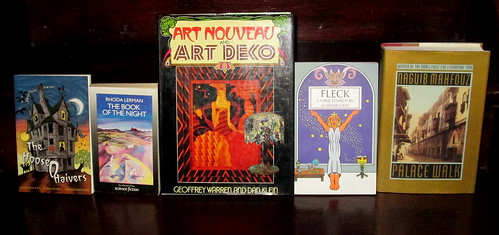
The Hoose O Haivers took my fancy just because of its title – it contains short stories by Matthhew Fitt, Susan Rennie and James Robertson.
Rhoda Lerman’s The Book of the Night is a Womens’ Press SF publication from 1986.
The Art Nouveau and Art Deco book was spotted by the good lady (who herself bought 13 books!) It has some lovely illustrations.
Fleck is a verse comedy by Alasdair Gray.
Palace Walk is the first of Naguib Mahfouz’s Cairo trilogy.
Goodness knows when I’ll get round to reading them.
The Hoose O Haivers and Fleck are quite short so I could fit them in easily enough I suppose. The Mahfouz looks like a long project though.
The book sale continues till Friday.
No Comments »
Posted in Andrew Crumey, Eric Brown, Orhan Pamuk, Other fiction, Reading Reviewed, Science Fiction at 12:00 on 31 December 2012
I don’t usually do end of year round-ups – mostly because most folk write theirs before Christmas and that offends my sensibilities. The year ends on 31st Dec, not before.
Whatever, I looked through all the fiction books I read this year and found twelve that stood out. In order of reading they were:-
PfITZ by Andrew Crumey
Zoo City by Lauren Beukes
The Master and Margarita by Mikhail Bulgakov
The Song of Achilles by Madeline Miller
The Kings of Eternity by Eric Brown
the Tiger’s Wife by Téa Obreht
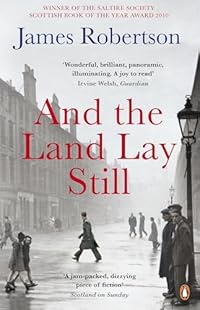
And The Land Lay Still by James Robertson
The Museum of Innocence by Orhan Pamuk
Redemption in Indigo by Karen Lord
New Model Army by Adam Roberts
Galileo’s Dream by Kim Stanley Robinson
D’Alembert’s Principle by Andrew Crumey
That’s four by women and eight by men, which is a pretty high strike rate for the distaff side compared to my fiction reading as a whole, 12:45 – is that shockingly low or a reflection of publishing? Four were SF, eight not; though that ratio alters if you count the fantastical – the Lord, the Obreht, the Bulgakov, and the Crumeys which feature stories from a city made up within one of the two. Only the Robertson and the Pamuk lie wholly within the realm of the naturalistic.
I don’t propose to rank the twelve in any way.
No Comments »
Posted in James Robertson, Reading Reviewed, Scottish Fiction at 23:30 on 21 August 2012
Penguin, 2011, 671p.
This is an ambitious novel which attempts to encapsulate the Scottish experience from the Second World War till the aftermath of devolution – an endeavour in which it succeeds admirably. As such it can be at times something of a history lesson but the outlaying of political events is almost incidental, the focus is always on the characters and their relationships both with each other and the nation as a whole.
Set mainly in and around the fictional Central Scotland towns/villages of Wharryburn and Drumkirk but never fearing to venture further afield, there is a multiplicity of narrative viewpoints. We have photographer Michael Pendreich, son of his fellow photographer father Angus; Don Lennie and his friend, a troubled former Far East PoW Jack Gordon; the original Mr Bond, an employee of the Secret Service, who is given the job of monitoring nationalist sentiment in Scotland; journalist Ellen Imlach; Tory MP David Eddelstane and not a few others. The plot hangs around an exhibition of his late father’s work which Michael is arranging. The various characters’ stories are intertwined and overlapped, elaborated and refined; all against the unfolding backdrop of the ups and downs of the campaign for an independent Scotland from the removal of the Stone of Destiny from Westminster Abbey in 1950 and its return in Arbroath Abbey onwards. Along the way Robertson allows some of his characters to express that socialist viewpoint and analysis of affairs which is rarely heard nowadays but was at one time so common. The book illustrates how much has changed in such a relatively short time.
At once nostalgic and elegiac, at times verging on the mystical, And The Land Lay Still is nevertheless somehow right. To anyone who lived through the latter half of the twentieth century in Scotland, the background events will strike resonances and evoke memories (even of things all but forgotten.) There is, too, a sense of roads not taken, of unfinished business, of resolutions to be made.
The writing is measured, assured, agreeably subtle and, despite the page length, economical.
For anyone interested in the recent Scottish experience or in Scottish literature in general this is a novel that should not be missed.
No Comments »
Posted in James Robertson, Reading Reviewed, Scottish Fiction at 13:00 on 25 June 2011
B+W, 1991. 144p.
(The cover shown on the right is different to my copy’s. My Library Thing link showed the correct one.)
This is a collection of 19 short stories – some very short indeed. Their settings lie mainly in Scotland and explore a variety of domestic and other situations but a few consecutive ones are set in the USA (where some gentle fun is poked at USians’ feeble grasp of the geography of the wider world) and one features Australia.
The most successful are the longest two A Little Irony, where a female artist uses photographs of her narrator boyfriend’s penis in an exhibition, and What Do You Want, How Do You Feel?, about a marriage going through a rocky patch. These feel more rounded perhaps because their length gives room for character exploration. The latter also comes closest to providing the standard twist that people used to expect of a short story.
The social background of Bottle, wherein ne’er-do-weels are employed inside bottle banks, could almost be read as SF. As indeed could Problem, where a man’s wife reveals that she is in fact (or has somehow become; it’s not quite clear) a man. Within the story this sort of transformation appears to be a wider social phenomenon.
Robertson can certainly create atmosphere. The first story, Border, isn’t about much (a young boy travelling north by train looks for the border point after Berwick) but says it well.
If I have a criticism it is that a lot of the stories tend to peter out rather than end. Indeed there is one which finishes with the words, “Any time now something would happen.” Isn’t it the happening that a short story should be about?
Despite this stricture, Close is a well rounded and diverse collection.
No Comments »