Archives » Istanbul

A Strangeness in my Mind by Orhan Pamuk

faber and faber, 2015, 613 p including v p Contents, ii p Aktaş and Karataş family tree, v p Index of characters and vii p Chronology. Translated from the Turkish Kafamda bir tuhaflik by Ekin Orlap.
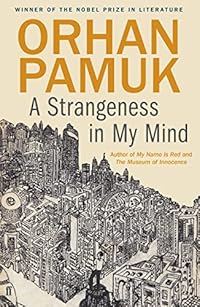
 A Strangeness in my Mind cover

This is the story of Mevlut Karataş who wanders the streets of Istanbul at night selling boza – a kind of fermented drink concocted so as Turks could believe they were not actually drinking alcohol even though they were – from the panniers hung from the pole across his shoulders. While the narrative is mainly carried by a third person account of Mevlut’s life and thoughts, the viewpoints of many of the individuals connected to Mevlut are interpolated into the text. All of these are written in the first person and introduced by that narrator’s name. Though all the details of Mevlut’s life from his arrival in Istanbul to help his father on his boza rounds, through his prolonged and ultimately unfruitful sojourn at the Atatürk Secondary School for Boys, his years conscripted in the army, the attempts to sell yoghurt, ice cream and cooked rice, the other ventures into employment, cashier in a café, car park guard, electricity inspector – residents of Istanbul seem to have been very creative in the ways they could steal electricity from the supply company – it is his love life which provides the book’s main thrust.

The first chapter depicts the defining incident in Mevlut’s life, and it is as magic realist as you could wish – only not magical at all. For three years Mevlut had been writing letters to Rayiha, a girl whose eyes he had stared into at the wedding of his cousin Korkut. Korkut’s brother Süleyman agrees to help Mevlut elope with Rayiha and arranges the deed. When Mevlut glimpses the girl in the back of Süleyman’s van that night he is bewildered to discover she is not the one he thought he had been writing to. Nevertheless, he marries her, comes to love her and have two daughters with her. Süleyman’s deception, of course, (he had designs on the girl with the eyes, Rayiha’s sister, Sadiha, himself,) has ramifications throughout the book.

Many observations about love are made within the text. Hadji Hamit Vural avows, “‘if you’re going to love a girl as deeply as your brother here … you’ve got to make sure to start loving her after you’re married …… but if you fall in love before that .. and you sit down to discuss the bride price with the girl’s father, then those cunning, crafty fathers will ask you for the moon … Most couples would not fall in love if they got to know each other even just a little bit before getting married …. There is also the kind that happens when two people get married and fall in love after that … and that can only happen when you marry someone you don’t know.’” Süleyman’s later lover Melahat (a stage performer under the name Mahinur Mehrem) lets us know that, “‘I could write a book about all the men I’ve known, and then I would also end up on trial for insulting Turkishness.’”

The changing face of the city into whose nooks and crannies Mevlut wanders plying his wares and the evolution of Turkish life become major themes, with the political ups and downs a background never fully occupying Mevlut’s mind; but a sense of the role played by emphasising the nation is never far away, “in this night, pure and everlasting, like an old fairy tale, being Turkish felt infinitely better than being poor.”

The more you read Pamuk the more it becomes clear that his real subject, his true love, is Istanbul; though Turkishness in the wider sense is also important and affairs of the heart never far away. Here Mevlut’s friend Ferhat tells us that, “What makes city life so meaningful is the things we hide.” Pamuk’s œuvre has probed into those hidden places – more so in A Strangeness in my Mind as his previous books have tended to concentrate more on middle class Istanbul, whereas here our hero (as Pamuk refers to Mevlut several times, this is a knowing type of narration) is one of those for whom getting on in the world has always been difficult, he does not know enough of the right people, never accumulates sufficient capital to become affluent.

Again in a Pamuk novel set in modern times there is an acute consciousness of football, but here no hint of anyone called Orhan Pamuk. If Istanbul itself were not enough, allusions to a journalist character from The Black Book would tie this novel in with previous works.

Through all his modern novels – and arguably in those set in historical times – Pamuk has been picking away at the threads of Turkish life, the tensions between religion and the secular sphere, the restrictions set on the people by political, societal and religious dictats. It is almost possible having read enough Pamuk to feel you know something about Turkey, and especially about Istanbul. This may be a delusion but it’s closer to the truth than those without that experience can ever have.

Pedant’s corner:- no start quotation mark when a chapter begins with a piece of dialogue, shopwindows (shop windows. Is it one word in Turkish?) “enormous billboards that look up one whole side of a six- or seven story [sic] building” (took up makes more sense,) “thirty two liras” (isn’t the plural of lira just ‘lira’? Many instances of liras,) “he would open at random to a page” (‘he would open a page at random’ sounds a more natural construction,) the text refers to Argentina and England being at war, and to ‘English’ ships (that of course should be Britain and British respectively,) occasional omitted commas before and after direct speech, “provide the overhead” (in British English it’s ‘overheads’,) “the lay of all the neighbourhoods” (the lie.)
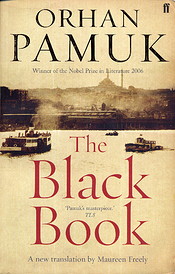
The Black Book by Orhan Pamuk

faber and faber, 2006, 476 p, including iv p Translator’s Afterword.
Translated from the Turkish Kara Kitap (published by Can Yayinlavi Ltd, 1990) by Maureen Freely.

 The Black Book cover

Galip comes home to find his wife Rüya (with whom he has been besotted since childhood and who is also his cousin – apparently this last is a custom widespread in Turkey) has left him. He spends the rest of the novel trying to find out where she has gone. Back to her first husband, once a left-wing firebrand? Or to live with her half-brother Celâl, a famous columnist for the newspaper Milliyet, who has also disappeared?

The chapters written from Galip’s point of view alternate with those in which Celâl’s columns are reproduced, a device which allows Pamuk to ruminate on Turkish and Istanbul history, customs and predilections. It is slightly more complicated than that as just over halfway through, with Celâl’s stock of columns and reprints beginning to run out, Galip takes to writing them himself and presenting them as Celâl’s, so it is possible that all such extracts may in fact be Galip’s thoughts. Indeed one telephone caller to Galip in the guise of Celâl asks if these columns contain the signs that would lead to life’s secret meaning -even if that secret meant nothing. He adds his insight that, “‘No one in this country can ever be himself.’”

In search of Rüya, Galip wanders the streets of Istanbul, especially at night. (A habit also attributed to Ibn Rashid, Sultan Selim, and Mehmet the Conqueror.) This is “the endless fascination afforded to those who wander a city in disguise.” In this novel the presence of the city as in effect a character in its own right – as are all big cities to be fair – is extremely pronounced. After reading the book it’s as if I could walk the place blindfolded. Istanbul also loomed large in the author’s later novel, The Museum of Innocence, and that book’s preoccupation with mementos of a life is prefigured here in The Black Book. What Rüya has left behind, Galip’s memories of Rüya and the remnants of Celâl’s existence are described in loving detail. Again prevalent is the habit of smoking. Everyone in this seems surrounded by clouds of blue tobacco smoke. Once more football as an important factor in Turkish life makes its appearance. (Imagine the reception a British “literary” novel would receive if it mentioned the game at all.)

Rüya was an avid reader of detective novels (which is to say Western detective novels, as the Turkish variant barely existed at the time of writing) and The Black Book has been described as a detective, or at least a mystery, novel. There is a mystery, the disappearances, but the usual preoccupations of a detective novel are absent and, as a detective, Galip is spectacularly ineffective even if, ‘murders that explain books and books that explain murders have a universal appeal, because it is only when a man believes himself to be someone else that he can bring the cudgel down on the victim’s head….. We learn all the rituals and telling details of murder from others, in other words, from legends, stories, reminiscences, and newspapers. In short, we learn about murder from literature….. Even the simplest murder … is an imitation, a literary imitation, even if its perpetrator doesn’t know it.’

Rather than a mystery The Black Book is more an examination of Turkey/Istanbul as seen through the apparently random reflections of Galip on his travels through the city or Celâl in his columns. To an outsider at least, Pamuk appears to have captured his city and culture in the round by focusing on the particular. It is also a rumination on the nature of life and story (or stories within stories inside stories.) “Each story led to another story in an infinite chain,” and, “no matter where they were set …. the love stories were sad and moving.”

In one of these a character pleads, “If people would only just be themselves. If only they would stop telling stories!” In another an heir apparent comes to believe, ‘A sultan’s duty is not to be happy – it is to be himself… it is everyone’s duty – everyone’s.’

The novel is a thinking writer’s work. Galip ponders on the second meanings that might be lurking inside pieces of writing – inviting us to speculate on what he might be hiding in plain sight. As the novel progresses so too does Galip develop a belief about the letters of the alphabet to be discerned on people’s faces and that everything that had ever been written, even the greatest and most authoritative texts in the world, were [sic] about dreams, not real life, dreams conjured up by words. That a text provides insights about its author is suggested by the thought, “What did it mean to read a text if it did not mean entering into the garden of its author’s memory?”

Galip (who, a very short passage intimates, may be Pamuk himself, an intimation which might itself constitute a misdirection) comes to the notion that nothing is as surprising as life. Except for writing, the only consolation.

Pedant’s corner:- Unfortunately the translation is into USian so that we get “soccer” (it’s football,) “a corner shot” (a corner,) “a head shot” (a header,) and “soccer uniform” (a football kit is called a strip.) One actual phrase used was, “after countering a corner shot with a head shot”. This may be how it’s expressed in Turkish but the English term would be “after heading a corner”. Otherwise: dilipidated (dilapidated – used later!) syphillis (syphilis,) “true to our ourselves” (an extraneous “our”,) Trabizon (now more usually rendered Trabzon,) caravansaries/caravansary (caravanserais/caravanserai,) “that I was on to something” (onto.) “Everything that had ever been written, even the greatest and most authoritative texts in the world, were about dreams,” (everything was about dreams,) “whenever writing about about real life” (remove one of those “about”s,) “it is is located” (ditto one “is”,) Averroes’ (Averroes’s – this was in a chapter epigraph so may be original to that.) “He up and left me” (upped and left me,) cul-de-sacs (culs-de-sac,) a lightbulb (light bulb,) “illumination than never came” (that never came,) imposter (impostor – used once, though imposter appeared several times,) “who it was who had beat him” (beaten him – it was a game of chess,) “left- and ring-wing splinter groups” (left- and right-wing,) reptutation (reputation,) “‘He asked me come here’” (to come here,) telerium (tellurium,) sawed-off (sawn-off,) “both staring Bruce Lee” (starring.) “‘These amusing little signs you sent out to your poor deceived readers’” (the rest of this tirade is in present tense so, send,) pedestrals (pedestals.) “The only sound to be heard in the hunting lodge were the cries of the crows” (the only sounds were the cries, or, the only sound was the cries,) “because the city could not afford to keep their generators running” (its generators,) ““destabilize”” (destabilize, preferably destabilise; however, the word is in inverted commas so may be a representation of an original deliberate misspelling in the Turkish.)

The Dervish House by Ian McDonald

Gollancz, 2010. 472p.

After Africa (Chaga – aka Evolution‒s Shore -, Kirinya and Tendeleo’s Story,) India (River Of Gods, Cyberabad Days) and Brazil (Brasyl), in The Dervish House McDonald now turns his attention to Turkey: specifically Istanbul.

The novel is set several years after Turkey has finally gained EU membership and joined the Euro (perhaps a somewhat more remote possibility now than when McDonald was writing) in an era when children can control real, mobile, self assembling/disassembling transformers and adults routinely use nanotech to heighten awareness/response in much the way they do chemical drugs at present. The fruit of what may have been a prodigious quantity of geographical and historical research is injected more or less stealthily into the text.

The main plot is concerned with a terrorists group’€™s plans to distribute nano behaviour changing agents designed to engender a consciousness of mysticism, if not of the reality of God/Allah. The resultant, what would otherwise be magic realist visions of djinni and karin, is thereby given an SF rationale.

In the interlinked narratives of those who live in and around an old Dervish House in Adam Dede Square, and covering events occurring over only four days, there are subplots about contraband Iranian natural gas, corrupt financial institutions and insider dealings, the circumscription of non-Turkish minorities, tales of youthful betrayal and frustrated love, not to mention the discovery of an ancient mummy embalmed in honey, which last gives the author the opportunity to deploy a nice pun on the phrase honey trap. The usual eclectic McDonald conjunction of disparate ingredients, then, and somehow amid all this he manages to finagle football into the mix as early as page two. Fair enough, though; Turkey’s fans are notoriously passionate about the game.

While not quite reaching the heights of Brasyl or River Of Gods, The Dervish House still has more than enough to keep anyone turning the pages.

One typographical quibble: the formula for carbon dioxide ought to be rendered as CO2 rather than CO2, though. To a Chemist like me there is a world of difference between the two.

free hit counter script