Archives » Interzone 290-291

The Society of Time by John Brunner

The Original Trilogy and Other Stories, edited by Mike Ashley. British Library, 2020, 287 p. Reviewed for Interzone 290-291, Summer 2021.
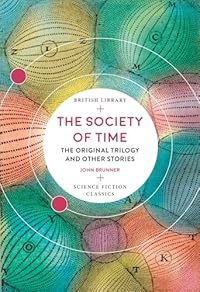
 The Society of Time cover

This British Library reprint, subtitled “The Original Trilogy and Other Stories” contains five novellas first published in 1961 and 1962. The “time” trilogy was collected as Times without Number shortly after then. Its three stories are set around the four-hundredth anniversary of the victory of the Duke of Parma’s Armada over the English fleet when a (Catholic) Spanish Empire – centred on the British Isles – of which our protagonist Don Miguel Navarro, a licentiate of the powerful Society of Time, is a citizen, is at its peak. These are, then, tales of Altered History, with place names such as Jorque and Londres
Curiously we are told Spain itself has been reconquered by “virile” Islam but nothing more is made of this. The Empire’s main rival is instead a Confederacy of Northern European states. The Society of Time controls the time travel machines of the Empire (“Borromeo showed us how we might rotate the dimensions of substances so that the worlds became flat and we could voyage back into time,”) and has rigorous rules to prevent interference with History. A similar organisation in the Confederacy acts likewise. The Islamic powers we must assume to have no time travel capability. All three stories centre round the inevitable (otherwise no story) floutings of these interference protocols. Miguel, a rather correctly behaved individual, is also shocked by other infractions the Society’s members condone, such as pandering.

In the first novella, Spoil of Yesterday, Miguel immediately recognises a work of Art as an illegal import from the past and arrests its owner. The breach is resolved by a trip to the past to replace it immediately after its removal, but the reader does not take this time trip with Miguel, is only told of it. In the second, The Word not Written, Miguel finds that prominent members of the Society actively explore ruptures in time when an argument between them is attempted to be settled by allowing female warriors from a time which would not have occurred bar interference to come to their present, with disastrous results. Again, only a trip back to the past, again unseen, restores the status quo ante. Only Miguel and his confessor retain memories of the infringement. In The Fullness of Time, in retrospect a cunning title, we do finally accompany Miguel to the past. The Empire’s exploitation of the mineral resources of its lands in the New World is protected by the (carefully worded, so as to avoid any possible contravention) Treaty of Prague between it and the Confederacy. Evidence has been found of the Confederacy using its time travel capability to mine in the past where it had no right to. While (in a nod to what actually happened in the reader’s world) recognising that without the Empire the natives of the New World might have been ground between the interests of competing European nations, Miguel’s companion, a Mohawk, resents the Empire’s intrusions on the natives’ ancient lands, despite his tribe becoming a leading light in Empire circles. It is his interference in the past which drives the story and ultimately ensures there will be no more Don Miguel tales.

This is all still very readable, though Brunner’s writing occasionally lapses into cliché, the characterisation is sometimes rudimentary, and there is a rather awkward portrayal of sexual roles and attitudes.

The other two novellas are stand-alones which arguably do not belong with the trilogy though editor Mike Ashley’s introduction says Brunner was at his best at novella length.

In Father of Lies a small area of England is on no maps and technology breaks down when it is entered. Miles Croton is part of a group investigating the phenomenon and penetrates the anomaly on foot after his car will no longer work. He almost straight away sees a dragon from whom he soon has to rescue a naked woman tied to a stake and finds he has entered a world based on mythology (mainly but not exclusively Arthurian.) While this might seem like a fantasy scenario Brunner supplies a rational explanation for them.

The Analysts by contrast is a tale of unusual architecture. Joel Sackstone can visualise from a drawing how a building will be experienced by its inhabitants and as such has been crucial to his firm’s success. A new project baffles him by its design – on which the clients are irrevocably set – seeming to lead people in a direction that isn’t there. In amongst all this oddness Brunner managed to include some asides on sexual and racial politics.

The following did not appear in the published review:- contains the phraseology of the time eg coloured for black.

Pedant’s corner:- “two capital L’s” (strictly speaking the plural is ‘two capitals L’, but that is not how people say it,) focussed (focused,) “if there was anything more undignified than a Licentiate could do” (if there was anything more undignified that a Licentiate could do,) “once for all” (once and for all,) “landing astraddle of the branch” (landing astraddle the branch,) staunch (stanch,) “that all was not well” (that not all was well,) a full stop where there ought to have been a comma, “ten year ago” (years.)
Wild Harbour by Ian Macpherson

British Library, 2019, 220 p, including a v p Introduction by Timothy C Baker, and Wild September a vi p article by MacPherson. First published in 1936. Reviewed for Interzone 290-291, Summer 2021.

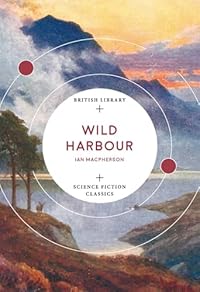
 Wild Harbour cover

In the mid- to late twentieth century Science Fiction by Scottish authors was all but invisible. Only four names spring to mind as being much in evidence at the time; J T McIntosh (who did though manage to publish over 20 SF novels,) Angus McVicar – whose output was aimed at YA readers (such books were called juvenile at the time) – and a reprint in the early 1960s of David Lindsay’s 1920 novel A Voyage to Arcturus, which despite its impeccably Science-Fictional title was arguably more of a fantasy than SF as such. Alasdair Gray produced his monumental Lanark in 1981 but that was such a unique novel (or four novels) that it hardly represented a trend or a model practicable to aspire to. And again it leaned towards fantasy, though some of his short stories were more recognisably SF. A tendency towards fantasy and horror in Scottish fiction had always been present – taking in George MacDonald’s Lilith etc and some of Robert Louis Stevenson’s stories (notably of course The Strange Case of Dr Jekyll and Mr Hyde) – as was the tale of the supernatural or, at least, encounters with the devil, whose origins go back even further than Victorian times. Forty to fifty years ago though, of evidence of SF either in that present or from earlier decades, there was barely a trace, neither as reprints nor on library shelves. Not until Polygon’s republishing of the novels of Lewis Grassic Gibbon – some of them published originally under his real name of J Leslie Mitchell – did I become aware that there had indeed been a Scottish tradition of writing SF before the appearance of Iain (M) Banks. Ken Macleod swiftly followed him. That dam having been broken by their success in the field, there are as of now a fair few Scots active in the genre.

With Ian Macpherson’s Wild Harbour, the British Library, whose new editions of British Crime Classics from the 1930s have brightened up bookshop shelves with vibrant Art Deco style covers redolent of the railway posters of that decade, has pulled another long languishing work of Scottish Science Fiction out of obscurity.

The book was written in the shadow of the looming Second World War. In it, something has happened in Europe and war has been declared, exactly what and between whom is unspecified. The novel starts sometime after with protagonist Hugh and his wife Terry being woken up in the middle of the night by the sound (and sight) of gunfire in the distance, towards Inverness. It soon becomes obvious they are taking refuge in a cave – the text goes on to lay out how well they had customised it to the requirements of living in the wild – as an escape and hiding place from the outside world. Hugh had had no inclination to fight in a war, had refused to follow the instructions of his call-up papers and the pair made off into the country to fend for themselves. Despite his aversion to war Hugh nevertheless has to kill animals to survive, hunting deer, fishing, snaring the odd rabbit.

The text takes the form of diary entries by Hugh with chapter titles which usually consist only of dates (from 15 May 1944 – 11 October) except for the final one, Night. Oddly, despite numerous mentions of salting of deer for the winter, when October comes we are told they have run out of meat.

In an observation on modern humans’ capacity to get by unaided that has even more relevance these days Hugh remembers an acquaintance from before the war telling him, “Our senses are blunted. We depend on a multitude of people to make our clothes and food and tools for us. We have noses that can’t smell, ears that are deaf -”

The pair’s struggle to survive and maintain their seclusion is threatened by human intruders into their surroundings, intruders whose shadowy nature and motivations only heighten the sense of threat. In this context Wild Harbour prefigures British SF’s “cosy” catastrophes of the 1950s.

The Introduction tells us, “Place is formative in all Macpherson’s novels, but the human relationship with place is never an easy one.” That is a statement that could be made about the Scottish novel in general. Another Scottish novelistic trait displayed here is a close attention to depiction of the land.

The writing is of its time, though, and the feel very reminiscent of Gibbon’s slightly earlier SF novels Three Go Back and Gay Hunter, both of which involve sojourns in almost deserted countryside, but also of John Buchan’s John Macnab, (plus there is the merest whiff of Geoffrey Household’s Rogue Male.) Macpherson, however, has an absurd overfondness for the phrase “commenced to” and from the perspective of over 80 years after publication it is noticeable that Terry’s contribution to the pair’s survival is confined almost entirely to the domestic sphere, within the cave.

In valediction, Macpherson offers us the thought that, “We are victors over fate when we choose well, though it destroy us.”

A subsequent article by Macpherson, entitled Wild September, which was published in September 1940, rounds off this edition, and in it he reflects on the actual war which started in 1939.

As Science Fiction, though, Wild Harbour on balance falls down. Its background is too sketchy and there is no real necessity for such a story to be placed in a putative future (except for the international situation at the time it was written.) It could as easily have been a present-day narrative with a more mundane reason than dodging conscription for escaping to the hills. However, that might be argued to be an unwarranted criticism as it projects twenty-first century ideas onto an older text and a work of SF is always about the time it was written, never the future. As a historical curiosity and a reminder that SF by Scottish writers has an extended history Wild Harbour is welcome. Modern SF readers, though, might prefer more meat on its bones.

Pedant’s corner:- in the Introduction; “depictions of violence in books bears little relation to” (depictions …. bear little relationship to.) Elsewhere; a lower case letter at the start of a sentence after a question mark at the end of the previous one, ditto after an exclamation mark, digged (dug,) “‘there didn’t use to be’” (used to be,) a switch of tense from past to present then back, “where I sunk his rifle” (where I had sunk his rifle,)

Interzone 290-291, Summer 2021

TTA Press, 2021.

After a longish break Interzone reappears with a double edition. The editorial is by Lavie Tidhar describing his early steps into being published (in Interzone natch,) and his quest to bring World SF to wider attention. This being a double issue there are two of Aliya Whiteley’s Climbing Stories. In the first she ponders museum artefacts what they tell us about the past – and the future. In the seconda she wonders about the connections we make – as people and as readers – and their validities. Whiteley is also the subject of the first item in the book reviews, where Duncan Lawie looks at both her latest novels Greensmith (“the more astonishing end of Philip K Dick”) and the gentler on the reader Skyward Inn (the name of a pub in the Western Protectorate.) Both “explore big questions whose answers lead to further thought.” I examine the British Library’s reprints of John Brunner’s “very readable” The Society of Time (which is in control of time travel in a Western Europe dominated by a Catholic Spanish Empire) and Ian Macpherson’s Wild Harbour, a cosy catastrophe avant la lettre, and Scottish to boot. John Howard relishes M John Harrison’s “selected stories” collection Settling the World, stories in which nothing is settling, the footing is always unsure. Stephen Theaker discusses David Ebenbach’s How to Mars, (“a good story, but gimmicky, of a one-way trip to Mars for a reality show but where one of the inmates against all the rules has become pregnant,”) Premee Mohammed’s novella These Lifeless Things (set fifty years after the Setback killed 99% of humans) and Martha Wells’s Fugitive Telemetry (an Android SecUnit investigates a murder on Preservation Station,) Maureen Kincaid Speller considers The Wall by Gautam Bhatia (filled with moments of deep emotional intensity but a little too overcrowded with possibilities) yet “deeply satisfying,” and Val Nolan finds the “darkly absurdist” Line by Nial Burke well worth waiting for.

The fiction was all well worth reading.

A Hollow in the Sky by Alexander Glass.1 Except for a few refuseniks called scatterlings humans have joined into a kind of hive mind called the Gathering. Our narrator Mateo is one of the scatterlings, looking after a vespiary in a monastery. Some years ago fellow scatterling Tomoko went off with/was taken away by extremely enigmatic aliens named the Borers. Now she has returned. This is well written but overuses the vespine metaphor.
In The Andraiad by Tim Major,2 the titular andraiad is a church organist and piano tuner called Martin Helm, built to replace a man who died in a fight, and determined to be better.

Pace Car by Lyle Hopwood. Gates – matter transmitters – apparently gifted to Earth as a punishment for the creation of part animal/part human chimeras – have transformed the world, but they are gradually destroyinh their surroundings. Billions of humans have died. Our narrator is a collector of old cars who requires a mechanic to maintain them. He is part goat.

An Island for Lost Astronauts by Daniel Bennet is set in a post sea-level rising world and the appearanceof a mysterious and otherwise unexplained White Ship where convicts are left to scavenge the islands outside East City where returning astronauts have also been outcast for fear of contamination. The story has a sub-Ballardian feel and is deliberately enigmatic.

The narrator of A Stray Cat in the Mountain of the Dead by Cécile Cristofari3 is a nurse of Arabic origin working in a French care home. As the story unfolds we discover she has a weak heart but it is the stray cat that gets in no matter what the staff do that drives the story. If it lies on their laps the deaths of inmates seem inexorably to follow.

Nemesis by Matt Thompson. In a world threatened by comets thrown Earthwards by the sun’s dark companion beyond the Oort Cloud (the Nemesis of the tile) a woman’s memories are being reconstructed.

The Mischief That is Past by John Possidente4 is a tightly controlled exposition of justified paranoia. A journalist on Humbodt, a space station, is in hiding after a contact tells him of someone called Sacagawea who died in 1812. Except she didn’t; she’s still alive, uncovered in Greenland 1937 along with an alien spaceship, and now a state secret. Yet this story ends as its narrator’s is just beginning.

The Egg Collectors by Lavie Tidhar5 are two ballooners (sic) sheltering from a storm on Titan who encounter some ovoid objects on the surface.

Without Lungs or Limbs to Stay by Shauna O’Meara is set on a generation starship where the population has gone rogue, is now space adapted, and recycles the sleep-frozen members of the intended colony in order to keep their nutrient balance the right side of viable.

Pedant’s corner:- aTim Lees’ (Lees’s,) “to not only” (not only to.) 1“a timpani” (timpani is plural; one of them is a timpano.) 2Louis’ (x2, Louis’s,) a mining lift cage accident is said to involve nine men on the top deck and seven below, but three lines later reference is to nine on the lower deck.) 3a missing comma before a piece of direct speech. 4“to lay low” (to lie low.) 5ballooners (balloonists,) “‘You’d think so, wouldn’t you.’” (is a question so ought to finish with a question mark.)

Interzone 290-291 Arrives

Wild Harbour cover

After a hiatus in publishing of the magazine the latest Interzone has now started to arrive on doormats. (At least it has on mine.) It’s a double issue 290-291 to make up for the time since issue 289.

This one (two?) contains my reviews of Wild Harbour by Ian Macpherson and The Society of Time by John Brunner, respectively originally published in 1936 and 1961/62 but both recently reissued under the British Library imprint.

free hit counter script