Archives » H G Wells

Episodes by Christopher Priest

Gollancz, 2020, 360 p

This is a collection of the late author‘s shorter work culled from throughout his career. Each story is prefaced by a ‘Before’ section saying how it came to be written and an ‘After’ section describing how the writing went and where the story was published. Priest’s writing is always controlled and well executed. In general it tends towards a feeling of unease, as if something is lurking below the surface or what has seemed to be reality morphs into something else but here I was surprised by how much of the contents leaned towards horror.

The Head and the Hand. A man who had become famous through allowing himself to be mutilated is persuaded out of retirement for a final cut.

A Dying Fall relates the thoughts that flash through a man’s mind as he is falling in front of a subway train. They are of travelling on a motorway in Belgium and of the training course in parachute jumping/sky diving he took there.

I, Haruspex is, I assume, in the mould of H P Lovecraft. (Priest’s ‘Before’word says it was solicited by a games company wanting something based on that author’s Cthulhu Mythos but he had no familiarity with that at all – similarly I have not. The company, while paying, never used the story and Priest later found a home for it elsewhere.) Effective in its own way it is told in an old-fashioned language of stilted particularity that, for a first person narration, is curiously distanced (not to mention distancing) and overladen with exclamation marks. After consuming his special meals, narrator James Owsley, descendant of a long line of haruspices, can halt or reverse time for a while. Off the Great Hall of his home, Beckon Abbey, lies a hagioscope over a pit which loathsome things are seeking to escape. In a nearby bog a German bomber plane is held in slow suspension as it crashes after being shot down, even though this is 1936. Someone, not a member of its crew, waves to him from the impending wreck and a voice speaks in his head.

Like the author’s novel The Space Machine, written as an hommage to H G Wells, Palely Loitering, a tale of time travel and thwarted love, bears the influence of Edwardian fiction. Despite including space travel (the McGuffin here – called the Flux Channel – was built to help launch a starship on its way,) the story has a resolutely antique feel to it. Its atmosphere of picnics and bandstands, its social and family dynamics were distinctly retro even in the 1979 in which it was first published. After the starship left, three bridges were built across the Flux Channel. The one leading straight across is the ‘Today’ bridge, two others, built at slight angles to the Channel, lead respectively to ‘Yesterday’ or ‘Tomorrow’. Our narrator as a boy one day leapt off the end of the ‘Tomorrow’ bridge and found himself thirty-four years in the future, where a young woman is pointed out to him by a man who says she is waiting for her sweetheart. The reader can from then fill in the gaps but Priest’s execution of the story is impressive.

An Infinite Summer again bears Edwardian hallmarks – but then part of it is set in 1903 where Thomas Lloyd is on the point of proposing to his intended, Sarah, when he is frozen by a camera-like device wielded by someone from the future. The frozen tableaux which result from these capturings can not be seen by contemporary passers-by but only by the unfrozen and the travellers from the future. The effect on Thomas wears off only in 1935 when he is free to move around again but has to wait more years for Sarah to unfreeze. In 1940 he, and Sarah’s image, are caught in the aftermath of the shooting down of a German bomber. The image of one of the bomber’s German crew held in suspension above a river after being captured by a freezer is unforgettable. I note the similarities here between this incident and the one in I Haruspex.

The Ament* is the tale of a man who was once part of a project to film two children, one male and one female, every week, to document changes during their growth and beyond, but who in his adulthood has dreams of committing murder. But are they dreams? The story is told in two alternating voices, his and a third person viewpoint.

The Invisible Men are those (not all men) who are detailed by their USian masters to spy on a British Prime Minister who feels he has to resign due to a financial scandal. (His statement that, “It’s British tradition for a public figure to resign his position if caught in the wrong,” seems altogether quaint now, 50 years after first publication.) His observations of his surroundings on a clandestine meeting on the Norfolk coast with his USian partner – a co-leader of a UK seemingly on the brink of becoming the 51st State – imbue the tale with a sense of foreboding.

The Stooge is employed by a stage illusionist to fake amazement at his tricks on being ‘randomly’ picked from his audience. The story’s title becomes doubly apposite.

In futouristic.co.uk a man responds to an email offering to sell him a time machine. It doesn’t work. For him.

Shooting an Episode presents the ultimate in reality TV, though it’s more like reality streaming. For its subjects no holds are barred. The trouble comes when our narrator has to go in amongst the participants to clean up their mess.

In The Sorting Out Melvina comes home late one night to find her door lying open having been forced. With increasing fear she moves through all her rooms, wondering if the man she has recently dumped has something to do with it, but a phone call reveals he is an hour away. Yet various of her books have been misplaced, their dust covers placed upside down, their normal, random arrangement systematised. One has been glued to a curtain.

In its ‘After’word Priest describes the gathering of books (which is what most readers do) as a kind of quiet madness. Well, all obsessions are. At least it’s a harmless madness.

*Amentia is the condition of feeble-mindedness or other general mental deficiency.

Pedant’s corner: Méliès’ (Méliès’s – especially since the final ‘s’ of Méliès is unsounded, thus demanding the apostrophe ‘s’ for its possessive,) maws (used for ‘mouth’; a maw is of course a stomach,) interlocuter (interlocutor,) aureole (areola,) Mrs Adams’ (Adams’s,) “more yachts were parked further away” (parked? Can you park a yacht?) “the king” (x 2, the King,) “the sort of problems the bank were concerned with” (the bank was concerned with,) soccer (football.)
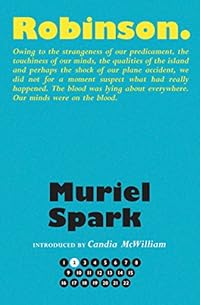
Robinson by Muriel Spark

Polygon, 2017, 176 p, plus i p Map of Robinson island, iv p Foreword by Alan Taylor and ix p Introduction by Candia McWilliam. First published 1958.

The novel is presented as the recollections of January Marlow, a passenger on an aeroplane which crashed on an island with only three survivors, herself, a man called Jimmie and another named Tom Wells. The island is the demesne of the mysterious and pernickety Robinson. (We note here a certain Crusoe, plus a Swiss family also marooned, not to mention the island of Prospero.) Robinson normally has few companions, a boy named Miguel – and a goat – though Jimmie had been on his way back to the island. Note too, that Wells’s surname evokes another island, that of H G of that ilk’s Doctor Moreau.

This all takes place at a time when communications were not as easy as they are now and the survivors worry about the effect their apparent disappearance will have on their lives back home. (They had in fact been declared dead.) The arrival of the annual pomegranate boat – that fruit is the island’s main produce – is awaited eagerly so that they can return to civilisation.

A small canvas such as this is of course a familiar staple of novelists even beyond the examples mentioned above and provides ample scope for interpersonal conflict. This is exacerbated when Robinson goes missing in suspicious circumstances halfway through the book and the rest suspect each other of killing him. Robinson’s mistrust of religion contrasts with January’s faith (and, of course, Spark’s.)

This was Spark’s second novel and has less opacity than many of her later works. This may be due to the use of a first-person narrator.

Pedant’s corner:- In the Introduction; Dr Benigno (in the text it’s Dr Benignus,) staunched (stanched.) Otherwise; a capital letter is used at the beginning of an unspoken thought expressed within a longer sentence. In those moments the typography therefore looks odd. “Anyway” beginning one sentence and, less than two lines later, “And anyway” begins another.

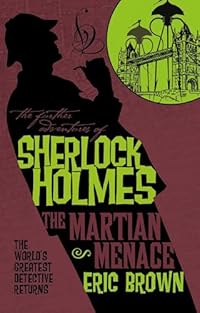
The further adventures of Sherlock Holmes The Martian Menace by Eric Brown

Titan Books, 2020, 343 p.

 Sherlock Holmes The Martian Menace cover

I have mentioned before that the detective story/crime fiction isn’t really my thing – nor Shelock Holmes for that matter. This however is by my friend Eric Brown who, although he has written in the crime genre, started off in the SF field and this certainly counts as Science Fiction. It is, as its title suggests, a mash-up (I was going to say curious mash-up but that is its whole point) of the work of H G Wells and Arthur Conan-Doyle. As is the way of such things we have many references throughout, starting early with the presence of Mr Herbert Wells himself – here a scientific liaison officer in the Martian Embassy to Great Britain and an aspiring writer whose output is deemed too fanciful to appeal to the public – and his love interest, Cicely Fairfield, whose writing efforts have been more successful.

This is a world where the Martians of War of the Worlds have returned, complete with their signature tripods and nightly cries of “Ulla, ulla,” and armed with antibodies to Earthly pathogens, transforming life on Earth with technological advances. This is a good brand of Martian, who came in peace, having overthrown their acquisitive predecessors. Or so they say. Some people on Earth doubt this story and there is an active political resistance to the Martian influence. Among their number are George Bernard Shaw and G K Chesterton.

Holmes, having established his credentials by solving the case of the murder of the Martian ambassador two or so years before the main plot of this tale begins – albeit by concealing the identity of the true culprit – is invited to Mars to investigate the murder of Delph-Aran-Arapna, one of the finest Martian minds of the era. Curiously no reference to this creature can be found in any of the Martian literature which Holmes has read. (The great detective has of course made himself fluent in Martian.) Our narrator, as is customary, is Dr Watson, who in an anti-Martian public meeting has made the acquaintance – or rather by design been made her acquaintance – of a Miss Freya Hamilton-Bell, a prominent member of the anti-Martian faction.

The journey to Mars having been made (also making his appearance here is a certain Professor Challenger,) Holmes and Watson are soon contacted by Miss Hamilton-Bell and told of the Martians’ plan to replace well-known or powerful men from Earth (or mostly men) with simulacra – with all the attributes, memories and brain-power of their originals’ but controllable at a distance – as a means to taking over Earth and eradicating humans entirely. Fortunately there is an underclass of Martians who were recently at war with the dominant aggressive faction who are able to help.

Unsurprisingly in a series of novels trading on the Holmes mythos, Professor Moriarty – indeed a whole series of Moriartys as the Martians have cloned his body multiple times – is a pivotal figure. More surprisingly he is less of an antagonist to Holmes than the reader might have thought.

All first-person novels (all novels, perhaps?) are an act of ventriloquism but that act is surely more difficult if the voice being simulated is not of the author’s own devising. Brown has made a good fist of the mash-up, capturing the stilted, repressed, awkwardnesses of “Watson’s” style and character, but also made it more accommodating to a modern audience. (Words like antibodies, pathogens and feisty seem unlikely for the 1910s. The agency of Miss Hamilton-Bell as active and important in the anti-Martian movement seems also to be a more modern note – but then again the book is set in the age of the suffragettes, who could be an unruly lot – though they are unmentioned.)

Holmes fans might hanker for more of the supposed deductive reasoning powers of Conan-Doyle’s hero (which are used sparingly here) but the Wells influence, the flavour of the scientific romance, is more to the fore. Brown is primarily an SF writer after all.

An enterprise like this is surely not meant to be conceived as a serious work of fiction and should not be read as such. As an entertainment, though, it succeeds admirably.

Pedant’s corner:- “Time interval later” count: substantial, plus variants such as “in due course” etc. Otherwise; Cicely (the real-life Miss Fairfield was named Cicily,) nought (naught,) maw (it’s a stomach, not a mouth,) smidgen (I prefer ‘smidgin’,) cannister (canister,) imposters (I prefer ‘impostors’,) cicatrise (cicatrice.) “The content of their originals’ minds have been reproduced” (The contents of their originals’minds,) “nine pence” (ninepence,) “the two Miss Fairfields” (the two Misses Fairfield.)

Evolution by Stephen Baxter

Grafton, 2003, 766 p.

 Evolution  cover

You can’t fault Baxter for ambition. This is potentially a daunting undertaking, to tell the story of human evolution – from those first small, nocturnal mammals scrabbling about under the feet of the dinosaurs all the way through modern Homo Sapiens to its far future descendants – via incidents from the imagined lives of individuals living at possibly pivotal moments in that great chain. It wouldn’t have been an easy task for anyone.

The story is told in three sections Ancestors, Humans, and Descendants, topped and tailed by a Prologue and Epilogue and interrupted by an Interlude between sections One and Two. There is a further episode set in the same time as these three framing passages though it is included as the last chapter in Section Two.

By its nature the narrative of Evolution tends to the episodic and that, for a novel, can be a problem. The reader is no sooner taken into the lives of our various protagonists than is brought out again, hurrying onward ever onward, usually leaping millions of years, jumping from habitat to habitat. But that, of course, is evolution. Our own experience of life, of story, is not even a blink in those terms.

The early chapters – set in the days immediately before the impact of the Chicxulub meteor (Baxter has it as a comet, with its huge “Devil’s Tail” spanning across the sky in its approach) – can at times read as the transcript of a lecture on palæobiology. Baxter has clearly done a power of research (and of course without that his story would have been much the poorer) but the way he introduces some of the creatures is usually not novelistic. Then there are the information dumping paragraphs describing the geological processes altering the animals’ environments and the Earth’s climate: necessary to the overall picture, but again not novelistic.

The influence of Richard Dawkins on the author’s vision is perhaps evident in the importance Baxter gives to sex, the passing on of genes, in the motivations and actions of his ‘characters’. There is a persistent insistence on the compartmentalisation of early primates’ brains. The beginnings of religion are described as an attempt to make sense of the forces shaping the world via a new way of thinking. The importance of food scarcities on the development of certain human behaviours is noted. By contrast the effect of the beginnings of agriculture on the health of human teeth (not good, the grit in the resultant bread from the grinding of the wheat between stones wearing them away) and of nutritional health more generally (lack of dietary diversity leading to deficiency disease, stunted growth) is almost a throwaway. But ‘civilisation’ lies this way. And its fall is due to the same impersonal forces of nature as did for the dinosaurs, though with a different mechanism. (Sixteen years on such a natural cause need not necessarily be looked to. As a species many of us still seem inclined to blindness to our own possible contribution to a mass extinction event.)

So; does it work? The book is an intellectual undertaking but not on a Stapledonian scale. A lot of the scenarios while differing in detail tend to the similar in their outline; ancestors, humans, or descendants encountering some new phenomenon, species, or climatic pressure. Baxter’s strengths as a storyteller lie in this sphere rather than in characterisation. His protagonists and those with whom they come into conflict are in this case too pragmatically designed to fulfil the niches assigned to them to fully come alive. Some of the future scenes also seemed to owe more than a little to H G Wells. (Baxter has of course since written a sequel to War of the Worlds.) As an introduction to the convoluted history of human evolution, though, this is a good starting place even if more recent discoveries have rendered it slightly out of date.

Pedant’s corner:- Written with USian spellings. Otherwise; “The smoke from the volcano” (we’ve previously been told that the smoke was due to forest fires,) “like an featherless” (a featherless,) “his clan were gone: (was gone,) “forever looking over their shoulder” (shoulders,) “was a kind of primates” (a kind of primate,) a missing full stop, auroras (aurorae,) “the laellyn group were overcome” (the group was overcome.) “But Capo’s troop were responding” (Capo’s troop was responding,) “‘one group of experimenters were’”” (one group was – but this was in dialogue,) “in the shape of their backs, skulls, trunks” (in the shapes of their backs, skulls, trunks,) epicentre (centre,) “Dust had already laid down by the fire” (lain down,) fitted (despite, earlier – and later – the USian form of the preterite, fit,) “just as his spear had flow” (had flown,) tepee-style (tepee-style,) a missing full stop, “where the sun was staring to set” (starting,) “that was why there was so many of them” (there were so many of them,) “raised to shoulder, height above the ground” (no comma after shoulder.) “It took Hononus and Athalaric many weeks reach Jordan” (It took Honorius and Athalaric many weeks to reach Jordan,) Neandertal (is this a USian spelling of Neanderthal?) A sentence lacking a name – or pronoun – as its subject (on page 671,) “for these pits were mouths. These deadly maws” (maws are not mouths. They are stomachs.)

The Massacre of Mankind by Stephen Baxter

A sequel to The War of the Worlds.

Gollancz, 2017, 464 p.

 The Massacre of Mankind cover

This sequel to H G Wells’s War of the Worlds is authorised by the H G Wells estate and in it, of course, the Martians return to Earth. Since in our timeline they did not ever come in the first place that makes this book an altered history. To make it correspond with the original Baxter has to employ early twentieth century cosmology and speculation as part of his story, in particular the supposedly superpowerful civilisation inhabiting Jupiter’s cloud banks.

Our narrator is Julie Elphinstone, sister-in-law of the narrator of the earlier book. Elphinstone is a journalist (divorced from her husband) and at the start of the novel is working in New York. Britain is under an authoritarian regime, astronomy is banned to the general public – apparently worldwide – but of course everyone expects the Martians to invade again at the next opposition. Elphinstone is invited back to England to hear from her brother-in-law of their imminent arrival.

This time they come in greater force, have adapted their tactics and gained immunity from the microbes that did for them before. Britain’s armed forces, though better prepared, still fight the last war and the Martians swiftly gain a foothold and press their advantage. Two years later landings take place all around the world, allowing Baxter to set more scenes in the US, but much of the book is taken up with how people in England adjust to life under the gaze of the Martians and efforts to strike back against them. Elphinstone becomes an unwitting agent of the government in its attempts to defeat the Martians in the same old way but is instrumental in invoking the power of the Jovians to rebuff the Martians – or at least to make them retreat to the Arctic.

All the familiar Wellsian touches recur, the heat-ray, the red weed, the Martians’ desire for the blood of their conquered foes. (I know this adds to the horror – and Baxter adds in some gruesome scenes to illustrate it – but it is extremely unlikely that human blood rather than flesh could be a prime food source. I find excessive harping on the efficacy of blood in magic rituals and the like, as here, risible.) Baxter makes more of the Cythrereans the Martians have brought from Venus than I remember Wells doing. A strange inconsistency was that despite the Martians targeting motorised transport it is still used later under their eyes.

Baxter’s use of a female narrator is, of course, a reflection of our times rather than Wells’s. In this regard the inclusion of the strongish female character Verity Bliss (who might once have been introduced solely as a love interest for Elphinstone’s former husband Frank Jenkins but actually has much more agency than that) is another nod to the twenty-first century. Baxter also references things about which Wells would have been ignorant, like the Schlieffen War – in the book still raging between the Empires of Germany and Russia – Craiglockhart Hospital, Porton Down, Stapledon, and Ataturk as an Ottoman representative. He has a certain RFC Lieutenant, William Leefe Robinson kill a Martian in an air attack on one of their machines and mentions Wells as the Year Million Man.

But I’m struggling to see the point. Did we need a sequel to War of the Worlds? Does it really tell us anything about ourselves now? Or is it about present day fears? As an illustration of the ills that plague us in Britain – and the Western world in general – I would have thought a story about unfeeling monied zombies bleeding us dry would be much more apposite.

I don’t blame Baxter for taking the project on; it’s an open goal after all and he does accomplish it rather well. And I suppose it’s entertaining enough.

Pedant’s corner:- I read an ARC (proof) so some of these may have been corrected in the final publication. Practise (as a noun, so practice,) “‘I am aware have called some of you’” (I am aware I have called some of you.) “Even the privileged few like myself who had advance warning of the new invasion, this coldly stated news, the reality officially confirmed, came as a dreadful shock.” (Even to the privileged few,) “meant for a comparative trickle commuting clerks,” (of commuting clerks.) “Frank already had an intuition that the percentage of survivors would be small, that the wounded they encountered from the periphery of the infall,” (that the wounded they encountered came from the periphery of the infall,) “Frank said as determinedly as we could” (as he could.) “‘But he’s had no time for his precious fishing that since he was called up for the reserves’” (no “that” required,) “as he was.,” (has an extraneous comma,) “my sister-in-had” (my sister-in-law had,) “the thousand-strong crew .” (should have no space between crew and the full stop,) scuttlebutt (a USian term, so an unlikely usage on a British warship in the 1920s,) Jenkins’ (Jenkins’s, which appears four lines later!) “the contents of the their kit-bags” (of their kit-bags,) “mirroring my own side by riddled with detail,” (mirroring my own side in being riddled with detail,) Ted Land (elsewhere always Ted Lane,) “‘That looks it came off a sewer.’” (That looks as if – or, That looks like – it came off a sewer’) “the next I remember I was lying in on green grass” (no “in”,) “sat on a low twig” (seated or sitting, but since it was a yellowhammer perhaps perched,) “‘I can always use an enthusiastic NCO’” (the British usage is “I could always do with an enthusiastic NCO”,) “supplies of antibiotics” (in the 1920s?) fit (fitted,) “we newcomers were been invited” (were invited; or, had been invited,) priel (prial,) an extraneous open quote mark, Chapter 23’s number and title were not in the larger font size of all the others, ”he based had his calculations” (he had based his calculations.) “Even now it’s hard to recall now” (has an extraneous now,) “”adjusting their positions, And Cherie saw them” (a full stop after positions or no capital A at and,) “from the gitgo” (isn’t it getgo?) “where the fires where” (where the fires were,) “had so nearly had befallen” (has one had too many.) “Straight after the Second War he plunged straight into the Basra conferences” (two straights in eight words.) “‘And he’s as careless of his health as ever he is,’” (as ever he was,) the earth (the Earth, many instances.)

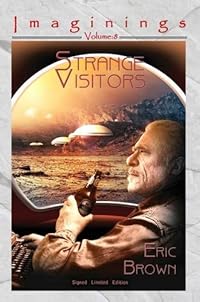
Strange Visitors by Eric Brown

Imaginings 8, NewCon Press, 2014, 158 p.

I ought again to point out that the author is well-known to me: is, indeed, a friend. I hope that this does not colour any appreciation – or lack thereof – of his output nor get in the way of any judgements or comments I make about his work.

 Strange Visitors cover

In any case in his introduction to this collection its publisher Ian Whates relays “stalwart of the British SF community” and former owner of Birmingham’s much-lamented Andromeda bookshop Rog Peyton’s opinion that Brown is our greatest living SF writer – as much for the author’s concentration on the humans in his stories as for anything else. Whatever, Strange Visitors contains an excellent body of stories displaying Brown’s range and it is striking here how often those which reflect humanity and its foibles most directly are the most successful and satisfying. Many of Brown’s perennial concerns are evident (religion surprisingly excepted) but their handling shows Brown’s assurance as a writer.

In Life Beyond…… 1 Brown pays effective homage to SF writer Clifford D Simak. An ageing writer faced with losing his recently orphaned grand-daughter to an adoptive family has a close encounter with a book-collecting alien.

Steps Along the Way2 is set thirty thousand years into the future where humans are effectively immortal, have spread all through the galaxy and can Enstate and Enable people from history.

Brown’s affection for the work of Michael G Coney shines through The Sins of Edward Veron3 where the titular Veron is an artist who has lost his ability to produce good work. Then an alien art collector from Mintaka V arrives at Sapphire Oasis. (SPOILER ALERT. There is a slight flaw in this story in that Veron seems to have been able to leave the Oasis the day after his wife died without engendering either suspicion or investigation.)

In Myths of the Martian Future4 Olinka and Tem, two crab-like cave dwellers on a far-future Mars, set out on their initiation rite on the surface. What they meet encompasses both the past of their species and a description of its future. There is a certain stiltedness in the narration, characteristic of all stories such as this.

The Scribe of Betelgeuse V5 is a tongue-in-cheek account of the invasion of Earth by octopods from Betelgeuse V, whose first act is to cause an episode of mass writers’ block. It manages to name check a couple of Brown’s writer friends as well as poke fun at the publishing industry.

The Rest Is Speculation6. Two and a half billion years into the future representatives of every sentient race that ever existed on Earth are gathered together by the Effectuators to witness its last days.

The Tragic Affair of the Martian Ambassador7 is a Sherlock Holmes pastiche wherein the great detective is invited to investigate the murder of the Martian ambassador at Mars’s London embassy, where the two human employees are a certain Herbert Wells and Miss Rebecca West.

In Bukowski on Mars, With Beer8 Brown imagines how Charles Bukowski would cope after being brought back to life – along with all the greats – on a future Mars. The beer helps.

People of Planet Earth9 is an alien invasion story where the method of body snatching is exceedingly unusual, to say the least.

In P.O.O.C.H.10 Michael is punished for electronically stealing from the rich (but relaying the proceeds to charity) by being given his own Personal Omni-Operational Correction Hound; a robot which mimics a real dog in all respects.

Pedant’s corner:- A total of 20 occurrences of “time interval later” plus one “within seconds”. Each story has its title as a header on odd-numbered pages except The Tragic Affair of the Martian Ambassador appears for both its own story and for The Rest Is Speculation and People of the Planet Earth appears for People of Planet Earth. Otherwise; 1USian spellings – disheveled, defense, etc; but…. manoeuvre. “of legion of thinkers” (of a legion; or, of legions.) “What if they alien” (the alien,) “I am loathe to give them up” (loth, or loath,) 2“men whose contribution to history were steps along the way” (contributions.) 3“accused her of having affair” (an affair,) “the piece in which I had tried to imbue” (the piece which I had tried,) back-peddling (back pedalling,) 4Barington (Barrington.) 5Carstairs’ (Carstairs’s,) stared at MS (the MS,) the BBC were on hand (the BBC was,) “I wil l-” (I will-,) Hemmings’ (Hemmings’s,) “‘I demanded reparations’” (demand.) 6a missing comma before a piece of dialogue, “this absence, this lacunae” (lacuna,) disk x 3 but disc x 1, “‘And they?’ I Kamis asked.” (‘And they?’ Kamis asked.) 7Wells’ (Wells’s,) “‘Was he is the habit….’” (in the habit,) “The slightest frowned marred” (frown,) “‘For a little short for six months’” (of six months,) Madame Rochelle’s (appears as Madame the first twice but subsequently as Madam, but this may have been an authorial distinction between that lady’s establishment and her person,) “‘if any of your ladies in the habit’” (are in the habit,) St Pauls (St Paul’s,) 8“A guy a silver suit” (in a silver suit,) “That last I remembered” (The last?) anther beer (anther beer sounds like great stuff but another beer was meant,) “to keep in breathable” (it breathable,) “and the all fucking” (and all the fucking.) 9the throes delirium (of delirium,) ‘Ladies and gentlemen, Speaker of the House’ (when starting a speech in Parliament the form is, ‘Mr Speaker, honourable members.’) 10”to answer to summons” (the summons,) descendent (descendant,) miniscule (minuscule,) you commands (your,) busses (buses.) Thirty minute (minutes,) banks accounts (banks’ accounts.)

Time Travel, Reviews, Hame and Rebellions

In an article in Saturday’s Guardian review, James Gleick examined the history of the time travel story since H G Wells more or less invented the form in The Time Machine. It was a skate over the subject really and veered into the territory of so-called Alternative History which of course I prefer to name Altered History but worth reading all the same.

In the same section of the paper was a review of Annalena McAfee’s new novel Hame. Many reviews are interesting, some make you think “definitely not”. Very few inspire you to go out and read the book concerned. Stuart Kelly’s did just that, as indeed did his review of Kevin MacNeil’s The Brilliant and Forever which I read a few months ago after also reading the same author’s A Method Actor’s Guide to Jekyll and Hyde due to the same review. McAfee’s Hame sounds intriguing and possibly funny. Definitely one I’ll look for.

I recalled McAfee’s name. She had an article in the Guardian Review some weeks ago which I wished to post about then but at the time could not find on the Guardian website but which now pops up fourth when you search her name there. The article was about the relative importance of Robert Burns and the possible balefulness of his mythologising (Aside. Why does no-one ever question this about Shakespeare?) and the continuing battle over whether Scots is a suitable medium of expression for literature.

My take is if the author wishes to use Scots it is entirely up to her or him. It may reduce the psossible readership but that is a question for author and publisher, not reader. Myself, though not very well versed in it, my mother being the daughter of two English parents, thus hardly a native speaker and unable to expose me to its richness, I do not consider Scots – as some do – as necessarily inferior form to English. It is at times much more pithy.

I have a quibble with McAfee over a detail in that piece, though. She stated that Burns was born “two decades after the failed rebellion against the Union.” While Prince Charles Edward Stuart’s Rebellion of 1745-6 was many things, not least the last flailing gasp of a failed dynasty, and the Battle of Culloden can even be considered as in some way (if you ignore its continuation into Ireland even into the twentieth century and possibly beyond,) the last of the Thirty Years War – though admittedly that was mostly fought out in German territories – it was not primarily against the Union. It was less general then that, more personal.

Public library and other stories by Ali Smith

Hamish Hamilton, 2015, 228 p

 Public Library cover

Borrowed from a doomed library.

The book cover and spine have “Public library” as the title but the colophon shows “ Public library ” (actually struck through several times.) As is usual in Smith’s output the left hand margin is justified but the right hand one is not – curiously, though, the acknowledgements page has the reverse. The prefatory “Library” is an apparently true story about Smith and her publisher coming across a building emblazoned Library; but it’s an exclusive club instead. Smith’s stories are interleaved with Smith and her correspondents’ memories of libraries and their importance to civilised life. These interludes are entitled “that beautiful new build”, “opened by Mark Twain”, “ a clean, well-lighted place”, “the ideal model of society”, “soon to be sold”, “put a price on that”, “on bleak house road”, “curve tracing”, “the library sunlight”, “the making of me” and “the infinite possibilities”.

As in Smith’s previous collections the short stories included here tend to have similar structures whereby the narrator will start off on one course and then veer onto another, and on occasion a return to the first topic will occur.

In Last the narrator sees a wheelchair-bound woman has been left behind on a train. While she tries to effect a rescue she muses on the changing meanings of various words.
Good voice is narrated by a woman who speaks to her dead father and ruminates on the First World War.
In The beholder a woman who has suffered a series of life altering events finds a growth on her chest. It seems to be a rose.
The poet relates the life story of the poet Olive Fraser whom Smith imagines being inspired by finding printed music on the binding (made from recycled old paper stock) of one of Walter Scott’s Waverley novels.
The human claim dwells on the unlikely connection between an unauthorised credit card transaction and the fate of D H Lawrence’s ashes.
The ex-wife has a woman trying to come to terms with breaking up from her ex-wife because she was so obsessed with Katharine Mansfield. In it Smith says, “What the writer does is not so much to solve the question but to put the question.” She also utilises the word pompazoon; as Mansfield did.
In The art of elsewhere the narrator tells of her desire to come upon some kinder, better, less constrained existence.
After life. A man is twice reported dead; both times falsely. The second time no-one cares. This leads him to muse on the vitality shown in the Mitchell and Kenyon films of turn of the twentieth century life.
In The definite article the narrator has an epiphany after lingering in Regent’s Park on the way to an important meeting.
Grass A book of Robert Herrick poems brings to the narrator’s mind an incident which occurred when she was minding her father’s shop during an Easter break in her finals year.
In Say I won’t be there the narrator has an ongoing discussion with her partner about not revealing the contents of her recurring dream which features Dusty Springfield (about whom her partner knows a lot more than her.) She tells us the dream instead.
And so on’s narrator ruminates on a friend who died young and her illness-induced imaginings that she was a work of art in the process of being abducted.

Pedant’s corner:- to not sway (not to sway,) ones bones (one’s bones,) H G Wells dream (H G Wells’s,) ‘We bought the book in Habitat, before Habitat became defunct.’ (Habitat isn’t quite yet defunct. It still has some outlets in a few Homebase stores.)

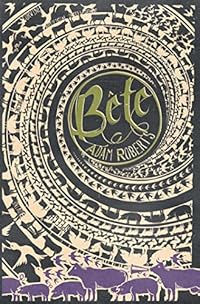
Bête by Adam Roberts.

Gollancz, 2014, 320 p. Reviewed for Interzone 255, Nov-Dec 2014.

Bête cover

We know from the epigraph, “You? Better. You? Bête” – attributed to Pete Townshend but given Roberts’s own slant – that we are in for a tale full of word play and allusion; everything from Led Zeppelin lyrics to the riddle of the Sphinx, with nods to previous SF (at one point there is the shout, “Butlerian Jihad!”) as well as Animal Farm.

The novel begins with dairy farmer Graham Penhaligon, who has also trained to butcher his own livestock, having a verbal disagreement with a “canny” cow which does not wish to be slaughtered. This is shortly before such Loquacious Beasts (as the Act has it) are to be legally protected. The encounter makes Graham famous, after a fashion. The advent of speaking animals had come with green activists, “creeping around farms in the dead of night, injecting chips into the craniums (sic) of farm animals.” These bêtes at first spouted authentic sounding phrases, responses of animal rights propaganda, but quickly the chips, by now AIs, develop into something more integrated with their hosts.

It is tempting to find faint echoes in this set-up of Wells’s Dr Moreau but the comparison is too stretched to be truly viable. No vivisection is involved; the chips only have to be ingested to make their way into the host’s brain. Graham reflects that Moore’s Law made this sort of augmentation inevitable but he never believes that the animals are really expressing themselves; it is the computers in their heads doing so. Soon enough bêtes become legal citizens competing with humans for jobs. Along with the almost simultaneous development of synthetic Vitameat, one of the ramifications is that Graham’s farm is no longer viable.

He resorts to a nomadic existence, taking the odd slaughtering job, living (poorly) off the land, his peregrinations bringing him into irregular but recurring contact with Anne Grigson, with whom he falls in love. She has a canny cat, Cincinnatus, which loves its mistress but also exhibits a peculiar interest in Graham.

Graham is prickly from the outset. “Don’t call me Graham,” he tells the argumentative cow – and nearly everyone else whom he meets thereafter. He is especially so with the bêtes he encounters. These internet enabled, wifi-ed animals recognise him instantly, but there is always a hint of menace in it. A shambling incoherent human appears to know Graham but has been chipped; with “higher” animals schizophrenia is the unerring result of such a merger. Dogs, cows, horses are much more suitable.

This scenario gives Roberts scope to comment on humanity’s collective relationship with the biosphere, sometimes through his minor characters, ‘“Animals have feelings and thoughts – it’s just that only now have they been able to bring them out,”’ otherwise through Graham’s thoughts, “Speciesism is more deeply entrenched within us than sexism, and that is deep enough,” “Nature: it’s not nice, it was never nice. Niceness is what we humans built to insulate ourselves from – all that.” Cincinnatus provides the barbed observation, “Misrecognition. It’s what humans are best at.”

At times Bête takes on some of the characteristics of the post-disaster stories associated with British SF of the fifties and early sixties. Also stalking the land and causing AIDS-like panic is the disease, Sclerotic Charagmitis, where mucous membranes scar over, leading to death. The countryside is abandoned to the animals, people huddle together in the larger towns, the regime becomes repressive, but shuts off the wifi too late. There are tales of inter-species war in the north, animals immolated on pyres by the army. In his isolation, Graham does not witness any of this, though.

He makes much of language and his relish of it and notes his is a very English tale. Language is a field, he tells us, and farmers are used to working with fields. A strange aspect of the narrative, though, is its frequent use of archaisms. “And you have brought it me,” wroth, thrice. Sadly, this last appeared only twice.

But Anne dies from cancer, and Graham reflects that the loss of love brings resentment, bitterness, anger, envy. Fair enough, but I don’t quite buy his contention that, for adults, crying is always a performance, intended for an audience. The crux of the novel comes at Graham’s delayed meeting with the leader of the bêtes in the south, an AI in the brain of a very old ewe known (in a piece of somewhat heavy-handed symbolism) as The Lamb, which makes him an offer.

While the essential motor of the plot is that this is a love story, Graham’s relationship with Anne does not come over like a grand passion. Everything is a touch too intellectual; described, not experienced. Bête is good stuff, though, probably enough to ensure Roberts’s usual award nomination.

The following did not appear in the final review.:-
There is reference to a film scene which, though it can be parsed, will only make immediate sense if you’ve actually seen the film. The proof copy I read was absolutely littered with typos, easily averaging one a page. The best of these was “imagining I was in the gondolier of some balloon.” That “gondolier” conveys quite a different image from the one that “gondola” would. We also had “ruptures of the Achilles tension” and riveta for Ryvita. Plus:- lay for lie, apothegms for apophthegms, liquorish (the sweet stuff; not anything to do with alcohol,) and a span.

Reelin’ In The Years 53: Forever Autumn

In a passage in Adam Roberts’s New Model Army (see my thoughts on it a few posts below) one of the characters thinks of Jeff Wayne rather than HG Wells when he hears the words, “War of the Worlds.” He at once mentions Richard Burton, David Essex and the Moody Blues. Well, as another song has it; two out of three ain’t* bad.

The character can be forgiven for the mistake, though. His mind wasn’t working properly at the time and it is understandable. Richard Burton and David Essex were both heard on the recording but it wasn’t all the Moody Blues who contributed to Jeff Wayne’s endeavour but their lead singer, the distinctively voiced Justin Hayward, certainly did. While Richard Burton was the spoken voice of the journalist Hayward took over for the singing and thus gave us the haunting Forever Autumn.

Justin Hayward: Forever Autumn

*Sorry for the inelegant language in the quote there.

free hit counter script