Archives » Gollancz

Two More Books

 This Fragile Earth cover
 The First Sister cover

I mentioned the new online SF magazine ParSec here.

Editor Ian Whates is keeping me busy. Two more books have arrived from him for review, This Fragile Earth by Susannah Wise published by Gollancz and The First Sister by Linden Lewis from Hodder.

Well it is actually my fault. I did ask for them from the list of review books he sent out.

Hey! A list!

I’ve just discovered through Ian Sales’s blog that the BBC has produced a list of “100 Books that Shaped our World.” It’s as idiosyncratic as any such list always is.

Ian has started a list of his own (with different criteria) of which you can see the first instalment via the link above. Nina Allan has also published her own list.

I doubt that I could go up to anything like 100 on the books that shaped me and my reading so I’m not even going to try except to say my love of Science Fiction was engendered by reading the SF of Captain W E Johns and Patrick Moore out of the children’s section of Dumbarton Library (in the basement, accessed via an outside door) and, once I’d graduated to the adult floor, the yellow covered Gollancz hardbacks.

Two exceptions.

I was about to give up reading SF when I read Robert Silverberg’s The Man in the Maze. It’s not his best but it’s one from the 1960s, in the “revival” stage of his career after he came back to SF and wrote stories the way they ought to be done – as distinct from the less considered works he’d written in the 1950s. It made me realise that SF could be literature.

So too, in spades, did Ursula Le Guin’s The Left Hand of Darkness.

Of the BBC’s list the ones I’ve read are in bold (19.) If I’ve read one or part of a series it’s in italics (2.) Some others here are on my tbr pile.

Identity
Beloved – Toni Morrison
Days Without End – Sebastian Barry
Fugitive Pieces – Anne Michaels
Half of a Yellow Sun – Chimamanda Ngozi Adichie
Homegoing – Yaa Gyasi
Small Island – Andrea Levy
The Bell Jar – Sylvia Plath
The God of Small Things – Arundhati Roy
Things Fall Apart – Chinua Achebe
White Teeth – Zadie Smith

Love, Sex & Romance
Bridget Jones’s Diary – Helen Fielding
Forever – Judy Blume
Giovanni’s Room – James Baldwin
Pride and Prejudice – Jane Austen
Riders – Jilly Cooper
Their Eyes Were Watching God – Zora Neale Hurston
The Far Pavilions – M. M. Kaye
The Forty Rules of Love – Elif Shafak
The Passion – Jeanette Winterson
The Slaves of Solitude – Patrick Hamilton

Adventure
City of Bohane – Kevin Barry
Eye of the Needle – Ken Follett
For Whom the Bell Tolls – Ernest Hemingway
His Dark Materials Trilogy – Philip Pullman
Ivanhoe – Walter Scott
Mr Standfast – John Buchan
The Big Sleep – Raymond Chandler
The Hunger Games – Suzanne Collins
The Jack Aubrey Novels – Patrick O’Brian
The Lord of the Rings Trilogy – J.R.R. Tolkien

Life, Death & Other Worlds
A Game of Thrones – George R. R. Martin
Astonishing the Gods – Ben Okri
Dune – Frank Herbert
Frankenstein – Mary Shelley
Gilead – Marilynne Robinson
The Chronicles of Narnia – C. S. Lewis
The Discworld Series – Terry Pratchett
The Earthsea Trilogy – Ursula K. Le Guin
The Sandman Series – Neil Gaiman
The Road – Cormac McCarthy

Politics, Power & Protest
A Thousand Splendid Suns – Khaled Hosseini
Brave New World – Aldous Huxley
Home Fire – Kamila Shamsie
Lord of the Flies – William Golding
Noughts & Crosses – Malorie Blackman
Strumpet City – James Plunkett
The Color Purple – Alice Walker
To Kill a Mockingbird – Harper Lee
V for Vendetta – Alan Moore
Unless – Carol Shields

Class & Society
A House for Mr Biswas – V. S. Naipaul
Cannery Row – John Steinbeck
Disgrace – J.M. Coetzee
Our Mutual Friend – Charles Dickens
Poor Cow – Nell Dunn
Saturday Night and Sunday Morning – Alan Sillitoe
The Lonely Passion of Judith Hearne – Brian Moore
The Prime of Miss Jean Brodie – Muriel Spark
The Remains of the Day – Kazuo Ishiguro
Wide Sargasso Sea – Jean Rhys

Coming of Age
Emily of New Moon – L. M. Montgomery
Golden Child – Claire Adam
Oryx and Crake – Margaret Atwood
So Long, See You Tomorrow – William Maxwell
Swami and Friends – R. K. Narayan
The Country Girls – Edna O’Brien
The Harry Potter series – J. K. Rowling
The Outsiders – S. E. Hinton
The Secret Diary of Adrian Mole, Aged 13 ¾ – Sue Townsend
The Twilight Saga – Stephenie Meyer

Family & Friendship
A Suitable Boy – Vikram Seth
Ballet Shoes – Noel Streatfeild
Cloudstreet – Tim Winton
Cold Comfort Farm – Stella Gibbons
I Capture the Castle – Dodie Smith

Middlemarch – George Eliot
Tales of the City – Armistead Maupin
The Shipping News – E. Annie Proulx
The Tenant of Wildfell Hall – Anne Brontë
The Witches – Roald Dahl

Crime & Conflict
American Tabloid – James Ellroy
American War – Omar El Akkad
Ice Candy Man – Bapsi Sidhwa
Rebecca -Daphne du Maurier
Regeneration – Pat Barker
The Children of Men – P.D. James
The Hound of the Baskervilles – Arthur Conan Doyle
The Reluctant Fundamentalist – Mohsin Hamid
The Talented Mr Ripley – Patricia Highsmith
The Quiet American – Graham Greene

Rule Breakers
A Confederacy of Dunces – John Kennedy Toole
Bartleby, the Scrivener – Herman Melville
Habibi – Craig Thompson
How to be Both – Ali Smith
Orlando – Virginia Woolf
Nights at the Circus – Angela Carter
Nineteen Eighty-Four – George Orwell

Psmith, Journalist – P. G. Wodehouse
The Moor’s Last Sigh – Salman Rushdie
Zami: A New Spelling of My Name – Audre Lorde
Dune Fifty Years On

In Saturday’s Guardian Review Hari Kunzru had an article – the lead article – reflecting on Frank Herbert’s Dune fifty years on, describing its genesis and continuing relevance.

I’ll slip over the contention in the above the piece strapline that Dune is perhaps the greatest novel in the Science-Fiction canon (on second thoughts I won’t slip over that, it simply isn’t) but it certainly spawned a series of gradually diminishing in return sequels.

Of course I reached it in the wrong way. My first contact with it was via Dumbarton Library when I had graduated to the adult shelves and devoured the yellow jacketed Gollancz hardbacks, the Dobson Science Fiction and Hale SF publications but it was Dune Messiah – the first (and best) sequel I read first as I didn’t realise it was a sequel since Dune wasn’t on the shelves – that day at least. This is perhaps why to this day I prefer Dune Messiah to Dune. I simply think it works better as a novel and indicator of what Herbert was getting at.

That, as Kunzru says, Star Wars was ripping off Dune I suppose I noticed subliminally. But then I never thought the film could be original in any way. I still think that SF works best on the page and not on a screen (of whatever size.) Film and TV images could only ever be a poor imitator of the pictures created inside the brain.

One thing that did occur to me on reading Kunzru’s piece though, was that with its championing of the Arabic/Muslim æsthetic in the culture and religion of the Fremen of Arrakis Dune would not – could not – be published today. (At least not by a traditional publisher. And even if it was, say, self-published, it would not meet with the same appreciation.)

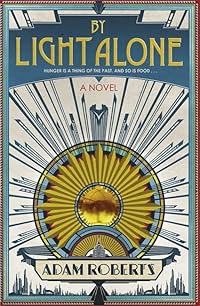
By Light Alone by Adam Roberts

Gollancz, 2011, 407p

 By Light Alone cover

I recently read Roberts’s Stone and was fairly impressed but have so far missed out on his more recent BSFA award nominated novel Yellow Blue Tibia and the earlier quite well received New Model Army. When By Light Alone popped up on this year’s BSFA Awards novel list I decided it was time to sample more.

In By Light Alone global warming has raised sea levels to the extent that a portion of “our” world has been submerged. A wall shields New York from the raised waters. More importantly the Neocles bug has enabled humans to photosynthesise, to be capable of producing blood sugars merely by breathing and drinking water. “Proper” food is scarce, a luxury available only to the rich, who take great care not to be inoculated and differentiate themselves as much as possible form the poor underclass “longhairs” – now kept jobless as there is no need to pay them. These spend hours exposing their fanned hair to the sun for sustenance.

A rich New York family on a skiing holiday in the Caucasus region has their daughter kidnapped. It is nearly a year before she is returned, changed. The novel explores the effects of the kidnapping on all involved. It is divided into four sections, each with a different viewpoint character.

The first and third parts are seen respectively through the thoughts of George Denoone, the father, and Marie Lewinski, the mother. (They are married but she has kept her own name.) The treatment in these two sections is more like a “mainstream” novel than SF. They reveal the pair and their acquaintances to be thoroughly tedious and self-regarding people, and hence fail to engage the reader’s sympathy. Of course they are meant to be aloof, being rich, and to be unwittingly treating their servants with disregard, but crucially we are not made to feel their emotions. It is as if we are seeing them all through a veil. George in particular is an extremely passive and unthinking character, annoyingly so. Indeed so disengaged is he that, in what is effectively an info dump, another character has to explain to him the ramifications of the Neocles bug.

The second section gives us the returned daughter’s viewpoint, which is more immediate and engaging. It is not until the fourth section, though, (pg 261!) that the novel starts to pick up. The focus here is on Issa, a longhair in the Caucasus. Some of this part of the book reminded me in its tonal qualities of Chris Beckett’s The Holy Machine (which is a much better novel.) Even though this section is explicitly tied into the rest at the end – by a connection fairly obvious from the off – overall By Light Alone does not fully cohere, feeling disjointed and unbalanced. It is really four shorter stories juxtaposed; not a unified whole.

I also had some problems with the scenario. Roberts does recognise the need of pregnant women for nutrition beyond mere sugars; indeed he makes this almost a plot point as they take jobs to gain the necessary food to bear a child. The males are presented as useless, not even drones. However, trace elements are necessary for everyone; not just the pregnant. The odd insect or soil which longhairs are said to eat at times would not suffice to assuage this. He also has the longhairs quickly lack energy in the absence of sunlight. Were the process in fact so inefficient it would not be worthwhile. After all plants survive throughout the hours of darkness quite well, their cells respire just as animal cells do. Indeed plants produce surplus sugars – and build them into starch.

Roberts plays on the fact that throughout human history the default state is that of poverty. The plight of the jobless longhairs is presented as an extension of this. (It is hardly Roberts’s fault but a reminder that “the poor are always with us” is not the most uplifting message to be hearing in a time of recession/austerity.)

In addition more attention could have been paid to minor detail. A character named Ysabella has her name spelled in four different ways inside the first twelve pages, though admittedly two of these are diminutives.

Roberts’s explicit referencing, twice, of a certain Arthur C Clarke phrase is a nod to the SF constituency but the SF elements of the book tend towards the perfunctory. While I am all for bringing more rigour in characterisation and the like to the SF novel By Light Alone might perhaps be falling between two stools. I really cannot see it being among the five best SF novels of last year.

Top 50 Gollancz Book Titles

Over at Orion Publishing Group their Gollancz imprint is celebrating 50 years of publishing SF. They’re having a vote to see which of their chosen titles is the best. There are two categories, one for SF, one for Fantasy.

I thought I’d do this as an Ian Sales type meme.

The ones in bold I have read.

Gollancz top 25 SF titles:-

A Case of Conscience by James Blish
Altered Carbon by Richard Morgan
Brasyl by Ian McDonald
The Dispossessed by Ursula Le Guin
Do Androids Dream of Electric Sheep? by Philip K. Dick
Dune by Frank Herbert

Fairyland by Paul McAuley
The Female Man by Joanna Russ (I have now read this.)
The Forever War by Joe Haldeman
Flood by Stephen Baxter
Flowers for Algernon by Daniel Keyes *
Gateway by Frederik Pohl
Hyperion by Dan Simmons
Last and First Men by Olaf Stapledon
More than Human by Theodore Sturgeon
Pavane by Keith Roberts
Rendezvous with Rama by Arthur C. Clarke
Revelation Space by Alastair Reynolds
Ringworld by Larry Niven
Stand on Zanzibar by John Brunner
Tau Zero by Poul Anderson
The Time Machine by H. G. Wells
The Separation by Christopher Priest
The Stars My Destination by Alfred Bester

Yellow Blue Tibia by Adam Roberts (I have now read this.)

* as a short story.

As you can see I’ve read all but five of these.

Gollancz top 25 Fantasy titles:-

Beauty by Sheri S. Tepper
Best Served Cold by Joe Abercrombie
Book of the New Sun (Vol 1&2) (Vol 3&4) by Gene Wolfe
The Book of Skulls by Robert Silverberg

Conan Volume One by Robert E. Howard
Dead Until Dark by Charlaine Harris
Elric by Michael Moorcock
Eric by Terry Pratchett
Fevre Dream by George R. R. Martin

The Final Empire by Brandon Sanderson
The Forest of Hands and Teeth by Carrie Ryan
Graceling by Kristin Cashore
Heart-Shaped Box by Joe Hill
I Am Legend by Richard Matheson
The Lies of Locke Lamora by Scott Lynch
Little, Big by John Crowley
Lud-in-the-Mist by Hope Mirrlees
Memoirs of a Master Forger by William Heaney
Mythago Wood by Robert Holdstock
The Name of the Wind by Patrick Rothfuss
The Runes of the Earth by Stephen Donaldson
Something Wicked this Way Comes by Ray Bradbury
Tales of the Dying Earth by Jack Vance
Viriconium by M. John Harrison
Wolfsangel by M. D. Lachlan

Only seven from the Fantasy list, though.

For what it’s worth I voted for Keith Roberts’s Pavane and Little, Big by John Crowley.

free hit counter script