Posted in Trips, Wild Life at 20:30 on 13 March 2022
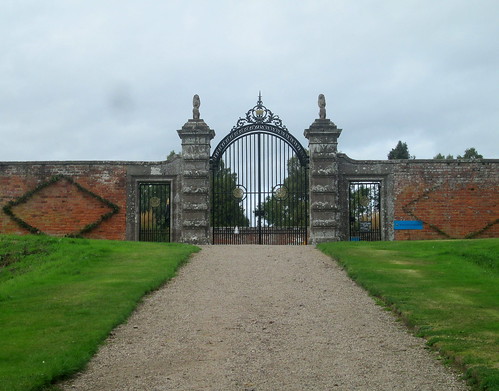
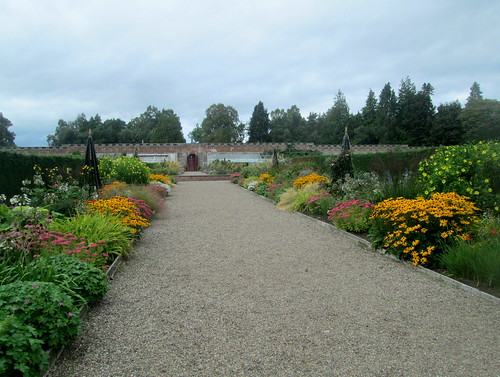
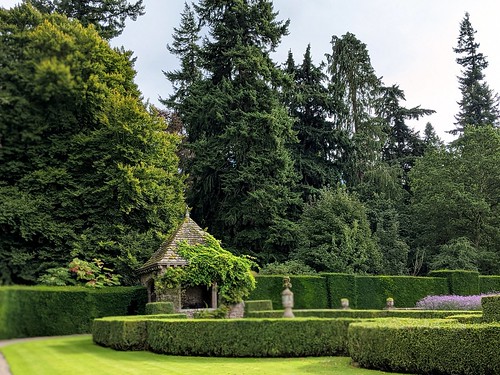
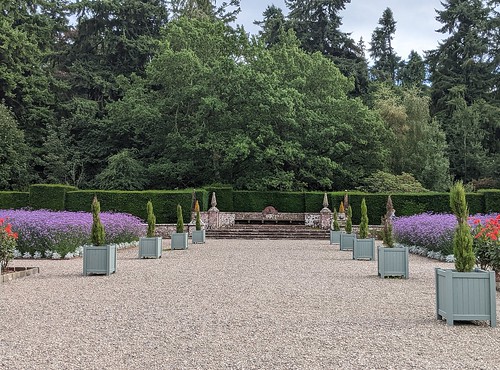
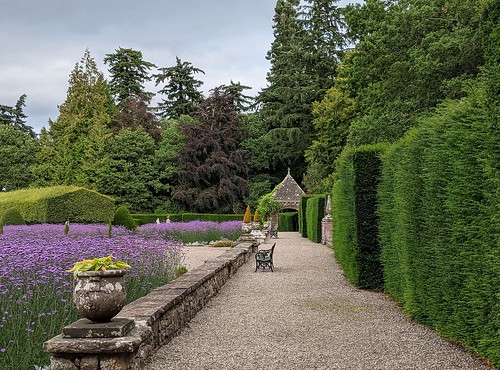
There are two formal gardens in the grounds of Glamis Castle.
Walled garden gateway:-
Walled garden interior:-
Italian garden entrance:-

Italian garden interior:-

Glamis Castle from Italian garden:-

Fountain in Italian garden:-

Italian garden and trees:-
In the castle grounds we found this “fairy ring” of fungi:-

Colourful fungi:-

Thee’s a frog in this one just below left of the leftmost mushroom:-

No Comments »
Posted in Bridges at 12:00 on 12 March 2022


Closer view:-
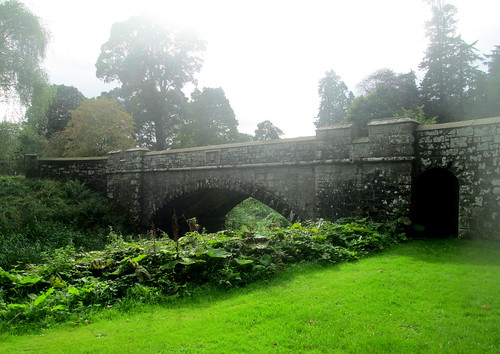
Reverse view:-

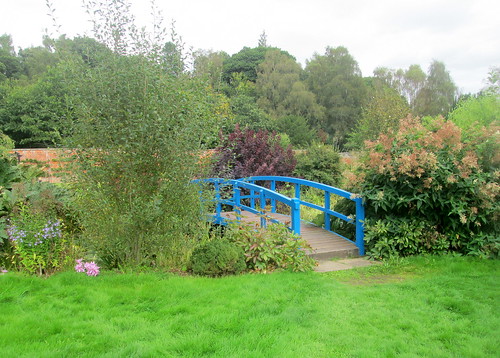
Japanese bridge in the walled garden:-
Iron Balustraded Bridge in Glamis Castle Grounds:-

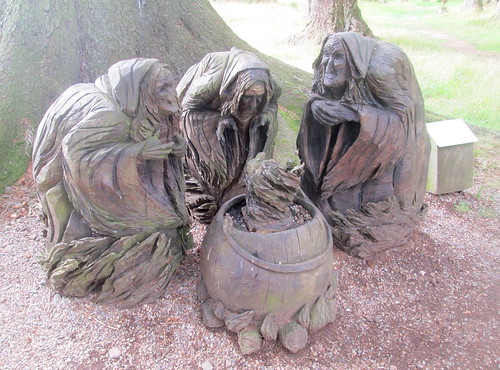
Three Witches Wood Carving:-
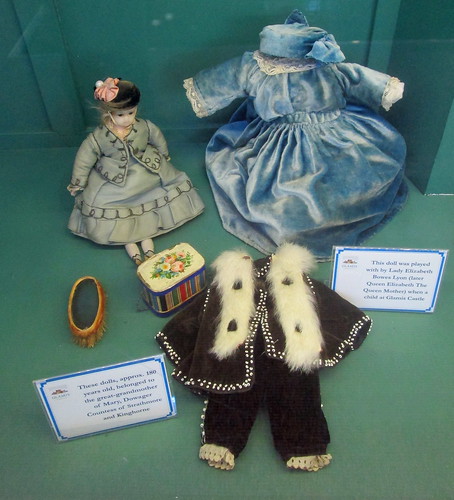
I forgot to put in my last post about Glamis these dolls, played with by the late Queen Mother, Elizabeth Bowes-Lyon:-
No Comments »
Posted in Architecture at 12:00 on 10 March 2022
I forgot to include this photo of Glamis Castle’s Billiard Room in my previous post:-

Despite the castle never having been built as a stronghold this intertnal door is still pretty sturdy:-

View through door to china collection:-

Powder Room. I forget now if this was used for storing gunpowder or it was the US meaning. The former I should think:-

After the tour of the castle proper comes a set of exhibition rooms with various exhibits.
Countess of Strathmore’s Wedding Dress:-

Information on Countess of Strathmore’s Wedding Dress:-

Doll’s’ House. I believe this was played with by Elizabeth Bowes-Lyon, later to be Queen Consort and Queen Mother:-


During the 1715 Jacobite Rebellion James III, as they knew him, but called the Old Pretender by Hanoverians, spent the night in Glamis Castle. He left his watch behind:-

World’s oldest tartan:-

Dolls in Glamis Castle. The taller one on the right here is in the image of the young Elizabeth Bowes-Lyon:-

2 Comments »
Posted in Architecture, Art Deco, Trips at 12:00 on 6 March 2022
This is apparently the room the Queen Mother used when she visited her childhood home at Glamis Castle as a young married woman. It is kept as it was in those days:-
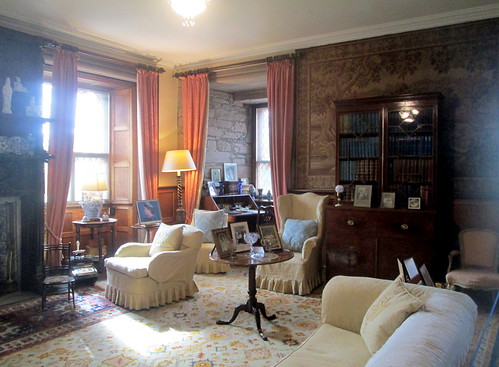
Fireplace and chairs used by the Princesses Elizabeth and Margaret Rose:-

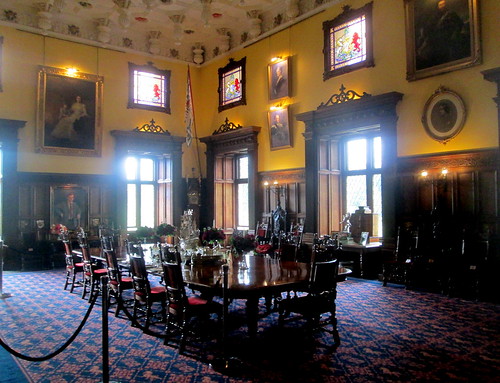
Dining Room, note armorial stained glass:-
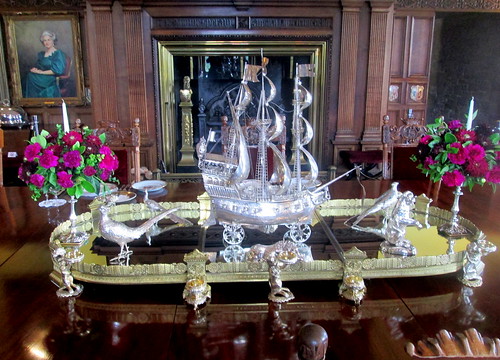
Dining Room centrepiece:-
Cupboard in Dining Room:-

Model of RRS Discovery the original of which can now be found in Dundee:-
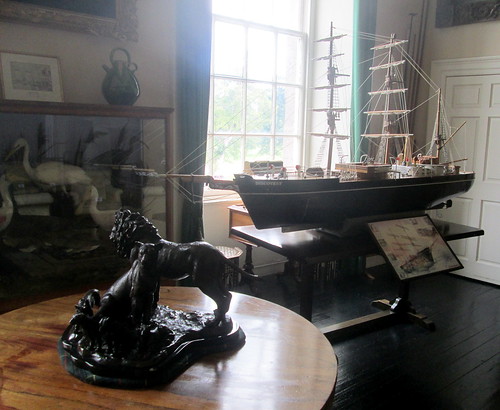
Drawing Room. The large painting is by Jacob De Wet:-

Drawing Room fireplace:-

Note again small chairs as used by the Princesses:-

Fireplace in Billiard Room:-

Lovely Art Deco cot used by Queen Elizabeth II when she was a child. And a nice rocking horse:-

No Comments »
Posted in Architecture, Trips at 12:00 on 3 March 2022
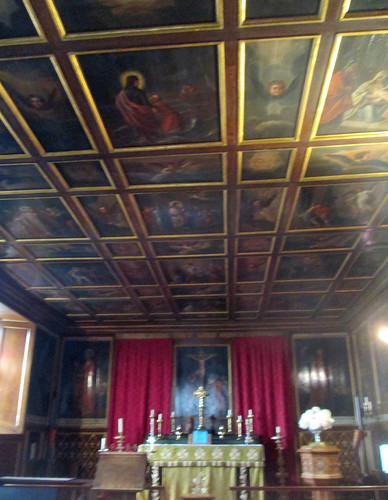
As is common with stately homes, Glamis Castle has some sumptuous ceilings.
Drawing room ceiling:-
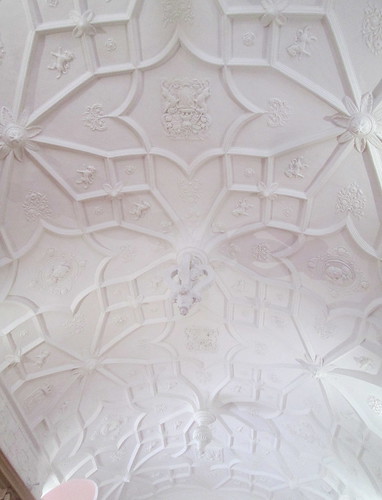
Dining room ceiling:-

Chapel ceiling and altar:-
Curiously, one of the first rooms on the tour is the Crypt Armoury:-

Stained glass coat of arms:-

Stairs and antlers:-

No Comments »
Posted in Architecture at 12:00 on 1 March 2022
Glamis Castle is one of Scotland’s most iconic. It’s not a castle in usual sense. It wasn’t built as a stronghold and has never suffered seige. It is perhaps most famous for being the childhood home of Elizabeth Bowes-Lyon, who married Prince Albert, became Queen Consort on his accession after the Abdication and so Empress of India and of course gave birth to the present Queen of the United Kingdom (and may other territories besides.)
The castle has avery long drivewat up to it from Glamis village.
Glamis Castle from end of driveway approach:-

The car park is round the back. Glamis Castle from Car Park:-

This fountain-like structure is on the grass opposite the castle:-

This photo was taken several yaers ago when we visited the grounds only:-

There are extensive grounds to the side and rear of the castle. Glamis Castle from east:-

In one of the exhibition areas inside there was this model of the castle which also shows its extent:-

2 Comments »
Posted in Trips, War Memorials at 12:00 on 20 February 2022
Kirriemuir, in Angus, Scotland was the birthplace of playwright and creator of Peter Pan, J M Barrie.
It’s a nice wee town, north of Dundee and a few miles away from Glamis and its Castle which was the childhood home of the late Queen Mother, Elizabeth Bowes-Lyon. (I posted a photo of the War Memorial for Glamis village, on which is the name of her brother, as the Honourable Fergus Lyon, here.)
Many of its buildings are constructed from red sandstone:-


In the centre of the town there is of course a statue of Peter Pan:-

Barrie’s birthplace is now in the hands of the National Trust for Scotland. The family lived in a room and kitchen on the first floor.

In a house like this the kitchen is a largish room with a cooking range of some sort and usually what is called a bed recess, which is an alcove designed to fit a box bed into. Probably all the kids in a family would have slept in that bed. Today a kitchen like that would be described as a ‘family room’ as it was multi functional. The ‘room’ usually had a bed recess too and the parents slept in that one. Sometimes the ‘room’ doubled up as a sort of parlour during the day. There were eight children in the Barrie family and what with all of them and the noise of the weaving looms on which his father worked, it must have been a bit lively.
The entrance doorway is round the back:-

Just across form the entrance is a washhouse which was J M Barrie’s inspiration for the Wendy House in Peter Pan.

There’s not much light in there but you can see the tub, basket and washboard:-

Barrie never forgot his origins. One of his brothers died young and he used this as the genesis of the idea for the ‘boy who never grew up.’ Barrie’s mother could not get over her loss and he himself felt pressure to live up to her perfect memory of his dead brother. Despite his subsequent fame and fortune he was buried in the family plot in Kirriemuir Cemetery (which is up a fairly steep hill from the road leading east out of the town.)
Barrie’s grave. The plaque saying ‘J M Barrie Playwright’ is reasonably new. When I first visited there the grave’s surroundings were much plainer:-

1 Comment »
Posted in War Memorials at 17:45 on 14 October 2012
This is the War Memorial in Glamis village, near to the entrance to Glamis Castle, a bit north of Dundee. Very dignified and well proportioned.

The main plaque gives the names of the fallen in the Great War.

Noteworthy here is the top name, Captain The Honourable Fergus Lyon. They probably didn’t have room to write Bowes-Lyon. He was the brother of the late Queen Mother, Elizabeth Bowes-Lyon, wife of George VI, mother to the present Queen Elizabeth. She was brought up at Glamis Castle. His loss is supposed to have affected her greatly and is said to be the reason why she placed her bridal bouquet on the tomb of the unknown soldier in Westminster Abbey as she entered before the ceremony.
The names are given in order of military rank. Glamis is a very small place, for there to be so many names implies the memorial encompasses the surrounding area and emphasises the casualty rates in World War 1.
By contrast the other plaque, for 1939-45, has only five names. (This disparity in numbers is reflected in War Memorials up and down the land. In World War 1 Britain and its empire carried the main Allied burden of the war from approximately mid 1916 up to mid 1918. Certainly after the French Army mutinies of 1917 till the arrival of US troops in earlyish 1918, and arguably after. In World War 2 the bulk of the fighting took place in the USSR and the Pacific, areas where the British Empire presence was less influential.)

Though the order here doesn’t follow military rank (the fourth name is preceded by GNR, presumably a General) it seems to follow the social one but is otherwise alphabetical.
First named is Captain The Honourable John Patrick Bowes-Lyon, Master of Glamis.
The Master of Glamis!
This was a time when we really were all in it together. His status as Master of Glamis didn’t stop him serving, nor being killed in the war.
No Comments »
