Braking Day by Adam Oyebanji
Posted in My ParSec reviews, Reviews published in ParSec, Science Fiction, Scottish Fiction at 12:00 on 8 February 2023
Jo Fletcher Books, 2022, 365 p. Reviewed for ParSec 3.
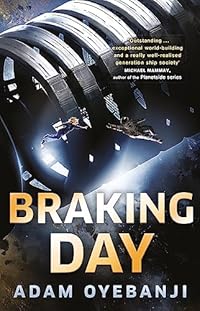
Every once in a while someone reinterprets an old SF trope, as if to show that newness isn’t necessarily a be-all and end-all, that even the hoariest of SF concepts can be dealt with in an altered light. Here, Oyebanji has taken the idea of the generation starship, stirred up its components and laid them out in a new configuration. And the result is something which for long-time readers of SF is almost nostalgic, but also verges on perfect.
The inhabitants of the Interstellar Space Vehicle Archimedes are onto the seventh generation on board but the ship is nearing its destination star Tau Ceti, and Braking Day is imminent. Lending distinctiveness to Oyebanji’s vision the ship has an unusual construction, between the forward shielding and the, for now silent, drive engine to the rear its body is made up of wheels named after old Earth countries, each rotating to produce artificial gravity but at different rates and in a contrasting direction to its neighbours’. Another divergence from the generation starship norm is the employment of those lift-like conveyances known as paternosters for movement between levels within a wheel.
Archimedes and its fleet companions Bohr and Chandrasekhar fled an Earth under the control of AIs with the (somewhat convoluted) acronym of LOKI, loosely organised kinetic intelligence, each “capable of reconfiguring itself as it learns and remembers” – dangerous both in and of themselves but also to their potential vulnerability to hacking. On board, these are anathema – unlike the implants all the ships’ inhabitants have inserted as children to allow them access to the hive and its information. Nevertheless the ship’s society is fairly rigidly stratified by occupation, especially between officers and crew, but its organisation means there is little but petty crime and there has been no conflict as such for generations.
The viewpoint character is Ravinder T MacLeod, whose family is a traditional thorn in the officers’ side but who is training to be an engineer and is the butt of remarks about his origins and frequently scruffy appearance. Water is a precious resource and used as a currency and his lowly status ensures he goes from one pay day to the next trying to conserve it. A trip to the officers’ wheel, Australia, where water abounds, marks a huge contrast between his existence and theirs. His best friend in training, Vladimir Ansimov, is also of humble background but his main companion is his perennially rebellious – albeit in a relatively minor way – cousin Roberta, known as Boz, a coding wizard. Her habitual smoking of cigarettes annoys Rav not only since it’s against ship regulations but also because he knows how knackered the recycling systems are. He takes a fancy to fellow trainee Sofia Ibori, unattainable due to her high-ranking lineage.
There is some dissent in the fleet in the form of a group known as BonVoyagers, who wish not to contaminate the Destination World as their ancestors did Earth but instead hope to journey the spaceways forever. Unlike the invocation of the ship’s name in the favoured expression of exasperation, “for Archie’s sake,” shipboard slang – sarding, gullgropers – is a little cloying at first but later contrasts effectively with usage on another ship.
Enough scope there you might think for any novel, but Oyebanji has still more for us. For a while it feels like he might even be about to give us a ghost story as down in the deepest part of the ship’s engines where Ravi has been sent on a repair job he hears a tapping sound which seems to be coming from outside the hull. On peering out of a porthole he sees a woman with dyed hair – something never seen on board – but also apparently impossible as she has no space suit. Blink and she is gone but he glimpses her the next day on one of the companionways. Ravi also begins to experience a recurring dream (or a recurring start to one.) In addition, memories that are not his and where the name indicators for genders appear to be reversed intrude into his consciousness. There is, though, a rational explanation for these events.
Further elements of mystery are added when Ravi sees the Captain and Chief Engineer examining an underfloor duct, he feels the drive turned on at low power late at night, discovers adaptations to the ship’s hull where rudimentary weapons have been attached, Boz is conscripted to devise software for a torpedo and the fleet is set to silent running. Something is out there and it is a threat.
Not the least of Braking Day’s pleasures is that its characters are rounded, with entirely human hopes, fears, motivations and flaws – and it is superbly plotted. Along the way Oyebanji conveys the attitudes imbued by growing up in a specific environment when Vlad compares the safety of shielding, bulkheads and life support to the exposure of life on a planet right next door to a star, with an atmosphere likely to be stripped away at any moment, and rhapsodises on the fifty square metres on Destination World he might enjoy – an almost unimaginably (to him) large amount of living space. Oyebanji makes this all real for us. This feels like how life on such a starship would be.
There is conflict here to be sure, even ordnance being set off, but what a pleasure it is (an unusual pleasure these days) to read an SF novel whose protagonists’ first resort is not to violence but to talking, diplomacy if you will. I doubt I’ll read a better SF novel this year.
Pedant’s corner:- When a chapter begins with a piece of dialogue the opening quote mark is missing, Petrides’ (Petrides’s,) Archimedes’ (Archimedes’s,) maws (these were mouths, not stomachs,) a missing comma at the end of a piece of dialogue, another at the beginning of a different piece, “the quiet whirr of power tools did their job” (whirr is singular, the pronoun ought to be too, ‘its job’, but then the sentence would need rejigged, ‘there was a quiet whirr as power tools did their job’,) andnightclubs (needs a space,) crewman (not crewmember, I note,) Outside the ship there are bits of ice on the superstructure. Since water is a currency on Archimedes these would surely be harvested, but in any case, exposed to vacuum would more likely sublime away before that could be done,) also drones for working outside the hull expend puffs of vapour as they manœvre, surely a waste of precious resources. “‘It’s has to be’” (It has to be,) “waiting for answer” (an answer,) “with the all the ship’s barristers” (that first ‘the’ is unnecessary.) “None of them were easy” (None of them was easy.) “He heard her a yell” (He heard her yell,) “of what had had once been” (only one ‘had’ needed,) grill (grille,) the Newton crewman (was a woman.) “If worse came to worst” (in my youth was always ‘if the worst came to the worst’.) “The cloud of numbers surrounding Ao Qin were already changing configurations.” (The cloud of numbers surrounding Ao Qin was already changing configuration’,) “theBohr” (needs a space,) “the use drugs to lower heartrate” (the use of drugs; heart rate,) “by LOKI’s” (LOKIs,) “‘you wanting it to different’” (it to be different.) “‘But,, sir –’” (has a comma too many.)