Posted in History, Museums at 12:00 on 26 May 2021
The codebreakers at Bletchley Park were indebted to the Polish secret service for helping break the Enigma code and for smuggling an Enigma machine to them just as war broke out.
At the entrance to the courtyard of houses seen in yesterday’s post lies a memorial to three of these Polish contributors. In Polish and English it commemorates, “the work of Marian Rejewski, Jerzy Różycki and Henryk Zygalski, mathematicians of the Polish intelligence service, in first breaking the Enigma code. Their work greatly assisted the Bletchley Park code breakers and contributed to the Allied victory in World War II.”


Nearer the main museum building is this memorial to those who worked at Bletchley Park. The letters read, “WE ALSO SERVED.”

Reverse of memorial:-

No Comments »
Posted in History, Museums at 12:00 on 23 May 2021
A couple of the exhibits at Bletchley Park related to the film Enigma. (I see from that link that the model submarine used in the film was also donated to Bletchley Park. This may be the model which is near the car park and can be seen in the third photo in this post.)
Austin 18 Ambulance:-


Sunbeam Talbot (note “blackout” headlights):-


As I recall this Packard saloon car was used by Bletchley operatives if they had to travel about the country. A lot of the messages from listening stations were carried to Bletchley by motor bike – see photos on the wall behind the Packard:-

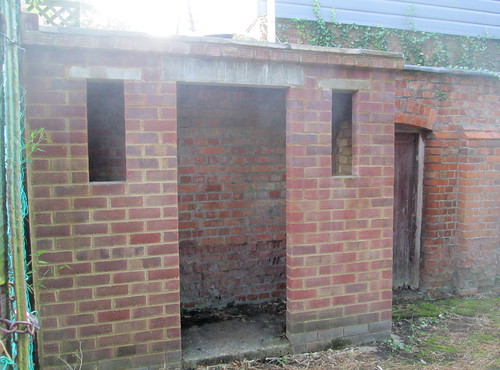
This is one of the sentry boxes where the despatch riders would have to check in:-
No Comments »
Posted in History, Museums at 12:00 on 20 May 2021
Most of the work at Bletchley Park was carried out in huts.
Hut corridor:-

Room with security reminder poster:-

The famous “Careless Talk Costs Lives” slogan and First Aid box:-

Another room in one of the huts:-

Alan Turing’s office:-


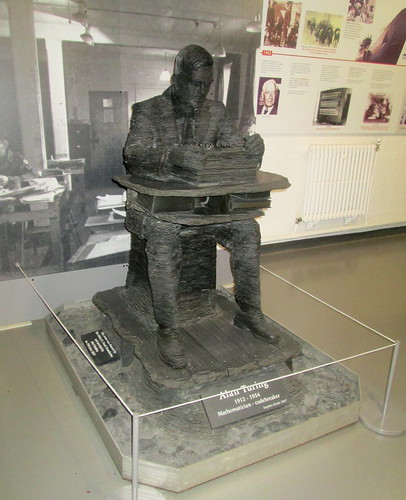
Statue of Alan Turing, made in slate. (This is situated in the main building, where most of the Enigma machines are displayed.)
No Comments »
Posted in History, Museums at 12:00 on 16 May 2021
Most of the endeavours at Bletchley Park were devoted to the decipherment of messages encrypted by machine – most famously the Enigma; but others were more imprortant to crack
An Enigma machine:-

Enigma machine with explanation:-

A cabinet of Enigmas:-


Remains of a Hungarian Enigma machine dug up from the earth somewhere in Europe:-

4 Rotor Enigma machine:-

Enigma + diagram:-

Hagelin Encryption Machine, Italian Naval cypher machine. Plus a German hand cypher sheet:-

The enigma was cumbersome to use, requiring three operators, the typist, the noter down and the telegraphist – and required a similar number of personnel at the receiving end.
The Germans began to produce more complicated machines – with more encryption rotors and a faster transmission system.
Lorenz T 32 Encryption Machine. Amazingly Bill Tutte managed to work out how this machine worked only from the form of the messages it encrypted:-

Siemens & Halske T52 Cypher Machine. Messages were typed in and encrypted automatically then transmitted by teleprinter to be decoded by the reverse machine at the other end. (The use of ordinary teleprinter letter encoding in this system was a weakness that the decoders were able to exploit):-

No Comments »
Posted in History, Trips at 12:00 on 11 May 2021
This notice records the Bletchley Park’s staff’s feelings at first decoding an enigma message:-

This is a replica bombe, the proto computer used to find ‘matches’ for Enigma encoded messages, leading to their decoding.

Every five minutes or so the replica simulates the operation of the originals. It’s very noisy. One of the huts elsewhere on the site housed several of these machines. Imagine the din!:-

Colossus was the first electronic computer; used at Bletchley Park to help decode enemy messages:-

1 Comment »
Posted in History, Museums, Trips at 12:00 on 8 May 2021
Bletchley Park near Milton Keynes (very near) is famous for the codebreaking efforts of its occupants during World War 2.
As a museum though it is so much more. It is one of the best I have ever visited. We spent nearly the whole day there.
And it is not devoted merely to the breaking of the Enigma (and related) WW2 codes.
The recommended route through on our (Covid distanced) trip took us first into the section covering Bletchley Park’s Great War predecessor – the famous Admiralty Room 40.
An amusing exhibit was this one of a magazine Room 40’s denizens produced for themselves to document their activities:-

Room 40’s workers were the “brightest and best”:-
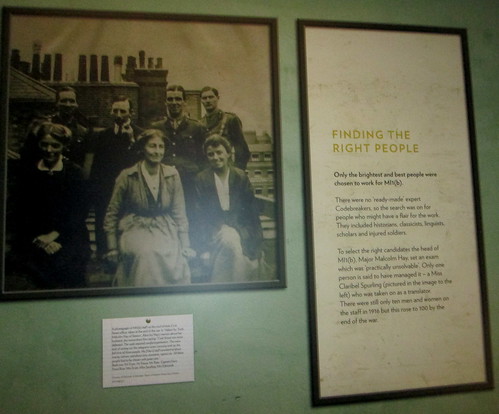
This exhibit lists the members of Room 40 who went on to the Government Code and Cypher School, Bletchley Park’s predecessor:-

I also liked the cover of this book on the Battle of Jutland:-

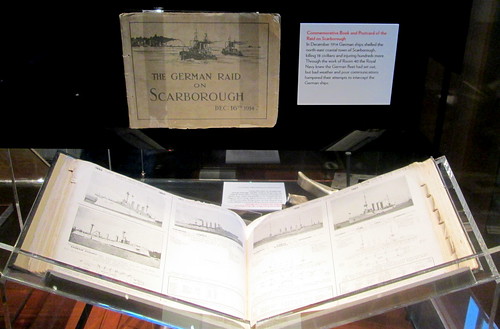
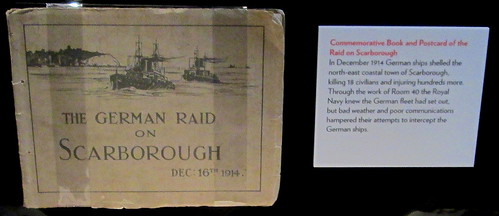
These document the German Naval bombardment of Scarborough:-

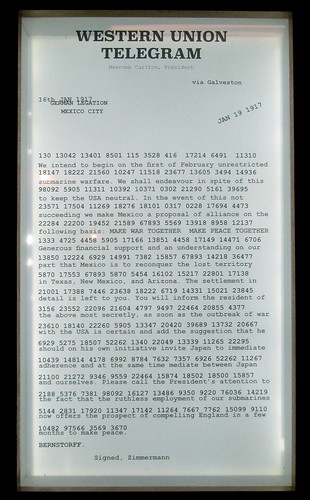
Room 40’s greatest achievement was the decoding of the Zimmerman Telegram:-
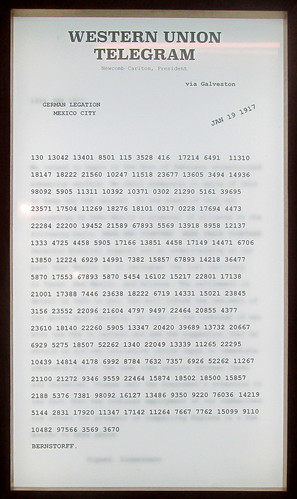
Its contents, with its invitation to Mexico to invade the US and promise to reward it with US territory, were the major reason the US entered the war against Germany.
No Comments »
Posted in Architecture, Art Deco, History, Museums, Trips at 12:00 on 4 May 2021
A lot of the buildings used during the Second World War in Britain had elements of deco style. Not surprisingly, the era had not really passed when the war began.
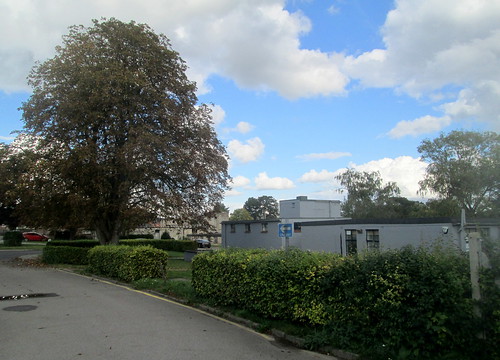
So it wasn’t entirely unexpected that when I rolled up at the car park at Bletchley Park, Buckinghamshire, home of the WW2 British code-breaking effort, last September, the first buildings I saw were in that flat-roofed, Critall-windowed mode.
Buildings by car park. These are the sorts of things you see at former WW2 airfields:-


This submarine model beside the road from the car park to Bletchley Park presumably commemorates the code-breakers’ role in winning the Atlantic war:-

This is a more modern building in that wartime style but I don’t think it’s part of Bletchley Park:-

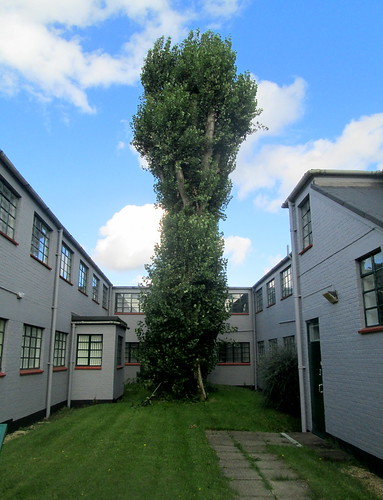
These modernised ones were all inside the Bletchley Park museum site:-

One of the internal exhibits was this photograph of the impeccably Art Deco Hollerith Factory where the calculating machines known as Bombes, which tried out the variations of the intercepted Enigma messages to get a code match were manufactured:-

Hollerith building and interior:-

1 Comment »
Posted in Trips at 17:16 on 9 July 2013
I just realised I had never posted this photo of the statue of Edward Elgar and a representation of Enigma which I took when we were in Great Malvern last year.
Great Malvern was, of course, Elgar’s birthplace.
I did feature his statue in Worcester here.

No Comments »
