The Skeleton Road by Val McDermid
Posted in Reading Reviewed, Scottish Fiction at 12:00 on 24 February 2025
Little Brown, 2014, 412 p
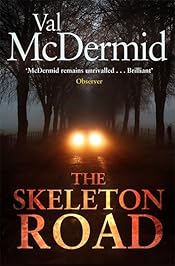 I noticed early on while reading this book how different the style was compared to the same author’s Queen Macbeth, which I read only a week or so before. The prose is much less literary, more utilitarian, with more intrusive information dropping. (Once again I only read this because the good lady had borrowed it from the local library.)
The present-day events of The Skeleton Road are set in the run-up to the Independence Referendum of 2014. (Which seems ancient History now and has no actual relevance to the plot.) Karen Pirie – now a DCI in the newly merged Police Scotland – is still in charge of cold cases but due to the reorganisation her office is now in Edinburgh, not Kirkcaldy, necessitating a commute across the Forth Road Bridge.
When an eight-year-old skeleton is discovered hidden in a roof turret on the crumbling John Drummond building in Edinburgh a hole in its head makes it obvious it was murder.
In the meantime the International Criminal Tribunal for the Former Yugoslavia is shaken up by its new boss’s determination to find the identity of the person going around killing the perpetrators of atrocities not yet – and not now (in the 2014 of the book) likely to be – brought to justice. Suspicion falls on former Croatian General Dimitar Petrovic who disappeared around the times these murders started. His wife, Oxford Professor Maggie Blake, in the absence of any other explanation, always assumed he had returned to his former existence in Croatia.
Thus DCI Pirie is launched into an investigation which will reveal to her more horrors about the Balkan Wars of the late twentieth century than she might have wished.
This is not really a surprising subject for McDermid to take on. After all, the first shot of those most recent Balkan Wars was fired in her home town of Kirkcaldy.
It is not hard for the reader to join the dots about the victim. The murderer is initially more of a mystery but a reference about three fifths of the way in rather jumped out.
Crime fiction is how McDermid made her name – and it is what pays her bills – but the contrast between this and Queen Macbeth demonstrates how undemanding the genre can be for a reader (and for its author?) but its consumers can’t seem to get enough of it. And there’s something disturbing about people seeing murder as entertainment.
If the purpose of the fictional detective is to set the world right again after the transgression of the crime, cases such as this give the lie to that assumption of cosiness.
Pedant’s corner:- confectionary (confectionery,) a missing start quotation mark at the beginning of a piece of dialogue, “Dorothy L Sayers’ description” (Dorothy L Sayers’s.) “‘He was as a much a butcher as …’” (He was as much a butcher as …)
 This is the second of McDermid’s Karen Pirie books. I read the first
 “The reception area had been designed with an eye to vomit and violence.” Thus begins this book, which if you hadn’t already known this was a crime novel would certainly have alerted you instantly.
 Richard Papen was brought up in Plano in California, a place he regards as a backwater. Nevertheless, he has made it to an elite college at Hampden in Vermont. His parents were not well off and he feels the contrast between himself and other students there. At first he tries not to be found out, but such things are hard to disguise. After originally being turned down as student of Greek by its professor Julian, Richard comes into the orbit of his rather small and close-knit class cohort, Francis, Henry, Edmond (known as Bunny,) and twins Charles and Camilla. (Those last two names perhaps now have more of a frisson than they would have had when Tartt wrote the book.) Richard overhears the five arguing about a Greek translation and provides them with a neat solution which encourages them to petition Julian to accept him.
 Alison McCoist has been all but shunned in Glasgow’s police after she made a mistake in believing the confession of a man called Knightley to the murder of a young pregnant woman. The real culprit remains at large and DI McCoist – who has enough on her plate already what with her name being similar to a well-known former footballer (‘I’ve heard all the jokes already’) and only seeing her twin children under access conditions at weekends – is as a result widely thought to be on the take.
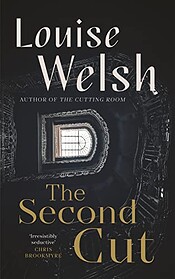 This one was published twenty years after Welsh’s first novel
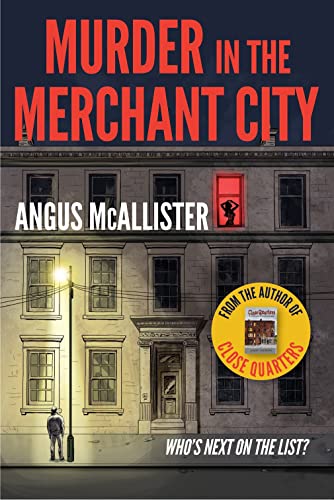 The book’s title perhaps says it all – there are murders, some scenes are set in Glasgow’s Merchant City – but is a trifle misleading. The action centres not on the Merchant City itself but on the so-called Merchant City Health Centre, a massage parlour – and an establishment with all the connotations that description of a business inevitably invokes. This is staffed by women in white coats – at least until they take them off to get down to offering extras. The most important of these to the plot are the beautiful Miranda, with the beaming smile and that way of saying, “How are you?” to her regulars, no nonsense up-front Claudia, the conventionally attractive Candy, the more homely in style Annette, and new girl Justine.