Descent by Ken MacLeod
Posted in Alan Warner, Iain (M) Banks, Ken MacLeod, Read Scotland 2014, Reading Reviewed, Science Fiction at 11:00 on 5 May 2014
Orbit, 2014, 407 p.
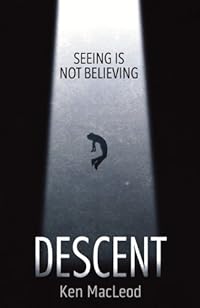
This book is dedicated to the memory of the author’s close friend, Iain (M) Banks, and may be considered as a tribute. It is topped and tailed by two of the protagonist’s dreams, titled respectively 0.1111 Recurring and 0.2222 Recurring. The first of these is very Banksian in tone.
Some time in the near(ish) future Ryan Sinclair and his friend Calum, who has a more demotic form of speech than Ryan, have a close encounter with a strange silver sphere in the hills above Greenock. Ryan thereafter experiences dreams/memories of the classic UFO alien abduction scenario. Calum does not. Both are subsequently visited by mysterious strangers – in Ryan’s case a man calling himself the Reverend James Baxter, a literal Man in Black. Thereafter Baxter figures intermittently throughout the novel. (Quite why MacLeod used the name of perhaps Scotland’s most famous footballer for this character is obscure; to me at least.)
Descent contains simultaneously an exploration and a debunking of the UFO abduction story but is also much more than this. Calum tells Ryan a family history about uniqueness and distancing. In his later life as a freelance science journalist, Ryan uncovers evidence, through fertility statistics, of speciation occurring within humans. This affects Ryan’s life directly in his relationship with Gabrielle, one of Calum’s relatives, whom he meets at a wedding. While Ryan is busy with his Highers* a worldwide change in economic arrangements called the Big Deal saves capitalism from itself by instituting what Calum refers to as a kind of socialism (but if it is, it is very dilute.) The pre-Big Deal revolutionaries evaporate away in this new dispensation where jobs are more abundant, while silver airships and smart fabrics make their appearance. Otherwise people’s activities, drinking, vaping (presumably of e-cigs,) buying, selling, work and relationships are more or less as we know them now. The UFO aspect of his story allows MacLeod to have some fun with government’s response to such manifestations.
The early scenes set in Greenock bear some similarities to Alan Warner’s The Deadman’s Pedal. Both novels have at their start a sixteen year old protagonist, a West of Scotland seaside town setting, a sudden attraction to a girl. The writing of the two novels is comparable also. Descent is a different beast altogether, however. While Warner’s book dealt with politics only obliquely MacLeod has always been a writer whose interest in political ideas has been foregrounded in his fiction. He never lets it get in the way of the story but his engagement with politics is distinctive among SF writers.
In character terms Descent deals with betrayal, revenge and redemption. While the SF elements are necessary to the plot, they could be considered as trappings, scaffolding on which to build the human story.
A nice touch was the inclusion of the phrase, “Gonnae naw dae that,” made famous in Scotland by the TV series Chewin’ the Fat.
*A Scottish educational qualification (originally the Higher School Leaving Certificate) and roughly equivalent to A-levels, but undertaken over one year.) Nitpick:- page 84 refers to Calum excelling at O-level technical drawing. O-levels were not a Scottish examination. Some Scottish schools did enter their pupils for them but I doubt that happened in Greenock. Nor will it. The Scottish equivalent, O-grades, were superseded in the 1980s by Standard Grades, which in their turn have this year been replaced by National 3, 4 and 5 qualifications. O-levels were replaced in England by GCSEs from 1988.


