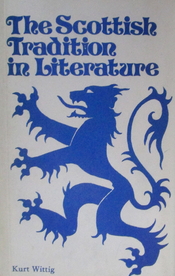
The Mercat Press, 1978, 304 p, including ii p preface, ii p contents. A facsimile of the 1958 edition.
On the surface it seems a little odd that a book on Scottish literature should be written by a German but Wittig’s second sentence begins, “Scottish literature is part of our European heritage.” He goes on to say he does not wish to erect an invisible barrier that would isolate it from “the larger world to which it inseparably belongs,” but nevertheless, “We must do the literature we are studying the honour of recognising that it has both ‘a local habitation and a name.’” He notes, “Deep down in the heart and mind of many Scotsmen there is a kind of schism arising out of the clash of his conflicting loyalties,” but stresses that “someone from outside can distinguish between the typical and the specific.”
Wittig’s starting point for the Scottish tradition is John Barbour’s epic poem The Bruce, which is, he says, without parallel in the Middle Ages, finding its neglect by scholars (of whatever stamp) truly astonishing. The Bruce predates Chaucer’s great poems and its theme that knightly virtues are of no account unless supported by the ideals of “fredome” and “richt” – ‘A! Fredome is a noble thing!’ – sets it apart from its contemporaries. Barbour is the “first of a long series of Scottish writers who seem not only to be on terms of an informal intimacy with God (or the Devil), but even to be disposed, on occasion, to argue with him. No wonder that the Scottish people were later to find the spirit of the Reformation so congenial.”
Since it manifests itself in pre-Reformation works (of which – William Dunbar’s “Lament ‘Quhen he was sek’” (aka “Lament of the Makars”) with its Timor mortis conturbat me refrain apart – to my shame I was mostly unaware) it would seem therefore that the gloomy prognostications and demeanour of Scots (“the mistrust even of happiness”) are not so much derived from Calvinism but are much more deep-rooted, part of the character induced by harsh, dark winters and the sair fecht of scratching a living from the land. It’s almost as if Scots were marking time till a belief system to embody their experience came along; and thereupon embraced it with masochistic fervour.
Barbour also employs what Wittig identifies as a typical Scottish trait; understatement, particularly in regard to the emotions, and he possessed a keen enjoyment of sense impressions. In Robert Henryson he notes, “genuine emotions of the soul are rather suggested than expressed, but the airs men give themselves are heightened to grotesquerie.” Such sense impressions, personification, or animism – visualisation – is another thread that Wittig discerns in the Scottish tradition. Others include alliteration, an intense economy of expression. He notes that much Scottish poetry is interlinked with music, using traditional metres, often very complicated, internal rhymes, frequent refrain on a thematic word.
After Gavin Douglas – the last of the Makars – and David Lyndsay this spring tide, as Wittig puts it, of the tradition begins to ebb and Scots as a language began to diminish in importance and scope. While the Union of the Crowns meant the old cultural ties with France were cut, more significantly the printing presses were in London and, perhaps crucially, the Bible, and therefore the word of God – in Church and elsewhere – was in English and so English came to be associated with serious, dignified subjects. As a result “‘guid hamelie Scots’ seemed unfit for higher and more intellectual purposes.” In the meantime the Scottish Ballads – “A Treasure-trove” – helped to keep the language alive.
A resurgence came in the eighteenth century with once again as in the Makars an expansion of the language and its uses. This reached a “High Water Mark” with Robert Burns and Walter Scott before tailing off again. In the twentieth century “Another Spring” had its highlights in Hugh McDiarmid, Lewis Grassic Gibbon and Wittig’s prime exemplar Neil M Gunn.
Wittig emphasises the cross fertilisation of Scots with Gaelic. The two languages existed side by side for centuries, even at court. Many Scots sentence constructions have their roots in Gaelic which, according to Alexander MacDonald, is supreme over all other languages, “strong, fluent, copious, resonant, and so forth” but in the main “it is the one language in which, since the Tower of Babel, bard or satirist can scold best. Modern Scottish speech, too, is often said to be unsurpassed for deflating an opponent.” It is especially apparent in poetry, “The chief respects in which Scots differs from English poetry are that it shows a stronger feeling for colour (and for other sense impressions); imagery is sharper and more detailed, it is capable of greater metrical complexity, is apter to personify inanimate objects, takes a keener interest in nature, is full of the spirit of clannishness, and makes a speciality of flyting and extravaganza,” all features, Wittig says, even more strikingly characteristic of Scottish Gaelic poetry.
Wittig states that, “Perhaps no other European literature is so dramatic” yet contrasts that with the lack of Scottish drama, a delicate, developing flower at the time he was writing. Nevertheless quoting James Bridie (Dr O H Mavor) “we cannot perceive the Universe except as a pattern of reciprocating opposites.”
The Scot displays “sometimes an aggressive spirit of independence or egalitarianism,” and is adept at the art of flyting, a contest consisting of the exchange of insults, often conducted in verse, between two parties. Then again the mediaeval Scots proverb has it that, “nippin and scartin’s Scots fowk’s wooin.” “The Scots as a nation are passionately addicted to argument.” “The Scots argue not to find a compromise but in order to disagree, to make their point, to assert their rugged independence and individuality. It is an innate tendency to challenge blind acceptance.” Disputatious for the sake of it, “the fervid Scottish delight in arguing – with themselves if no other opponent is available – ” is prevalent in the works of Scott, the first Scottish writer who endowed landscape with a life of its own to the extent of making it one of the protagonists in his novels. (Wittig’s italics.) Landscape in Scott is much more than mere background, it is a formative influence.
James Thomson the younger wrestled with sin and guilt, and repeatedly saw himself as two separate personalities: “I was twain,/Two selves distinct that cannot join again;/One stood apart and knew but could not stir” typical of the emotional and intellectual dualism of Scots – the “Caledonian Antisyzygy” – which may have arisen due to coming to use one language to express thought, another to express feeling.
In the context of why a Scots tale seems to need a sharply portrayed character to tell it Wittig quotes Robert Louis Stevenson as saying, “the English speak with less interest and conviction, while the Scot puts his whole personality into it” and asks, “Is there any such thing as an absolute detached prose in Scots? Is it indeed, possible?”
Wittig occasionally casts aspersions. He calls William McGonagall the “shabbiest of public-house rhymesters” and says that here it is “not rock-bottom that we touch…. that would suggest something solid; with him, poetry is irretrievably sunk in mire,” while John Buchan’s English verse “reads like exercises in a foreign language.”
He notes how many Scots poets do not mention the sea at all. Neither do most writers of prose. (This may well, though, be related to the lack of fishing till well on in the eighteenth century.)
Drink is “a gateway to a new kind of world that provides distortion, new perspectives, and surprising insights.” Wittig says, “I do not know of any other country in which is found a similar attitude to drink: but when Magnus Merriman speaks of this violent Scotland with its hard drinking as a country worth living in and refashioning it reminds me at once of several Scottish acquaintances, poets and others.”
J Leslie Mitchell (Lewis Grassic Gibbon) produces the effect of a “reality that is both subjective and communal. This is the culmination of the inherently dramatic character of Scots, for all the time somebody is imagined to be speaking – or letting his thinking become audible – though his identity may not be specified.” A person can view himself as “you.”
This is a magnificent book. Wittig’s knowledge of his subject appears encyclopaedic, his insights are sharp, his advocacy of the existence of such a thing as a Scottish tradition in literature and his demonstration of its importance and enduring relevance a stirring redress to those who would claim otherwise.
Pedant’s corner:- Reflexion (reflection,) connexion (connection,) medieval, irreverance (irreverence, which appears four lines later!) simplyc alled (simply called,) for convenience’ sake (convenience’s sake,) sublter (subtler,) Blaweary (Blawearie.)