Archives » Ian McDonald

Planesrunner Update

Planesrunner cover

My review of Planesrunner by Ian McDonald has been delivered to Interzone.

A full month ahead of deadline as it happens.

It won’t see the light of day for a couple of months, though.

Locus 21st Century Poll

Following on from the Locus 20th century polls I posted about a few days ago this is their list for SF novels published from 2000 on.

1 Scalzi, John : Old Man’s War (2005)
2 Stephenson, Neal : Anathem (2008)
3* Bacigalupi, Paolo : The Windup Girl (2009)
4 Wilson, Robert Charles : Spin (2005)
5 Watts, Peter : Blindsight (2006)
6* Morgan, Richard : Altered Carbon (2002)
7 Collins, Suzanne : The Hunger Games (2008)
8 Gibson, William : Pattern Recognition (2003)
9* Miéville, China : The City & the City (2009)
10 Stross, Charles : Accelerando (2005)
11* Mitchell, David : Cloud Atlas (2004)
12* McDonald, Ian : River of Gods (2004)
13 McCarthy, Cormac : The Road (2006)
14* Harrison, M. John : Light (2002)
15= Willis, Connie : Black Out/All Clear (2010)
15=* Chabon, Michael : The Yiddish Policemen’s Union (2007)

7 out of 16. I’m obviously not keeping up with modern SF.

BSFA Awards Winners

Over at Science Fiction Awards Watch the results of this year’s BSFA Awards have been posted.

The novel award went to Ian McDonald for The Dervish House and the short story to Aliette de Bodard for The Shipmaker.

Congratulations to all the winners.

BSFA Awards

I’ve now read four of the five short-listed novels – the first time I’ve ever managed such a feat before the vote. While it is so much easier to find books in these internet days I did make a conscious effort this time. My reviews of these five are in the previous post plus here, here and here. It’s probably the one I’ve missed (Zoo City by Lauren Beukes) that will win now.

The nominations for Best Art are to my mind profoundly uninspiring except perhaps the spaceship by Andy Bigwood on the cover of Conflicts.

As to the short stories: the BSFA booklet has been devoured and here are my thoughts.

Flying In The Face Of God by Nina Allan.

The Kushnev drain is a(n unexplained) treatment that allows deep space expeditions to be undertaken more easily. Viewpoint character Anita, a film-maker whose mother was murdered in an anti-space-exploration terrorist attack when she was months old, is in love with Rachel, a recipient of the Kushnev drain who is about to set off into space. Rachel’s boyfriend, Serge, has moved on already.

The Science Fiction in this story is peripheral, being only the mentions of the Kushnev drain and space travel. Apart from that it’s … well, nothing much really.

At the level of the writing, an apparent change of viewpoint character in paragraph 1 (and 2) brought me to a shuddering stop in paragraph 3. Throughout, there is a high degree of info dumping. Tenses within the flashbacks are not precise enough making keeping track of things difficult. Anita’s grandmother features for no good plot reason that I could see. None of the characters displays much psychological depth.

As a result I found this story to be a bit incoherent. And nothing happens.

The Shipmaker by Aliette De Bodard

In a Chinese dominated future culture the shipmaker of the title is in charge of designing a spaceship – on principles that appear to relate to or derive from feng shui. The ship is to be piloted by a flesh and electronic hybrid Mind, gestated in the womb of a volunteer, the mechanics of which process are not laid out. The birth-mother turns up early and throws the delicately balanced design process into confusion. The culture is sketched efficiently and the characters’ problems are believable enough.

This is a proper story with forward movement and motivated characters but with an ending that is perhaps too glib.

The Things by Peter Watts

This story is told from the point of view of an alien, who has always heretofore been able to meld with and assimilate to other lifeforms, and is capable of warding off entropy. The creature’s offshoots have survived a crash and are trying to come to communion with the human members of an Antarctic expedition who come to realise its presence and resist it. Its gradual understanding of the singular nature of human existence, that we have brains – which it regards as a form of cancer – that we die; is well handled.

Again, this is a story, but due to its nature the humans it depicts are never more than names. The alien, however, is as real as you could wish. The last sentence is a little intense, though, not to say unsavoury.

Arrhythmia by Neil Williamson

In a Britain which is reminiscent of the early- to mid-20th century with concomitant working practices and social attitudes yet still has room for Top Of The Pops, Steve whiles away his days at the factory and yearns for the company of Sandra, who is sometimes assigned to work alongside him.

The factory runs to the tune of the Governor. Literally. The assembly line moves in time with piped music – as if Music While You Work was a control mechanism. In fact so suffused with music is this story it even begins with an anacrusis.

The key event is when Sandra gives Steve a copy of a vinyl single by the singer Arrythmia, whose iconoclastic attitude encourages rebelliousness.

As I almost said in my review of the anthology it came from, Music For Another World, this story could perhaps have been titled 1984: The Musical. Arrythmia doesn’t suffer too much by that comparison.

This Year’s BSFA Awards

This year’s BSFA Awards shortlist has been published.

Five novels have made it this year (I’ve read one) and four short stories (ditto,) five non-fiction pieces and six art works.

I didn’t make the list with Osmotic Pressure (I doubt I was nominated by anyone) but
I’ll look forward to reading the shorts I’ve missed so far: I assume the BSFA will send them out in a booklet as in the past two years. They’ll all likely be available on the web soon I should think – if not already.

The Dervish House by Ian McDonald

Gollancz, 2010. 472p.

After Africa (Chaga – aka Evolution‒s Shore -, Kirinya and Tendeleo’s Story,) India (River Of Gods, Cyberabad Days) and Brazil (Brasyl), in The Dervish House McDonald now turns his attention to Turkey: specifically Istanbul.

The novel is set several years after Turkey has finally gained EU membership and joined the Euro (perhaps a somewhat more remote possibility now than when McDonald was writing) in an era when children can control real, mobile, self assembling/disassembling transformers and adults routinely use nanotech to heighten awareness/response in much the way they do chemical drugs at present. The fruit of what may have been a prodigious quantity of geographical and historical research is injected more or less stealthily into the text.

The main plot is concerned with a terrorists group’€™s plans to distribute nano behaviour changing agents designed to engender a consciousness of mysticism, if not of the reality of God/Allah. The resultant, what would otherwise be magic realist visions of djinni and karin, is thereby given an SF rationale.

In the interlinked narratives of those who live in and around an old Dervish House in Adam Dede Square, and covering events occurring over only four days, there are subplots about contraband Iranian natural gas, corrupt financial institutions and insider dealings, the circumscription of non-Turkish minorities, tales of youthful betrayal and frustrated love, not to mention the discovery of an ancient mummy embalmed in honey, which last gives the author the opportunity to deploy a nice pun on the phrase honey trap. The usual eclectic McDonald conjunction of disparate ingredients, then, and somehow amid all this he manages to finagle football into the mix as early as page two. Fair enough, though; Turkey’s fans are notoriously passionate about the game.

While not quite reaching the heights of Brasyl or River Of Gods, The Dervish House still has more than enough to keep anyone turning the pages.

One typographical quibble: the formula for carbon dioxide ought to be rendered as CO2 rather than CO2, though. To a Chemist like me there is a world of difference between the two.

British SF Masterworks?

Over on his blog a week or so ago Ian Sales has with some help come up with a list of fifty British SF Masterworks.

The list is below. It has only one book (or series) per author and a “completely arbitrary cut off date of 1995” I suppose on the grounds that anything younger can not yet be called a masterwork.

It’s an interesting set of choices.

The ones in bold I have read.

1 Frankenstein, Mary Shelley (1818)
2 The War of the Worlds, HG Wells (1897)
3 Last And First Men, Olaf Stapledon (1930)
4 Brave New World, Aldous Huxley (1932)
5 Nineteen Eighty-four, George Orwell (1949)
6 The Day of the Triffids, John Wyndham (1951)
7 The Death of Grass, John Christopher (1956)

8 No Man Friday, Rex Gordon (1956)
9 On The Beach, Nevil Shute (1957)
10 A Clockwork Orange, Anthony Burgess (1962)
11 The Drowned World, JG Ballard (1962)
12 Memoirs of a Spacewoman, Naomi Mitchison (1962)

13 A Man of Double Deed, Leonard Daventry (1965)
14 The Time Before This, Nicholas Monsarrat (1966)
15 A Far Sunset, Edmund Cooper (1967)
16 The Revolt of Aphrodite [Tunc and Nunquam ], Lawrence Durrell (1968 – 1970)
17 Pavane, Keith Roberts (1968)
18 Stand On Zanzibar, John Brunner (1968)
19 Behold The Man, Michael Moorcock (1969)
20 Ninety-Eight Point Four, Christopher Hodder-Williams (1969)

21 Junk Day, Arthur Sellings (1970)
22 The Continuous Katherine Mortenhoe, DG Compton (1973)
23 Rendezvous With Rama, Arthur C Clarke (1973)
24 Collision with Chronos, Barrington Bayley (1973)
25 Inverted World, Christopher Priest (1974)
26 The Centauri Device, M John Harrison (1974)

27 The Memoirs of a Survivor, Doris Lessing (1974)
28 Hello Summer, Goodbye, Michael G Coney (1975)
29 Orbitsville [Orbitsville, Orbitsville Departure, Orbitsville Judgement], Bob Shaw (1975 – 1990)
30 The Alteration, Kingsley Amis (1976)
31 The White Bird of Kinship [The Road to Corlay, A Dream of Kinship, A Tapestry of Time], Richard Cowper (1978 – 1982)
32 SS-GB, Len Deighton (1978)
33 Where Time Winds Blow, Robert Holdstock (1981)

34 The Silver Metal Lover, Tanith Lee (1981)
35 Helliconia, Brian W Aldiss (1982 – 1985)
35 Orthe, Mary Gentle (1983 – 1987)
36 Chekhov’s Journey, Ian Watson (1983)

37 A Maggot, John Fowles (1985)
38 Queen of the States, Josephine Saxton (1986)
39 Wraeththu Chronicles [The Enchantments of Flesh and Spirit, The Bewitchments of Love and Hate, The Fulfilments of Fate and Desire], Storm Constantine (1987 – 1989)
40 Kairos, Gwyneth Jones (1988)
41 The Empire of Fear, Brian Stableford (1988)
42 Desolation Road, Ian McDonald (1988)
43 Take Back Plenty, Colin Greenland (1990)

44 Wulfsyarn, Phillip Mann (1990)
47 Use of Weapons, Iain M Banks (1990)
48 Vurt, Jeff Noon (1993)

49 Ammonite, Nicola Griffith (1993)
50 The Time Ships, Stephen Baxter (1995)

I’m sure I haven’t read Frankenstein in the original. I have however read Brian Aldiss’s Frankenstein Unbound but of course he’s in the list for the Helliconia trilogy.

I read Doris Lessing’s Shikasta soon after publication and could not get to grips with it at all. It seemed to me like the classic case of a mainstream writer attempting SF and not bringing it off. Among other things it was too didactic, too preachy, totally unengaging. As a consequence I did not persevere with her SF output; nor indeed the remainder of her oeuvre.

I’m not sure of A Man of Double Deed at no 13 nor A Far Sunset (15). I may have read these out of the library when I was a young thing.

One point of interest. The only two Scottish writers in the list seem to be Naomi Mitchison, for a book published in 1962, and Iain M Banks, 1990. (See my post on the dearth of Scottish SF till extremely recently.) Mitchison was of course more renowned for her non-SF.
Cyberabad Days by Ian McDonald

Gollancz, 2009. 313p

Cyberabad Days

This is a collection of shorter pieces of varying length, companions to McDonald’s novel River Of Gods. Cyberabad Days extends the vision of a future India laid out in the novel into a bigger round, replete with water wars, IT wars, robots, virtual reality technology embedded in earpieces called hoeks, AIs (Indianised to aeais) and nano dust, not to mention cricket and soap opera. As in Brasyl, McDonald once again manages to dragoon football into his scenarios.

McDonald’s focus is always on the characters caught up in the events surrounding them, whether it be a woman who marries an aeai, The Djinn’s Wife, another who is destined to be the unwitting agent of final victory in an inter-family feud, The Dust Assassin, a child who is made a Dalai Lama-like goddess (and a pawn) but has that role taken from her and has to find her own way in the world, The Little Goddess, a man used as a surrogate by an aeai to further an affair, An Eligible Boy, a Western child whose life is lived in a compound and who loses his best friend – an Indian boy – after they venture outside together, Kyle Meets The River. Then there is Vishnu At The Cat Circus on which I commented here.

This is big, bold SF treating with issues of concern to the world but never losing sight of the need to tell a story and of the necessity of rounded characters. That it is set outwith the confines of the Western world view is doubly refreshing. The India McDonald has constructed here feels entirely believable – and exciting.

BSFA Awards 2010

The ballot paper for this year’s awards is due to be completed before or at Eastercon. I’ll not be attending so I’ll need to email my votes. My thoughts on the fiction nominations that I have read are below.

Best Novel
Ark by Stephen Baxter (Gollancz) Not read by me.
Lavinia by Ursula K Le Guin (Gollancz) Not read by me.
The City & The City by China Mieville (Macmillan) See my review here.
Yellow Blue Tibia by Adam Roberts (Gollancz) Not read by me.

I bow to no-one in my admiration for Ursula Le Guin’s writing but I am slightly puzzled as to why Lavinia is on this list. As I understood it the book is a historical novel with no speculative content. If so, why it should be on the ballot for the British Science Fiction Association Awards?

Best Short Fiction

I was hoping to receive a booklet with all the short stories in it in my spring BSFA mailing, as we members did last year, but the package hasn’t arrived yet so I resorted to the internet to read most of the candidates. Links can be found on the page where the shortlists appear.

1. “Sinner, Baker, Fabulist, Priest; Red Mask, Black Mask, Gentleman, Beast” by Eugie Foster
This one is very Science Fictional with a first person present tense narration. It depicts a society where people must choose a mask every morning. To be unmasked is a crime. The mask imprints them with a personality for the day which may mean a pleasurable or painful experience results. One day our unnamed narrator meets someone who unmasks both herself and him.
All the characters are unnamed; only the queen who set up and directs the system (and is clearly inspired by the bee genus) has a designation.
I might add this story has an unusual solution to the problems inherent in info dumping.
Interesting but violent.
It has echoes of last year’s winner Exhalation so may be one to watch.

2. The Push by Dave Hutchinson (Not on internet? Unread.)

3. Johnnie and Emmie-Lou Get Married by Kim Lakin-Smith
The story is a reworking of Romeo and Juliet (or, given the gang background, West Side Story) with a scenario reminiscent of the car race from Grease or even The Phantom Menace. I was also reminded of Roger Zelazny’s Deadboy Donner And The Filstone Cup (1988.)
The language contains a strange cross-Atlantic mixture and other infelicities. Lakin-Smith uses “arse” not “ass” but “dove” not “dived” and surely could have found a better verb than “splurged” for an exhaust emission. She also unfortunately has a car “loose” momentum as if it can set that quantity free, plus there is a “span” count of one.
This is readable but inconsequential.

4. Vishnu at the Cat Circus by Ian McDonald. (Not on internet? Read from the collection Cyberabad Days.)
This reminded me more than a little of Midnight’s Children. But it’s a Midnight’s Children hyped up on steroids, overdosed on speed and LSD. Told in McDonald’s trade mark pyrotechnic prose it is the life story of Vishnu, a gene-enhanced Brahmin (see his novel River Of Gods,) who ages at half the pace of normal humans. It traces his arc from harbinger of the future to obsolescence and the getting of wisdom of sorts, all mixed up with a compelling depiction of a future India and replete with AIs, other universes and picotechnology. The Paul Daniels allusion and the reference to a Goodness Gracious Me sketch may be over the top for some but I was amused – and the second was justified by the subject matter.

5. The Beloved Time of Their Lives by Ian Watson and Roberto Quaglia
An unusual story of undying love transcending the boundaries of time.
Jonathan meets the love of his life, a physicist, in her old age. When she dies in his arms he resolves to investigate time and eventually uses the somewhat unorthodox medium of a McDonalds to travel back in time to meet her in her youth. The story is light hearted but contains a degree of amusing speculation. Unfortunately it is slightly marred by being told to us rather than unfolded for us.

6. The Assistant by Ian Whates
This story is about a chief cleaner whose company keeps their client’s building free from infestation by microbots and regenerating moulds and other Science Fictional whatnot. The latest attack weapons turn out to be powered by a strange source.
Conventionally told in the first person this is unusual SF in that it focuses on humble workers rather than on innovators or inventors or explorers.

To pick one of these is like choosing between sellotape, string, glue and Blu-Tack. They all hold stuff together but in different ways; for different purposes.
Vishnu at the Cat Circus is the most ambitious – but it has room to be. The others are shorts. Vishnu is a novella. This argues for the BSFA to split its short story category like the Hugos do. I believe the difficulty here, since the BSFA membership is relatively small, might be there may not be enough nominations for this to be practicable.

Brasyl by Ian McDonald

Pyr, 2007

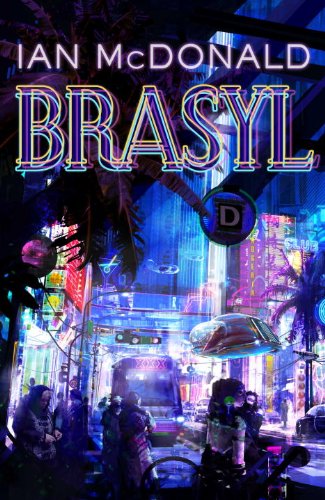
Brasyl cover

Don’t you just hate multi-stranded narratives? There’s always one strand that you can’t wait to be over with before you get back to the more interesting ones. And then that one turns out to be pivotal to the resolution. Authors; you just can’t trust them!

Ian McDonald has taken to multiple narratives in a big way. “River of Gods” had five or six separate strands. Brasyl has three.
In 2006, TV assistant Marcelina Hoffman’s attempts to bring to the screen a new programme for her company Canal Quatro are thwarted by a mysterious presence.
In 2032, small-time impresario Edson de Freitas falls for a girl physicist who can deactivate the smart location chips in stolen goods.
In 1732, Irish Jesuit Luis Quin is sent up the Amazon to bring a renegade priest back to the fold.

I must say I never thought to see in an SF novel an account of the fateful final match of the 1950 World Cup – hell, I never thought to see much about football at all. Alexei Panshin did try it in Rite Of Passage but you could tell he didn’t know the game. He called it soccer for a start. But McDonald’s setting is Brazil, past, present and future. I’m led to believe that football is important there. And it is germane to the 2006 plot. He does gild the lily a bit, though, by having a form of the game appear in the 1730s narrative. (What US readers might make of these aspects of the novel is something else.)

In the early 1730s sections McDonald demonstrates he is more than capable of writing in a straight-forward non-SF style – not that that could ever have been doubted. There are inevitable echoes here of The Mission and Heart Of Darkness but quite soon SF elements creep in, including a Governing Engine which is directed by punched cards and some philosophising which is effectively modern and seemingly out of place.

The initial link between the narratives is the appearance in each of Q-blades, knives which are sharp down to the quantum level.

In the 2030s we hear of a quantum computer which spans all the multiple universes quantum theory gives rise to. This is capable of effectively copying people from one universe into another thus creating doppelgangers. There is also a multiverse police of some kind dedicated to eradicating such inter-universe incursions. These latter aspects brought to my mind Keith Laumer’s Imperium stories read in my young adolescence. In the other two narratives access to the many worlds can be achieved using the drug, curupaira.

McDonald does not take the doppelganger aspect in the direction a Scottish writer might have done but his doppel- are actually more like viel-gangers.

I did take him on trust a bit, letting all the Portuguese words wash over me. (I found the glossary at the back only after I’d finished the novel.) But we SF types are used to neologisms, right? The form is just about impossible without them. And in Brasyl there is substance beneath the surface glitter of the prose.

I can see why some felt disappointed in the central theme,* there is no really ground-breaking speculation in Brasyl. But novelty for its own sake is not a virtue. There is surely room for exploring all the implications of any SF idea without loading new ones on top all the time. Neither is it always necessary to push the boundaries. And an idea, however good, does not make a story. Characters do. McDonald gives you characters in abundance.

* I believe it was the review in Vector but, of course, I can’t find it now.

The Pyr edition can be found at http://www.pyrsf.com/Brasyl.html

free hit counter script