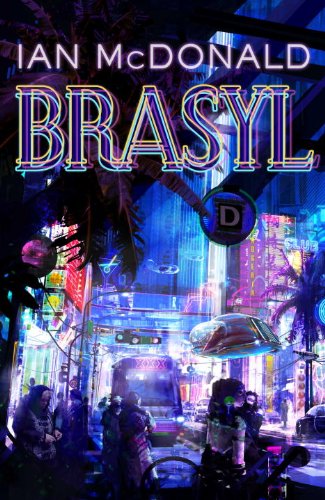
Brasyl by Ian McDonald
Posted in Ian McDonald, Reading Reviewed, Science Fiction at 14:49 on 4 November 2008
Pyr, 2007
Donât you just hate multi-stranded narratives? Thereâs always one strand that you canât wait to be over with before you get back to the more interesting ones. And then that one turns out to be pivotal to the resolution. Authors; you just canât trust them!
Ian McDonald has taken to multiple narratives in a big way. âRiver of Godsâ had five or six separate strands. Brasyl has three.
In 2006, TV assistant Marcelina Hoffmanâs attempts to bring to the screen a new programme for her company Canal Quatro are thwarted by a mysterious presence.
In 2032, small-time impresario Edson de Freitas falls for a girl physicist who can deactivate the smart location chips in stolen goods.
In 1732, Irish Jesuit Luis Quin is sent up the Amazon to bring a renegade priest back to the fold.
I must say I never thought to see in an SF novel an account of the fateful final match of the 1950 World Cup â hell, I never thought to see much about football at all. Alexei Panshin did try it in Rite Of Passage but you could tell he didnât know the game. He called it soccer for a start. But McDonaldâs setting is Brazil, past, present and future. Iâm led to believe that football is important there. And it is germane to the 2006 plot. He does gild the lily a bit, though, by having a form of the game appear in the 1730s narrative. (What US readers might make of these aspects of the novel is something else.)
In the early 1730s sections McDonald demonstrates he is more than capable of writing in a straight-forward non-SF style – not that that could ever have been doubted. There are inevitable echoes here of The Mission and Heart Of Darkness but quite soon SF elements creep in, including a Governing Engine which is directed by punched cards and some philosophising which is effectively modern and seemingly out of place.
The initial link between the narratives is the appearance in each of Q-blades, knives which are sharp down to the quantum level.
In the 2030s we hear of a quantum computer which spans all the multiple universes quantum theory gives rise to. This is capable of effectively copying people from one universe into another thus creating doppelgangers. There is also a multiverse police of some kind dedicated to eradicating such inter-universe incursions. These latter aspects brought to my mind Keith Laumerâs Imperium stories read in my young adolescence. In the other two narratives access to the many worlds can be achieved using the drug, curupaira.
McDonald does not take the doppelganger aspect in the direction a Scottish writer might have done but his doppel- are actually more like viel-gangers.
I did take him on trust a bit, letting all the Portuguese words wash over me. (I found the glossary at the back only after Iâd finished the novel.) But we SF types are used to neologisms, right? The form is just about impossible without them. And in Brasyl there is substance beneath the surface glitter of the prose.
I can see why some felt disappointed in the central theme,* there is no really ground-breaking speculation in Brasyl. But novelty for its own sake is not a virtue. There is surely room for exploring all the implications of any SF idea without loading new ones on top all the time. Neither is it always necessary to push the boundaries. And an idea, however good, does not make a story. Characters do. McDonald gives you characters in abundance.
* I believe it was the review in Vector but, of course, I canât find it now.
The Pyr edition can be found at http://www.pyrsf.com/Brasyl.html
Tags: Science Fiction

Jill Maxick
4 November 2008 at 18:47
Since you’re reviewing–and picturing–the US edition of Brasyl as published by Pyr, can you please also include a sales link for the US edition? The Brasyl page on our website has several buying options on the left hand margin: http://www.pyrsf.com/Brasyl.html
Thank you!
Jill Maxick
Director of Publicity
Prometheus Books
Pyr — an imprint of Prometheus Books