Art Deco, Dunbar
Posted in Art Deco, Eric Brown, Trips at 12:00 on 9 December 2012
It was a few weeks ago now I last visited Eric Brown in Dunbar.
While there I saw and photographed this shop front: the gates are brilliant.

Posted in Art Deco, Eric Brown, Trips at 12:00 on 9 December 2012
It was a few weeks ago now I last visited Eric Brown in Dunbar.
While there I saw and photographed this shop front: the gates are brilliant.
Posted in Eric Brown, Reading Reviewed at 12:00 on 18 November 2012
Abaddon Books, 2012, 271p.
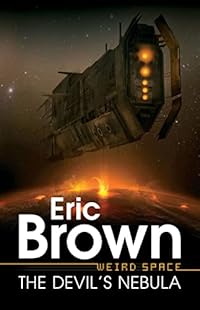
Ed Carew operates outside the confines of the oppressive human civilisation of the Expansion. In search of a valuable artefact Carew, together with his companions Lania Takiomar and Jed Neffard, entered the forbidden space occupied by the aliens known as the Vetch (who had invaded Carew’s home world when he was a child and killed his family.) On returning to human space the trio is captured by Expansion forces, tried and sentenced to death. A reprieve is offered them if they will undertake to travel across Vetch space to a star system near the astronomical phenomenon known as the Devil’s Nebula.
Meanwhile on a planet called World a young girl called Maatja has grown to mistrust the Weird who took control of the lives of the humans who settled there a few generations before.
Until these two strands merge (World is of course the planet to which Carew and his companions are bound) the sections on World are less compelling, sketched economically but not really fleshed out. Unsurprising as the plot is not principally concerned with World but rather the effect the Weird may have on wider human society.
Had I not known who wrote this I could have guessed the author. Many of Brown’s signature preoccupations and SF elements appear – telepaths, strange but understandable aliens, a character who is perhaps too reserved for his own good – though not here, religion. There is too a sort of Brownian slant to the prose.
The front cover interposes ‘Weird Space’ between the author’s name and the book title suggesting a series is in prospect. The final chapter does indeed open up the possibility of more books in this universe.
Posted in Eric Brown, Reading Reviewed, Science Fiction at 12:00 on 30 August 2012
Newcon Press, 2009, 103p.
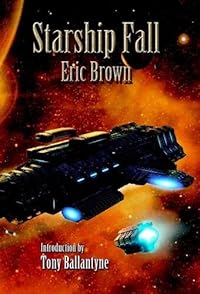
This is a novella, second in Brown’s “Starship” sequence, in homage to Michael G Coney, and begun with Starship Summer. In its telling, though, it is more reminiscent of Brown’s “Bengal Station” trilogy than Coney.
In Starship Fall the former holo star Carlotta Chakravorti-Luna has come to Delta Pavonis IV and disturbed the quiet life of narrator David Conway.
The novella’s title refers to something which is not directly involved with the story we experience in Starship Fall but, rather, kicked it off. A nice Brown touch, though, is naming the holoes Carlotta starred in after Coney novels.
Once again in a Brown story religion makes an appearance; the alien natives undergo a ritual wherein they might die (or not) but see their destiny. David’s friend Hawk’s girlfriend is a native whose partaking in the ritual triggers the crucial events.
Seasoned Brown (and Coney) readers know not to expect everything to turn out perfectly but here Brown still manages to confound at least one of the possible expectations.
On the whole well-written and agreeably character based Starship Fall bears out the theory that the novella is an ideal length for a rounded SF story. Brown does however overuse the formulation [“time interval” later] whether that time interval is hours, minutes or seconds.
Posted in Eric Brown, Reading Reviewed, Science Fiction at 12:00 on 20 June 2012
Orbit, 2012, 387p.
Since he has moved up to Scotland now, I took the opportunity to make a trip down to Dunbar last week to see Eric and it reminded me to catch up on his output.
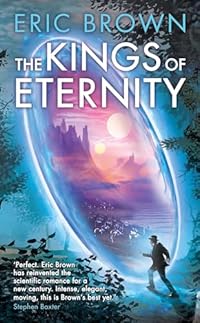
The Kings of Eternity at first appears to be two stories, a third person narrative set on the Greek island of Kallithéa in 1999, and a first person one which starts in 1935, both of which feature a writer as protagonist. (Due to internal clues the reader quickly intuits they are the same person under a different name.)
As Daniel Langham he is a reclusive author living on the Greek island of Kallithéa and suspicious of anyone who shows an interest in him. These sections relate his wariness of an investigative journalist who seems to know too much about him and, at first, of a female artist who has come to live there and whom he later befriends. The pre-war sections – styled as a Scientific Romance (the Wellsian precursor of Science Fiction) – contain that most English of SF/fantasy tropes, strange goings on in a wood.
There are similarities with other works of Brown’s, which have from time to time focused on authors or artists. Where before these may have been background colour only or else not entirely convincing, here those elements are totally integrated into the story. The Kallithéa segments are reminiscent too of the style of Michael Coney which Brown adapted in Starship Summer.
The plot involves portals from other star systems, alien technologies, galactic wars and an immortality serum. The three companions, who take this last, toast themselves as “the Kings of Eternity!” All this allows Brown to treat with those novelistic biggies, love and death. Another of his familiar themes, religion, is absent here, though.
There are places in which you could interpret the writing as a manifesto. Brown has one of his Kings (not Langham but another author – of Scientific Romance) say, The novelist owes his reader more than the mere documenting of the world already known and written about by a thousand other writers. I try to offer alternative visions, views that perhaps no-one has quite broached in the same way before. But don’t get me wrong, I’m interested in human beings, in the constancy of human motivation and reaction – You’ll find these in my novels as well. Later on another character says, That’s why I find your visions so liberating. They speak to me of something beyond the mundane, the petty concerns of humankind. But these comments are not gratuitous, they counterpoint the plot.
The loneliness, the yearnings, of a man who does not age when those around him do is well conveyed – if perhaps over-elaborated towards the conclusion. At one point Daniel Langham muses, The process of living seems to me to be nothing but a gradual accretion of sadness.
Even though Brown does nothing innovative here and the big conflict of the galactic war is totally off-stage there is, especially in the first two-thirds of the book, a wholeness to his treatment, a sense of everything coming together, that he maybe did not quite achieve before in his novels. This is the fruit of someone approaching the top of his game. Forget all that flash-bang-wallop space battle pyrotechnic stuff others concentrate on, the emphasis on the personal here, on human dilemmas, is the real deal.
Posted in Eric Brown, Reading Reviewed, Science Fiction at 13:00 on 21 January 2012
Solaris, 2010, 350p
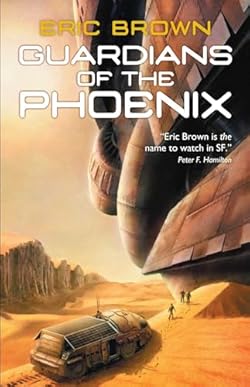
In his recent Bengal Station trilogy Brown has been revisiting some of the conventions of Pulp SF. He has also treated us to a Big Dumb Object novel in Helix. In Guardians of the Phoenix, he has turned his attention to the disaster novel, or rather, to the post-Apocalypse tale. Here too, though, there are faint echoes of Pulp SF in the Phoenix of the title.
The Earth is parched, the oceans boiled away. Resource wars and plagues have reduced humanity to dreams – and fears – of the old times. In a handful of small communities sparsely spattered over Europe a few surviving humans cling on, barely scratching a living from the harsh, sun-battered environment.
To begin with there are three main viewpoint narratives. With large animals extinct and plants beyond scarce, Paul traps lizards on the girders of the Eiffel Tower to feed his dying mentor Elise. In Aubenas the locals net bats for food and their leader quietly supplements their diet with a little cannibalism. A band of renegades has kidnapped the daughter of one of the elders of the decimated community in Copenhagen.
The action kicks off when the renegades turn up in Paris to seek out the rumoured food horde in a bank vault. A group from Copenhagen has pursued them. In the resulting gunfight the chief renegade, Hans, escapes and Paul, who had fallen into his clutches, is rescued.
Since Elise has died Paul joins the Copenhagen group’s onward trip to drill for water below what had been the Bay of Biscay. Hans returns to his former home in Aubenas just in time to join an expedition to Bilbao to find the remains of an abandoned project designed to save humanity from extinction.
As usual with Brown the focus is mainly on the characters, who are well rounded – the relationship between Dan and Kath from Copenhagen is particularly well laid out and Hans makes a convincing psychopath – though Paul, even given his earlier relative isolation, is perhaps still a little too naïve. Given the above the book’s plot has to follow certain lines but there are twists and turns along the way. The resolution is saved from being a bit of a deus ex machine by very short premonitory chapters featuring members of the Bilbao project, which however give the Phoenix game away somewhat.
As an adventure story the novel works admirably but I found I couldn’t quite buy the scenario – an Earth where the water has evaporated from the oceans would admittedly have a consequent runaway Greenhouse Effect but unless all the atmosphere had gone along with them it would surely be more like Venus, constantly overcast, and hence sunburn would be no problem. (I also wondered how in a parched world as depicted would plants be able to photosynthesise and thus keep O2 levels up? Though animals to breathe it in have of course mostly disappeared.) These quibbles aside however Guardians of the Phoenix is fine entertainment.
Posted in Eric Brown, Reading Reviewed, Science Fiction at 13:00 on 5 November 2011
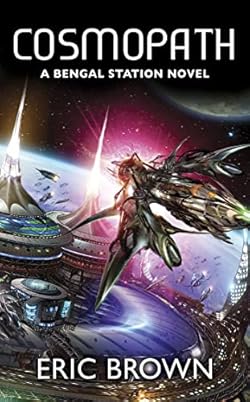
Solaris, 2009, 414p.
This is the third of Brown’s Bengal Station novels, which feature the telepath Jeff Vaughan. In Cosmopath someone is asassinating telepaths. In the first two chapters both Vaughan and Parveen Das, another of the viewpoint characters, thwart attempts on their lives and are then separately invited by an extremely wealthy businessman, Rabindranath Chandrasakar, to join him on an expedition to another world. The action thereafter mainly focuses on Vaughan, but Das and Sukari, Vaughan’s wife, have occasional chapters to themselves.
With this third instalment we can see a pattern to the Bengal Station stories.
There will be a threat to Vaughan or those he cares about, or a financial incentive which drives him to undertake a mission for some third party. In Cosmopath his daughter, Li, has leukæmia and Chandrasakar offers to pay for the treatment.
The case will involve a trip off world where events reminiscent of pulp SF take place. In this one, on Delta Cephei VII, the resident aliens don’t wish humans to spread further than they already have.
While Vaughan is away his loved ones will be in danger of some sort. Here, Vaughan’s wife Sukari and his adopted daughter, Pham, are kidnapped to try to force him to reveal the secrets of Delta Cephei VII.
The self-serving Dr Rao will make an appearance or two.
None of this breaks any ground – nor is it intended to, Brown is reworking and updating familiar themes. It’s not cutting edge but it is all very readable.
Posted in BSFA, Chris Beckett, Eric Brown at 19:05 on 26 October 2011
On one of our two nights in Cambridge I had agreed to meet up with Eric Brown who lives nearby.
He arranged for other SF writers from the area to join us. They were Chris Beckett, Una McCormack, Philip Vine, BSFA chairman Ian Whates and Rebecca Payne, most of whom I had not met before. The six of them have semi-regular meetings in the Pickerel Inn in Cambridge.
The good lady and I had a meal in the Pickerel before everyone else arrived. Our plates groaned. So many peas were heaped on them we must have been served about half a kilogram between us.
I had meant to take some pictures of the gathering but such a good time was had by all that I forgot.
(No. I wasn’t drunk. I had to drive back to the hotel.)
Posted in Eric Brown, Reading Reviewed, Science Fiction at 13:00 on 8 June 2011
Tor, 2008. 358p.
After the events in the first of Brown’s Bengal Station series, Necropath, Jeff Vaughan hung up his telepathic implant and married Sukara. Two years later he has an undemanding but low paid job plus a baby on the way. A former colleague invites him to join her detective agency for good pay using the new improved, and hence less mentally debilitating, implants. For the sake of his wife and child Vaughan does not need much persuading. The subsequent investigation, farmed out by an overstretched police force, centres on the trademark murder of three people by laser.
A young orphaned girl, Pham, witnessed the latest killing and underwent a strange experience immediately afterwards. She now has a voice in her head which promises to protect her, a voice which is the consciousness of an alien.
As well as Vaughan and Sukara, the self-serving Dr Rao from Necropath also appears in this sequel. Perhaps it is the familiarity established from the previous book but here the characterisation seemed fuller – although there is too much emphasis on how Pham resembles Sukara’s dead younger sister Tiger.
As in Necropath, Vaughan leaves Earth – this time for the planet Mallory, where again the encounters he has are somewhat in the tradition of pulp SF. (A xenopath turns out to be a telepathic alien.) Vaughan’s departure has left Sukara in danger, though. The working through of the various plot lines and the tying together of the strands are effected efficiently.
Brown has something here. The Bengal Station setting is a grand conceit, a macrocosm whose levels Brown has barely touched and which could support many more stories; not all about telepaths. The society on Bengal Station seems to be modelled on India but the construction as a whole is really only glimpsed, and sometimes brings to mind memories of Babylon 5. I did wonder, though, whether relationships and attitudes in such a new environment would be quite so close a mirror of the old. But human nature is unchanging, I suppose.
Posted in Eric Brown, Fantasy, Horror, Other fiction, Reading Reviewed, Science Fiction at 13:00 on 23 May 2011
Postscripts 22/23, PS Publishing, 2010. 394 p

The book – one of the most recent in the Postscripts series of anthologies – contains short stories encompassing a range of genres from SF, Fantasy and Horror through to mainstream but mostly in the speculative realm. There are too many stories to consider individually but the standard is high. Even if not all are entirely successful the book contains very few duds. One of the most effective tales is the title story, by Lucius Shepard, about a plot by a famous movie star to enravel his associates in the – perhaps simulated – murder of his girlfriend. Eric Brown’s The Human Element works well even if it re-visits one of his early themes, the relationship between an artist and his work. All the contributions are worth reading though I found Bully by Jack Ketchum too predictable. The Forever Forest by Rhys Hughes was curiously old fashioned, as if the author was trying too hard to convey otherness; it reads as if it might have been written in the 1950s. There’s also a story, Osmotic Pressure, by someone called Jack Deighton, which contains a fair bit of (arguably necessary?) information dumping.
Posted in Eric Brown, Reading Reviewed, Science Fiction at 14:00 on 5 May 2011
Solaris, 2008. 414p.
Jeff Vaughan is a telepath working on Bengal Station, a structure containing a bustling city and busy spaceport rising out of the Bay of Bengal. Vaughan’s special talent is as a necropath, a telepath who can access the thoughts of the very recently dead before they fade too far. He is sickened by the revelations his talent in general has given him about the nature of humanity and wishes for respite from it.
As the book starts he feels his boss – who wears a shield against telepathy as part of his job – is up to no good and the story seems set for the usual sort of trajectory, but his boss commits suicide (so does his wife after she kills their child) as soon as Vaughan’s police contact, Chandra, hauls him in on a small charge.
Thereafter, as part of his investigation, Vaughan finds himself drawn into the orbit of a new religious cult, the Church of the Adoration of the Chosen One, centred round a young girl from Verkerk’s World, where the cult originated; a child who closely resembles Holly, a dead girl from Vaughan’s past. There is a whiff of overkill here as there seem to be a few such resonances. Before she died of a drug overdose, Vaughan was friendly with a girl nicknamed Tiger who in pureness of mind also reminded him of Holly. There are echoes in this of Brown’s earlier New York trilogy where the protagonist also had a paternal relationship with a teenage girl.
Vaughan and Chandra take a voidship to Verkerk’s World. One of the sections set here is narrated from Chandra’s point of view – perhaps since Vaughan’s telepathic ability would mean the interrogation which takes place would otherwise have been over much too quickly. The pair eventually find the source of the religious cult is an alien species called the Vaith who are using their devotees religious impulses for their own ends. This aspect of the plot came close to being in the nature of pulp SF (see here) part 3, and does not quite suspend disbelief.
Another narrative strand involves Suraka, a prostitute in Thailand who, too, has a pure mind. Again, the sections dealing with Suraka’s relations with aliens fail to ring quite true.
While never being less than readable, throughout Necropath too much plot and sub-plot are being shoe-horned into the narrative, which in turn makes the characterisation seem rushed. Brown also withholds information about the dead girl Holly until too near the end.
Bengal Station itself is an interesting scenario, however, but Brown does not exploit it as much as he might. There are two more in the trilogy to come though.
