Archives » Fantasy

Creatures of Passage by Morowa Yejidé

Jacaranda, 2021, 310 p, including 2 p Map.

I was attracted to this by its cover which reminded me of the Trylon and Perisphere at the New York World’s Fair of 1939-40 but having now read it there’s nothing in the book which links to that at all.
It is set in 1977 in a fantasy area called Anacostia whose geography actually corresponds to part of Washington DC. Many of the references are to contemporaneous places in our world to which in most respects Anacostia corresponds. However, it is surrounded by the various Kingdoms of Delaware, Maryland and Virginia so clearly not our world.

Nephthys Kinwell drives a Plymouth round town as a kind of taxi service where she just seems to turn up where- and whenever she is needed. Every so often the text mentions the white girl in the boot (Yejidé uses the term trunk) thumping on the tyre or otherwise making a noise. The girl is a ghost. A pointer to the fact that strange happenings are in store is that Nephthys’s domestic life is plagued by the mysterious moving of bottles and other objects.

Nephthys was a conjoined twin and where they were separated she and her brother Osiris both have/had a half finger which sometimes glows but Osiris died in the local river some while ago; thought to have been killed by a shark due to the teeth marks on his body.

His daughter Amber is the author of the lottery, a newspaper column which predicts odd deaths and other occurrences. On his sojourns to the river Amber’s son Dash sees and converses with someone he calls the River Man. A schoolmate witnessed him there apparently talking to no-one and goads him about it. His response gets him in trouble.

Dash also is concerned by an act of molestation he thinks he saw committed by his school caretaker, Mercy Ratchet, on a girl in his class. Ratchet of course has a long history of such acts including on Rosetta, another viewpoint character, whose life’s trajectory he precipitated, as his was by his own experiences at the hands of a priest.

Osiris exists in the book’s main timeline as a ghost, though flashbacks show how he actually died. His travels in the realm of the dead, his name and that of Nephthys reflect ancient Egyptian mythology and the book’s five sections are titled according to the five ways creatures of passage die: moving through spaces; staying in one place; resigning life to another; surrendering one’s life; entering the void.

The writing style is fluid but often non-standard, frequently omitting commas in lists, “Where signs omens bones transpired in infinite ways and indefinite outcomes …… Each hour was a day year decade,” the continued (over?)use of the phrase “Many years later” perhaps meant to invoke Gabriel García Márquez. A flavour of the novel’s interests lies in the invocation of the Conundrum of Three, where the mind sought the memory of a body long gone, and the body withdrew from the mind and the spirit, and the spirit chased the echo of the other two.

There is a lot going on here, some of which I may have missed as my knowledge of Egyptian myth is sketchy but Yejidé brings all the strands together. Creatures of Passage‘s portrayal of the humans involved, their flaws and dilemmas is convincing. Though it looks at life from an odd angle it is one that illuminates.

Pedant’s corner:- “boys hung in jail cells” (hanged,) “found a remnant of indigo cloth that their mother had made in her closet” (to avoid ambiguity this is better phrased as ‘found in her closet a remnant of indigo cloth that their mother had made’,)

Plus points for areolae and for the subscripts in C16H14N2O.

Darkness Descending by Harry Turtledove

Earthlight, 2001, 596 p, plus 5 p Dramatis Personae and 2 p Map.

With Harry Turtledove you know what you’re going to get. No-nonsense utilitarian prose. An episodic narrative seen from many points of view. Actions telegraphed long before they happen. Reminders of information previously revealed (in that respect it’s as if Turtledove may himself have needed reminding.) Characters not acting for or as themselves but there simply to make a point or progress the plot. Not great literature certainly, perhaps not even literature at all.

And yet somehow it doesn’t seem to matter. His grand sweep carries you along. Even when his inspiration is ridiculously obvious – as it is here in an allegory of our Second World War, with the Kingdom of Algarve standing in for Germany as the baddies and its main opponent, the Kingdom of Unkerlant, a Soviet Union analogue; still baddies (or at least its ruthless ruler is,) as was true in our 1940s. There is no true counterpart to the US however, the other countries here (all political entities in this scenario are Kingdoms) are all too small – and none parallel the British Empire either.

The feature of this series, an exotic flourish, is the fantastic elements; ley lines, dragons, unicorns, behemoths, leviathans, magic; all pressed into military service. Apart from that the war follows a familiar pattern.

In this episode the hitherto always victorious Algarvians are held before the Unkerlant capital, Cottbus; the magical equivalent of the Manhattan Project trundles on slowly in this world’s southern regions; Kaunians are already suffering the early stages of a Holocaust, being herded into ghettos, transported to the front to be killed so that mages can use their deaths to unleash sorcerous energies on the enemy; and it seems as if one of the characters may be destined to become a counterpart of Anne Frank – though I admit her prior experiences have been fairly different.

Sourcing cinnabar, a mineral necessary for dragons to breathe fire, is being set up to be the main Algarvian military objective of the next book, precursorily promising a battle to emulate Stalingrad.

This society of Turtledove’s is, however, almost relentlessly sexist and misogynistic.

Pedant’s corner:- “Pantilo swept off his heat” (his hat,) “for Brivibas’ sake” (Brivibas’s. Most names and words ending in ‘s’ here are treated by Turtledove as if they were plural rather than singular,) Unkerlanter (used several times when Unkerlant was meant,) “the eastern back of the stream” (bank of the stream,) “he hadn’t know” (hadn’t known,) “because he obviously did not care about what happened to the Kaunians” (the character thought the opposite; ‘he obviously cared about what happened to the Kaunians’,) “hauled him to the feet” (to his feet,) “making certain she’d not a spy” (she’s not a spy.) “Hearing Kaunian spoke inside the Algarvian Ministry” (Hearing Kaunian spoken inside…) “Even the Forthweg would have been better off if King Penda hadn’t gone to war” (that sentence doesn’t make sense in the context,) “now they kept spring into his head all unbidden” (they kept springing,) “who know no more than he did” (who knew no more,) “had proclaimed him his cousin Raniero King of Grelz” (had proclaimed his cousin,) “a teamster might have envied” (these societies do not have teamsters,) “They know what happened to a village” (They knew what happened to.) “‘Nonsense, my dead,’ Siuntio said’” (‘Nonsense, my dear’.) “But no: Now his name was on the list” (a colon is not usually followed by a capital letter,) receiving more than a curtsy from some of the, but that” (from some of them, but that,) “a couple of more soldiers” (no need for that ‘of’,) “‘were farther from Trapani than we are from Cottbus’” (we’re farther from,) “might try to settle a score that had simmered, unavenged but forgotten, for half a dozen generations” (context demands ‘unavenged but unforgotten’,) “towards the other Algarvians” (there was only one other Algarvian.) “The soldiers would have known nothing” (again there was only one,) “seeing more or you” (more of you,) “it was narrow, twisting, altogether, unpaved” (ought not to have that comma between altogether and unpaved,) “even the women who yelled” (the woman.)

The Phoenix Keeper by S A MacLean

Gollancz, 2024, 474 p. Reviewed for ParSec 11.

Aila Macbhairan has been besotted with exotic birds, in particular the Silimalo phoenix, since she was eight years old. Now, having been through zoo college, she is, along with other responsibilities, the keeper of the Silimalo phoenix at San Tamculo zoo, which specialises in magical animals. The Silimalo is critically endangered but her zoo’s breeding facilities have been in abeyance for over ten years and the exhibit houses only one specimen, a female called Rubra.
Aila’s other main charges are an archibird, somewhat unimaginatively dubbed Archie, a kind of superannuated magpie, with an eye for shiny objects and whose spit is a superglue for metals, and, oddly, (birds and sea creatures tend to be somewhat different,) the zoo’s kelpie, Maisie, a carnivorous aquatic horse usually wreathed in mists.

Aila is socially awkward, tongue-tied in public, shy of contact with others, but can be voluble when she is talking about phoenixes. The only people with whom she feels at ease are her parents, who encouraged her youthful enthusiasm, and her friend Tanya, the girl with whom she shared a room at college, who always took her for who she was and now looks after the zoo’s Bix phoenix.

Others of the zoo’s employees are the impossibly accomplished, perfectly groomed Luciana, with whom Aila shares a dislike having its origins at college, which Luciana seemed to breeze through with effortless grace and who puts on the zoo’s popular show starring her peacock griffins, while the “gorgeous” Connor looks after its diamondback – and other – dragons.

Aila’s main trouble is her interest in and concern for animals overrides any she might have for humans. I note, though, that she shows no distress for the mice Luciana feeds to her griffins or the goat carcases the kelpie is fed. It seems empathy can only go so far. But, of course, these animals have to eat.

Plot kicks in when a break-in at Jewelport Zoo in the South Coast area of Movas sees its recently hatched phoenixes stolen without trace. Within hours Aila has emailed the directorate of the International Magical Wildlife Service, in charge of the phoenix breeding programme, to put forward San Tamculo as the ideal site for the transfer of Jewelport’s remaining male phoenix. There follow anxious times waiting and preparing for the IMWS inspection, the further wait for its decision and the inevitable (without it there would be no story) arrival of that male, Carmesi.

Minor plot tension comes from whether the pairing of Rubra and Carmesi will be successful and if any chicks hatched will be safe from theft but there is also a gradual development of both Luciana’s and Aila’s characters.

So far so fine, if not particularly remarkable, and it is pleasing to read a fantasy eschewing the default mediaeval setting, but on the level of the writing there are some reservations.

The planet this is set on is clearly not Earth and there is no mention of it being a colony world yet the people are referred to as humans. While the planet’s geography is sketched out in terms of its different climates, and the zoo (map provided just before chapter one) has exhibits from the various regions, Kenkaila, Vjar, Fen, Ziclexia, Ozokia, the creatures depicted – vanishing ducks perhaps aside – are not noticeably magical, as opposed to Earth-mythical, unicorns and dragons for example. It does come across as odd, though, that among all this fancifulness the vegetation – olives, cypress, eucalyptus and so on – is not exotic, characters’ names, Connor, Tanya, Teddy, Patricia, Tom etc, are profoundly quotidian, and the societal trappings here, mobile phones, an internet, live camera feeds, would not be out of place in the twenty-first century of the reader. MacLean’s inventiveness has clearly gone into what she considers to be the interesting aspects of her story, including cod illustrated zoo information plaques for the Silimalo phoenix, the archibird and the peacock griffin, but this lack of attention to incidentals nags at suspension of disbelief. (Or is this asking too much of a debut novelist?)

There is a problem, too, with pacing, most of the background information has been front-loaded rather than drip-fed through the book. To be fair, though, the information MacLean has let us know about her creatures and the compounds in which they are held comes into play in the dénouement, in which Aila is faced with a pair of (rather cartoonish) villains along with their insider accomplice.

There is overuse, too, of unconvincing, invented minor expletives – horns and fangs, skies and seas – (despite usages of the f-word occurring elsewhere,) and expressions like “scrunched her nose,” plus a plethora of raised or rocketed up eyebrows, with MacLean’s treatment of sexual matters being coy to the point of sub-adolescence. (If this is supposed to be a YA book there is no hint of that in the accompanying blurbs.)

MacLean’s writing here is undemanding, doubtless targeted at her intended audience – who will most likely take to it. There is a place for simple entertainment after all. There is a story here but for me it is too overdosed with persiflage. Once MacLean has found the resolve to kill her darlings she may well come up with something a little more absorbing.

The following did not appear in the published review.

Pedant’s corner:- pegasi (this plural of ‘pegasus’ looks odd but then so does ‘pegasuses’,) “the perceptive mink” (minx?) “Teddy had an inch of height on her – unfair, both her tall parents passing on the lamest genetics” (has MacLean not heard of regression to the mean?) “an merlion” (a merlion – unless merlion is pronounced in a very unusual way,) “lights shined” (lights shone,) “from griffin show” (from the griffin show,) “a silver poof” (pouffe.) “Not teachers telling her” (this was in a list of sentences beginning with ‘No’. So. ‘No teachers telling her’,) “like a baton in a championship foot race” (like a baton in a relay race,) Movas’ (Movas’s,) “to get her feathers laying right” (lying right.) “She brought up her legs up” (only one ‘up’ necessary,) “the sweet of mango lingered on the air” (the sweet smell of mango,) “on rare occasion” (on rare occasions,) “laying low” (lying low.)

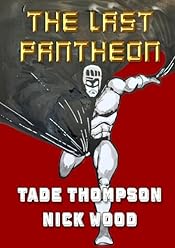
The Last Pantheon by Tade Thompson and Nick Wood

NewCon Press, 2024, 128 p (including 1 p Introduction by Tade Thompson, 2 p In Memoriam (of Nick Wood,) 1 p About the Authors, 2 p Genesis of the Pantheon, 3 p Interview with Tade Thompson, 3 p Building Super-Heroes and 3 p The Last Word on the Pantheon. Illustrated by Tade Thompson. Reviewed for ParSec 11.

This book is in part an In Memoriam for Nick Wood, who died in 2023. So it goes. Fellow author Thompson and he had an admiration for African superheroes of the 1970s like South Africa’s Mighty Man and Nigeria’s Power Man (who are name-checked in the story.) Together they wrote The Last Pantheon as a kind of homage and it was published in the collection AfroSFv2. Thompson’s Introduction here says this edition was more how they first imagined it would be, a short and sharp illustrated book wearing Silver Age bona fides on its sleeve. The illustrations were provided by Thompson himself, in his words a motivated amateur artist.
The story features Black Power (now using the name Sipho Cele) and Pan-African (Tope Adedoyin.) Though Pan-African refers to Black Power as brother they have been antagonists at various times over the years since they fled to Earth on a spaceship a very long time ago. Black Power can fly and move very quickly, Pan-African levitates, can read minds (and sometimes influence them) and is surrounded by a limited force-field. As the meat of the story unfolds their past is outlined in memories and flashbacks in one of which Black Power wonders at his anatomical and DNA similarities with humans. The story the book tells ranges over how they intervened (or failed to) at important moments in, mostly recent, African history – the deaths of Patrice Lumumba, Dag Hammarskjöld and Murtala Mohammed, the Sharpeville massacre – but also encounters with Shaka Zulu and a certain primate in 15,000 BP.

Black Power has always been on the side of law and order and Pan-African more or less the opposite. The last time they had clashed, the atmosphere over the Sahara was so disturbed it began to snow. In the aftermath Pan-African turned himself in. At this story’s start he is being released from prison after serving his time. Soon he is on a TV programme phone-in being interviewed by journalist Elizabeth Kokoro to explain his career choice. Black Power comes on the line. The ensuing conversation reveals their antipathies. Kokoro (who it’s later revealed has an extremely expensive brain implant connecting her directly to the internet) is amused by their verbal sparring but is then startled by Pan-African telling her the old comics featuring Black Power were propaganda, funded by the CIA and dosed with chemicals that may have been mind-altering. (Asides such as this help to provide an oblique critique of colonialism and its effects.) The interview, though, has laid the groundwork for the superheroes to meet in a televised last battle.

The novel has many grace notes, including a knowing nod to The Incredible Hulk, but, oddly, a scene near the end where Pan-African meets a pair called Nick Wood and Tade Thompson who are to write the graphic novel of the last encounter. A meta-fictional step too far?

For fans of superheroes there are plenty scenes of the pair demonstrating their powers but the structure and treatment, the characterisation, will also gratify appreciators of more literary virtues.

The illustrations are not (as Thompson warned us) up to comic standards, but neither are they crude.

I doubt anyone reading The Last Pantheon will have any cause for complaint.

The following did not appear in the published review.

Pedant’s corner:- Thompson’s In Memoriam of Wood is attributed to “Tade Thomson” (Tade Thompson,) “both victims and perpetuators” (x2, perpetrators,) low lives (usually lowlifes,) Jonnie Walker (it was whisky, so, Johnnie Walker.) “She wore shorts and burdened under a backpack” (She wore shorts and was burdened … ?) “Once the settled in a price” (Once they settled on,) staunching (stanching,) a missing full stop. “‘Thembeka, some back!’” (‘come back’ makes more sense,) “ a twelve miles journey” (a twelve mile journey,) “onto the stationery boy” (stationary,) “a chair in the next table” (at the next table,) Thendeka (several times, but elsewhere usually spelled Thembeka,) a line break after two thirds of the line, “the corpses ragged head and body wounds” (corpses’,) “where the chances for collateral damage was less” (where the chances … were less,) “far side of he hall” (of the hall.) “He out a cowhide covered shaft” (He pulled out a …,) bonafides (bona fides,) Addidas (Adidas,) “knew his presence has been marked” (had been marked.) In ‘About the Authors’; “in ddition to” (in addition to.) In ‘Building Super-heroes’; “is being control of” (is being in control of) “the character’s and their supporting cast” (characters.)


ParSec 12

ParSec 12 is due for release this Friday, 8th November. By my count there will be six of my reviews in this edition.

Lake of Darkness by Adam Roberts

Nordic Visions. The best of Nordic speculative fiction edited by Margrét Helgadóttir

Laughs in Space edited by Donna Scott

Birdwatching at the End of the World by G W Dexter

Darkome by Hannu Rajaniemi

and Strange Beasts by Susan J Morris.

Two More Books

Two books arrived last week for me. I was away over the weekend and so didn’t get round to noting them here until now.

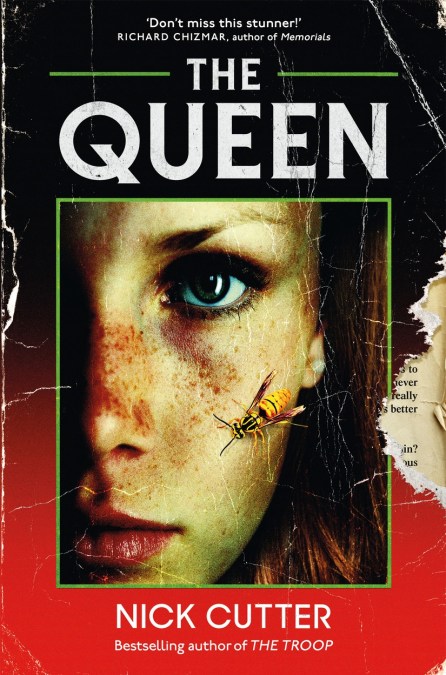
They are Strange Beasts by Susan J Morris and The Queen by Nick Cutter, both writers new to me.

The cover of The Queen says, “Bestselling author of The Troop.” I looked that up and it was published in 2014 and was followed by four (and a half, co-written with Andrew F Sullivan) more since. Nick Cutter is a pseudonym of Craig Davidson.

These books are of course for review in ParSec.

Episodes by Christopher Priest

Gollancz, 2020, 360 p

This is a collection of the late author‘s shorter work culled from throughout his career. Each story is prefaced by a ‘Before’ section saying how it came to be written and an ‘After’ section describing how the writing went and where the story was published. Priest’s writing is always controlled and well executed. In general it tends towards a feeling of unease, as if something is lurking below the surface or what has seemed to be reality morphs into something else but here I was surprised by how much of the contents leaned towards horror.

The Head and the Hand. A man who had become famous through allowing himself to be mutilated is persuaded out of retirement for a final cut.

A Dying Fall relates the thoughts that flash through a man’s mind as he is falling in front of a subway train. They are of travelling on a motorway in Belgium and of the training course in parachute jumping/sky diving he took there.

I, Haruspex is, I assume, in the mould of H P Lovecraft. (Priest’s ‘Before’word says it was solicited by a games company wanting something based on that author’s Cthulhu Mythos but he had no familiarity with that at all – similarly I have not. The company, while paying, never used the story and Priest later found a home for it elsewhere.) Effective in its own way it is told in an old-fashioned language of stilted particularity that, for a first person narration, is curiously distanced (not to mention distancing) and overladen with exclamation marks. After consuming his special meals, narrator James Owsley, descendant of a long line of haruspices, can halt or reverse time for a while. Off the Great Hall of his home, Beckon Abbey, lies a hagioscope over a pit which loathsome things are seeking to escape. In a nearby bog a German bomber plane is held in slow suspension as it crashes after being shot down, even though this is 1936. Someone, not a member of its crew, waves to him from the impending wreck and a voice speaks in his head.

Like the author’s novel The Space Machine, written as an hommage to H G Wells, Palely Loitering, a tale of time travel and thwarted love, bears the influence of Edwardian fiction. Despite including space travel (the McGuffin here – called the Flux Channel – was built to help launch a starship on its way,) the story has a resolutely antique feel to it. Its atmosphere of picnics and bandstands, its social and family dynamics were distinctly retro even in the 1979 in which it was first published. After the starship left, three bridges were built across the Flux Channel. The one leading straight across is the ‘Today’ bridge, two others, built at slight angles to the Channel, lead respectively to ‘Yesterday’ or ‘Tomorrow’. Our narrator as a boy one day leapt off the end of the ‘Tomorrow’ bridge and found himself thirty-four years in the future, where a young woman is pointed out to him by a man who says she is waiting for her sweetheart. The reader can from then fill in the gaps but Priest’s execution of the story is impressive.

An Infinite Summer again bears Edwardian hallmarks – but then part of it is set in 1903 where Thomas Lloyd is on the point of proposing to his intended, Sarah, when he is frozen by a camera-like device wielded by someone from the future. The frozen tableaux which result from these capturings can not be seen by contemporary passers-by but only by the unfrozen and the travellers from the future. The effect on Thomas wears off only in 1935 when he is free to move around again but has to wait more years for Sarah to unfreeze. In 1940 he, and Sarah’s image, are caught in the aftermath of the shooting down of a German bomber. The image of one of the bomber’s German crew held in suspension above a river after being captured by a freezer is unforgettable. I note the similarities here between this incident and the one in I Haruspex.

The Ament* is the tale of a man who was once part of a project to film two children, one male and one female, every week, to document changes during their growth and beyond, but who in his adulthood has dreams of committing murder. But are they dreams? The story is told in two alternating voices, his and a third person viewpoint.

The Invisible Men are those (not all men) who are detailed by their USian masters to spy on a British Prime Minister who feels he has to resign due to a financial scandal. (His statement that, “It’s British tradition for a public figure to resign his position if caught in the wrong,” seems altogether quaint now, 50 years after first publication.) His observations of his surroundings on a clandestine meeting on the Norfolk coast with his USian partner – a co-leader of a UK seemingly on the brink of becoming the 51st State – imbue the tale with a sense of foreboding.

The Stooge is employed by a stage illusionist to fake amazement at his tricks on being ‘randomly’ picked from his audience. The story’s title becomes doubly apposite.

In futouristic.co.uk a man responds to an email offering to sell him a time machine. It doesn’t work. For him.

Shooting an Episode presents the ultimate in reality TV, though it’s more like reality streaming. For its subjects no holds are barred. The trouble comes when our narrator has to go in amongst the participants to clean up their mess.

In The Sorting Out Melvina comes home late one night to find her door lying open having been forced. With increasing fear she moves through all her rooms, wondering if the man she has recently dumped has something to do with it, but a phone call reveals he is an hour away. Yet various of her books have been misplaced, their dust covers placed upside down, their normal, random arrangement systematised. One has been glued to a curtain.

In its ‘After’word Priest describes the gathering of books (which is what most readers do) as a kind of quiet madness. Well, all obsessions are. At least it’s a harmless madness.

*Amentia is the condition of feeble-mindedness or other general mental deficiency.

Pedant’s corner: Méliès’ (Méliès’s – especially since the final ‘s’ of Méliès is unsounded, thus demanding the apostrophe ‘s’ for its possessive,) maws (used for ‘mouth’; a maw is of course a stomach,) interlocuter (interlocutor,) aureole (areola,) Mrs Adams’ (Adams’s,) “more yachts were parked further away” (parked? Can you park a yacht?) “the king” (x 2, the King,) “the sort of problems the bank were concerned with” (the bank was concerned with,) soccer (football.)

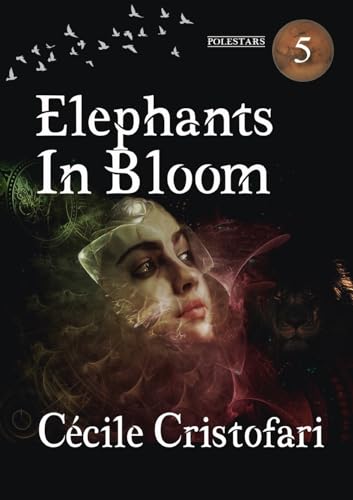
Elephants in Bloom by Cécile Cristofari

NewCon Press, 2023, 239 p. Reviewed for ParSec 10.

This is the author’s first collection of short stories. Ten of them appeared in a variety of publications over the past five years, eight are original to this book. Each is provided with an authorial afterword. Some of these mention Cristofari’s French background and the latitude she gains as a writer from having two languages to draw on. She casts her net wide, with settings ranging from prehistory through to the present day and beyond. A common thread running through them is ecological collapse and possible recovery from it, in perhaps a sign of recent events some feature characters living in the aftermath of a pandemic.
A few are set in France, two even in Québec. Most succeed well but The Fishery, where “fishing boats” scour the universe for usable materials while avoiding inhabited worlds, has a central metaphor which is unfortunately stretched beyond breaking point. All have a firm focus on the humans at their heart and the dilemmas which they face.

The scenarios vary widely: a woman lives in a house with a window which gives onto other worlds so providing a means of escape, a couple try to evade an ongoing apocalypse on an otherwise deserted island, an intrusive cat in a care home seems to be a feline angel of death, a girl in post-Great War France talks to her never born brother to honour her non-French origins, a dangerous encounter on a mountain road ends in various ways, a witch has an uneasy pact with a hangman, another woman, with the help of the Moon, flies to Pluto in a plastic bottle to find her son who set out to search for his dead grandmother, a research scientist in a kind of steampunk fascist dictatorship secretly works against the regime, two children put a cat into a quantum bag in a glorious excuse for the author to deploy numerous cat puns (the least of which is is it alive or dead, and in which world?) An alien reports back to her planet from World’s End in Tierra Del Fuego, a museum caretaker converses with the (long dead) exhibits after hours, three travellers bearing gifts for a newborn trudge through a post-apocalyptic Québec winter, a stone-age woman finds a home outside her birth group despite the disfigurement inflicted on her to prevent it, a woman meant for sacrifice is surprised to find herself in the goddess’s world, a witch and a space-faring knight come to an accommodation after the battle they fought destroyed the world. The end can come in three ways, by wind, by flood, and by someone singing “My Bloody Valentine”, a group of archaeologists investigating the interior of the god who fell to Earth on the local mountain find an unusual treasure.

With the single exception mentioned above Cristofari handles all of them very well.

The following did not appear in the published review:-

Pedant’s corner:- “outside of” (just outside, no ‘of’,) “knowing fully well” (the phrase is ‘knowing full well’,) “that forced me to quiet” (to stillness,) “a thick handful of filaments were already drying on the windowsill” (a thick handful … was already,) “sank behind underwater buffs” (bluffs?) “Madame Darmon sit up” (sits up,) “Gaspard withdraw his paw” (withdraws,) “between oaks trees” (oak trees.) “Door and windows were open everywhere” (Doors and windows,) “the brand news dreadnoughts” (brand new,) “I will not baulk at any sacrifice” (balk.) “None of us have.” (None of us has,) a missing end quote mark, “as soon as the oil had ran out” (had run out.) “They dragged me until the edge of the woods” (dragged me to the edge of the woods,) “terrified that the he would ride away” (no need for the ‘the’,) “in disgust of our marred faces” (in disgust at our marred faces,) “the moon waxed and waned nine more time” (nine more times,) “on all four” (all fours,) fit (fitted.) “Its flower-fruit were turning” (was turning,) “precious guinea fowls” (the plural of guinea fowl is ‘guinea fowl’,) “always easier than thriving for a real solution” (striving for?)


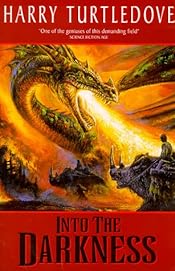
Into the Darkness by Harry Turtledove

Earthlight, 1999, 595 p, plus ii p Map and vi p Dramatis Personae.

This is the usual Turtledove type of story-telling. An episodic narrative seen from many viewpoints; very similar to, indeed indistinguishable from, his Great War, American Empire and Settling Accounts series as well as his World War and Colonisation books. Only the setting here really differentiates it from those.

Unlike in those though everything is prefaced by a map. This world has seemingly only one major continent, Derlavai, though there is a counterpart to Antarctica to its south and a minor one to its northeast. Only the latter (plus a few scattered islands) is situated north of the planet’s equator. To the east of Derlavai is the Bothnian Ocean. This presumably goes all the way round the world to Derlavai’s west but there it is labelled on the map, Bothian Ocean.

Magic or sorcery (both terms are used,) not technology, is the driving power in this world and there are frequent references to its governing rules of similarity and contagion. Since the discovery of ley lines from which power can be drawn (it’s not clear if this source is purely magical or if it derives from magnetism) travel has tended to follow those lines. Adding to the fantasy factor we have dragons, unicorns, behemoths, leviathans, and sticks firing energy beams. Rather than bombs, artillery fires eggs, also able to be dropped from dragons. Military units can be accompanied by mages. Beyond the range of ley lines magical energy needs to be procured by the sacrifice of human life. (Despite the exotic setting the people described are in effect humans – or as much as anyone in a Turtledove book can be said to be human.)

Dragons of course take the part of aeroplanes here, behemoths are in effect large rhinoceroses adapted and armoured for warfare, leviathans are counterparts of whales and take the role of submarines though with only one crew member. The unicorns are just glorified horses and don’t seem to have exotic uses. In amongst all this make-believe, names like Algarve, Cottbus and Ventspils do tend to break the spell a little.

Sometime in the past Derlavai was dominated by the Kaunian Empire. It was overthrown though, and now its successor realms of Unkerlant, Algarve, Forthweg, Valmiera, Jelgavia, Gyongyos, Lagaos and Kuusamo form various and variously shifting alliances. Each of these are monarchies with social hierarchies embedded in them. Ethnic groupings are frequently referred to in what amounts to racist terms, blonds, redheads etc. Those identified as of Kaunian descent are particularly disdained. There is also a high degree of sexism or outright misogyny in the way female characters are spoken about and treated by the male ones. Very few men here show any kind of respect towards them.

The story revolves around a war of revenge instigated by the Provinces of Algarve and Unkerlant but anyone with a passing interest in the Second World War (not as the back blurb has it, the First World War) or who has read Turtledove’s ‘Settling Accounts’ trilogy can spot resemblances and the tactical and strategic manœuvres to come. There even promises to be, in further instalments, a magical equivalent of the Manhattan Project whose nascent stirrings are given here.

As usual, Turtledove’s “characters” are no more than cyphers, in place merely to push the overall scenario forward or illustrate attitudes. Often we find them saying the same things over again in only slightly different ways. Unlike in Kate Atkinson’s Human Croquet, this is not beyond the purpose of emphasis, with the result it feels like being beaten about the head with words. Moreover, it reads as if parts of the book were written by different authors who did not know what the others had already told us.

There are five (five!) others of these ‘Darkness’ books to go. At least they’re not demanding reading.

Pedant’s corner:-Written in USian. Otherwise; a missing opening quotation mark at a piece of dialogue, “the Twinkings War” (many times; to avoid being misread this would have been better rendered as ‘the Twin Kings War’.) “He brought a chunk of melon … from a vendor” (He bought a chunk,) “that would have burned a hole in man” (in a man,) “‘wouldn’t by any chance by Algarvian ships’” (be Algarvian ships,) “on the other wide” (other side,) “had bee anything but idle” (had been.) “Bembo instead, he said,” (Bembo instead said.) “‘If I had to chose’” (to choose.) “‘You can borrow the book after I’d done with it’” (after I’ve done with it,) “a carried at his beck and call” (a carriage,) “found water with it in the days of the Kaunian Empire. Now people all over Derlavai dowsed for water with it in the days of the Kaunian Empire. Now people all over Derlavai dowsed for water, for metals, for coal,” (The sentence I have italicised is superfluous,) “‘till we shop up on their doorstep’” (till we show up,) a missing comma before a piece of dialogue, “even though a crystal” (even through a crystal,) a missing closing quotation mark, “wracking their brains” (racking,) ley lines/ley-lines (spelling switches between the two.) “‘We shall also put yachts to see’” (‘to sea’ makes more sense even if the next two words were ‘to peer’,) “on to the streets” (onto the streets,) Forgiathwens (Forthwegians.) “Wherever they were, though they had great strength.” (needs a comma after ‘though’,) “let alone to dot on a map” (let alone to a dot,) “to peasants haled before such tribunals” (hauled before,) an extraneous quotation mark at the end of one paragraph. “‘Just get the filth of my blackboard’” (off my blackboard.) “He patted Eforiel, bring the leviathan to a halt” (brought the leviathan to a halt.) “The first trousered soldiers was labeled Valmeria” (were labeled – and of course it’s ‘labelled’ in British English,) “had one of the tables up and spoken” (upped and spoken,) “Raunu shook his head” (the character concerned was Skarnu,) “arguing about for year” (for years,) maw (it’s not a mouth.) “Kaunian wheezed” (the character was Krasta, and she isn’t Kaunian.) “‘to send word or your doings’” (word of your doings,) “the ass’ ear” (x 2, ass’s,) “to find out of” (to find out if,) “squeeze in close behind him” (close beside him,) “in the paly” (in the play,) “the mist might lay on the sea all day” (might lie on the sea.) “They’d overran her” (overrun her.) “He thrashed for a couple of minutes, ever more weakly, they lay still” (then lay still.)

Plus marks for ‘stanch’ referring to a flow.

ParSec 11

The latest edition of ParSec magazine (no 11) is available for purchase. At £5.99. It’s a bargain.

This edition contains no less than five of my reviews.

The Last Pantheon by Tade Thompson and Nick Wood.

The Phoenix Keeper by S A MacLean.

Dark Shepherd by Fred Gambino.

Sparks of Bright Matter by Leeanne O’Donnell.

And, last but not least, Navola by Paolo Bacigalupi.

Those reviews will appear here after a decent interval.


free hit counter script