Archives » China Miéville

Looking for Jake by China Miéville

Pan, 2006, 307p.

Looking For Jake cover

This is a collection of Miéville’€™s shorter fiction culled from various previous publications, with some original to this book.

Looking for Jake. After an unspecified disaster has depopulated London an unnamed narrator goes looking for his missing friend Jake. The very Art Deco Gaumont State cinema in Kilburn is given several mentions and an image of it appears on the book’s cover. See also the picture at the end of this post.

In Foundation a First Gulf War veteran haunted by his experiences there is known as a house whisperer because he talks to buildings. Their foundations talk back.

The Ball Room, a story written along with Emma Bircham and Max Schaefer, has the eponymous play area of a furniture warehouse not entirely dissimilar from IKEA cause its clientele to experience strange and compulsive goings on.

Reports of Certain Events in London is a typographical riot of fonts, scripts, reports, “handwritten”€ letters, interpolations and transcribed pamphlets and employs an unusual framing device. Narrator “€œChina Miéville” inadvertently opens a package delivered to his address but intended for a Charles Melville and finds himself fascinated by the contents – the proceedings of a group devoted to tracking the shifting location of, and combats between, London’€™s feral houses.

Familiar has a witch making a familiar out of a mixture of his own body fluids. It disgusts him and he gets rid of it but it comes back to haunt him. Ho-hum.

Entry Taken From a Medical Encyclopædia is errr…. an entry from a medical encyclopædia. Complete with footnotes and references. The infection described is caused by pronouncing a word in a certain way, which thus propagates itself in the victim’s brain.

In Details a young boy takes food every week from his mother to an old woman who keeps herself close, in the dark, barely opening her door before snatching the food, closing it again and getting him to read to her. She once saw something nasty, not in the woodshed, but in the details of a brick wall. She has been hiding from the patterns out to get her ever since.

Go Between sees a man receive from a mysterious organisation messages concealed inside his purchases. He fails to deliver the final one and wonders if he did the right thing.

An old man buys himself a seventieth birthday present, an old window with stained glass. He discovers he can see Different Skies through it, but there are potential horrors on the other side.

An End to Hunger has a genius computer programmer infuriated by the eponymous charity’€™s campaign. He works to expose its sponsors’ hypocrisies. They don’€™t like it.

In ‘€˜Tis the Season Christmas and its accompanying paraphernalia have been privatized. Yuleco owns the rights and so ChristmasTM, SantaTM, MistletoeTM, RudolphTM etc are all under licence – even tinsel is illegal without one, never mind a tree. An unnamed father has won a prize to Yuleco’s official party. On the way there he and his daughter get caught up in the anti-privatisation protests. Slight, in a fun way. I just hope it doesn’€™t give anybody in power any ideas.

Jack in Miéville€’s city of New Crobuzon, familiar from Perdido Street Station and The Scar, is a Remade. Altered as a punishment – feathered wings for arms or oily gears for innards and skin changed, or otherwise bizarrely surgically changed – Remades are looked down upon by the “normal”€ citizens. Jack Half-A-Prayer fights the system, standing up for the underprivileged. The city can tolerate so much as a release valve – but Jack goes too far.

On The Way To The Front is a graphic short story illustrated by Liam Sharp which would take longer to describe than it did to read. The reproduction is in black ink and might have benefited from colour (which would obviously have been too expensive.)

The Tain is much the longest story in the collection, a novella set in the aftermath of Earth’s invasion by the creatures who live behind mirrors, the Tain of the title. A Londoner is strangely immune to their attentions and sets out to parley with their leader. One of the Tain is also a viewpoint character. Not your usual alien encounter story.

While not every story hits the mark, as a whole the collection illustrates Miéville’€™s range and writing ability. It also highlights his fascination with London and his recurring theme of otherness, the not-quite-identical.

And here is the majestic (in that monolithic, Stalinist kind of way) Gaumont State Cinema.

Gaumont State Cinema

Current Reading

I have temporarily stopped reading Looking For Jake by China Miéville about halfway through to concentrate on my latest Interzone review (of Empty Space by M John Harrison) in order to have plenty of time to get the review done.

I’ll be getting back to Looking For Jake in due course.

Clarke Award Stushie*

It seems Christopher Priest, whose BSFA Award listed novel The Islanders I am reading as we speak (or read, or converse, or whatever-the-hell-it-is-we-do-on-the-internet,) has attacked this year’s Clarke Award shortlist.

Go on. Read it. It’s an entertaining rant however unfortunately open to the charge of sour grapes at not himself being on the Clarke list it may be. (Priest tries to cover this angle by saying he would withdraw his novel from any consideration if the Clarke list were to be rethought as he proposes.)

I would insert the turbulent Priest joke here but someone used it decades ago in one of the BSFA’s journals and I actually think Priest has a point. Perhaps several.

My impression of the BSFA shortlist novels I have read is that last year wasn’t a particularly good one for SF novels – though my sample is admittedly small. And I agree that to have China Miéville win the Clarke Award for a fourth time would suggest that no-one else need bother writing SF (nor fantasy) as we could all then give up and go home.

I disagree, though, with his interim assessment of Adam Roberts’s By Light Alone. See my review here.

Charles Stross (whom Priest castigates in his piece) has linked to a comment thread engendered by Priest’s rant and has also seized upon the criticism as a marketing opportunity (see link to Stross’s post.)

Among other things Priest complains Stross writes “och-aye” dialogue. “Och-aye” dialogue. What’s wrong with that? People do not necessarily speak RP, or estuary, or USian, now or in the future. Get over it.

By the way, I used to receive a yearly invitation to the Clarke Award do but I could never go – it’s in London and I always had work that day and the next. Those invitations dried up some while ago now, though.

*Stushie is a Scottish word for contretemps.
stushie [ˈstʊʃɪ], stishie, stashie
n Scot
1. a commotion, rumpus, or row
2. a state of excitement or anxiety; a tizzy. Also spelled stooshie, stoushie.

Clarke Award Shortlist

The Clarke Award (named obviously for British SF pioneer Arthur C Clarke) is an annual award for the best SF novel of the year. It’s fair to say its choices lean towards the literary end of the SF spectrum and its shortlist usually provides a marked contrast to the BSFA Award.

This year’s shortlist – for novels published in 2011 – is here and is reproduced below:-

Greg Bear, Hull Zero Three (Gollancz)
Drew Magary, The End Specialist (Harper Voyager)
China Miéville, Embassytown (Macmillan)
Jane Rogers, The Testament of Jessie Lamb (Sandstone Press)
Charles Stross, Rule 34 (Orbit)
Sheri S.Tepper, The Waters Rising (Gollancz)

Of these I have read only Chinatown. (Edited to add:- I meant Embassytown.)

Compare and contrast the BSFA Award list:-

Cyber Circus by Kim Lakin-Smith (Newcon Press)

Embassytown by China Miéville (Macmillan)

The Islanders by Christopher Priest (Gollancz)

By Light Alone by Adam Roberts (Gollancz)

Osama by Lavie Tidhar (PS Publishing)

My strike rate here is higher; the Miéville, the Roberts and (currently reading) the Priest.

BSFA Awards Short Stories

Over the past few weeks I have read the short stories nominated for this year’€™s BSFA Awards. I am assuming that, as in the past couple of years, the BSFA will be producing a booklet containing them but since each has been posted on the internet (there is a link from the BSFA’s Awards page to the online versions which is how I managed to read them – though I found off a screen is not the most comfortable of ways to do so) perhaps that might not happen.

The Silver Wind by Nina Allan, from Interzone issue 233, is a kind of time-travel story mixed with parallel worlds. It tells of the encounter of a man from a fascistic future Britain with a genius who makes clocks (which he refers to as time machines.) To begin with there is too much info dumping and throughout a lot is told rather than shown. Perhaps the story needed more space to breathe but I felt the sureness of touch of an accomplished story teller was missing. There is a use of words that is not quite precise -€“ eg ‘hoping one soldier would not see me’ rather than ‘€œhoping none of the soldiers would see me’€ – and twice we are treated to the peculiar phrase, ‘€œIt was growing dusk,’€ but at least Allan knows the use of ‘€œnor’ as in, ‘€œnot for love nor money nor any of these new-fangled gadgets.’

The Copenhagen Interpretation by Paul Cornell, from Asimov’s, July2011, is set in an altered future where European monarchies strive to keep the balance of power throughout the Solar System, souls have weight that is aligned to dark matter and Newton came up with a kind of relativity theory which allows space to be folded – all amenable to a tale of espionage and derring-do admixed with betrayals of various sorts. This stretches suspension of disbelief at times but overflows with ideas and is excellently written.

Afterbirth by Kameron Hurley, from Kameron Hurley’€™s website, is about a woman in a backward-leaning religious society which is engaged in a never-ending war, whose rulers have deliberately cut it off from the stars – originally as an escape from whatever’€™s out there but now to prosecute the war better. In her forbidden astronomical observations she finds God in a torn filter laid across the night sky. Again there is a fair bit of info dumping -€“ perhaps inevitable in stories of short length.

Covehithe by China Miéville, from The Guardian, 20/4/11, features sunken oil-rigs returning to land to drill into the earth and lay – eggs? seeds? – from which smaller rigs later emerge. Atmospheric, but again info-dumpy. The human involvement in Covehithe – a father and his daughter observing one such landing -€“ doesn’€™t really overlap with the SF background. Another scenario where society has suffered extreme breakdown and the military has a strong presence.

Of Dawn by Al Robertson, from Interzone 235, has a woman whose soldier brother has been killed being inspired by his poetry, the music of a long neglected composer, an all but forgotten TV documentary and a figure from Greek myth to produce a synthesis of poetry and music by bringing all those strands together. The final part of the jigsaw is provided by a shadowy figure in a village commandeered by the army long ago, but which had inspired both poet and musician. The story contains echoes of the Green Man myth and illustrates that English fascination with the pastoral. The info dumping here is well embedded.

The futures shown by the five stories are all bleak, having in common repressive regimes of either military or religious stamp. SF is never about the future, though. These stories tell us a lot about where we are now.

As stories though, rounded works of fiction, I found most of them unsatisfying. The only truly successful one was Paul Cornell’s. If these represent the best of last year the SF short story is in a bad way.

BSFA Awards Shortlist

It’s that time of year again. The BSFA Award nominations are out.

The full lists can be found here.

The fiction nominees are:-

Best Novel:-

Cyber Circus by Kim Lakin-Smith (Newcon Press)

Embassytown by China Miéville (Macmillan)

The Islanders by Christopher Priest (Gollancz)

By Light Alone by Adam Roberts (Gollancz)

Osama by Lavie Tidhar (PS Publishing)

Of which I have (so far) read one.

Best Short Fiction:-

The Silver Wind by Nina Allan (Interzone 233, TTA Press)

The Copenhagen Interpretation by Paul Cornell (Asimov’s, July)

Afterbirth by Kameron Hurley (Kameron Hurley’s own website)

Covehithe by China Miéville (The Guardian)

Of Dawn by Al Robertson (Interzone 235, TTA Press)

I have read none of these as yet but only The Copenhagen Interpretation is not available online via the BSFA page linked to above. Presumably the booklet of nominated stories that the BSFA has produced for the past two years will be repeated this time around, too.

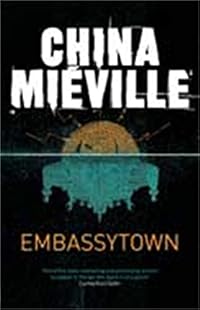
Embassytown by China Miéville

Macmillan, 2011, 405 p

 Embassytown cover

It’s not often a novel is concerned primarily with language but Embassytown is that exception. Unlike in Suzette Haden Elgin’s Native Tongue series, however, Miéville does not merely dally with the idea of language and translation but instead embeds this concern in the narrative; indeed the plot’s resolution is dependent on language and communication.

On a planet named Arieka, at the edge of known space, the Bremen colony of Embassytown is a habitable enclave surrounded by the otherwise poisonous demesnes of the indigenous Ariekei who are known as Hosts. Their language (Miéville emphasise its importance to the novel by naming it Language rather than Ariekan) contains no facility for lying and also requires the simultaneous uttering of two words/thoughts in order to be understood. This leads to a typographical representation oddity which I cannot fully reproduce here and is merely one illustration within the book of Miéville’s fascination with duality, a seam mined repeatedly in his earlier novels. “Twinned” Ambassadors referred to as doppels are identicalised individuals, kept identical by regular cleansing sessions which remove the superficial blemishes picked up between these ablutions, have been tested for empathy and trained to interact with the locals by speaking simultaneously. They have names such as ArnOld, RanDolph, CalVin, MagDa, CharLott or JoaQuin and are always referred to in the plural in constructions such as “the Ambassador were” – except when their components are on their own. The first three sections of the book, up to the initial crisis, are also twinned, with succeeding chapters respectively headed as Formerly or Latterday. Here, the difficulties of communicating with the Hosts and the struggles of a few of them to adopt human modes of speech are laid out. The remainder of the book deals with the fall-out from that endeavour.

Narrator Avice Benner Cho is a former immerser – a traveller in the immer, the void between planets – who, unusually for one of her kind, has returned to Arieka. Like many Embassytowners she has been made into a simile (she is the girl who ate what she was told, rather than what she wanted.) These human similes help the Ambassadors to talk with the Hosts. Avice’s status is, of course, vital to the plot’s development.

Disappointingly in a book so concerned with language, Miéville somehow manages (twice) to use grit where gritted is surely preferable but overall Embassytown is impressive. It may well be a front runner for this year’s BSFA Award, or even the Hugo. It is not flawless, though. Too many Ambassadors are indistinguishable (not in themself, but between them – you see where this twinning thing makes comment problematic) and the characterisation and motivations can be sketchy. That the Hosts are mere plot carriers is more forgiveable as they are not human and Miéville has taken pains to underline the difficulty of cross-species understanding.

Overall, though, as an intellectual exercise, an exploration of the idea of language as a defining cultural construct, the book succeeds admirably.

Kraken by China Miéville

Kraken utilises Miéville’€™s common setting of London, albeit a strange London. This otherness beside the familiar is a strand in his work evident from King Rat and Un Lun Dun through to THE CITY AND YTIC EHT.

This one started out as if it may have been written with a film or TV adaptation in mind – one with a potentially light-hearted take – but soon veers off down strange Miévillean byways which may be unfilmable. For these are the end times and cultists worshipping all manner of weird gods abound.

It begins with a kind of locked room mystery as a giant squid, Architeuthis, has been stolen – formalin, tank and all – from its stance in the Darwin Centre, a natural history museum where Billy Harrow is a curator. He helped to prepare the squid for show and is thought to hold the knowledge that might allow all those interested in its recovery to find it. The police fundamentalist and cult squad, the FSRC, is called in to help investigate the disappearance which becomes more involved when Billy discovers a body pickled (in too small a jar) in the museum’s basement. And these are merely the first strangenesses to be encountered in this book. We also have the consciousness of a man embedded within a tattoo, a tattoo which moves and speaks. Then there is the double act of Goss and Subby – two shapeshifting baddies from out of time (they shift other people’€™s shapes) – and weird sects, cults and mancers of all sorts.

Never short of incident and brimming with plot the novel is probably a bit too convoluted, with too many characters for its own good, and its one-damn-strange-thing-after-another-ness can verge on overkill. But this is an unashamed fantasy, a form to which I am antipathetic when it is taken to extremes; and Miéville is not one for restraint.

While Kraken sometimes skirts along the edge of comedy it never fully embraces it. There are too many killings and acts of violence for comedy to sit comfortably. I might have liked the novel better if it had. Its main fault is that it never manages to settle on which sort of book it is meant to be, straddling various narrative stools such as police procedural, one man against the odds, woman in search of the truth about her vanished lover, etc.

This may be a reason why it failed to make the award ballot for this year’€™s BSFA Awards.

Pedantic asides:- Miéville did make me think what the plural of quid pro quo might be. (To my British mind Miéville’€™s anglicised formulation “quids pro quo”€ would mean getting money for something rather than a mutual back-scratching.) Taking the phrase as meaning “€œthis for that”€ then the English plural, for the phrase as a whole, would be quid pro quos. For the Latin plural you would have quae pro quibus (these for those.) There are two other semantic possibilities; quid pro quibus (this for those) and quae pro quo (these for that.) Miéville also seems to think that “law”€ and “lore”€ are homophones. Not where I come from they aren’€™t. And the establishment is a dry cleaner’s, not a dry cleaners.

I believe Miéville’€™s next is to be set in space. It’€™ll be interesting to see his take on that.

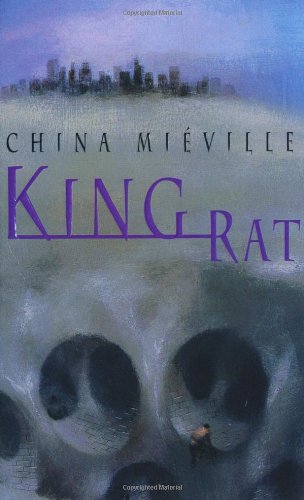
King Rat by China Miéville

Pan, 1999. 421p

King Rat cover

Saul Garamond is arrested when his father is found dead having fallen, jumped or been pushed, through a window of their house. Saul is sprung from custody by a mysterious figure who calls himself King Rat and asserts that Saul’s mother was a Rat. King Rat is able to move freely between the London which Saul knows and the unnoticed spaces which constitute a hidden Rat city. Under his tutelage Saul becomes rat-like too but King Rat, of course, is not quite what he seems. In this netherworld Saul also meets the Bird Superior, Loplop, and Anansi, head of the spiders. Meanwhile Saul’s friend Natasha, a creator/DJ of Drum and Bass, is befriended by a mysterious flute player called Pete and Police Inspector Crowley is increasingly puzzled by the spate of bizarre and bloody murders occurring on his patch.

The other city conceit seems to be one of Miéville’s running themes; it also occurs in Un Lun Dun and THE CITY & YTIC EHT though of course this would be its first appearance. (King Rat is the last in my attempt to catch up with Miéville’s oeuvre apart from his latest Kraken.) This one is very London-centric though, which annoyed me strangely.

The language of the novel is simple; even a little sketchy at times. In this it has pre-echoes of Un Lun Dun. Indeed, were it not for the violence and the expletives this could well have been a tale for young adults.

Though the plot strands do cohere and music is integral to its resolution, at times the novel appears diffuse, as if it does not know whether to be a fantasy, a musical odyssey or a police procedural – though it has embedded within it a nice retelling of the Pied Piper of Hamelin story told from the rats’ point of view. Miéville also takes the opportunity to throw in a minor bit of political consciousness raising.

Had I read this on first publication I could certainly have foreseen an Un Lun Dun – though perhaps not a Perdido Street Station.

But: One of the characters seems to be under the impression that layered music never existed before Drum and Bass. Come off it.

Un Lun Dun by China Miéville

Pan, 2007. 522p.

This is Miéville’s first book for younger readers. It is also copiously (and well) illustrated by the author. In it Zanna and Deeba, two of a group of normal young teenagers in London, are beset by strange occurrences. They are attacked by smoke tendrils, freaked out by an ambulatory umbrella and Zanna is addressed as Shwazzy several times during different chance encounters in one of which she is given a card naming her as such.

Soon they are both transported to a strange place where the sun is too large – and doughnut shaped – weird and colourful characters abound and telecommunications work through the medium of what can only be described as carrier wasps. Zanna is revealed as the choisi – chosen – the girl who will save the abcity of Un Lun Dun (unLondon) from the menace of the Smog. She is presumed to know the details of the Armets and their secret weapon the Klinneract which saved real London and drove the Smog to Un Lun Dun. (This parallel existence also contains other abcities such as Parisn’t, Lost Angeles, Sans Francisco and Hong Gone.)

The book which contains the Shwazzy prophecy – and which speaks morosely a la Eeyore or Marvin – turns out to be wrong, though, and Zanna is unable to help. She is incapacitated by the Smog whose attack is only driven off by using specially slit and treated unbrellas made by Mister Brokkenbroll to ward off the smog’s projectiles. With this apparent victory Deeba and the still far from well Zanna return to London. But Deeba cannot forget her experiences, realises that not all may be well in Un Lun Dun and so makes her return. On her quest to find a weapon to defeat the Smog she is accompanied by the aforementioned Book of Prophecy, Bling, a silver furred locust, Diss, a brown bear cub, a four-armed, four-legged, many-eyed man called Cauldron, a half-ghost, half-normal boy called Hemi, and Curdle, an animated milk carton Deeba adopts as a pet.

There are some nice coinages – mostly portmanteau words like smombies, Propheseers and smoglodytes. Mister Brokkenbroll – the Unbrellissimo – is a particularly redolent case. There are also glazed, wooden framed, eight legged things called Black Windows. These are just a few examples of Miéville’s playful linguistic invention.

There is more than a hint of Alice in Un Lun Dun though generally Through The Looking Glass rather than Adventures In Wonderland. This is underlined on page 296 when the Speaker of Talklands echoes Humpy Dumpty by saying, “WORDS MEAN WHATEVER I WANT.” We also have a pair of Tweedledum/Tweedledee-ish mitre-wearing clerics, in white and deep red robes respectively, who only move in zig-zags. There are parallels too with THE CITY & YTIC EHT Miéville’s recent adult novel, which I reviewed here.

Un Lun Dun is an enjoyable romp. For its target audience I would have thought it might be more than a touch too long, though its young readers may welcome a long immersion in Miéville’s skewed world.

free hit counter script