Archives » BSFA Awards

The Push by Dave Hutchinson

Newcon Press, 2009, 95p

The Push

The Push is the freebie book included in my BSFA August mailing in lieu of the usual magazine.

I realized when I was reading this that it was a story that had been nominated for the BSFA award in 2010 and appeared in the BSFA booklet. My thoughts on it at that time are here.

I may have been a trifle harsh on that occasion. Re-reading it I found the characterization again fine, the humour agreeable and not overdone and the plot satisfying. Perhaps it being in book rather than booklet form had a subliminal effect, lending it more gravitas; maybe I was just in a better mood. As its appearance in book form suggests The Push is not really a short story, more a novella. It’s a fine example of Science Fiction, worthy of its nomination.

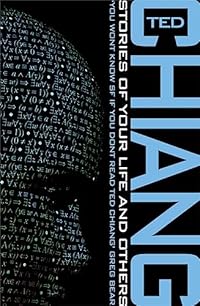
Stories of Your Life and Others by Ted Chiang

Tor, 2004, 333p.

 Stories of Your Life and Others cover

Chiang has won a slew of awards in the SF field but his output is small and restricted to stories short of novel length. His short story Exhalation won the BSFA Award in 2009. This is his only collection so far published.

Tower of Babylon is set in ancient Babylon where a group of miners is called in to ascend the eponymous tower and mine into the vault surrounding the world. The tower is so high it takes them four months to reach the top before they can begin the task. The cosmology of this Earth seems at first to be Ptolemaic – they pass the moon and the sun on the way up (not to mention stars) but in the end is even weirder.

In Understand a brain-damaged man has been given a drug called Hormone K to take him out of a coma. Tests reveal his memory and brain-processing power to be enhanced. This is reminiscent of Flowers For Algernon but Chiang takes the story arc in a different direction.

Division by Zero has a mathematician discover a proof that threatens to undermine the reality of maths. The story is structured in numbered sections 1, 1a, 1b, 2, 2a, 2b, etc in which the first in each subsection is always a description of a theorem from the history of maths.

Story of Your Life. A linguist is employed to understand the language(s) of heptapodal aliens newly arrived to Earth. Their written and spoken languages differ radically as their worldview turns out to be non-sequential. The turning point in her discovery comes through the use of diagrams (reproduced in the text) showing the refraction of light. The story’s narration – as if to the linguist’s daughter – reflects non-sequentiality, employing usages such as “you will say” and “your father is about to.” This story is an example of the type of speculative narrative which can only be achieved through the medium of Science Fiction.

Seventy Two Letters is a kind of steampunk story (but not quite) set in a Victorian type society where sexual reproduction is different from in our world (both sperm and eggs contain homunculi which have to merge before a fœtus can form) and automata can be activated by sliding names into slots. It turns out that naming – or at least its encoding – is very important in this universe. The story draws on a wide variety of fields for its inspiration and is admirably worked out. But the characters are wooden.

The Evolution of Human Science. In a world featuring metahumans utilising digital neurotransfer the story is couched as a scientific report commenting on the differences and similarities between ordinary and meta-humans. Diverting but no more.

Hell is the Absence of God. Angels manifest themselves on Earth, each visitation accompanied by devastation of some sort. Hell is visible through brief transparent openings and there is visible evidence of souls ascending to Heaven when people die. Neil Fisk’s wife dies as a result of a visitation. He spends the rest of the story trying to love God.

Liking What You See: A Documentary. The narrative is couched as transcripts of interviews and video clips from a documentary about the use of calliagnosia, a procedure whereby its recipients no longer react to the beauty (or ugliness) of people’s appearance.

Chiang’s stories are always well delineated, thoughtful, thought provoking and frequently impressive. Intellectual even. They do however have a tendency to be told rather than unfolded. There is a dryness to the delivery, a distancing. Readers looking for engagement may be disappointed.

Where Have All The Good Times Gone?

Science Fiction is dead – again.

Or at least moribund according to Paul Kincaid in his review of both of the Year’s Best SF collections for the LA Review of Books.

Actually I have some sympathy with parts of his argument – which does chime with what I said about this year’s BSFA Award short story nominees.

I also agree that when the SF tips over into Fantasy or wish fulfillment, the “six impossible things before breakfast” scenario, we might as well give up.

He may also have a point about a lot of modern short story – or novel length come to that – SF being retreads of well-worn themes. (But the writer in me says that if I nevertheless have something to say, a newish angle on a trope if you will, doesn’t that story deserve to be told? We can’t all be dazzlingly inventive all the time. And while of course SF ought to harbour, even showcase, the experimental the virtue of a story starting at the beginning and going right through to the end is often a relief as a reader.)

Where we really differ, though, is in Kincaid’s seeming request for optimism. I don’t know about Paul but I can’t see much to be optimistic about right now; nor for the foreseeable future.

I obviously can’t say often enough SF is never about the future. It’s about now. And the here and now is profoundly depressing.

I suppose a little hope would not go amiss but where is it to come from? The Arctic ice is melting at a rate of knots, extreme weather events are multiplying and we haven’t been back to the Moon for 40 years.

We might not deserve it perhaps but we may be getting the only SF that is presently possible.

BSFA Awards Result

The BSFA Awards for fiction this year coincided with my views.

Chris Priest’s The Islanders won the best novel.

And Paul Cornell’s The Copenhagen Interpretation the short story award.

John Meaney’s compering of the awards has attracted some criticism.

the guardian* reported only on the novel award, unsurprisingly focusing on Chris Priest’s Clarke Award comments.

*I hate that lower case!

Clarke Award Stushie*

It seems Christopher Priest, whose BSFA Award listed novel The Islanders I am reading as we speak (or read, or converse, or whatever-the-hell-it-is-we-do-on-the-internet,) has attacked this year’s Clarke Award shortlist.

Go on. Read it. It’s an entertaining rant however unfortunately open to the charge of sour grapes at not himself being on the Clarke list it may be. (Priest tries to cover this angle by saying he would withdraw his novel from any consideration if the Clarke list were to be rethought as he proposes.)

I would insert the turbulent Priest joke here but someone used it decades ago in one of the BSFA’s journals and I actually think Priest has a point. Perhaps several.

My impression of the BSFA shortlist novels I have read is that last year wasn’t a particularly good one for SF novels – though my sample is admittedly small. And I agree that to have China Miéville win the Clarke Award for a fourth time would suggest that no-one else need bother writing SF (nor fantasy) as we could all then give up and go home.

I disagree, though, with his interim assessment of Adam Roberts’s By Light Alone. See my review here.

Charles Stross (whom Priest castigates in his piece) has linked to a comment thread engendered by Priest’s rant and has also seized upon the criticism as a marketing opportunity (see link to Stross’s post.)

Among other things Priest complains Stross writes “och-aye” dialogue. “Och-aye” dialogue. What’s wrong with that? People do not necessarily speak RP, or estuary, or USian, now or in the future. Get over it.

By the way, I used to receive a yearly invitation to the Clarke Award do but I could never go – it’s in London and I always had work that day and the next. Those invitations dried up some while ago now, though.

*Stushie is a Scottish word for contretemps.
stushie [ˈstʊʃɪ], stishie, stashie
n Scot
1. a commotion, rumpus, or row
2. a state of excitement or anxiety; a tizzy. Also spelled stooshie, stoushie.

Clarke Award Shortlist

The Clarke Award (named obviously for British SF pioneer Arthur C Clarke) is an annual award for the best SF novel of the year. It’s fair to say its choices lean towards the literary end of the SF spectrum and its shortlist usually provides a marked contrast to the BSFA Award.

This year’s shortlist – for novels published in 2011 – is here and is reproduced below:-

Greg Bear, Hull Zero Three (Gollancz)
Drew Magary, The End Specialist (Harper Voyager)
China Miéville, Embassytown (Macmillan)
Jane Rogers, The Testament of Jessie Lamb (Sandstone Press)
Charles Stross, Rule 34 (Orbit)
Sheri S.Tepper, The Waters Rising (Gollancz)

Of these I have read only Chinatown. (Edited to add:- I meant Embassytown.)

Compare and contrast the BSFA Award list:-

Cyber Circus by Kim Lakin-Smith (Newcon Press)

Embassytown by China Miéville (Macmillan)

The Islanders by Christopher Priest (Gollancz)

By Light Alone by Adam Roberts (Gollancz)

Osama by Lavie Tidhar (PS Publishing)

My strike rate here is higher; the Miéville, the Roberts and (currently reading) the Priest.

BSFA Awards Short Stories

Over the past few weeks I have read the short stories nominated for this year’€™s BSFA Awards. I am assuming that, as in the past couple of years, the BSFA will be producing a booklet containing them but since each has been posted on the internet (there is a link from the BSFA’s Awards page to the online versions which is how I managed to read them – though I found off a screen is not the most comfortable of ways to do so) perhaps that might not happen.

The Silver Wind by Nina Allan, from Interzone issue 233, is a kind of time-travel story mixed with parallel worlds. It tells of the encounter of a man from a fascistic future Britain with a genius who makes clocks (which he refers to as time machines.) To begin with there is too much info dumping and throughout a lot is told rather than shown. Perhaps the story needed more space to breathe but I felt the sureness of touch of an accomplished story teller was missing. There is a use of words that is not quite precise -€“ eg ‘hoping one soldier would not see me’ rather than ‘€œhoping none of the soldiers would see me’€ – and twice we are treated to the peculiar phrase, ‘€œIt was growing dusk,’€ but at least Allan knows the use of ‘€œnor’ as in, ‘€œnot for love nor money nor any of these new-fangled gadgets.’

The Copenhagen Interpretation by Paul Cornell, from Asimov’s, July2011, is set in an altered future where European monarchies strive to keep the balance of power throughout the Solar System, souls have weight that is aligned to dark matter and Newton came up with a kind of relativity theory which allows space to be folded – all amenable to a tale of espionage and derring-do admixed with betrayals of various sorts. This stretches suspension of disbelief at times but overflows with ideas and is excellently written.

Afterbirth by Kameron Hurley, from Kameron Hurley’€™s website, is about a woman in a backward-leaning religious society which is engaged in a never-ending war, whose rulers have deliberately cut it off from the stars – originally as an escape from whatever’€™s out there but now to prosecute the war better. In her forbidden astronomical observations she finds God in a torn filter laid across the night sky. Again there is a fair bit of info dumping -€“ perhaps inevitable in stories of short length.

Covehithe by China Miéville, from The Guardian, 20/4/11, features sunken oil-rigs returning to land to drill into the earth and lay – eggs? seeds? – from which smaller rigs later emerge. Atmospheric, but again info-dumpy. The human involvement in Covehithe – a father and his daughter observing one such landing -€“ doesn’€™t really overlap with the SF background. Another scenario where society has suffered extreme breakdown and the military has a strong presence.

Of Dawn by Al Robertson, from Interzone 235, has a woman whose soldier brother has been killed being inspired by his poetry, the music of a long neglected composer, an all but forgotten TV documentary and a figure from Greek myth to produce a synthesis of poetry and music by bringing all those strands together. The final part of the jigsaw is provided by a shadowy figure in a village commandeered by the army long ago, but which had inspired both poet and musician. The story contains echoes of the Green Man myth and illustrates that English fascination with the pastoral. The info dumping here is well embedded.

The futures shown by the five stories are all bleak, having in common repressive regimes of either military or religious stamp. SF is never about the future, though. These stories tell us a lot about where we are now.

As stories though, rounded works of fiction, I found most of them unsatisfying. The only truly successful one was Paul Cornell’s. If these represent the best of last year the SF short story is in a bad way.

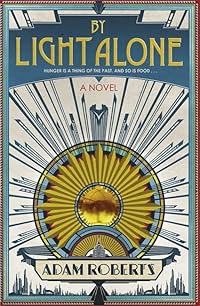
By Light Alone by Adam Roberts

Gollancz, 2011, 407p

 By Light Alone cover

I recently read Roberts’s Stone and was fairly impressed but have so far missed out on his more recent BSFA award nominated novel Yellow Blue Tibia and the earlier quite well received New Model Army. When By Light Alone popped up on this year’s BSFA Awards novel list I decided it was time to sample more.

In By Light Alone global warming has raised sea levels to the extent that a portion of “our” world has been submerged. A wall shields New York from the raised waters. More importantly the Neocles bug has enabled humans to photosynthesise, to be capable of producing blood sugars merely by breathing and drinking water. “Proper” food is scarce, a luxury available only to the rich, who take great care not to be inoculated and differentiate themselves as much as possible form the poor underclass “longhairs” – now kept jobless as there is no need to pay them. These spend hours exposing their fanned hair to the sun for sustenance.

A rich New York family on a skiing holiday in the Caucasus region has their daughter kidnapped. It is nearly a year before she is returned, changed. The novel explores the effects of the kidnapping on all involved. It is divided into four sections, each with a different viewpoint character.

The first and third parts are seen respectively through the thoughts of George Denoone, the father, and Marie Lewinski, the mother. (They are married but she has kept her own name.) The treatment in these two sections is more like a “mainstream” novel than SF. They reveal the pair and their acquaintances to be thoroughly tedious and self-regarding people, and hence fail to engage the reader’s sympathy. Of course they are meant to be aloof, being rich, and to be unwittingly treating their servants with disregard, but crucially we are not made to feel their emotions. It is as if we are seeing them all through a veil. George in particular is an extremely passive and unthinking character, annoyingly so. Indeed so disengaged is he that, in what is effectively an info dump, another character has to explain to him the ramifications of the Neocles bug.

The second section gives us the returned daughter’s viewpoint, which is more immediate and engaging. It is not until the fourth section, though, (pg 261!) that the novel starts to pick up. The focus here is on Issa, a longhair in the Caucasus. Some of this part of the book reminded me in its tonal qualities of Chris Beckett’s The Holy Machine (which is a much better novel.) Even though this section is explicitly tied into the rest at the end – by a connection fairly obvious from the off – overall By Light Alone does not fully cohere, feeling disjointed and unbalanced. It is really four shorter stories juxtaposed; not a unified whole.

I also had some problems with the scenario. Roberts does recognise the need of pregnant women for nutrition beyond mere sugars; indeed he makes this almost a plot point as they take jobs to gain the necessary food to bear a child. The males are presented as useless, not even drones. However, trace elements are necessary for everyone; not just the pregnant. The odd insect or soil which longhairs are said to eat at times would not suffice to assuage this. He also has the longhairs quickly lack energy in the absence of sunlight. Were the process in fact so inefficient it would not be worthwhile. After all plants survive throughout the hours of darkness quite well, their cells respire just as animal cells do. Indeed plants produce surplus sugars – and build them into starch.

Roberts plays on the fact that throughout human history the default state is that of poverty. The plight of the jobless longhairs is presented as an extension of this. (It is hardly Roberts’s fault but a reminder that “the poor are always with us” is not the most uplifting message to be hearing in a time of recession/austerity.)

In addition more attention could have been paid to minor detail. A character named Ysabella has her name spelled in four different ways inside the first twelve pages, though admittedly two of these are diminutives.

Roberts’s explicit referencing, twice, of a certain Arthur C Clarke phrase is a nod to the SF constituency but the SF elements of the book tend towards the perfunctory. While I am all for bringing more rigour in characterisation and the like to the SF novel By Light Alone might perhaps be falling between two stools. I really cannot see it being among the five best SF novels of last year.

BSFA Awards Shortlist

It’s that time of year again. The BSFA Award nominations are out.

The full lists can be found here.

The fiction nominees are:-

Best Novel:-

Cyber Circus by Kim Lakin-Smith (Newcon Press)

Embassytown by China Miéville (Macmillan)

The Islanders by Christopher Priest (Gollancz)

By Light Alone by Adam Roberts (Gollancz)

Osama by Lavie Tidhar (PS Publishing)

Of which I have (so far) read one.

Best Short Fiction:-

The Silver Wind by Nina Allan (Interzone 233, TTA Press)

The Copenhagen Interpretation by Paul Cornell (Asimov’s, July)

Afterbirth by Kameron Hurley (Kameron Hurley’s own website)

Covehithe by China Miéville (The Guardian)

Of Dawn by Al Robertson (Interzone 235, TTA Press)

I have read none of these as yet but only The Copenhagen Interpretation is not available online via the BSFA page linked to above. Presumably the booklet of nominated stories that the BSFA has produced for the past two years will be repeated this time around, too.

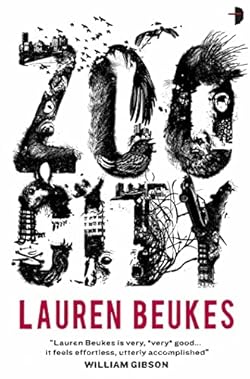
Zoo City by Lauren Beukes

Angry Robot, 2010, 349 p

(Plus 4 pages of acknowledgements, 1 page “about the author”€ and 24 pages containing three short stories from winners of a competition to set a story in the milieu of Beukes’€™s previous novel Moxyland, an unnecessary addition to my mind.)

 Zoo City cover

I have previously lamented the fact that the general run of fantasy novels seem to be set in a default mediævality and that no-one is trying to write fantasy in a contemporary setting. Well Zoo City is taken by some to be SF – it was on the BSFA Award shortlist for best novel last year – but to my mind fantasy would be a better description. In particular magic is an essential component of the setting and plot. Yet the novel takes place in the present day! (Albeit a present day thoroughly transmogrified.)

Zinzi December is an aposymbiont – who are derogatorily termed as animalled. Aposymbionts are individuals who, as a result of committing a serious crime, have gained an animal companion with whom they have a psychic link, in the process acquiring an attribute. This is not quite the same as in Philip Pullman’€™s His Dark Materials trilogy, which Beukes does refer to in the text, as in his universe the animals begin attachment at birth. Zinzi’s companion is a sloth and her attribute is sensing lost objects. She can follow psychic threads to recover things. This is her apparent job but to pay her debts she moonlights as an email scammer. She is engaged by two rather unsavoury individuals (both animalled) to find a lost pop star and is drawn into a world of intrigue, backstabbing and murder.

Narrated in an urgent present tense, apart from the interpolations of cod press articles and psychological papers fleshing out the background, the novel is of a piece with the thriller feel of much near future SF. But Beukes is good at this – very good indeed – the gritty realism makes her scenario entirely believable while you’€™re immersed in it. That the novel takes place in South Africa may be one factor in its appeal. African phrases and words are utilised frequently but not so as to obfuscate or confuse. The acceptance of magic is a given (as it may be in “our”€ South Africa.)

Where the story veers away from thriller SF into fantasy is that the transformation of the world to one where animals can become “€œfamiliars”€ is not given much of a rational explanation.

Zinzi and her boyfriend Benoît, whose animal is a mongoose, are well drawn, nuanced characters with full backstories which mercifully emerge from the story as it is told rather than being dumped on the reader. Others are equally believable.

This was fun, sharp and (the misuse of pre-empt aside) well written stuff.

free hit counter script