Archives » BSFA Awards

BSFA Awards List

The lists for this year have been announced.

The novels are:-

God’s War by Kameron Hurley (Del Rey)

Ancillary Justice by Ann Leckie (Orbit)

Evening’s Empires by Paul McAuley (Gollancz)

Ack-Ack Macaque by Gareth L. Powell (Solaris)

The Adjacent by Christopher Priest (Gollancz)

I’ve read one of these already and have another, Ancillary Justice, on the tbr pile.

The short fiction:-

Spin by Nina Allan (TTA Press)

Selkie Stories are for Losers by Sofia Samatar (Strange Horizons)

Saga’s Children by E. J. Swift (The Lowest Heaven, Pandemonium)

Boat in Shadows, Crossing by Tori Truslow (Beneath Ceaseless Skies)

I have so far read Spin.

The Separation by Christopher Priest

Gollancz, 2004, 405 p

This is an altered history of a superior sort which won the BSFA Award for 2002 and the Clarke Award in 2003. It focuses on the lives of twin brothers, Jack and Joe Sawyer, who both have the same middle initial and so can be easily confused for one another. The twins won a bronze medal in the coxswainless pairs at the Berlin Olympics. Their medals were presented to them by Deputy Führer Rudolf Hess, who plays a large part in the novel. Both Joe’s and Jack’s written (or transcribed) memories carry the burden of the narrative.

While in Berlin the twins stay at the home of some Jews their parents were friendly with. When they leave they smuggle the couple’s daughter, Birgit, out of Germany in the boot of their car. She soon marries Joe. After war comes in 1939 Jack joins the RAF and subsequently pilots bombing raids over Germany, while Joe is a conscientious objector and undertakes work for the Red Cross. Given the attitudes they presented while in Germany both these developments are surprising.

There is a framing device (which is not returned to so it’s more like a set-up device) where Stuart Gratton, a historian searching for his next subject, has happened upon the twins’ existence. This is a curious sort of prelude as it serves to unbalance the narrative somewhat. It is set in a world where the British war with Germany ended on May 10th 1941 (the day in our world when Hess landed in Scotland and was taken prisoner). An untrammelled Germany then overpowers the USSR, the USA is embroiled in a war in China – where it defeats Mao – and there is a subsequent Cold War with Germany. Yet the notebooks Gratton receives from Jack Sawyer’s daughter describe memories from our world. In these notes Jack is asked by Churchill to meet the imprisoned Hess and concludes the prisoner is a look-alike. That within the body of the novel The Separation Gratton does not comment on these discrepancies compared to the history of his world struck me as odd. That there may be a possible connection between Gratton and the twins is something we have to infer for ourselves.

Possibly due to his conscientious objection Joe is set upon and suffers head injuries. Thereafter he experiences “lucid imaginings” – premonitions, hallucinations, experiences from other realities – which provide a rationale of sorts for the altered history. The hint of unreliability hangs heavy over all of this though.

There is not one separation here but several. A possibility, not of one altered reality, but quite a few. Whether the real Hess took off for Britain (claims that the Hess tried at Nuremberg and held in Spandau Prison was not real have been refuted) whether he was shot down by his own side, the twins’ estrangement due to them both loving Birgit, the peace talks and armistice, Joe’s “imaginings,” Gratton’s from the twins.

I’m not entirely sure that in the end the novel as a whole coheres but Priest’s writing is always enough to make the journey through one of his books worthwhile.

More Awards News

Great to see that Ian Sales’s BSFA Award winning Adrift on the Sea of Rains has made it to another awards short list, this time the Sidewise Awards; which are for Altered History (or Alternate History as they affect to call it.)

Clarke Award Shortlist

Last year it was Chris Priest who incited controversy over the Clarke Award, this year it seems to be the judges themselves – for not including a book by a woman on their shortlist.

The contending books are:-

Nod by Adrian Barnes (Bluemoose)
Dark Eden by Chris Beckett (Corvus)*
Angelmaker by Nick Harkaway (William Heinemann)
The Dog Stars by Peter Heller (Headline)
Intrusion by Ken MacLeod (Orbit)*
2312 by Kim Stanley Robinson (Orbit)*

I’ve read the last two of these and Dark Eden is on the TBR pile.

The overlap with this year’s BSFA Awards novel short list is strong (asterisked titles) but only 2312 is also up for the Hugo.

I’m a bit surprised that M John Harrison’s Empty Space didn’t make the list, it’s the sort of book that Clarke Award juries tend to like.

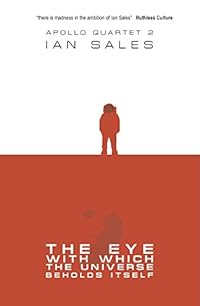
The Eye With Which the Universe Beholds Itself by Ian Sales

Whippleshield Books, 2013, 80p.

This is the second in the Apollo Quartet, the first of which, Adrift on the Sea of Rains, has just won the BSFA Award.

Once again we have an Altered History. Here, Alexei Leonov was the first man on the Moon but the Russians quickly gave up going there to concentrate on Space Stations. Our hero, Brigadier General Bradley Elliott, USAF, though, was the first – and only – man on Mars, in 1979. What he found there drives the plot as he is recalled to NASA twenty years later to undertake a faster than light trip to Gliese 376 to investigate what has happened to the colony there.

As in Adrift, there are two strands interleaved with each other (which is not unusual) and tricks with typography but again the Glossary which follows rounds out the tale – even if one part of it appears to contradict a piece of dialogue in the text. That latter could have been a deliberate misdirection, though and a Coda explaining the central conception and the FTL drive is a less successful addition to the formula.

With his utilisation of the glossary Sales seems to have found a new way to tell the space exploration story. It is of course a species of info dumping but he has arguably turned the necessity into a strength.

He is very good on the nuts and bolts of space travel, especially if you can thole the alphabet soup of NASA terminology. A list of abbreviations is given to help with this. Elliott is a complex enough figure though the other characters are less fleshed out; but in an 80 page book only 47 of which are actual story it could hardly be otherwise.

BSFA Awards Stop Press

Via Jim Steel’s blog we have this year’s Awards as given on tor.com.

Jack Glass by Adam Roberts won for best novel. (I have not yet read this.)

Best short story was Adrift on the Sea of Rains by Ian Sales.

I’m delighted for Ian.

Best Artwork was Blacksheep for the cover of Jack Glass

Best Non-Fiction winner was The World SF Blog, Chief Editor Lavie Tidhar.

Congratulations to all the winners.

Edited to add:- I have now added the World SF Blog to my sidebar.

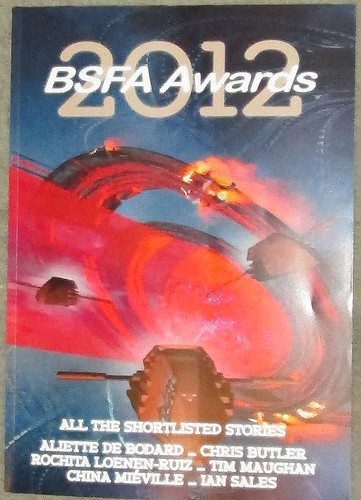
BSFA Awards 2012 Short Stories

All the Shortlisted Stories BSFA, 2013, 90 p.

(The awards for 2012 will be presented this Sunday (31/3/13) at the Bradford Eastercon.)

BSFA Awards Booklet 20122013

Immersion by Aliette de Bodard (Clarkesworld, no. 69)

A domineering culture known as Galactic has a piece of tech called an immerser which at once disguises its wearer but also provides him or her with cues to fit in culturally.
The narrative is twofold – one in second person from the viewpoint of a non-Galactic woman who never takes her immerser off (originally in an effort not to embarrass her Galactic husband,) the other in third person focusing on Quy, a non-Galactic inhabitant of Longevity Station, and whose sister Tam is trying to unravel the complexities of Galactic tech to neuter the effect of immersion.

The story could be read as an allegory of US influence on the modern world, the (possibly unthinking) extension of its ways and attitudes onto other cultures. Equally valid is the view it is about addiction (in this case to immersion) or even submersion. The immerser acts as a kind of hijab, hiding its wearer behind a persona. In the process it removes some of the personality it covers.

Doubts concern the mechanics of the story and the relationships within it, examination of which makes it, in the end, unconvincing.

There was a strange usage (late minute revisions) and a typo (it wasn’t where Quy’s had last left it.)

Song Of The Body Cartographer By Rochita Loenen-Ruiz (Philipine Genre Stories)

Among a set of creatures known as Timor’an, Siren is a body cartographer tasked with examining her lover Inyanna’s body map to find the reason for her inability to fly with a windbeast. And then to carry out the repair work which might mean Inyanna will leave her forever. Told in third person from Siren’s viewpoint this is a simple love story with an unusual setting.

The reading experience is marred by a few infelicities (dispair, a simply relocation) plus some misplaced commas.

The Flight of the Ravens by Chris Butler (Immersion Press)

This is a novella rather than a short story. Set mainly in Amsterdam in 1889, with excursions to Vienna and Frankfurt and also to the Amsterdam of 1452, it starts with two children entering a house and encountering an old man and a vortex which absorbs one of them. The remainder works through the ramifications of this for the girl, Elizabeth, and the father of the boy, Huginn Raaf, who form a compact to try to prevent a reoccurrence of the tragedy. The narrative features a fire giant confined within the vortex and a rather unconvincing Sigmund Freud whom, under Huginn’s prompting, Elizabeth consults. The ravens of the title are Odin’s companions, Muninn and Huginn. (Yes.) The characters don’t come to life and Butler’s use of words is occasionally awkward while his adoption of viewpoint within a scene can be too diagrammatic -“This was it then,” when we reach the climax? Otherwise the text was clean. To my mind this is a fantasy story, and not SF.

Limited Edition by Tim Maughan (1.3, Arc Magazine)

In an intensely surveilled society – an exaggerated version of our consumer driven one – a new type of must-have trainers which make stuff appear round them every time thee touch the ground is advertised on to the spex people wear. On spex, ))blink((ing takes the place of mouse clicking on a computer. Cash-starved Grids and his mates decide to raid the shop the trainers will be sold in to get themselves the shoes. The narrative is interspersed occasionally with Twitter style comments from the affluent or deprived commenting on the proceedings as they unfold.

The characters speak in a demotic that attempts to be futuristic or “street.” The twist, when it comes, is not really surprising.

There were two grammatical oddities. “Him and College look skyward.” “His clothes is splattered.”

Three Moments of an Explosion by China Mieville (Rejectamentalist Manifesto)

This is an extremely short piece (550 words or so) featuring the extension of marketing into warfare and (here) demolition projects. Logos appear in the explosion remnants. Its main thrust, though, deals with people who use a time-dilating drug to climb and descend the building as it collapses in what would be the most extreme of sports. It did contain, though, an irritating overuse of “&” instead of “and.”

Adrift on the Sea of Rains by Ian Sales (Whippleshield Books)

My (extended) thoughts on this are here.
The more remote from it I get the better this story lies in my memory.

Marcher by Chris Beckett

Cosmos Books, 2008, 304 p.

A drug called slip allows people, shifters, to move between parallel universes – which are arranged in a tree shape. Charles Bowen is an immigration officer in a universe (not ours) where his main job is to deal with shifters in an effort to eradicate the problem they represent. Here the poor and unemployed are kept in sink estates known as Social Inclusion Zones from which it is difficult to break free. Unusually, and all the more welcome for it, the main setting for the novel is the Bristol area. Bowen likes to think of himself as a guardian of the borders – between universes in his case – the “Marcher” of the title. He is himself attracted to shifting without at first quite knowing why.

Shifters are treated as criminals because they can do what they like and then evade capture by shifting. To be fair some of them follow the cult of Dunner, based on Norse mythology, and are dedicated to mayhem. These misfits commit a massacre in Clifton which allows the government to crack down hard on Social Inclusion Zones and any shifters – cultees or not – who are captured.

In the chapters written (in first person) from Bowen’s viewpoint his relationship with a social worker called Jazamine and his part in her shifting are treated as haunting him but the relationship itself is only portrayed at its beginning, its end (her shift) and otherwise in snapshots. Other sections are written in third person but as narrated by Bowen.

The proof-reading is at times inadequate. At various points a word required to make complete sense of the sentence is missing, “He was (a) decent man,” “He looked as if he’d (be) more comfortable,” “But (it) was hard to turn away,” and there are places where the author has clearly changed one part of a phrase or sentence but not another where sense requires it, “I’ve never understand this bit,” “Carl that he had always known that acts of courage would lead to something new,” “he had been moved him to another high security unit.”

Beckett’s previous book The Holy Machine was a treat despite suffering from the same issue with words missing. Marcher is less focused and also has too much telling rather than showing plus some not too well integrated info-dumping. His latest novel, Dark Eden, has been nominated for this year’s BSFA Award.

BSFA Awards Time Again

BSFA Awards Booklet 20122013

Yesterday the booklet containing the short listed stories and artwork for the BSFA Awards for works from 2012 landed on my doormat.

It’s a handsome enough thing, seeming thicker than in previous years.

I’ve already read Ian Sales’s Adrift on the Sea of Rains (my thoughts on that are here) and three others of the stories on the internet which I was going to post about soon.

I’ll now be able to complete the set before voting.

BSFA Awards 2012

The BSFA Award shortlist for stories published in 2012 has been announced.

For best novel we have:-

Dark Eden by Chris Beckett (Corvus)

Empty Space: a Haunting by M. John Harrison (Gollancz)

Intrusion by Ken MacLeod (Orbit)

Jack Glass by Adam Roberts (Gollancz)

2312 by Kim Stanley Robinson (Orbit.)

Unusually I have read three out of the five already, two of those courtesy of Interzone and its kind reviews editor. Thank you, Jim.

My views on 2312 I posted on this blog only two days ago. Those on Empty Space will be forthcoming.

Intrusion I reviewed here.

As for the short stories I have read only one of them so far, the last on this list; and very good it was too.

Three others, though, are available to read on the net. Doubtless the BSFA will be producing its usual booklet.

Immersion by Aliette de Bodard (Clarkesworld no. 69)

The Flight of the Ravens by Chris Butler (Immersion Press)

Song of the body Cartographer by Rochita Loenen-Ruiz (Phillipines Genre Stories)

Limited Edition by Tim Maughan (1.3, Arc Magazine)

Three Moments of an Explosion by China Miéville (Rejectamentalist Manifesto)

Adrift on the Sea of Rains by Ian Sales (Whippleshield Books)

free hit counter script