Posted in Architecture, Trips at 20:00 on 17 July 2018
So farewell, then Orkney. The Castle of Mey, formerly owned by Queen Elizabeth the Queen Mother, was so close to where we made landfall on the Scottish mainland once more that it made sense to visit. It is, after all, far too far for a day trip.
Castle from car park:-

Going through the gate seen in the above photo leads to the side of the castle. The castle’s garden is behind you in this view:-

Front view of castle:-

I had taken the rear view before entering the castle proper. No photos were allowed inside:-

Castle from garden:-

Pentland Firth and Hoy from the castle’s garden:-

I took this to try to capture an image of the Old Man of Hoy. A telescope on the elevated platform the previous photo was taken from showed it, just, but it was too misty without sufficient magnification:-

This is Dunnet Head – the northernmost part of the Scottish mainland, from the car park at the Castle of Mey. (I managed to capture a bird in flight as well):-

No Comments »
Posted in Reading Reviewed, Science Fiction at 21:50 on 24 July 2013
Gollancz, 2012, 611 p
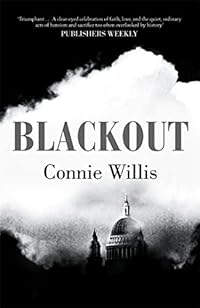
Why does Willis have a fascination with the 1940s Britain of the Second World War? One of her most celebrated short stories, Fire Watch, is about the preservation of St Paul’s from destruction in the Blitz, To Say Nothing of the Dog relied on the bombing of Coventry Cathedral for its plot motor and now we have a whole novel (split into two parts – I still have All Clear to come) devoted to the subject. (There are scenes set in the similarly troubled London of 1944 under doodlebug bombardment but these end when one of the characters is apparently hit by a V1 and we are thereafter firmly stuck in 1940.) Fair enough, Pearl Harbor, D-Day and the Battle of the Bulge get mentions but you’d have thought a USian would have been more interested in these scenarios – or the Pacific War. Or is it that the details of those would be more familiar to her core US readership and she thinks she can busk it here? I certainly wasn’t convinced that life during the Blitz was anything like Willis describes it here.
As to details, the back cover puff from the Washington Post “every detail rings true” raises a hollow laugh in a British reader; for the details are what consistently hit wrong notes. For example, we hang out the washing, not the laundry – hanging out a building where washing takes place would be a mite difficult. And again, our trains and buses have timetables, not schedules. The text is littered with such divergences in use of language. This is not a trivial criticism; the characters are supposed to be British (though one has a US language implant) and it is their viewpoints we experience. Even more egregiously, in a chapter heading about not evacuating the princesses to Canada the relevant quote is attributed to their grandmother Queen Mary rather than their mother Queen Elizabeth.
As is usual in Willis’s Oxford Time Travel stories we start in the Oxford of 2060 where historians are “prepping” to make use of the time travel apparatus to experience their periods of study themselves. Between our time and then there has been some sort of disruption (the Pandemic – and a terrorist with a pinpoint bomb has blown up St Paul’s) but the feel of this future is curiously old-fashioned. Desk top telephones for urgent communication?
The plot depends on things going wrong with the mechanism of time travel, preventing the historians’ return to the future. Slippage of location and time of each “drop” are not unexpected – there are apparently inviolable rules for when and where a historian can be dropped and when the drop may reopen plus divergence points to which there is no access. It is not surprising to the reader, though, that not all goes smoothly: disorganised is too mild a word to describe the 2060s lab. This renders all the anguishing of the characters as to why their drops won’t open, that it’s their fault, tiresome.
Blackout is the usual Willis read, though, despite her famous technique, in her presentation of awards speeches, of digression to build up tension being grossly overused. In a novel it only delays getting to the point and is an almighty irritant but I suppose it helps to increase the word count.
I’m at a loss to understand why the Blackout, All Clear combination won the Hugo Award last year. The only other novel on that year’s list I have read, Ian McDonald’s The Dervish House, far outshone this.
No Comments »
Posted in War Memorials at 17:45 on 14 October 2012
This is the War Memorial in Glamis village, near to the entrance to Glamis Castle, a bit north of Dundee. Very dignified and well proportioned.

The main plaque gives the names of the fallen in the Great War.

Noteworthy here is the top name, Captain The Honourable Fergus Lyon. They probably didn’t have room to write Bowes-Lyon. He was the brother of the late Queen Mother, Elizabeth Bowes-Lyon, wife of George VI, mother to the present Queen Elizabeth. She was brought up at Glamis Castle. His loss is supposed to have affected her greatly and is said to be the reason why she placed her bridal bouquet on the tomb of the unknown soldier in Westminster Abbey as she entered before the ceremony.
The names are given in order of military rank. Glamis is a very small place, for there to be so many names implies the memorial encompasses the surrounding area and emphasises the casualty rates in World War 1.
By contrast the other plaque, for 1939-45, has only five names. (This disparity in numbers is reflected in War Memorials up and down the land. In World War 1 Britain and its empire carried the main Allied burden of the war from approximately mid 1916 up to mid 1918. Certainly after the French Army mutinies of 1917 till the arrival of US troops in earlyish 1918, and arguably after. In World War 2 the bulk of the fighting took place in the USSR and the Pacific, areas where the British Empire presence was less influential.)

Though the order here doesn’t follow military rank (the fourth name is preceded by GNR, presumably a General) it seems to follow the social one but is otherwise alphabetical.
First named is Captain The Honourable John Patrick Bowes-Lyon, Master of Glamis.
The Master of Glamis!
This was a time when we really were all in it together. His status as Master of Glamis didn’t stop him serving, nor being killed in the war.
No Comments »
