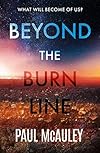
Beyond the Burn Line by Paul McAuley
Posted in My ParSec reviews, Reading Reviewed, Reviews published in ParSec, Science Fiction at 12:00 on 14 September 2023
Gollancz, 2022, 459 p. Reviewed for ParSec 6.
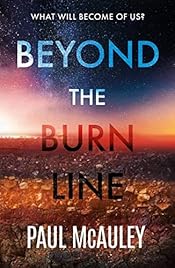 The burn line is a geological stratum of scorched remains marking where a catastrophe – partly of their own making – befell what the inhabitants of a far future Earth remember as ogres. After the ogres’ demise a civilisation of intelligent bears developed, bears who enslaved Pilgrim Saltmire’s people before the bears in turn lost sway and regressed to feral habits. But the people’s memories of enslavement are long and bitter. The society in which Pilgrim lives is at a more or less agrarian level, transport is typically by four-legged animal known as a mara, though a slow growth is occurring of techne inspired by artefacts dug up from archaeological sites, for example messages are being sent by tapcode. The prevailing religion’s deity is referred to as Mother, a mother who could at first be interpreted as Mother Earth but turns out not to be.
Saltmire has a gammy leg, is an albino and a pure – a person who doesn’t feel the effect of the yearly Season, and is pitied for it. We follow his story after the death of his mentor, the scholar Master Able, who spent his time trying to elucidate whether accounts of strange visitors accompanied by lights in the sky had any truth to them. Saltmire’s wish is to carry on Able’s work but all his writings were returned to Able’s family on his death and Saltmire is forced to go back to his own tribe to try to obtain funding to carry on the work. It does not go well and he is exiled for a year for a violent, though in self-defence, attack. In exile, he is charged with setting to rights a neglected library. One day he discovers a map which appears to show a visitor beside a hitherto unknown bear city. Unfortunately, he falls foul of the local law enforcement officer and loses the map to him. Thereafter, the remainder of Part One of the book, Archaeologies of Memory, lies in his attempts, along with members of The Invisible College, a group of female activists, to regain the map via a prophet, Foeless Landwalker, who claims the coming of the visitors is imminent and has gathered a cohort of adherents to call them down. Like all such, Landwalker’s connection to the object of his obsessions is negligible. When the visitors reveal themselves, it is not to him.
There is then a sudden jump to Part Two, The Other Mother. Pilgrim Saltmire is fourteen years dead, the visitors, descendants of ogres – humans sent out in seedships in a failed attempt to colonise other planets but now returned – live openly with, but separate from, the people (who are much smaller in stature, being descended from racoons) with treaties regulating their interactions. The controlling intelligence of the returned seedship, an AI, is referred to as Mother and has an array of advanced technologies at her disposal.
Human Ysbel Moonsdaughter of the Bureau of Indigenous Affairs is sent to investigate the deaths of two of the people as a result of a speedboat race between two humans, Trina Mersdaughter and Joyous Hightower. The local bailiff she is dealing with, Goodwill Saltmire, is Pilgrim’s nephew and he realises that the map, the prize Mersdaughter and Hightower were racing for, is the same one his uncle had lost. Its hint of a possible connection between humans and bears long before the recent supposed First Contact combined with a possible re-emergence of intelligent bears has potentially threatening consequences for relations between humans and the people. Ysbel’s investigations delve into the map’s background, unfold the history and antagonisms of both Mothers – and the possible existence of a third. During them she meets numerous setbacks, betrayals and agents acting in bad faith. At one point her commlink to the Mother’s network is memorably described by one of the people as a “telephone in her head.”
It is not often that a work of Science Fiction has as its central focus, its plot driver, a historical artefact. (Of course, to us readers in 2022 it is in effect a contingent future one.) The blending of far future SF with a quest for a defiantly mundane document works well here and the notion of a reverse First Contact is a neat twist to that trope. The main characters are depicted acting in recognisable ways (sometimes all too recognisable) but nevertheless have individuality.
Some may complain this is all too narrowly drawn, that the First Contact is witnessed but its immediate ramifications are not. That the climactic battle between the two Mothers occurs off-stage. But the stories of individuals caught up in larger events are as, if not more, worthy of depiction as those events themselves. It is, after all, as individuals that we live our lives.
Pedant’s corner:- “‘where you’re planning to go, someone like you is you’re going to need someone like me’” (doesn’t need the ‘you’re’,) “reached a brief crescendo” (brief climax,) “jutting at at different levels and angles” (either no first [or second] ‘at’, or, ‘jutting out at’.) “ ‘So far no one will tell me who am I supposed to be co-operating with’” (who I am supposed to be co-operating with,) “when it came of matters of trust” (when it came to matters of trust,) “the map had once been belonged to his tribe” (no need for that ‘been’,) “‘and return it my tribe’” (return it to my tribe,) make sure that that neither the humans nor native authorities” (no second ‘that’,) accidently “accidentally,) oughten’t (oughtn’t.)