Something Changed 8: Is It Like Today?
Posted in 1990s, Music, Something Changed at 12:00 on 23 March 2018
Another 90s song that alludes to the Apollo programme.
World Party: Is It Like Today?
Posted in 1990s, Music, Something Changed at 12:00 on 23 March 2018
Another 90s song that alludes to the Apollo programme.
World Party: Is It Like Today?
Posted in Altered History, BSFA Awards, Reading Reviewed, Science Fiction at 12:00 on 10 April 2013
Whippleshield Books, 2013, 80p.
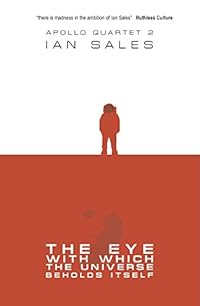
This is the second in the Apollo Quartet, the first of which, Adrift on the Sea of Rains, has just won the BSFA Award.
Once again we have an Altered History. Here, Alexei Leonov was the first man on the Moon but the Russians quickly gave up going there to concentrate on Space Stations. Our hero, Brigadier General Bradley Elliott, USAF, though, was the first â and only – man on Mars, in 1979. What he found there drives the plot as he is recalled to NASA twenty years later to undertake a faster than light trip to Gliese 376 to investigate what has happened to the colony there.
As in Adrift, there are two strands interleaved with each other (which is not unusual) and tricks with typography but again the Glossary which follows rounds out the tale – even if one part of it appears to contradict a piece of dialogue in the text. That latter could have been a deliberate misdirection, though and a Coda explaining the central conception and the FTL drive is a less successful addition to the formula.
With his utilisation of the glossary Sales seems to have found a new way to tell the space exploration story. It is of course a species of info dumping but he has arguably turned the necessity into a strength.
He is very good on the nuts and bolts of space travel, especially if you can thole the alphabet soup of NASA terminology. A list of abbreviations is given to help with this. Elliott is a complex enough figure though the other characters are less fleshed out; but in an 80 page book only 47 of which are actual story it could hardly be otherwise.
Posted in Television at 14:00 on 15 January 2011
The Signature Edition. HBO, 1998.
This box set was one of the presents I received in December. I think it was for my birthday, though, rather than Christmas. I missed it when it was transmitted in Britain.
The series is Tom Hanksâs eulogy to and elegy for the Apollo programme. Said actor appears only in the last episode in a frankly ridiculous and unnecessary role as assistant to Georges Méliès whose early film Le Voyage Dans La Lune, disgracefully stolen by Thomas Alva Edison for US distribution, was the first to depict such a trip. Hanks does, however, introduce the other eleven in a walking shot at the start of each. He has a writing credit for episode twelve and part wrote some of the others.
All aspects of the US end of the space race from Kennedyâs decision to initiate the endeavour to the last Moon mission are covered.
Cleverly, or annoyingly depending on your point of view, the episodes do not all focus on the hardware and the voyages in space; though they necessarily have their place. In broader takes on the times one episode reflects on the upheavals of 1968, one on the changing attitudes of journalists, and another focuses on the astronautsâ wives. NASA expected them to shield their husbands from any domestic worries while at the same time acting as clothes horses in public and generally being uncontroversial. (Few of the marriages managed to survive in the long term. But that could be true of most US marriages, of which I believe 50% end in divorce.)
In passing we have the casual smoking of the 1960s, the unconscious sexism, and the sheer scale of the programmeâs achievement which was so very shortly after unappreciated.
Thatâs actually not quite right; it was so quickly unappreciated that it was regarded as a commonplace by the time the last three Apollo missions flew.
The most interesting to a scientist was the episode in which the astronautâs training in geology was outlined, a training which bore fruit during Apolloâs 17âs landing when they found a piece of anorthosite, in which an unmanned probe would likely have failed.
Each episode is prefaced with Kennedyâs still inspiring, âWe choose to go to the Moon. We choose to go to the Moon in this decade and do the other things; not because they are easy but because they are hard,â speech, making the series an homage to the men and women who took part in, supported, or built the equipment for the enterprise. In this it is perhaps a reflection of the belief that no such challenge faced Hanksâs generation, unlike those of their fathers (Apollo) and grandfathers (WW2.)
In all, itâs a worthy memorial to the participants in the Apollo programme and a sad reminder that in 40 years we havenât gone back to the Moon.
I could have done without the syrupy music, though.
Edited to add:- There is a fifth disc containing trailers, behind the scenes and special effects “featurettes,” histories of famous astronomers and a history of the Moon; but I haven’t bothered to look at any of that one.
