Archives » Kevin MacNeil

Love and Zen in the Outer Hebrides by Kevin MacNeil 

Canongate, 1998, 77 p.

MacNeil first published works of poetry before going on to write some of the most idiosyncratic novels to come out of Scotland this century – or indeed the past many decades. (See The Stornoway Way, A Method Actor’s Guide to Jekyll and Hyde and The Brilliant and Forever.) This was his first book of poems and comprises IV Parts, the first of which, Learning the Art, consists mostly of very short stories which are poem-like in their economy. A couple are written in a form of English which approximates the Western Isles dialect. (The author is from Lewis.) The remainder of the book contains poems – some as terse as haiku – written in English or in Gaelic with English translations appended.

Pedant’s corner:- “ ‘We’ll go hack to the pub,’” (back,) “the lay of the land” (it wasn’t a song so ‘lie of the land’.)

Best of 2017

Fifteen novels make it onto this year’s list of the best I’ve read in the calendar year. In order of reading they were:-

The Amazing Adventures of Kavalier and Clay by Michael Chabon
His Bloody Project by Graeme Macrae Burnet
A Man Lies Dreaming by Lavie Tidhar
The Panopticon by Jenni Fagan
The Stornoway Way by Kevin MacNeil
The Sea Road by Margaret Elphinstone
The Untouchable by John Banville
Swastika Night by Katherine Burdekin writing as Murray Constantine
Spaceman of Bohemia by Jaroslav Kalfař
The Power by Naomi Alderman
Imagined Corners by Willa Muir
This is Memorial Device by David Keenan
The Underground Railroad by Colson Whitehead
Kalpa Imperial by Angélica Gorodischer
Psychoraag by Suhayl Saadi

That’s six by women and nine by men. Six were SF or Fantasy, counting in The Underground Railroad, (seven if the Michael Chabon is included,) seven were by Scottish authors.

The Stornoway Way by Kevin MacNeil

Hamish Hamilton, 2005, 269 p

The Stornoway Way cover

“If you are easily offended, consign this book to the flames immediately, or return it to the shop from which you stole it.” So begins The Stornoway Way, but not the novel of that name contained within this book. The conceit is that the embedded novel is a manuscript sent to our author Kevin MacNeil by one R Stornoway (yes, the schoolboy joke is acknowledged) whose real identity – the town of the surname being one where everyone knows everyone else; and their business – MacNeil has sworn to keep secret. I doubt we are supposed to be taken in by any of this. In any case there is not really too much to be offended by; except I suppose if you are one of those determined killjoys for whom “the Old Testament was a good start, but it didn’t go far enough” with which the Western Isles and Scotland generally have historically been saddled.

The cover is a work of genius, by the way, invoking both Whisky Galore and the island obsession, also shared by much of the mainland, with alcohol. The cartoon figure, blotto, with bottle still in hand, is a particularly apposite touch. Unlike in Compton MacKenzie’s book though, the dark side of alcohol dependency gets an airing here. In case this sounds gloomy I should say that in many ways The Stornoway Way is an amusing book, but while at times comedic it is never light, and always serious. (The recitation entitled “The Neighbours We Could Have Had” might not find favour in southern parts of these islands though.) And it has copious footnotes!!!! Who doesn’t love footnotes? Admittedly a lot of these are translations of various Gaelic terms – some of which aren’t even in the text – but better footnotes than a glossary. In them for example we find the Gaelic Sasanach has no pejorative connotations, unlike its Scots/English borrowing.

Before the internal novel begins we are presented with a map of Scotland upside down compared to the usual occidentation*. This helps to illustrate the point that in Stornoway, “We do not live in the back of beyond, we live in the very heart of beyond…. Our blood relatives in Scandinavia to the left, our blood relatives in Ireland to the right.” Though “R Stornoway” perhaps overdoes it when he says, “The Western Islander’s response to our diminishing way of life is that of the oppressed the world over, from Native American to Australian aborigine: a powerful urge to drink oneself underground.” The Western Islanders – and the Scots – have been drinking themselves underground for centuries.

When the novel proper starts, poverty has brought would-be artist “R Stornoway” back to Lewis and his childhood home, which he had been avid to leave as soon as possible. From there we range over various incidents from his life, his first experience with alcohol being a seminal moment. In all of these, even his relationship with Eva, a student from Hungary, alcohol plays a significant part – as it does for Stornoway the town.

An example of the narrator’s sardonic humour occurs when he is accused of being uncaring – and an alky. He replies, ‘Some people will believe anything if you tell them it’s a rumour.’

His existential crisis comes when he wakes up beside a beautiful woman and, due to the booze, cannot remember who she is, how she came to be there, nor exactly what happened between them the night before. His decision to fetch the ingredients for breakfast without waking her backfires when he returns to find her gone. At this point there is still a substantial part of the novel to come though. Eventually he comes to terms with himself and his relationship with alcohol. “Drink doesn’t give you a better sense of who you are, it gives you a nonsense of who you are.”

The latter part of the novel has a more downbeat nature than the delicious early chapters, concomitant with the cumulative effects of alcohol on the individual personality, but even with that The Stornoway Way is overall brilliant stuff.

*One of MacNeil’s coinages, see also gloominous clouds, muselicious.

Pedant’s corner:- smoothe (smooth,) Captain Moses’ place (Moses’s, several instances,) Stevens’ (Stevens’s.)

Time Travel, Reviews, Hame and Rebellions

In an article in Saturday’s Guardian review, James Gleick examined the history of the time travel story since H G Wells more or less invented the form in The Time Machine. It was a skate over the subject really and veered into the territory of so-called Alternative History which of course I prefer to name Altered History but worth reading all the same.

In the same section of the paper was a review of Annalena McAfee’s new novel Hame. Many reviews are interesting, some make you think “definitely not”. Very few inspire you to go out and read the book concerned. Stuart Kelly’s did just that, as indeed did his review of Kevin MacNeil’s The Brilliant and Forever which I read a few months ago after also reading the same author’s A Method Actor’s Guide to Jekyll and Hyde due to the same review. McAfee’s Hame sounds intriguing and possibly funny. Definitely one I’ll look for.

I recalled McAfee’s name. She had an article in the Guardian Review some weeks ago which I wished to post about then but at the time could not find on the Guardian website but which now pops up fourth when you search her name there. The article was about the relative importance of Robert Burns and the possible balefulness of his mythologising (Aside. Why does no-one ever question this about Shakespeare?) and the continuing battle over whether Scots is a suitable medium of expression for literature.

My take is if the author wishes to use Scots it is entirely up to her or him. It may reduce the psossible readership but that is a question for author and publisher, not reader. Myself, though not very well versed in it, my mother being the daughter of two English parents, thus hardly a native speaker and unable to expose me to its richness, I do not consider Scots – as some do – as necessarily inferior form to English. It is at times much more pithy.

I have a quibble with McAfee over a detail in that piece, though. She stated that Burns was born “two decades after the failed rebellion against the Union.” While Prince Charles Edward Stuart’s Rebellion of 1745-6 was many things, not least the last flailing gasp of a failed dynasty, and the Battle of Culloden can even be considered as in some way (if you ignore its continuation into Ireland even into the twentieth century and possibly beyond,) the last of the Thirty Years War – though admittedly that was mostly fought out in German territories – it was not primarily against the Union. It was less general then that, more personal.

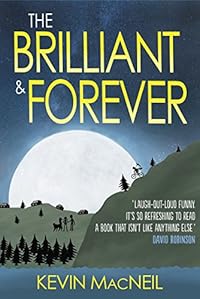
The Brilliant and Forever by Kevin MacNeil

Polygon, 2016, 251 p.

 The Brilliant and Forever cover

The Brilliant and Forever (B&F) of the title is an annual literary competition set on a Hebridean island, an island inhabited by humans – and talking alpacas. Everyone (and alpaca) on the island seems to be a writer or at least aspires to that state. The B&F is the highlight of the year and open to outsiders. There are two Decisions to be made, one by the Judges and one by the People. The judges’ winner gets signed up to a prestigious agency and an advance on a book deal.

The situation allows MacNeil to explore different kinds of demarcation. Not only is there discrimination and prejudice between (some) humans and the alpacas but the humans are divided between whitehousers (privileged) and blackhousers (less so) and there is even distinction among the alpacas from the island’s north and its south.

Our unnamed narrator – a devotee of haiku-kery, a culinary style limited to a certain number and kind of ingredients – is best friends with the human Macy and the alpaca Archie, who has the unfortunate habit of dribbling constantly (and therefore has to be accompanied everywhere by his spittoon) and is attempting to promulgate a catchphrase, “It’s like a jazz thing you don’t get.” As a writer himself Archie has entered the B&F – the first alpaca to do so for some time.

The entries to the competition are given in full. If you were to be uncharitable you could say MacNeil has found a way to shoehorn more than a few totally unrelated short stories into the format of a novel but you also have to admit it’s ingenious.

In amongst all this we have the aperçus, “‘Somehow, despite it all, something will be okay. That’s the best anyone can hope for,’” and “‘a writer tells lies to reveal greater truths and a politician tells half-truths to reveal greater lies.’”

The landscape description is a typically Scottish trait, here exemplified by, “In the broad expanse below – the mellow moorland and the flat, mirrored lakes and the muted sea and the sleeping villages – ” (though that lakes really ought to be lochs,) and there was a nice pun I hadn’t seen before; Lance Pharmstrong.

I was not entirely convinced by the stated response to the consequences following on from the People’s Decision but I shall not indulge in any spoilers. MacNeil’s is certainly an idiosyncratic and unique voice in the modern Scottish novel.

Pedant’s corner:- smartass (smartarse, please,) Madison Gardens (Madison [Square?] Garden? It was about cycling so may have been a play on Madison; but it should still be Garden,) mic (it was always mike in my day,) stoved in (staved in,) “out of his cakehole. ‘-you have….’” (comma after cakehole instead of full stop,) “how the majority were voting” (was,) he lay a plastic bag on the table (laid.) Many plus points for the wonderful portmanteau word gloominous as in “gloominous sky”.

A Method Actor’s Guide to Jekyll and Hyde by Kevin MacNeil

Polygon, 2011, 219 p.

 A Method Actor's Guide to Jekyll and Hyde cover

As a Scot I could only warm to a novel that begins – as this one does – with the sentence, “I’m in two minds.” Two minds, duality, or, as the front cover blurb here has it (medically inaccurately I would think) schizophrenia, has been a running theme in the Scottish novel from James Hogg’s brilliant Private Memoirs and Confessions of a Justified Sinner through Robert Louis Stevenson’s The Strange Case of Dr Jekyll and Mr Hyde to Angus McAllister’s The Canongate Strangler and beyond. This book has not one, not two, not even three but no less than eight prefatory quotations and its Part One is entitled “The Unbearable Likeness of Being” where our protagonist is named Robert Lewis; an actor cast in the lead role – roles – in a new stage version of The Strange Case of Dr Jekyll and Mr Hyde, at least until a new cast member appears. He is attracted to the lead actress Juliette but her interests seem to lie elsewhere. However he has suffered an accident on his bicycle and his tale may be an hallucination – especially given Part Two, “That Small Theatre of the Brain, Lighted,” which starts with Julie’s Narrative. As she waits in the hospital where her man (a writer who suffers from depression) is fighting for his life after an accident on a bicycle, Julie writes down his tale to give her comfort. He is tended to by Nurse Stevenson. The narration flips over to the man halfway through. He has the sense of, “Everything being nested inside something bigger. Images, stories, identities,” and refers to his writing as method imagining.

An unreliable but knowing narrative then, which nevertheless gives MacNeil the opportunity to comment on the state of Scotland, “Edinburgh. Home to a national parish council, an almost powerful parliament indolently bustling with her irreconcilable flow of accurate rumours and unreliable press releases. The tiny capital of our proud-to-be-humble and fighting-to-be-fought-for nation that isn’t a nation, where our Old Testament God has cursed us with a fear of failure and blessed us with a fear of success,” on being Scottish, “I went because I expected to learn how to further extend my range of emotions, harness those joyous emotions for which we Scots are so uncelebrated,” and the national sense of incompleteness, “There is no Scotland. No Edinburgh. They exist in the plural. These are places that have not yet found their true and lasting selves.” Duality isn’t quite enough to contain all Lewis’s (or Scotland’s?) dichotomies: “I contain multitudes.”

Along the way MacNeil throws barbs at the instrumental approach to acting, “‘The greatest deception the devils of method acting ever perpetrated was the myth that method acting is anything better than actual acting,’” and the insecurities of the profession, “‘Jekyll and Hyde. Which. One. Are. You. Being. Now?’”

He also tells us, “Stevenson did not create Dr Jekyll/Mr Hyde. He revealed them. Him. Them. He shed the right amount of shadowy light upon that which is within us all.”

That front cover blurb says, “May well be the last, and funniest, word on Scotland’s national schizophrenia.” While I doubt it will be the last such word it certainly has its moments. I’ll be looking out for more MacNeil.

Pedant’s corner:- vocal chords (cords,) “a quickening bourne out of sudden love” (born out of makes more sense,) smartass (smartarse,) “‘The neutrons in the nerves are responding.’” (That would be neurons; but the speaker is confused,) “I have plants out back” (USian; out the back or in the back is more usual in Scotland,) “to help leverage myself up” (to help lever myself up.)

free hit counter script