Archives » Japan

Deep River by Shusaku Endo

Peter Owen, 1994, 220 p. Translated from Japanese by Van C Gessel.

Deep River cover

I read Endo’s Silence (published 1966) and The Samurai (1980) years ago now but this is the first book of his I have read since. Endo’s writing is unlike most Japanese authors in that it is coloured by his Christianity, specifically Roman Catholicism. Silence dealt directly with the missionary times in Japan, The Samurai with the cultural differences between Japan and “the West.”

Deep River engages with yet another culture, that of India, mainly following a group of Japanese tourists there ostensibly to visit Buddhist sites but each of whom has his or her own concerns. Isobe has lost his wife to cancer but on her deathbed she whispered she was convinced she would reincarnate; he has learned of a possible candidate in India. Mitsuko has a connection to Ōtsu, a man she tormented in her college days who is now doing good works in Varanasi (the book spells this city’s name as Vārānasī throughout.) Numada is a children’s writer who wants to set free a myna bird as an act of restitution. Kiguchi is haunted by his experience on the Highway of Death in the retreat from Burma and wishes to have a reconciliatory memorial service to the fallen of both sides.

(Aside:- It is perhaps understandable that little of the hideousnesses that Kiguchi remembers from the retreat is remarked on in non-Japanese writings. In the aftermath of an ill-advised offensive which duly went wrong the soldiers were left to their own devices and suffered accordingly. But then even in their good times Japanese soldiers were notoriously ill-served by their superiors. In retreat they were just forgotten.)

While the first part of the book chronicles the back-stories of the four main characters it is India that is the true centre of the novel. All four encounter the overpowering nature of that country. The deep river is not only the Ganges at Varanasi but the mass of humanity. Yet even here Endo’s Catholicism makes itself felt. Ōtsu has his own particular take on theology, failing his seminary education by being unable to accept European views and seeing God in all religions not exclusively in one. Nevertheless he clings to what he sees as his Christian beliefs.

The trip coincides with Indira Gandhi’s assassination. This coupled with his experiences on the Highway of Death makes Kiguchi come to the somewhat jaundiced conclusion that, “It was not love but the formation of mutual enmities that made a bonding between human beings possible.”

While the manifestations of Japanese, and indeed Indian, culture may appear odd to western eyes, reading books like this shows that at their hearts people really do not vary much the world over. Here it is religion that is the biggest estranging factor.

Refreshingly the translation is into British English but there were some entries for Pedant’s Corner:- négligé (négligée,) when he laid (lay) in wait, her name in Rajini (is,) when… gets me alone this (like this,) resembling that of his dead wife’s (a possessive too far,) we’d better just lay low (lie,) of the the taxi, “a harmonium, an instrument resembling a harmonica” (it isn’t clear whether this is supposed to mean two different instruments or if a harmonium resembles a harmonica – which it doesn’t,) to eat they daily bread (their.)
Confederations Cup 2013

This year’s tournament has been very watchable stuff, even if the games involving Tahiti were total mismatches.

Italy have been strange; leaking goals in the group games was very unlike them. They reverted to defensive type in the semi-final against Spain, though, except they seemed to adopt that most un-Azzurri tactic, the ball over the top. An un-Italian inability to convert chances scuppered them in the end. I wonder if Brazil will try the ball over the top in the final. It caught Spain out a few times, confirming the sense that the Spanish are get-at-able at the back.

Nigeria look to have the nucleus of a side for the future; get themselves a clinical finisher and they’ll be there.

I was surprised that Japan ended up with no points. They were excellent but allowed themselves to be caught out. Given a good draw in next year’s World Cup they could go deep into that competition.

Brazil aren’t the full article yet either but Neymar is a player (even if he falls over too easily.)

And what a transformation for Uruguay’s Edinson Cavani from the group games – when he looked lost – to the semi-final, where he was influential all over the pitch.

(The final will probably be a let down now.)

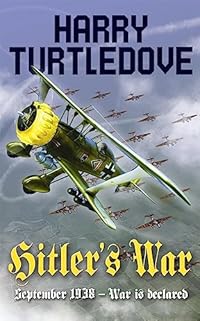
Hitler’€™s War by Harry Turtledove

Hodder, 2010, 496 p.

The usual fare from Turtledove. This time the altered history is that World War 2 starts in 1938 – though the actual Jonbar Point seems to be when Spanish General Sanjurjo survives his aeroplane flight from Portugal to Burgos to head up the Nationalist army in the Spanish Civil War which continues long after it did in our history as, after a failure of the talks in Munich two years later Hitler declares war on and invades Czechoslovakia. Major differences are that Poland then becomes a German ally, the invasion of France is not swift enough (apparently due to the early German panzers not being quite as effective as their later 1940 counterparts would be) and Japan eventually attacks the already war-embroiled USSR in Siberia.

The viewpoints are many, but hardly varied as the characters are as cardboard (or as functional) as always, or there simply to outline the war’€™s progress. The writing is as annoying as ever with its repetitions of information we already know. Particularly irritating was the observation that someone or other didn’€™t like some aspect of warfare ‘€œone bit€’ occurring again and again.

The reading is easy though; something I felt I needed after Gardens of the Sun. I don’t think I’€™ll be following the rest of The War That Came Early series though. There’€™s now another four of the beggars!

Weaver by Stephen Baxter

Gollancz, 2008, 321 p.

Unlike the previous volumes in Baxter’s “Time’s Tapestry” series which were spread over several centuries and as a result had a disjointed feel, the action in this one is spread over only a few years in the late 1930s and early 1940s. The tale is tighter and more cohesive as a consequence.

The prologue features an Irishman called O’Malley who at MIT has invented a machine he calls a “loom” with which – with the contribution of the dreams of an Austrian Jew called Ben Kamen – he has managed to send a message back to pre-Roman Britain. It isn’t long before both the loom and Kamen have been snatched by the Nazis and incorporated into their greater plan of altering history to ensure the triumph of the Reich.

The meat of the book is set in and after the invasion of Southern England by German forces once the BEF had been destroyed on the shore at Dunkirk. A hasty (and to my mind unlikely) deal by Churchill with the US sees them given military bases – US sovereign territory – south of London. As Hitler is seeking to avoid war with the US the German advance halts when they encounter these. This struck me as more of a sop to possible US readers of the book than something that would have occurred in such a scenario. The presence of a female US newspaper correspondent and her son in the cast of characters also points in this direction. A demarcation line cutting off South-East England is where the war situation settles down.

Off-stage Churchill falls as Prime Minister, to be succeeded by Lord Halifax who nevertheless continues the war – which goes on more or less as in our timeline; Barbarossa, Pearl Harbor, Stalingrad, El Alamein all get a mention, Japan’s invasion of Australia is new though. Again it may be more likely that Halifax would have sued for peace, but perhaps that would have been unthinkable with a substantial part of the UK – not just the Channel Islands – under German rule.

While Weaver can be read as a one-off with no detriment to the reading experience there are several nice touches where Baxter has his characters travel to locations which appeared in earlier books in the series; places like Birdoswald on Hadrian’s Wall and Richborough in Kent (Roman Rutupiae.)

This is the sort of thing that Harry Turtledove essays so frequently. Baxter’s characters are more rounded than Turtledove’s generally are and the extra twist of the loom makes for an added commentary on the contingency of historical events.

Infamy

I suppose a seventieth anniversary is something special but perhaps it is more so when it involves an almost iconic event.

7/12/2011 marks seventy years since the Pearl Harbor attack, the event which turned relatively localised war into World War. “7th December 1941: a date which will live in Infamy,” – FDR.

It is sobering to realise that the Second World War lasted less than four years after that. The US and UK have now had troops dying in Afghanistan for much longer than that; and in Iraq for not much less time. Not so many troops dying admittedly, but dying nonetheless.

I vaguely remember Gore Vidal saying something to the effect that the difference between Pearl Harbor and the September 11th attack was that no-one saw the latter one coming. He had a personal reason to blame the US authorities for the war with Japan, though. His lover died in the Pacific fighting.

Denmark 1-3 Japan

Royal Bafokeng Stadium, Rustenburg, 24/6/10

A thoroughly deserved win for Japan. Denmark were turgid, uncreative and pedestrian. The Japanese were quick, bright and incisive, passing the ball delightfully, and in Keisuke Honda had the best player on the pitch – though some of the other Japanese ran him close. If it weren’t likely to be construed as politically incorrect I’d have said the Japanese were nippy. The Danes weren’t at the races.

Their first two were magnificent strikes (goalkeeping aberrations accepted) but Japan’s third goal was a thing of beauty, Honda turning the Danish defender inside out and giving Thomas Sorensen the eyes before laying it on a plate for Okazaki.

(Speaking of un-PC-ness, what was it with the Germans and that black outfit in the Ghana game? I know it’s one of the colours on their flag but a black uniform on Germans has unfortunate resonances. What was wrong with their traditional green second strip?)

And what odds could I have got on New Zealand going through their group unbeaten?

As I thought in game 1, Italy were vulnerable at the back. Buffon’s absence probably didn’t help them. At least they weren’t wearing that sky blue effort – not to mention the brown shorts – they had at the Confederations Cup.

And France went out early as I expected.

More 1966-all-over-again nonsense to endure from the commentariat.

At least until Sunday.

free hit counter script