Posted in History, Trips at 12:00 on 12 February 2025
Bannockburn is the site of the Scottish nation’s birth. Had it not been for the victory Robert the Bruce won over the forces of the English King Edward II in 1314 Scotland would almost certainly have been absorbed into England, as Wales was under the previous King Edward – Edward I, known as Longshanks and also as the Hammer of the Scots. (Not that the intervening 700+ years have eroded Welsh identity entirely away nor the three hundred since the Union of the Parliaments diluted the sense of Scottishness.) But Scotland as we know it would not exist, its separate legal and educational system not even a fleeting thought.
While the fact of the battle is undeniable there is no archæological evidence of the actual battle site, most of the soldiers’ accoutrements being perishable, its exact location is now a matter of conjecture informed by historical sources and topography.
We visited the Visitor Centre in April. This is the major information board:-

There was also this tableau of the battle site constructed from historical references:-

The tour guide (a genial Englishman) was very informative and there were some cartoonish films no doubt intended to appeal to children filling in some of the background to the battle.
On the small hill outside the Visitor Centre there is a huge flagpole flying the Saltire of Scotland. It is situated within a rotunda:-


Inside the rotunda is a cairn which bears the inscription “For God and St Andrew Robert the Bruce King of Scots planted his flag near this spot when the Scottish patriots under his command vanquished the armies of Edward of England at the Battle of Bannockburn, 24th June 1314.” Below that is a quote from the Declaration of Arbroath, the assertion of Scottish nationhood sent to the Pope in 1320. “We fight not for glory nor for wealth nor honour but only and alone we fight for freedom which no good man surrenders but with his life.”

In the background above can be seen the statue of King Robert seated on a horse which dominates the area beyond the rotunda:-


Rotunda and flagpole seen from the path to the statue:-

View down to suggested battlefield site:-

No Comments »
Posted in Architecture, History at 12:00 on 18 September 2022
Lanercost Priory is not far and a bit east from Carlisle in Cumbria. It was founded in the Twelfth Century.
Just before his death Edward I of England (Malleus Scotorum of evil memory) also known as Longshanks, on his last campaign against the Scots and during his final illness spent some months at Lanercost, almost bankrupting the place.
Priory information board:-

The remains of the Priory lie behind the Church:-


In the grounds to the left is the stub of a cross, known as the Lanercost cross:-

Stitch of two photos. Remains of Priory. Church to left and cloisters and Dacre Hall even further left:-

Cloister area and Dacre Hall behind:-


From cloisters:-

Church wall:-

No Comments »
Posted in Events dear boy. Events at 21:00 on 7 March 2022
It goes without saying that what is happening in Ukraine is terrible and totally unjustified.
Sadly it does not look as if it will end any time soon.
As in the law of unintended consequences, Vladimir Putin’s intention to prevent any further expansion by NATO has been thoroughly undermined by his unprovoked attack on a neighbouring country. As a result Finland has pivoted to being amenable to joining NATO and even Sweden, the neutral country par excellence, is thinking about it.
What Putin hoped to achieve by attacking Ukraine and killing its citizens is incomprehensible. What is certain is that he will now have made Ukrainians implacably opposed to close ties with Russia, still less to incorporation into it. I am reminded of the English King Edward I’s campaigns to subjugate Scotland, the single most important factor in forging a sense of Scottish nationhood, and still relevant over 700 years later. Something similar to this will be Putin’s legacy. From now on, no matter the outcome, Ukrainians will not trust Russia or its intentions for a very long time indeed.
On Charles Stross’s blog there is an appeal from the writing community in Ukraine for everyone to make their best efforts to help Ukraine and to inform Russian citizens of the true situation.
No Comments »
Posted in Architecture, History, Wild Life at 12:00 on 12 March 2020
Scone Palace isn’t actually a palace but an old house, near the village of Scone itself near Perth, Perth and Kinross.
The name palace derives from the site being that of an Abbey with its accompanying Abbot’s Palace.
The Palace’s grounds contain the ancient coronation site of the Kings of Scotland where the Stone of Destiny, also known as the Stone of Scone, was situated on Moot Hill.
Scone Palace from drive:-

Closer view:-

Old gates. These are not on the main drive but nevertheless a few years ago some delivery driver tried to get through them and knocked the central stones down. The arch has been well restored:-

Chapel on Moot Hill:-

Chapel and Stone of Destiny, Moot Hill. You have to look really hard from this angle to see the Stone:-

Stone of Scone replica (or is it?) There have always been rumours that the stone Edward I of England removed to Westminster Abbey and on which the monarchs of England and, from 1701, the UK have been crowned was not the original:-

Scone Palace is also renowned for its peacocks (and peahens):-

They are reasonably tame and will eat out of your hand:-

2 Comments »
Posted in Curiosities, History, Trips at 20:00 on 9 January 2016
Edward I of England, known as Edward Longshanks, and also Malleus Scotorum or Hammer of the Scots may have been a Middle Ages hard man but it seems he loved his wife, Eleanor of Castile. When she died at Lincoln he had her bodytransported to London for burial and at each stop along the way ordered that a cross be erected in her memory. These are known as Eleanor Crosses.
On our trip down south last summer we were so close to two of these we had to photograph them.
The first was at Hardingstone just south of Northampton:-
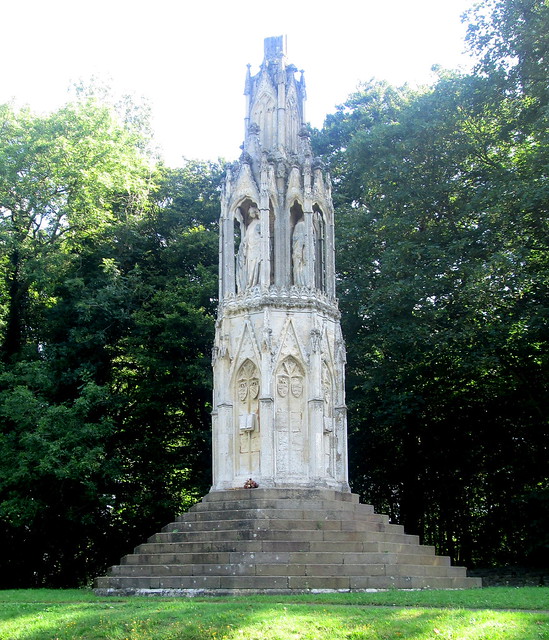

There is an inscription (pretty much unreadable) in the stone on the wall behind the Cross:-

The inscribed words are reproduced on the plaque:-

Another descriptive plaque is on a pedestal nearby:-

No Comments »
Posted in Bridges, History at 12:00 on 6 August 2015
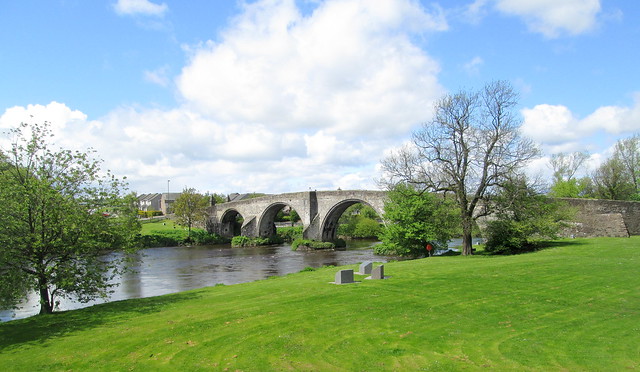
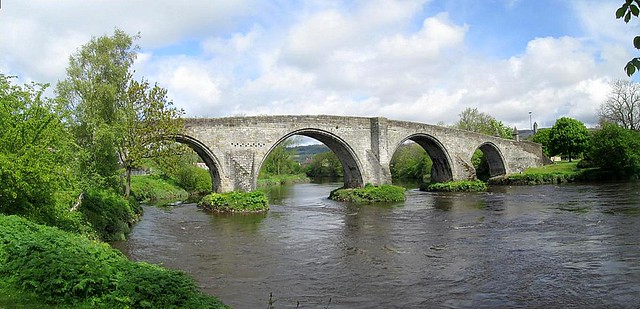
A bridge has spanned the River Forth at Stirling for centuries. Not the same one obviously but the most famous of them was the one where William Wallace won his great victory over the army of Edward I of England (Edward Longshanks) at the eponymous battle in 1297.
The “old” bridge that still survives now carries foot traffic only. It was built 500-600 years ago. It is a lovely structure of four arches and three supports, here shown from the “east” bank.
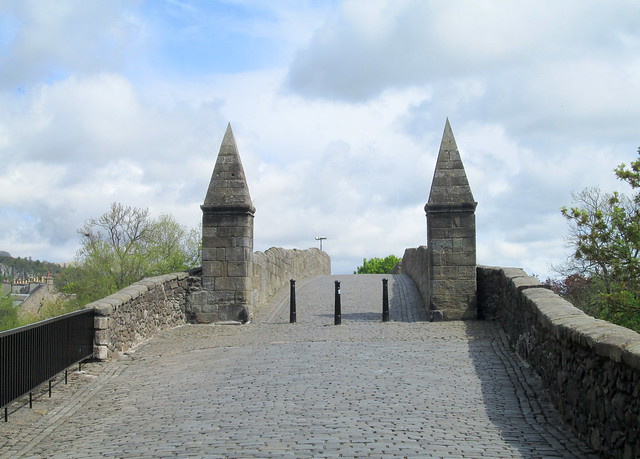
These are the approaches from the west. Note the cobblestones:-
This is the old bridge from the modern road bridge:-
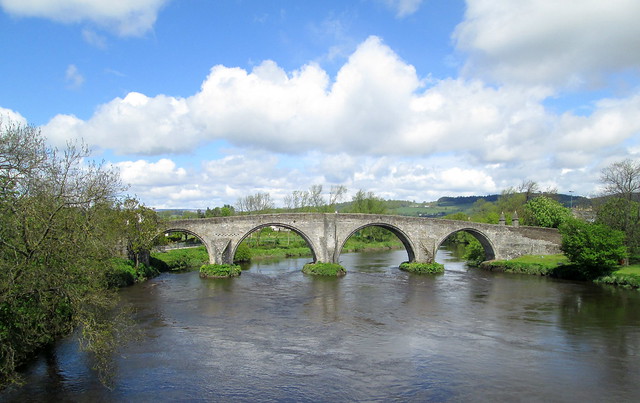
And this is a view from the “west” bank. The Wallace Monument can be seen as a distant spire beside the lamp standard at the extreme right of the bridge as seen here:-
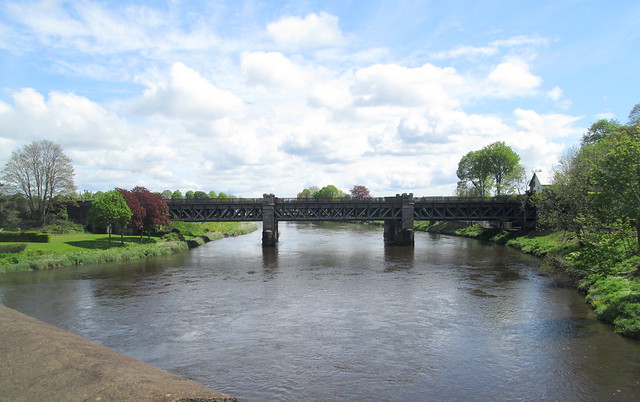
Two “modern” bridges also cross the Forth close by. This is the railway bridge from the modern road bridge:-
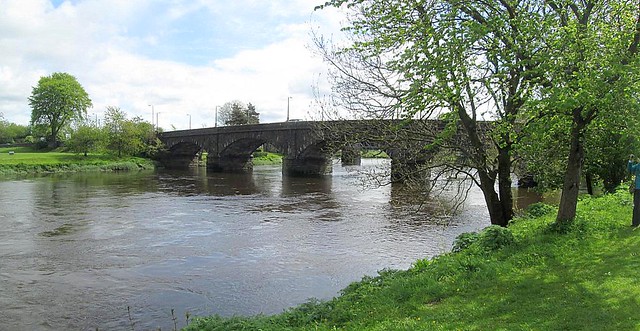
The road bridge is in the foreground here with the railway bridge supports visible through its arches:-
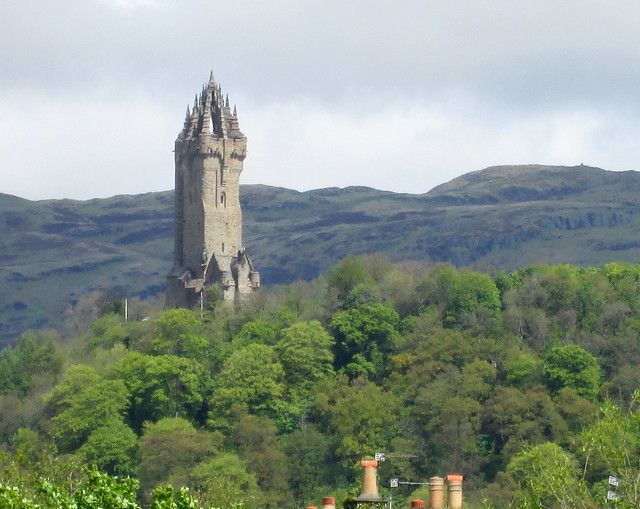
The Wallace Monument from the old bridge:-
No Comments »
