Archives » disaster novel

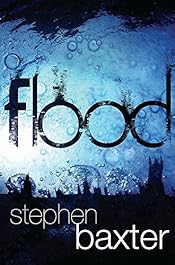
Flood by Stephen Baxter

Gollancz, 2008, 478 p.

This could be seen as a revival of the British SF tradition of the disaster novel (sometimes dubbed the cosy catastrophe as there were always survivors just about coping) in the manner of the Johns, Wyndham and Christopher. There are resonances in Flood of The Kraken Wakes, but also of J G Ballard’s The Drowned World. Baxter’s take on it is his own, though.

Sea levels are rising – and not slowly. Very rapidly coastal cities are inundated and the rise continues, indeed progresses faster as time goes on. It is not mere global warming, then, and Baxter has come up with a scenario involving huge reservoirs of subterranean water brought to the surface through thermal vents at tectonic plate boundaries.

His treatment of the tale is episodic – much like that of his novel Evolution – but the time scale here is not that of millions of years but at most decades, and the ongoing scenes feature recurring characters, principally one Lily Brooke.

Just before the floods began she and three others, plus the baby one of them had had during their incarceration, had been freed from five years’ captivity at the hands of terrorists in Barcelona by agents of a corporation known as AxysCorp. Its head, Nathan Lamockson, takes an interest in the welfare of these five survivors (a sixth was killed just as the rest were being liberated) and their lives from then on. Baxter relies on the survivors’ concern for each other as a driver for the reader’s interest. However, in their actions they seem to be relatively unaffected by those experiences and show little sign of psychological trauma. The baby, Grace, the result of the rape in captivity of Helen Gray by a Saudi prince, becomes the subject of diplomatic dispute when she is relinquished by AxysCorps to the Saudis and spirited off to the Arabian peninsula. Only much later is she returned from there.

The main focus of the narrative is on the relentless sea rise, the efforts of humans to flee to higher ground and of the various characters involved to protect themselves and their families. In particular Lamockson manifests his megalomaniac tendencies in a series of ever more elaborate schemes, the last of which is to build a full-scale replica of the Queen Mary,  which he calls Ark Three, to house those of his friends, associates and employees which it can carry. Ark One is a starship onto which Grace is inveigled not long before its launch when what remains of humanity is reduced to living on huge rafts. That leaves Ark Two’s existence or whereabouts unrevealed at the book’s end. (There is a sequel titled Ark.)

Pedant’s corner:- mentions the projected 2018 World Cup in England (this shows the dangers of authorial short term projection of the future,) and regarding that same tournament’s later abandonment says the US team was among the favourites (no comment required,) “peering at streets signs” (usually rendered as street signs, if not it should be streets’ signs,) Himelayas (Himalayas – as in a later appearance,) “the wetsuits were one item that were wearing out fast” (one item that was wearing out.)
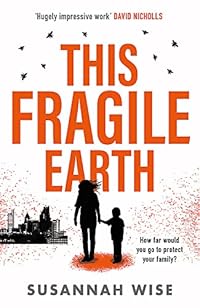
This Fragile Earth by Susannah Wise

Gollancz, 2021, 356 p. Reviewed for ParSec 1.

In the 1950s and up to the mid-1960s British SF consisted mainly of stories of worldwide disaster – a subgenre which Brian Aldiss somewhat unkindly dubbed cosy catastrophes – whose most prolific contributors were the Johns, Wyndham and Christopher, but also to which, at a stretch, J G Ballard’s early novels could be assigned. While the disaster story never disappeared completely the vogue did ebb and British SF began to cleave the paper light years with the best of them.

In recent times SF writers more generally perhaps sensed the coming contagion. Emily St John Mandel’s Station Eleven helped to revive the concept of a fictional worldwide disaster and Caroline Hardaker’s Composite Creatures (also reviewed for ParSec 1) has elements of the form. In this book Susannah Wise inhabits that global catastrophe tradition full on – and in a British context.

It is an altered Britain though, which has a heavy Chinese influence. Six year-old Jed’s schoolteacher is a Miss Yue, a supermarket chain is called Lianhua, noodles and rambutan are common foods and a mysterious company called Shīluò zhì lurks in the background.

The common elements of the catastrophe novel are present: communication breakdown, food queues, barricaded roads, troops on the streets. Less usual ingredients here are that bees have gone extinct (though attempts have been made to restore them synthetically) with their pollination tasks in the meantime replaced by tiny drones; following on from beetle blight a rampant disease called Bovine Staph is apparently transmitted through rainwater and can affect humans; venturing outdoors requires UV goggles to be worn to protect against eye damage from sunlight; the currency is exclusively digital – Litecoin spent via Lite-cards.

Pre-disaster just about every service is accessed wirelessly or via AI robots such as BinX, DoctreX, MediX and WaitreX. GScopes, mediated by a system named GQOS, have replaced mobile phones. Roads are constructed from fibre-glass panelling and road signs are exclusively electronic. Agrico-bots roam the countryside.

Then one day the drones start to malfunction, the electricity goes off and everything shuts down. Viewpoint character Signy comes home to a fridge in meltdown, its food rotting. Despite the resultant lack of amenities her partner Matthew keeps saying things will be all right “tomorrow” but one night, while Signy and Jed hide in the loft, Matthew confronts burglars at their house and is killed. Signy sets off from London with Jed to try to reach her mother’s home in Northamptonshire – by bicycle. Along the way they meet the usual assortment of people who either help or steal from them but also uncover the importance of TrincXcode and its links to musical form.

Wise’s writing is fine but in what is presumably a striving for immediacy she exhibits an over-fondness for verbless sentences. Like this one. Her characterisation is generally convincing enough but her portrayal of Jed is inconsistent. As indications of his youth he sometimes has to have words defined to him and he refers to “Mr Mack Wrecker” from the Peter Rabbit books but he also comes out with absurdly adult phrases supposedly remembered from Miss Yue. Things like, “Quantum field which allows the system to work out infinite possibilities,” and, “The system can work out in milliseconds every possible outcome that can happen from any action it takes in multiple universe models and make the best choice.” OK, the reader is getting the info dump but these sentences read as unlikely to come from the mouth of a six year-old, however tech savvy. There is also his memory from three years earlier of his grandfather telling him something “terrible and important,” to wit, “TrincX is the birth of true Artificial Intelligence – God’s daughter come to walk on Earth,” a warning now come true.

This central role of AIs in the background of the narrative has the effect of making the book’s resolution a literal deus ex machina, or, rather, dei ex machinae. Whether that makes it cosy or not is a fine judgement but it certainly leans towards it.

Pedant’s corner:- GQOS’ (GQOS’s,) “the Orkneys” (the locals prefer the designation Orkney, or, the Orkney Islands,) “more combustible that the old carbon boiler” (than,) gotten (in dialogue? In Britain?) Signy rushes out the front door with no mention of its mechanism previously not working due to the shutdown of communications, hummous (hummus.) “‘Danny!’.” (doesn’t need that full stop, the exclamation mark provides that function.) “It lay uncertain rays across” (It laid uncertain rays,) “‘I bought it from home.’” (brought it.) “‘It’s wasn’t Lau Chen was it?’” (‘It wasn’t’.)

alt.human by Keith Brooke

Solaris, 2012, 414 p. (Published in the US and Canada as Harmony.)

In the city called Laverne humans are marginalised, subjected to the rule of aliens and their various underlings – chlicks, watchers, headclouds (with their assorted commensals,) grunts and slaves. Movement is restricted by a series of pass controls which can only be negotiated by having identifiers called pids in the bloodstream recognised and verified. Over Laverne hangs a skystation, a kind of spaceport controlled by a starsinger. These beings can manipulate reality (creating by singing or destroying by unsinging) and act as protectors of their cities.

Dodge is a member of the human clan Virtue. He has expertise in fooling the pass system with fake pids and chances upon Hope, a young girl who has no pids, using his ability to help to avoid her being detained at a checkpoint. Hope becomes central to the story’s resolution (rendering the programmatic nature of her name a touch heavy-handed.)

The narration is mainly first person from Dodge’s viewpoint but there are sections where he narrates other characters’ experiences in the third person. One of these is Hope, who has come to Laverne after her city Angiere was destroyed. Other escapees from Angiere warn that competing factions among the aliens mean that Laverne is unsafe and urge travelling on to the semi-mythical city of Harmony. Life in Laverne is shown in detail and depicted very well, the characters and their motivations entirely believable.

After the area of Laverne where Dodge lived has been unsung a small group of humans decides to move out of Laverne before the whole city is destroyed. They set off to try to find Harmony. The travelogue in this second section of the novel has moments which are reminiscent of a Wyndhamesque disaster story but in the end alt.human is not like that at all. For one thing it has a resolution.

The first part of the novel, set mostly in Laverne, the bulk of the book, feels as if Brooke had invested his heart and soul in it, it has characters who seem real and a just about believable setting. The two subsequent sections felt less convincing, but characterisation and its development wasn’t lacking.

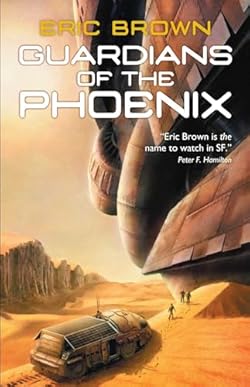
Guardians of the Phoenix by Eric Brown

Solaris, 2010, 350p

 Guardians of the Phoenix cover

In his recent Bengal Station trilogy Brown has been revisiting some of the conventions of Pulp SF. He has also treated us to a Big Dumb Object novel in Helix. In Guardians of the Phoenix, he has turned his attention to the disaster novel, or rather, to the post-Apocalypse tale. Here too, though, there are faint echoes of Pulp SF in the Phoenix of the title.

The Earth is parched, the oceans boiled away. Resource wars and plagues have reduced humanity to dreams – and fears – of the old times. In a handful of small communities sparsely spattered over Europe a few surviving humans cling on, barely scratching a living from the harsh, sun-battered environment.

To begin with there are three main viewpoint narratives. With large animals extinct and plants beyond scarce, Paul traps lizards on the girders of the Eiffel Tower to feed his dying mentor Elise. In Aubenas the locals net bats for food and their leader quietly supplements their diet with a little cannibalism. A band of renegades has kidnapped the daughter of one of the elders of the decimated community in Copenhagen.

The action kicks off when the renegades turn up in Paris to seek out the rumoured food horde in a bank vault. A group from Copenhagen has pursued them. In the resulting gunfight the chief renegade, Hans, escapes and Paul, who had fallen into his clutches, is rescued.

Since Elise has died Paul joins the Copenhagen group’€™s onward trip to drill for water below what had been the Bay of Biscay. Hans returns to his former home in Aubenas just in time to join an expedition to Bilbao to find the remains of an abandoned project designed to save humanity from extinction.

As usual with Brown the focus is mainly on the characters, who are well rounded – the relationship between Dan and Kath from Copenhagen is particularly well laid out and Hans makes a convincing psychopath – though Paul, even given his earlier relative isolation, is perhaps still a little too naïve. Given the above the book’s plot has to follow certain lines but there are twists and turns along the way. The resolution is saved from being a bit of a deus ex machine by very short premonitory chapters featuring members of the Bilbao project, which however give the Phoenix game away somewhat.

As an adventure story the novel works admirably but I found I couldn’€™t quite buy the scenario – an Earth where the water has evaporated from the oceans would admittedly have a consequent runaway Greenhouse Effect but unless all the atmosphere had gone along with them it would surely be more like Venus, constantly overcast, and hence sunburn would be no problem. (I also wondered how in a parched world as depicted would plants be able to photosynthesise and thus keep O2 levels up? Though animals to breathe it in have of course mostly disappeared.) These quibbles aside however Guardians of the Phoenix is fine entertainment.

free hit counter script