Archives » Crime fiction

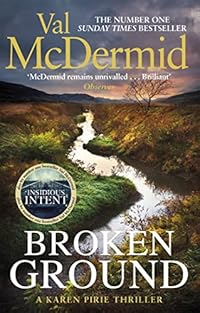
Broken Ground by Val McDermid

Little Brown, 2018, 428 p.

This is the fifth outing for Karen Pirie, head of Police Scotland’s Historic Cases Unit, at the start here still trying to come to terms with the death of her romantic partner, Phil Parhatka, unable to sleep until she has walked herself to exhaustion in the streets of Edinburgh late at night.

She is juggling three cases, two hers, one not. The HCU is working on a series of brutal rapes from the 1980s whose perpetrator’s make of car they have a new lead on when a murder in Wester Ross, linked to the burial there of two Indian motorcycles left behind by the US Army after World War 2, turns up. Karen also has a peripheral involvement in a murder case she takes an interest in after a conversation between two women she overheard in a café twitched her police instincts.

Her hopes at the replacement of her old boss by the new one being a woman – female solidarity and all that – are swiftly extinguished. Assistant Chief Constable Ann Markie has saddled Karen with a new DS, Gerald McCartney, mostly in order to spy on her. My suspension of disbelief at this second boss in a row wanting rid of Karen was not quite assuaged by the reasons given for it, which seemed altogether too programmatic. But fiction is all about conflict. And Karen’s approach to her work is unconventional and occasionally confrontational, if not downright bolshie. Not qualities likely to endear you to a boss sensitive to public and political scrutiny.

There are ongoing updates on Karen’s background, the café Aleppo she helped Syrian refugees to establish in the previous book has been a success and her assistant DC Jason ‘the Mint’ Murray is growing into the job while the tedium of some police work is not ignored.

But the duty of the detectives in a novel is to set the world to rights by finding the perpetrators and calling them to account. So job done. Inasmuch as a murder can be set to rights.

Pedant’s corner:- “River’s voice was a clear as” (was as clear as.) “There were a handful of Lanarkshire towns” (There was a handful,) scoffed (various characters do this at various times; e g ‘Jason scoffed.’ Scoffing usually requires further elaboration,) “a pair of gin and tonics” (the main noun here is gin; it is that which should be plural: ‘a pair of gins and tonic’.)

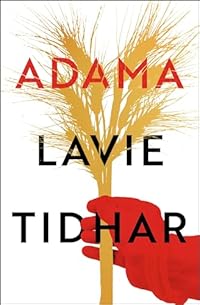
Adama by Lavie Tidhar

Head of Zeus, 2023, 397 p.

This is the second in Tidhar’s Maror sequence, in which he examines the history of Israel. I reviewed the first here. In Adama (the name is Hebrew for earth, and here is used as a synonym for homeland) the focus is on the setting up and evolution of the Israeli state as seen through the experiences of the members of one family. The book is episodic in nature, ranging in time from Haifa in 1946 and a displaced persons, DP, camp in Germany in 1947 via the war to establish Israel (what Palestinians refer to as the Nakba,) the aftermaths of the Six Day and Yom Kippur wars, events in Kibbutz Trashim in intervening years, to Florida in 2009; not necessarily in date order.

Told in fifteen parts starting with one titled The End and with the last called The Beginning, our viewpoint characters are matriarch Ruth, her sister Shosh, their children Yoram, Ophek and Yael, grandchildren Lior and Esther, fourth generation Hanna and Shosh’s husband Dov.

As a staunch believer in a Jewish homeland, Ruth made her way to Palestine early, leaving behind in Europe her family who were apparently betrayed to the Nazis by Shosh’s then boyfriend Nathan Deutsch – upon whom Ruth later wreaks an extended revenge. Only Shosh survived. Unlike her sister, Shosh was not invested in the dream of Israel, only ever wanting to make her way to the US. Their descendants navigate the vicissitudes of the Israeli experience, the souring of the kibbutz ideal of socialism, its failure (and by extension Israel’s) to live up to its promise, the compromises and accommodations necessary to keep things going.

Ruth does what she has to as a member of the Jewish underground during the British mandate; as does Shosh in her efforts to be away from the DP camp. Only Ruth has some success. Dov’s tale relates to the 1948 war and shows its unforgiving nature. Kibbutz life is illuminated in passing as the book’s incidents unfold.

In 1989 Lior returns to the kibbutz from Tel Aviv for the funeral of his friend Danny, not believing the story he is told about Danny’s apparent suicide, and finds something rotten in its state. “Lior knew what hash smelled like, it smelled like Lebanon, there was so fucking much of it.” In this section Chief Inspector Cohen from Maror makes a brief appearance, reminding the reader (if any such were needed) of the murky underbelly of Israeli society which Tidhar is exploring.

A prominent recurring reference in the novel is a fictional film called The Vultures, starring actor Bill Goodrich, a film shot partly in the kibbutz, perhaps here intended to show the founding of Israel as Israelis would like to see it: but extortion, drug running and violence are never far away from any of the characters in this book.

Tidhar’s writing is immediate; sharp, abrasive and to the point. Despite its tight focus, Adama contains multitudes.

Pedant’s corner:- “Ruth was sat in front of the television” (‘was sitting in front of the television.) “They were sat in the Casino” (They were sitting,) “where there were nothing but camels” (where there was nothing but….,) “the metaplot” (elsewhere spelled metapelet.) “‘Did he, fuck,’ he said.” (no need for that comma after ‘he’; plus it actually changes the meaning.)

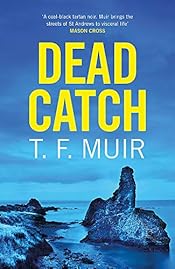
Dead Catch by T F Muir

Robinson, 2019, 377 p.

Following on from Life For a Life I would most likely never have looked at this, crime fiction not really being my thing, except that  the good lady had borrowed it from the local library so I thought I might as well.

A fishing boat washed up on Tentsmuir beach is found to contain a body restrained by wire in such a way that any movement would have resulted in a slow death. The boat belonged to Joe Christie who had disappeared – along with the boat – several years ago. The victim isn’t Christie though but Stooky Dee, an alleged associate of big Jock Shepherd, Scotland’s criminal kingpin. Muir makes much use of italicising alleged in the book in relation to Shepherd’s activities. DCI Andy Gilchrist, based in St Andrews, investigates the case.

Gilchrist has problems with his adult children and difficulties with the forensic pathologist Dr Rebecca Cooper whose brief liaison with him she cut off when she decided to reconcile with her husband. These attempts to humanise our hero are something of a distraction from the main plot. There is a nice moment, though, when Gilchrist tells his daughter when she says he knows how to talk to women as if he knows what they’re thinking, “No man knows what any woman is thinking.”

It soon turns out others of Shepherd’s henchmen, Cutter Boyd and Hatchet McBirn, have been killed recently but it seems the police in Strathclyde, Shepherd’s main area of operations, do not want Gilchrist muscling in on the case.

Further complications arise from Gilchrist’s DS Jessie Janes’s brother Tommy – on the run accused of murder, though Jessie doesn’t think he did it – contacting her about information he wants to give her.

All is mixed up with a big drug deal the Strathclyde force – along with HM Government – is hoping will lead to the arrests of major dealers, for which they send DI Fox, a supercilious creature to retrieve the case files from Fife.

Things become a bit too conspiracy laden when Gilchrist and (Jessie) Janes are tied up in a lock-up garage in Anstruther before a shoot-out resolves their problem.

This book confirmed that modern crime fiction is not for me. I doubt I’ll sample Muir’s work again. (It’s also enough to give anyone an aversion to visiting Fife.)

Pedant’s corner:- “to go back onboard” (back on board,) “a dumpster” (not a UK term. Muir’s sojourn in the US has got to him. We say ‘skip’, or [maybe] ‘wheelie-bin’,) “as if everyone …. were indoors” (as if everyone  … was indoors,) “driven to the scrappies and dumped” (not a plural; a possessive: ‘to the scrappy’s’.) “Capisci?” (it’s spelled ‘Capisce’,) “right from the get-go” (‘right from the start’; please,) “when the caller finally gave out” (gave up,) “that all was not well” (that not all was well.)


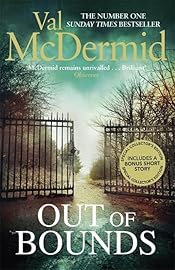
Out of Bounds by Val McDermid

Little Brown, 2016, 440 p.

In this (fourth) instalment of the cases of DCI Karen Pirie she is still trying to get over the death of her romantic (and former professional) partner Phil Paratka, murdered in the line of duty in The Skeleton Road. Unable to sleep properly she strolls the backways of Edinburgh at night, particularly the Restalrig railway path.

We start, though, with Ross Garvie, a joyriding teenager, whose exploits lead to him killing his three passengers in a crash and only surviving himself in a deep coma.

Then we meet (briefly) Gabriel Abbott, an obsessive about exploitation in the third world unburdening his worries about a Thai correspondent of his to a friend in a pub in Kinross.

Garvie’s DNA provides a familial hit to the murder of Tina MacDonald in Glasgow years before, thus giving Pirie’s cold case unit a lead, but complicated by the fact Garvie was adopted and accessing the original birth certificate is all but legally forbidden.

Then Abbott is found murdered on the path by Loch Leven from Kinross. It turns out his mother was killed by a bomb on a light aircraft years before – an atrocity blamed at the time on the IRA despite the crude MO not being a fit. Pirie does not believe in such coincidences but the local officer has dismissed Abbott’s death as a suicide.

Cue much treading on toes as Pirie sets out to solve both cases and the aircraft bombing, ignoring protocol as is her wont.

A sub-plot involving Syrian refugees she meets on the railway path who have nowhere they can meet up manages to entwine with the main one near the end.

I suppose this is pretty standard police procedural (or in Pirie’s case non-procedural) fare but McDermid keeps the pages turning.

Pedant’s corner:-  “none of them were worried” (none of them was worried,) “Lees’ reward” (Lees’s reward,) “macaroon bars made traditionally with icing sugar and mashed potatoes” (McDermid is here misrepresenting for comic effect, macaroon bars are not made from mashed potato,) congratulations for the subscripts in H2O and H2SO4, “where the leak sprung from” (sprang from.) “Noble shook head” (shook his head,) snuck (horrible USianism; ‘sneaked’, please.)

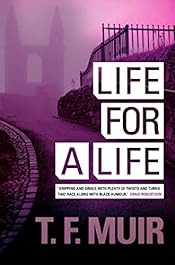
Life for a Life by T F Muir

Constable, 2013, 394 p. First published 2007.

There is a certain sameness to modern crime fiction; which is to say modern detective fiction. Gone are the days of the gentleman sleuth such as Poirot or Wimsey, and the even more gentle woman, Miss Marple, solving crimes almost at leisure and in relatively salubrious surroundings. Now we have the hard-bitten, hardened police detective dealing with contemporary (well, in this case twelve years old) psychopathic criminality in all its grisly detail.

I would not normally have read this but it is set almost exclusively in Fife, where I live, (with such familiar locations as Boarhills, Kingsbarns, Crail and St Andrews,) and was recommended by our nearest local librarian as an introduction to the author prior to his visit to the library this November. Suitably enough it was published by Constable.

The short Chapter One features a young woman fleeing from a brutal captivity along a Fife coastal path on a freezing night. That is the last time we are given her point of view. It is her body DCI Andy Gilchrist, a widower, and his new DS Jessica (Jessie) Janes, are called to investigate a few days later, dead from a blow to the head, possibly after a fall from the path, and subsequent exposure. They trace her back to a cottage in Kingsbarns where they find two more young women dead, decapitated, and evidence of enslavement into prostitution.

Janes has a sideline in stand-up comedy which she undertakes to try out jokes written by her deaf son, Robert. Her mother has a criminal record but is a constant thorn in her side trying to gain legal access to Robert.  Gilchrist and the forensic pathologist Dr Rebecca Cooper have a mutual attraction complicated by the fact that she is married to someone else (albeit not happily). One of the other female detectives has a problematic relationship with a man who turns out to be unknowingly involved in the case, another has a booze problem.

I thought Janes’s background as teased out by Gilchrist in their conversations and his investigations into her mother’s origins would have made it unlikely for her ever to have been accepted into the police but maybe their standards aren’t too high these days.

This is pretty much the standard police procedural offering but some of the details were perhaps unnecessarily gruesome (of course this may be what the crime fiction market now demands) and there was a cliffhanger scene which stretched credulity by being kept going too long.

On putting this book onto my Library Thing account I found this was actually DC Gilchrist’s fourth appearance in print. I may try one more to confirm my thoughts that it’s not really my thing.

Pedant’s corner:- In the Acknowledgements “whne” (when.) Otherwise; “change in tack” (x 3, the phrase is usually ‘change of tack’,) “chaffed and reddened by a cold Scottish wind” (chafed and reddened,) “all was not as it seemed” (not all was as it seemed,) “oblivious of his presence” (it’s ‘oblivious to’ not ‘oblivious of’,) “as his drove on” (as he drove on,) “the Kingsbarns’ killings” (Kingsbarns here is adjectival, not possessive; ‘the Kingsbarns killings’,) two police acronyms used and immediately explained within two lines (both could have been avoided or worked around without loss of clarity,) “not to help him breath” (help him breathe,) facia (fascia,) “and looked at Gilchrist’s way” (and looked Gilchrist’s way,) “seemed to be order of the day” (to be the order of the day) “toodle-do” (the formulation is usually ‘toodle-oo’.)

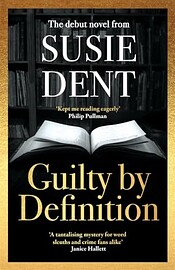
Guilty by Definition by Susie Dent 

Zaffre, 2024, 391 p.

The author is of course the doyenne of Countdown’s Dictionary Corner and the title of this, her first novel, plays on that connection. As do the book’s contents. It is set in Oxford among the lexicographers of the Clarendon English Dictionary (presumably a thinly-disguised OED,) and each chapter is prefaced by a word – some obscure, others not – along with its definition, which encapsulates the events depicted. In addition most of the characters at one time or another think of the derivation of a word that comes into their thoughts. In this respect Guilty by Definition has similarities with Eley Williams’s The Liar’s Dictionary though here the insertion of such definitions seemed more intrusive. It is however likely to be exactly what readers might expect from a novel by Dent.

The plot relates to the sudden disappearance ten or so years earlier of Charlotte Thornhill, sister of this story’s main character Martha. After a long sojourn in Berlin Martha was appointed senior editor at the CED six months before the novel’s events, to the chagrin of her colleague Simon who had coveted the job.

The action kicks off when mysterious letters written in a cryptic style from someone calling themselves Chorus begin to arrive at the CED and at the homes of various people connected to it. They seem to point at a mystery involving Charlotte’s disappearance and hint that she was murdered.

The rest of the novel consists in the team trying to unravel the clues the letters from Chorus contain in order to discover what Charlotte had been doing in the months before her disappearance, what became of her and, finally, just who Chorus is. This involves a dealer in antiquarian books for whom Charlotte did some work before branching out on her own and the existence of a commonplace book compiled by Shakespeare’s sister Joan Hart for whom Guilty by Definition may be an attempt to reclaim for history.

Dent’s writing is efficient enough but nothing out of the ordinary. I suppose the book might be classified as cosy crime since any nefarious activities occur offstage

Note. One character uses the Scots term whisht – used in the imperative as an injunction to stop talking (though it’s more often pronounced and spelled as wheesht.)


Pedant’s corner:- whiskey (many times; whisky,) half-silouetted (silhouetted,) “casting a prism that danced and flickered on the wall” (prisms aren’t cast. Light is cast through them and is thereby refracted,) “lying prostate on the ground” (prostrate, surely,) “Douglas Adams’ The Hitchhiker’s Guide to the Galaxy” (Douglas Adams’s,) “‘perhaps that’s one of reasons’” (one of the reasons,) the digit ‘8’ appears several times, sometimes within a larger number; in each case it looks upside down – with the larger piece of its hour-glass shape to the top, not the bottom,) “a slip … bearing the name of the lender” (this being a system for allowing books in the Bodleian Library to be consulted, ‘of the borrower’ makes more sense.)

Maror by Lavie Tidhar 

Head of Zeus, 2022, 558 p

The author has previously displayed his middle Eastern background in a couple of books, Central Station and Neom, and his Jewish heritage in A Man Lies Dreaming but as far as I know he has not up till now examined the state of Israel. As I was typing it I intended that that last sentence contains a pun. Because here we have a kind of history of Israel from 1974 to 2008 – of its existence as an entity and of its situation as a nation. For as much as it is anything this is a “condition of Israel” novel, or at least the condition of Israel between those dates. Then again, it seems from the outside that its circumstances as depicted here have only been exaggerated in the times since.

In a series of incidents taking in a set of beachside rapes and murders, forced confessions, observations on venal or predatory (or both) politicians and army high-ups, kidnappings, extortions, drug running from Lebanon’s Bekaa valley with the apparent connivance of the Israeli Defence Force, networks extending to Colombia and the US, accompanied by a host of murders/executions, a varied cast of flawed characters, Chief Inspector Cohen, who talks in quotations – usually biblical but sometimes Shakespearean – fellow cop Eddie Raphael, small-time crook Benny, budding journalist Sylvie Gold, cop’s son Avi Sagi plus Nir Yarom, navigate their ways through an underworld of violence, mayhem and exploitation of the surrounding land. All is interspersed with details of prevailing styles of music on the radio or TV and underpinned by the overwhelming presence of drug dealing and gangsterism.

As it says on the backcover, Maror is a Jewish ceremonial dish of bitter herbs which is eaten during the Passover, symbolizing the bitterness of the Israelites’ enslavement by the Egyptians. The long history of the Jews since has emphasised that they have little need of a ceremonial dish to remind them of persecutions through the ages; engendering a natural desire to return to their roots and have a homeland of their own – with all that that means.

At one point Benny thinks of the quote from Ben Gurion, “We shall only have a true state when we have our own Hebrew thief, our own Hebrew whore, our own Hebrew murderer.” Maror indicates Israel has those in spades, a bitter harvest indeed.

Towards the end of the book Avi hallucinates a man saying, ‘In every time and in every place there must be someone to speak for the soul of their nation.’ The overall narrative here might imply that the utterly compromised character of Cohen is actually that man. (Or is it Tidhar who in this book is trying to fulfil that role?)

The epigraph to the last chapter, as if said by Cohen, is, “Fashioning a new nation demands sacrifice.” Here there are sacrifices aplenty. Maror, the novel, could be read as a warning to be careful what you wish for.


Pedant’s corner:- Written in USian. “‘What this?’” (‘What’s this?’,) “‘Did you use to do that, too?’” (‘Did you used to …’,) non-descript (one word; nondescript.) “He felt hands envelope him” (envelop him,) “Esther Landes’ private diaries” (Landes’s.) “‘What did you do with?’” (‘What did you do with them?’.) “The clock on the well” (on the wall,) Yitzak (Yitzhak,) Offer (elsewhere it’s spelled Ofer,) Genghis’ (x 2, Genghis’s,) “attached to it was brand new Brutalist building” (attached to it was a brand new…) “I’ve had gun pointed at me before’” (‘I’ve had a gun pointed at me before’,) “the sound of mortar” (of a mortar, or, of mortars.) “Then then car slowed down” (Then the car slowed down,) “laughing at though the idea was absurd” (laughing as though,) “official stationary” (stationery,) “plate of humous” (x 2, plate of hummus,) Yosef (elsewhere always Yossef,) Pincohet (Pinochet,) “in a dark clouds” (in a dark cloud.) “She folder her notebook” (folded.) “Even in in the Soviet Union” (has one ‘in’ too many,) “back in Israel had had detested that time between two and four when the shops closed” (has one ‘had’ too many.)
The Skeleton Road by Val McDermid 

Little Brown, 2014, 412 p

I noticed early on while reading this book how different the style was compared to the same author’s Queen Macbeth, which I read only a week or so before. The prose is much less literary, more utilitarian, with more intrusive information dropping. (Once again I only read this because the good lady had borrowed it from the local library.)

The present-day events of The Skeleton Road are set in the run-up to the Independence Referendum of 2014. (Which seems ancient History now and has no actual relevance to the plot.) Karen Pirie – now a DCI in the newly merged Police Scotland – is still in charge of cold cases but due to the reorganisation her office is now in Edinburgh, not Kirkcaldy, necessitating a commute across the Forth Road Bridge.

When an eight-year-old skeleton is discovered hidden in a roof turret on the crumbling John Drummond building in Edinburgh a hole in its head makes it obvious it was murder.

In the meantime the International Criminal Tribunal for the Former Yugoslavia is shaken up by its new boss’s determination to find the identity of the person going around killing the perpetrators of atrocities not yet – and not now (in the 2014 of the book) likely to be – brought to justice. Suspicion falls on former Croatian General Dimitar Petrovic who disappeared around the times these murders started. His wife, Oxford Professor Maggie Blake, in the absence of any other explanation, always assumed he had returned to his former existence in Croatia.

Thus DCI Pirie is launched into an investigation which will reveal to her more horrors about the Balkan Wars of the late twentieth century than she might have wished.

This is not really a surprising subject for McDermid to take on. After all, the first shot of those most recent Balkan Wars was fired in her home town of Kirkcaldy.

It is not hard for the reader to join the dots about the victim. The murderer is initially more of a mystery but a reference about three fifths of the way in rather jumped out.

Crime fiction is how McDermid made her name – and it is what pays her bills – but the contrast between this and Queen Macbeth demonstrates how undemanding the genre can be for a reader (and for its author?) but its consumers can’t seem to get enough of it. And there’s something disturbing about people seeing murder as entertainment.

If the purpose of the fictional detective is to set the world right again after the transgression of the crime, cases such as this give the lie to that assumption of cosiness.


Pedant’s corner:- confectionary (confectionery,) a missing start quotation mark at the beginning of a piece of dialogue, “Dorothy L Sayers’ description” (Dorothy L Sayers’s.) “‘He was as a much a butcher as …’” (He was as much a butcher as …)


A Darker Domain by Val McDermid 

Harper Collins, 2008, 377 p.

This is the second of McDermid’s Karen Pirie books. I read the first in 2017/8. In this one she is now a DI in charge of the Cold Case Review Team at Glenrothes Police headquarters. A woman, Misha Gibson, has walked into the station and reported her father missing. He was Mick Prentice, a former miner who painted in his spare time, who left during the coal strike of the 1980s and wasn’t heard from again, assumed to have joined the scabs who decamped for jobs in the Nottinghamshire coalfields. Misha’s son has leukaemia, needs a close relative tissue match for him and this is her only hope.

Meantime, freelance investigative reporter Bel Richmond, on holiday in Italy, has stumbled on what looks like a crime scene in an apparently hastily abandoned villa and recognises a poster there as resembling a ransom note from a kidnapping gone wrong years ago. In a proposed money handover, Catriona, only daughter of successful Scottish businessman Brodie Maclennan Grant, was shot and Grant’s grandson, Adam, spirited away by the kidnappers.

How the two cases interlap is what is revealed as the book progresses, with a couple of twists thrown in along the way.

The scenario allows McDermid to illustrate how the legacy of the bitter mining strike of the 1980s endures and poisoned relations between mining communities and the Police. Various locations such as the Wemyss caves are very familiar to anyone who lives in the area, as I do, though some are invented (Grant’s home of Rotheswell Castle) or slightly renamed conflations of real places (the village of Newtown of Wemyss.)

The way the book was structured, with each section preceded by an italicised heading giving its location and date, was slightly intrusive though it did give McDermid the opportunity to present the relevant scene novelistically rather than as being related to Pirie or Richmond as in an interview.

As a character Pirie is engaging but we perhaps don’t see enough of her here.

Pedant’s corner:- “The women who entered” (The woman,) “In his Wham period” (the band was named Wham!) “in Simon Lees’ gut” (Lees’s; there was another Lees’ later,) fit (fitted,) “the big Tesco down by the bus station” (when spoken, yes, but when spoken of, that big Tesco was still a William Low’s supermarket,) sprung (sprang,) “‘not a Raith Rovers shirt’” (I know this was for the benefit of readers furth of Scotland but a Raith fan would have said simply ‘a Rovers shirt’,) “a smile that reminded him of Julia Roberts’.” (Julia Roberts’s,) “her Harvey Nicks’ sundress” (her Harvey Nicks sundress. You don’t say ‘an Armani’s suit’,) Certifcato de Morte (Certificato de Morte,) “scribbling the details down on.” (down on what?) “Toby Inglis’ name” (Inglis’s,) staunch (stanch.)


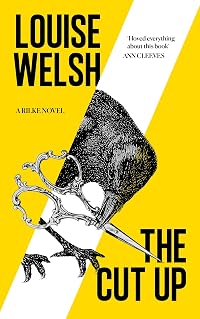
To the Dogs by Louise Welsh

Canongate, 2024, 334 p, including 2 p Acknowledgements.

“The reception area had been designed with an eye to vomit and violence.” Thus begins this book, which if you hadn’t already known this was a crime novel would certainly have alerted you instantly.

Jim Brennan is the son of a minor criminal who managed to evade a life of petty crime and has worked himself up to the position of vice-Chancellor at the Universty. He has lived comfortably with his wife Maggie and children Eliot and Sarah till his existence is turned upside down by Eliot’s arrest for possessing drugs with the intention to deal. This drags him into the shady world he thought he had left behind as he finds himself having to dance to the tune of the gangsters to whom Eliot owes a large amount of money, all while navigating the problems of his work – a student who has committed suicide, the University’s possibly compromising connections with China, the Principal’s impending retiral, a Physics professor’s antipathy and the overseeing of granting of contracts for new buildings.

This odyssey into the darker side of life leads him into contact with Eddie Cranston, now a low-grade criminal lawyer with a sideline in helping youths to stay out of trouble, a property developer called Henders, an ex-student named Becca and – eventually – with one of his father’s old sparring partners.

In a conversation with Henders he contrasts the change in attitudes over his life by saying, “‘My dad was a low-grade hardman. An occasional enforcer with what we’d now call anger management issues. Back in the day folk just said he was mental.’”

There is, though, really only one incidence of violence in the book – which occurs offstage – and also a death in the climactic scene, but on the whole the novel doesn’t actually deliver on the threat of that opening line. Not that that’s a bad thing.

As a portrait of a man caught on the horns of a prickly dilemma it is entertaining enough with Welsh’s typical good writing and convincing characterisation.

Pedant’s corner:- “on the brew” (usually rendered as ‘on the broo’; from burroo, a west of Scotland corruption of bureau, itself short for Employment Bureau, the precursor of Job Centres,) “breath smelt of fruit pastels” (fruit pastilles,) “an urge to hoick and spit” (to hawk and spit,) “wedding band” (is a USianism, the British is always wedding ring, which was used five lines later, so maybe this was to avoid quick repetition,) Henders’ (several times; Henders’s,) “hung themselves in despair” (hanged themselves.) “He got to his feet, ending indicating the meeting was over” (either ‘He got to his feet, ending the meeting’, or, He got to his feet, indicating the meeting was over’,) “made it barely seemed to matter” (made it barely seem to matter,) “before he hung himself” (hanged himself,) “Rowan was on her knees in the kitchen, cleaning the oven, when Jim entered the kitchen” (doesn’t need two mentions of the kitchen.) “A barbers manned by …” (A barber’s,) “that another pair of eyes were observing him” (another pair … was observing him.) “A crowd of students were streaming down the hill” (a crowd  … was streaming.) In the acknowledgements; “Writing a books is nice work if you can get it” (either ‘Writing a book’ or, ‘Writing books’.)

free hit counter script