Blue Remembered Earth by Alastair Reynolds
Posted in Alastair Reynolds, Reading Reviewed, Science Fiction at 12:00 on 2 October 2013
Gollancz, 2012, 506 p.
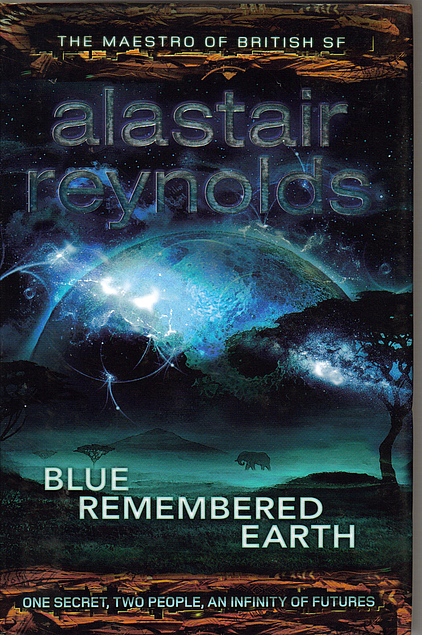
Global warming and sea level rises have altered the political landscape of Earth drastically. Africa is bounded by walls to keep out the sea and has become a global power house. People in this future have internal augmentation for long distance information and communication. Very few environments are beyond the reach of this Surveilled World, run by the Mechanism, which by overseeing everyone’s implanted augmentation prevents crimes occurring. Brother and sister Geoffrey and Sunday Akinya are two of the grandchildren of Eunice, the founder of the prominent industrial company Akinya Space, but are detached from this family enterprise; cousins Hector and Lucas are very much involved in its running.
Geoffrey is using aug to study elephants in the Amboseli region of Africa, Sunday is an artist in the Descrutinised Zone, an area of the Moon where, for privacy reasons, the Mechanism doesn’t operate. When Eunice dies both Geoffrey and Sunday are drawn into a search for something she may have left behind which Hector and Lucas fear may impact badly on the company’s fortunes.
The action roams from the shadow of Mount Kilimanjaro to the Moon, under the Indian Ocean in the realm of the United Aquatic Nations, on to Phobos, then Mars, out to the Kuiper Belt and back. An array of instruments known as the Ocular, spanning vast areas of the Oort Cloud, has allowed imaging of extraterrestrial planets at high resolution and detection of a structure known as the Mandala on Sixty-one Virginis-f.
In this vision of a future where humanity is scattered over the Solar System Blue Remembered Earth is reminiscent of Kim Stanley Robinson’s 2312. That novel, though, was to a large extent plotless, and its hero was really the Solar System. Blue Remembered Earth’s plot is intricately and cleverly meshed – like whatever passes for clockwork these digital days. And therein lies a problem. The characters are drawn all over the system by the plot’s exigencies. It is over-engineered, with complications that inspire “hold on a minute” moments. Its heroine is in effect Eunice, and she never makes an appearance except by way of machines imprinted with versions of her personality.
It’s still good SF though.
Pedant’s corner: overlaying for overlying. There was also a scene set on Mars where an abandoned Russian site on Mars had a faded hammer and sickle flag and Reynolds also mentions a former Soviet submarine. Is he still lost somewhere in the Cold War?