Archives » Catherine Carswell

The Camomile: An Invention by Catherine Carswell

British Library, 2024, 203 p, plus i p Contents, ii p The 1920s, ii p about Catherine Carswell, ii p Preface by Helen Vincent, i p Publisher’s Note and vii p Afterword by Simon Thomas. First published 1922.
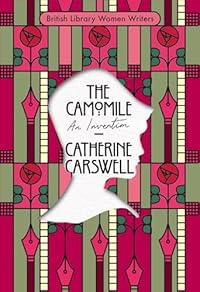
This is structured mainly as the journal entries of Ellen Carstairs, along with some letters – all addressed to her friend Ruby in Germany where Ellen spent some years studying music. Ellen lives with her brother and fiercely religious Aunt Harry in Glasgow. For income Ellen has taken pupils for piano lessons but she really wants to be a writer. Indeed, one of her schoolteachers is so disappointed that she has not so far pursued her true vocation that she refers to Ellen (publicly) as a prostitute for neglecting her talents. Not a description to be welcomed in the 1920s – or I suppose anytime.

In a prefiguring of Virginia Woolf’s famous essay Ellen is much delighted by renting a room where she can receive pupils and write. “I have a Room!” she tells Ruby. “A room all to myself and away from home.” Not that it is in any way salubrious. But she has the right to refuse any one entry. And it is an escape from Aunt Harry.

Ellen’s imagination is fired by meeting in the Mitchell Library an older man whom she calls Don John. His knowledge of literature and London publishers will provide her with a potential route into writing professionally.

It is he who recites to her the quote from Shakespeare that gives the book its title, “The camomile, the more it is trodden on, the faster it grows.” He is referring to Ellen’s writing but the sentence could also apply to Ellen herself.

Despite his learning and apparent gentility Don John turns out to be poor and prone to lapses into drink.

Ellen reflects on writing novels that, “It is hardly ever from likely touches, nearly always from unlikely ones, that the reader gets that sudden piercing sense of life in a good book. Yet at the same time it must never be an unlikeliness that is contrary to nature.”

The book is peppered with Ellen’s thoughts on women’s place in life and their likely prospects. She wonders about marriage and children but defers that expectation to the future. However, she betrays attitudes of the time – or perhaps in a preemptive strike against possible dismissal of her worth – with the thought, “when I’m reading anything serious, to know that the author is a woman who sat in her petticoats and her hairpins, leaving life aside to put words on paper, puts me off like anything.”

After returning from a trip to London, she tells Ruby (and us) she is engaged to a man named Duncan, home on a break from his civil service position in India. She toys with the idea of consummation but shies away from it despite thinking relations between the sexes ought to be freer. Duncan professes to admire her frame of mind but gradually it becomes clear that the conformities of life in India are uppermost in his thoughts, giving Ellen pause.

Though it starts falteringly, this reads like an accurate portrait of middle-class life in Scotland in the early part of the twentieth century.

Pedant’s corner:- “the Miss Clarks” (the Misses Clark,) a missing comma before a piece of direct speech, “the Miss McFies” (the Misses McFie,) “the Trosachs” (Trossachs.)
 

Reading Scotland 2015

A lot of my Scottish reading this year was prompted by the list of 100 best Scottish Books I discovered in February. Those marked below with an asterisk are in that 100 best list. (In the case of Andrew Greig’s Electric Brae I read it before I was aware of the list and for Robert Louis Stevenson his novella was in the book of his shorter fiction that I read.)

Electric Brae by Andrew Greig*
A Sparrow’s Flight by Margaret Elphinstone
The Guinea Stamp by Annie S Swan
The Girls of Slender Means by Muriel Spark
The White Bird Passes by Jessie Kesson*
Attack of the Unsinkable Rubber Ducks by Christopher Brookmyre
Buddha Da by Anne Donovan*
Flemington by Violet Jacob*
Tales From Angus by Violet Jacob
Annals of the Parish by John Galt
The Book of Strange New Things by Michel Faber
Change and Decay in All Around I See by Allan Massie
The Hangman’s Song by James Oswald
Wish I Was Here by Jackie Kay
The Hope That Kills Us Edited by Adrian Searle
Other stories and other stories by Ali Smith
Young Adam by Alexander Trocchi*
The Gowk Storm by Nancy Brysson Morrison*
No Mean City by H McArthur and H Kingsley Long*
Shorter Scottish Fiction by Robert Louis Stevenson*
The Expedition of Humphry Clinker by Tobias Smollett*
Girl Meets Boy by Ali Smith
Fair Helen by Andrew Greig
The Dear, Green Place by Archie Hind*
Fur Sadie by Archie Hind
Greenvoe by George Mackay Brown*
Stepping Out by Cynthia Rogerson
Open the Door! by Catherine Carswell*
The Silver Darlings by Neil M Gunn*
Scotia Nova edited by Alistair Findlay and Tessa Ransford
After the Dance: selected short stories of Iain Crichton Smith
John Macnab by John Buchan
Another Time, Another Place by Jessie Kesson
Consider the Lilies by Iain Crichton Smith*
The Thirty-Nine Steps by John Buchan*
Poems Iain Banks Ken MacLeod
Mistaken by Annie S Swan
Me and Ma Gal by Des Dillon*
Tea with the Taliban: poems by Owen Gallagher
A Choosing by Liz Lochhead
The Cone Gatherers by Robin Jenkins*
Born Free by Laura Hird*
the first person and other stories by Ali Smith

That makes 42 books in all (plus 2 if the Violet Jacob and Archie Hind count double.) None were non-fiction, 3 were poetry, 2 SF/Fantasy, 19 + (4x½ + 3 doublers) by men, 13 + (3 doublers and 1 triple) by women, 2 had various authors/contributors.

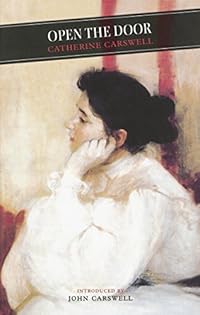
Open the Door by Catherine Carswell

Canongate, 1996, 431 p + xii p introduction by John Carswell. Borrowed from a threatened library.

On the spine plus the front and back covers the title is written as above but the title page and other mentions have it as Open the Door! (as did a Virago reprint I saw yesterday in a charity shop.) One of the 100 best Scottish Books.

 Open the Door! cover

Joanna Bannerman has had a strict religious upbringing in Glasgow. Her father dies on an evangelising trip to the US, but didn’t really love anyone. “Better than his curbed enjoyment of his wife’s virginal freshness” was his love of public speaking: hence his ministry. Joanna’s mother, Juley, might have had a religious vocation – so much so that had she been a Roman Catholic she would have entered an order; “But to her the Church of Rome was the Scarlet Woman.” And there it is again; that stab of religious intolerance that blighted Scotland for so long and, partly, still does. However, Joanna’s life is a long attempt to throw off this background. Not that the novel focuses too much on religion, it’s more concerned about her wish to shake off restrictions (to open the door to living) and her relationships with the men in her life, Ben Ranken, Mario Rasponi, Lawrence Urquhart, Louis Pepper, whom she strings along, or is strung by, in one manner or another. The first she enters into an engagement with then breaks it off, the second she marries but he dies not long after they move (in his case, back) to Italy, the third is an intermittent presence, the fourth is a much older married man with whom she has a years long affair.

In Italy Mario also restricts her, not wishing her to appear in public where “she carried on her the lovely bloom which comes to some women when they are first possessed.” But she does notice a sunken door in a wall which she is told admitted a lover to the house of the Renaissance courtesan “La Porziuncula”. Mario’s death in a crash on a motorcycle of his own construction is something of a release. Her return to Glasgow to live with her mother is only relieved by her meeting with Pepper. Her mother’s friend Eve Gedge is described thus, “Barren of life herself, her deepest passion was to balk and defeat the entering of others into life.” I’m sure we’ve all met one of them.

On seeing her sister Georgie with her son Joanna thinks, “Their mother had done this for them, and her mother for her, and all with the same eager and touching confidence in the next generation. And what was to come of it? Nothing! Nothing because it was based on a lie..…… No! If the children, born and unborn were to be served fairly, one must utter clearly and fearlessly one’s own word of truth in one’s own lifetime.” She feels that, “‘evil’ (in the Christian sense of the word) quite as much as ‘good’ had made her alive ….. had made her an individual,” and her thought, “She remembered the words – ‘In sin did my mother conceive me,’ Why not – “In sin did my father beget me’?” shows that feminism is by no means a recent conception.

Mainly due to her affair with Pepper Joanna seems to drift through life. This gives the novel for most of its length the trajectory of a tragedy but Carswell seems to resile from this for the dénouement. Perhaps this was because, as her son John’s introduction reveals, a large part of the book is autobiographical in origin. Already less than overwhelmed by the novel – among other things it is overlong and too full of introspections – I must confess I was all the more disappointed by this (as usual I left the introduction till after I had read the book) as, while of course an author’s life experiences will feed into the work produced, it is better to rely on imagination to create something completely fictional in order to address deep truth. Towards the end there is a strange passage about the attractions of Fife towns. “Cupar, Falkland, Auchtermuchty, Strathmiglo! Such promising names as they had!”

I’m glad I read this and I suspect it was more of a ground-breaker when it was first published in 1920 but for me there were too many longueurs.

Pedant’s corner:- in the blurb page; annulment (annullment,) Observerand (space is missing,) Boccocio (Boccaccio,) Hugh Macdiarmid (Hugh MacDiarmid.)
In the main text:- first pain them was past (has a four character gap between pain and them,) Asias’s Millions (Asia’s Millions,) an end quote mark where none had been opened, sewed up (sewn up,) or his Easter Holiday (for,) thig (thigh,) students were too shy speak (the s and t of students are underprinted with t and o respectively and the word “to” is missing,) an opened pair of quote marks where no speech followed, pigmy (pygmy,) showed (shown, x 2,) “o return home” (to return home,) ay one (anyone,) beams o the guttering candle (the space between “o” and “the” suggests “of” was meant,) forment (foment,) missing quote marks at the beginning of a piece of dialogue at a chapter’s start, a missing full stop, to day (today,) eveybody’s (everybody’s.)

free hit counter script