Archives » 100 Best Scottish Books

John Burnside

I was sad to read that while I was away in The Netherlands Scottish poet and novelist John Burnside has died.

I only knew him through his prose, which I first came across through the inclusion on that list of the 100 Best Scottish Books (nearly all of which I have now read) of his novel Living Nowhere. After reading that I bought his other fiction books whenever I happened upon them. I have reviewed those I have read here, here, here and here. Every single one is excellent.

John Burnside: 19/3/1955 – 29/5/2024. So it goes.

Project Completed (Almost)

Two posts ago I listed my review of Robert Alan Jamieson’s A Day at the Office, one of the 100 Best Scottish books.

That makes it just about all of the fiction on that list that I have now read, plus the non-fiction The Golden Bough

The only exceptions are The Wind in the Willows (which I believe I did read as a child but can’t remember actually doing so,) the J K Rowling Harry Potter book (which I won’t be reading) and Trainspotting, which along with Lewis Grassic Gibbon’s Sunset Song has appeared on all the lists of Scottish books* which I have covered over the past few years.

Since it was written in Gaelic I’ve also not read An Oidhche Mus Do Sheòl Sinn (The Night Before We Sailed) by Aonghas Pàdraig Caimbeul (Angus Peter Campbell.)

I feel a sense of satisfaction at not only having tracked down these books but finally reading them.

I have seen the film of Trainspotting, which did not encourage me to read the book. I suppose that is a bullet I must bite sometime though.

*As well as the 100 Best there were:-
The Scotsman’s 20 Scottish Books Everyone Should Read (from 2005.)
The Herald’s 100 Best Scottish Fiction Books
Scotland’s Favourite Book

A Day at the Office by Robert Alan Jamieson

Polygon, 1991, 236 p. One of the 100 best Scottish Books.

This seems a consciously literary endeavour. It has no fewer than four epigraphs, a prefatory two-page introduction telling us that what follows is a day and night in the life of a Scottish city and that its three main characters are encompassed by a sequence of symbols of the major arcana of the Tarot, before riffing on the importance of dreaming and the imagination. Each subsequent narrative section begins with a page or two in page-centred bold print, sometimes using multiple fonts and sizes, headed with the time of day it refers to. Characters’ thoughts – italicised and also centred on the page – pop up in between the descriptive, or indeed speech, passages making the layout for those elements appear as a poem might. In the sections focusing on Douglas Shaw speech is denoted by opening ‘<>’ rather than the usual quote marks. Throughout, contractions such as can’t, won’t, couldn’t etc are rendered without their usual apostrophe.

Those three main characters are nineteen-year-old Ray Craig, searching for some blow, Helen Orr, 24, who married at seventeen but left her husband because he hit her (yet her mother wants her to get back with him,) and works in a casino’s restaurant, and Douglas Shaw, a drug dealer using an antique shop in a run-down but likely to gentrify area as a front and who is waiting for a big deal in Holland to come off. Helen now lives above Douglas’s shop in a flat rented from him – with whom she is in a loose relationship – while Ray comes across Douglas while seeking his hit and is offered a job (and that flat as a place to stay) by him.

There is nothing particularly memorable about their interactions or, indeed, their backgrounds. The only thing lifting A Day at the Office out of the ordinary as a novel is the typographical eccentricity of its layout. Which is not to say it’s bad. Not at all. I have certainly read a lot worse. I don’t think I would put it near my list of best 100 Scottish books, though.

Pedant’s corner:- mantlepiece (mantelpiece,) “taken care off” (of,) Douglas’ (several times, Douglas’s,) St Leonards (St Leonard’s,) “a gang of scaffolders were setting up” (a gang … was setting up,) “a second gang were at work” (was at work,) |”that brought to Douglas mind his brother” (Douglas’s,) a missing close quote mark at the end of one piece of speech, “or spit back” (spat back,) some missing full stop at sentences ends, stunk (stank,) focussed (focused.) “The opera was reaching a crescendo” (no. It wasn’t; the opera’s crescendo was reaching a climax,) “making with an effort at a smile” (that ‘with’ is unnecessary,) beneficient (beneficent) “on the bed next her” (‘next to her’ is more organic.)

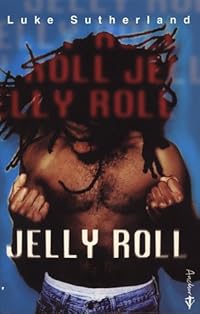
Jelly Roll by Luke Sutherland

Anchor, 1998, 411 p. One of the 100 best Scottish Books.

 Jelly Roll cover

When a book’s epigraph is the passage from Marlowe’s Doctor Faustus which ends in, “Why this is hell, nor am I out of it,” as uttered by Mephistopheles, you know its contents will not be an unalloyed bundle of laughs. Jelly Roll has its lighter moments but the subject matter is indeed serious.

The novel starts when Glasgow jazz band The Sunny Sunday Sextet’s saxophonist, Malc, who is a bit of a psychopath, decides, for domestic reasons, to stop playing with them. The ensuing discussions among the band’s members – in uncompromising Glasgow dialect – relate to whether to give up altogether or find a replacement, and even if doing the latter would be a wise move given Malc’s likely reaction. The prospect of a tour of the Highlands and Islands has the potential to sway things. The group’s drummer Paddy introduces narrator Roddy Burns (whose tipple is the unlikely Bailey’s) to his sister’s boyfriend Liam; who plays like a dream. He seems the perfect answer, young, gifted and ……. black. Embarrassments ensue when he comes along to the next band practice as Roddy has somehow neglected to mention that last fact to the other members. He thinks they are being racist and they think he is, precisely because he didn’t mention it. Liam’s response is to ignore any tension. It turns out this is his strategy to cope with the harassments he habitually has to endure because of his skin colour.

The novel then jumps forward in time to describe incidents occurring during the tour, taking in a roll-call of Scottish towns – Blairgowrie, Dunkeld, Crieff, Fort William, Inverness, Portree, Ullapool – which are usually described by an italicised gazetteer entry. (Ullapool’s is a touch harsh. It merely says herring 1788.) It is obvious we have missed something in the interim. A later return to events which occurred after Malc rejoined the band, with Liam as a supposed backing saxophonist, fills in the gaps. Malc is an unreconstructed racist, as his dubbing of Liam as ‘Banana’ emphasises. His tendency to violence and to pick fights is displayed in several scenes, including the plot’s fulcrum. Not that Malc is alone in his racism or indeed his violence. The band’s reception at one of the venues develops into a rammy due to elements of the audience taking exception to Liam’s appearance.

I assume the book gains its title from Roddy’s penchant for “jellies” (diazepam.) When I first read the blurb on the back I declined to buy it thinking it would not be for me but given my wish to complete that “100 Best Scottish Books” list (at least all the fiction on it) I subsequently could not ignore a charity shop copy at a very reasonable price. I was pleasantly surprised – depictions of violence notwithstanding: there is a lot more going on in Jelly Roll than I have commented on. Its appearance on the list may be due to its highlighting of racism (in his youth Sutherland was the only Scots-African in Orkney) but it is certainly better written than some others which are on it.

Pedant’s corner:- the speaker grill (grille,) sunk (x3, sank,) sprung (sprang,) peninsular (peninsula,) “another thing comin” (another think,) whinging (to me ‘whingeing’ is the better spelling,) duffelcoat (duffel coat,) “to fall back onto” (fall back on to,) span (spun,) the watersedge (the water’s edge,) lungeing (conversely, lunging,) “seemlessly into the cultural fabric” (seamlessly,) twinging (twingeing,) Hawkins’ (Hawkins’s,) doppleganger (doppelganger,) “‘Ah’m ah fuck?’” (‘Am ah fuck.’) “fob us of” (off,) windowledge (window ledge,) Dunkin Doughnuts (I believe the company spells it Donuts,) “a hand held short” (hand held shot,) snuck (sneaked.)

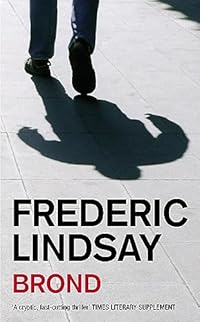
Brond by Frederic Lindsay

Polygon, 2007, 220 p. First published 1984. One of the 100 best Scottish Books.

 Brond cover

Glasgow University student Richard sees a man throw a boy off a bridge into the River Kelvin but at first thinks he must have imagined it. Through the medium of fellow student Margaret Briody, whom he fancies and who asks him to deliver a package for her, it is not long before he is drawn into a complex situation involving IRA sleepers, multiple murder and the machinations of agents of the state against Scottish independence activists (though this last does not become clear until quite late on in the book.) Chief of those agents is the mysterious Brond of the title, whose baleful presence pervades the novel.

Before settling into the more or less standard thriller mode, though with the odd philosophical aside, the narrative has a tendency to be slightly overwritten, as if Lindsay is trying too hard, though there are some fine touches. (Of the noise-propagating acoustics of the University of Glasgow’s Reading Room Robert says, “It was such a drawback in a library I was sure the architect must have won a clutch of awards.”)

The politics of the plot are mostly relegated to the background. One character describes Scotland as a valuable piece of real estate, another opines, “here in Scotland we have this difficulty finding our voice.” One English girl questions Robert, “‘What do you mean “accent”?’” before adding, “‘I don’t talk like a Cockney… I talk like ordinary people who sound as if they don’t come from anywhere.’” One of the spooks speaks of the necessity “‘to forestall … the risk, however remote, of the natives here getting restless.’”

In my view there are too many thriller/crime novels on that “100 Best” list. Brond is yet another. I can see, because of the background politics, why some people might regard it as a significant Scottish novel but it doesn’t, to my mind, really address the nature of Scottishness, or go much beyond “the state acts in its own interests” trope though it incidentally reflects attitudes of some English people to their neighbours.

It does, however, all pass easily enough but I was never able to suspend my disbelief to the required degree.

Pedant’s corner:- like lightening (lightning,) sulphur lamps (they did give off a yellowish light but they were sodium lamps,) the Barrows (always known as the Barras, never the Barrows. Its name above its gates even says ‘the Barras’,) contigent (contingent,) a missing comma before a piece of direct speech, comitments (commitments.)

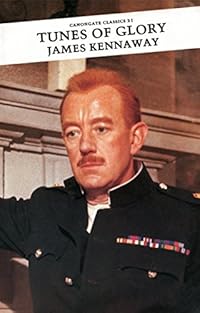
Tunes of Glory by James Kennaway

Canongate Classics, 1989, 180 p, plus v p Introduction by Allan Massie. One of the 100 best Scottish Books.

 Tunes of Glory cover

Lt Colonel Jock Sinclair, ex-Barlinnie, has come up from the ranks and the Pipe Band via a good war to become acting commander of a battalion of an unnamed Scottish regiment. While the battalion is engaged in boisterous dancing practice the new Colonel, Basil Barrow, graduate of Eton, Oxford and Sandhurst (and a Japanese POW camp,) arrives the evening before he was expected. His displeasure at the raucous activity is clear and the seeds of conflict are sown. The new Colonel is soon dubbed Barrow boy, and his demand that all officers gather in the early morning three days a week to practice dancing in a more refined style incurs resentment.

Sinclair has a penchant for drink and a daughter, Morag, of whom he is overly protective. He also maintains an interest in Mary Titterton, an actress in the local Repertory company, with whom he can relax. These two women are the only two in the book and are little more than placeholders. Kennaway’s interests lie elsewhere, in the exigencies of army life, the necessity of sticking to military etiquette and the drawbacks these entail.

Sinclair’s behaviour on a night out in the town eventually puts Barrow in an impossible position. Neither can deal with the consequences.

I watched the film made from this on television a few years ago. As far as I recall it, it stayed remarkably true to the book. In his introduction Allan Massie says the ending works better cinematically than in the novel, mainly due to Alec Guiness’s presence as an actor. There is something to this analysis but Kennaway’s examination of army life and the pressures it puts on emotional life is nevertheless illuminating.

Pedant’s corner:- in the author’s background information page; Aucherarder (Auchterarder.) The publishing information says first published in 1933 in Canada; the text mentions television sets and is clearly set post-Second World War , so 1953? In Allan Massie’s Introduction; “a corporal, unknown to him, is his daughter’s boyfriend” (a corporal who, unknown to him, is….) locak (local,) Reportory (Repertory,) “He didn not.” (He did not,) respsonsibility (responsibility.) Otherwise: hooched (this can be read to be an allusion to illicit alcohol. The sound referred to is more usually written as ‘heughed’,) Jesus’ (Jesus’s,) a missing comma before a piece of direct speech, clack-handed (usually it’s cack-handed.) “There were a score of details” (there was a score.)

Reading Scotland 2018

The ones in bold are in the 100 Best Scottish Books list.

I’ve read 33 Scottish (in the broadest sense) books in 2018, 7 SF or Fantasy (italicised,) 13 by women, 20 by men. E M Brown (aka Eric Brown) qualifies by having a small part of Buying Time set in Scotland and by living near Dunbar for the past few years.

I’ve not a good balance this year between men and women, mainly due to exhausting the women on the 100 Best list.

The Distant Echo by Val McDermid
Living Nowhere by John Burnside
The Hound of the Baskervilles by Arthur Conan Doyle
The Gathering Night by Margaret Elphinstone
When They Lay Bare by Andrew Greig
Autumn by Ali Smith
The Great Chain of Unbeing by Andrew Crumey
The Lie of the Land by Michael Russell
As Though We Were Flying by Andrew Geig
Madame Doubtfire by Anne Fine
Jericho Sleep Alone by Chaim I Bermant
Hame by Annalena McAfee
The Thirteenth Disciple by J Leslie Mitchell (Lewis Grassic Gibbon)
Memento Mori by Muriel Spark
Miss Marjoribanks by Margaret Oliphant
The No 1 Ladies’ Detective Agency by Alexander McCall Smith
The Gloaming by Kirsty Logan
The New Road by Neil Munro
Glitter of Mica by Jessie Kesson
From Russia with Love by Ian Fleming
The Abbess of Crewe by Muriel Spark
Supercute Futures by Martin Milllar
The Corn King and the Spring Queen by Naomi Mitchison
Places in the Darkness by Chris Brookmyre
Confessions of an English Opium Eater by Thomas de Quincey
Adam Blair by J G Lockhart
Naming the Bones by Louise Welsh
The Shipbuilders by George Blake
Mr Alfred M.A. by George Friel
Serious Sweet by A L Kennedy
Interrupted Journey by James Wilson
The Bone Yard by Paul Johnston
Buying Time by E M Brown

Mr Alfred M.A. by George Friel

Canongate Classics, 1987, 181 p, plus v p Introduction by Douglas Gifford. First published in 1972. One of the 100 best Scottish Books.

Mr Alfred is an ageing teacher of English unable to make connections with the pupils at the school where he teaches – a comprehensive in a rough area. Never married, his sense of failure is compounded by the lack of success his poetry collection found. His only solace is to habituate the local and not so local pubs. Not even ladies of the night hold any attraction for him. Strangely – the practice was not followed in the schools I attended as a pupil at much the same time as this book is set – the classes in Mr Alfred’s school are segregated by sex; until halfway through the book he has never taught girls.

Alfred is particularly irritated by the habitual misbehaviour, in and out of school, of Gerald Provan, a child whose mother indulges and cossets him, perhaps as a counterbalance for the absence of his father – though it was not uncommon for mothers of that generation to favour sons unduly. Gerald’s younger sister, Senga, is under no illusions as to Gerald’s unpleasantness as she has to bear its brunt at home. Mr Alfred’s mistake in striking Gerald in class becomes the source of the abiding resentment of and animosity towards Alfred of both son and mother.

A particular example of Scottish perceptions lies in the incidental exchange, “‘How is she qualified to improve anybody?’ Mr Alfred asked.
“I told you,’ said Mr Dale. ‘She’s English,’” which speaks volumes.

We also have, “Scotch reserve looked askance on kissing even between kin.”

An odd interpolation comes with the passages concerning the doomed relationship between relatively well-to-do Graeme Roy and the working class Martha Weipers, whose respective parents disapprove of the liaison. Both go on to University but while Martha does well Graeme fails his first year exams. Neither was taught by Mr Alfred but Martha’s sister, Rose, is in his first girls’ class and he forms too close an attachment to her, sending her to buy his lunch, rewarding her with pocket money, inviting her to his classroom at lunchtime. While he is aware such relationships can overstep the boundaries of decent behaviour he shies away from the thought – or act – of exploiting theirs in any sexual way. His conduct is nevertheless highly unprofessional and it provides the two Provans with the perfect excuse to accuse him. He is forced out to another, rougher, school – a Primary – and his descent accelerates.

Much of the latter part of the book sees Mr Alfred wandering the streets at night pondering the writing on the wall, a host of graffiti asserting different gang allegiances, each name followed by the words YA BASS. This sense of societal breakdown had been presaged by Gerald Provan’s encouragement of after-school fights in the Weavers Lane, the casual psychological cruelty he and his cohorts visit on Granny Lyons, their baiting of and petty theft from Italian shopkeeper Mr Ianello, and is accentuated when Mr Alfred witnesses encounters between gangs in broad daylight. Alfred even takes up chalk himself to reproduce that original writing on the wall, MENE MENE TEKEL UPHARSIN, in a cri-de-coeur against Philistinism. This protest is only too redolent of Alfred’s estrangement from the world he inhabits, an estrangement mirrored in the text by Friel’s use of uncommon words – kyphosis, pandiculating, messan, raniform, poplitic, ophidian, invulting, claudication, lycorexia, perlustration, battology, nuchal, diplopia, prosthodontia, pyknophrasia, and indeed by the untranslated reference to Belshazzar’s Feast above. Alfred’s subsequent arrest leads to a psychologist pronouncing him to be suffering from a whole list of phobias.

While the book is rooted in Scottishness – or at least in the experiences of the Glasgow conurbation – Alfred’s feeling of dissatisfaction with the world as it turned out has a more universal resonance.

Pedant’s corner:- In the Introduction: “she borde the kitchen” (the book’s text had borded.) Otherwise; “she borded the kitchen sink (bordered?) “you hands” (your hands,) comming up (coming up,) invulting (I can’t find a definition of this,) lushus (of a blonde, but why not luscious?) Mr Briggs’ (Mr Briggs’s,) “so remoted from the world’s slow stain,” (is an awkward way to phrase it. Was it perhaps meant to be so removed from the world?) broadshouldered (not one word surely? Or at least hyphenated,) the Garelochhead (Garelochhead is a village/town, it does not require a ‘the’ before it,) apotrapaic (apotropaic,) Mr Brigg’s (Mr Briggs’s,) Pythagoras’ theorem (Pythagoras’s,) a missing full stop.

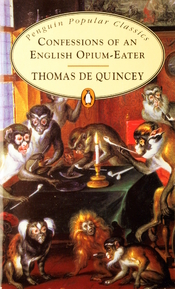
Confessions of an English Opium-Eater by Thomas De Quincey

Penguin Popular Classics, 1997, 265 p, including Original Preface (7 p,) Preface to the Collected Edition (4 p,) The Daughter of Lebanon (6 p,) Appendix (9 p.) First published 1821-22. One of the 100 best Scottish Books.

Confessions of an English Opium-Eater cover

I doubt I would have read this had it not been in that list of 100 best Scottish books but what place it has in such a list I have no idea. While describing the author’s peregrinations through England – taking in Manchester, London and the Lake District – and Wales there is nothing at all to indicate any sense of Scottishness within it. The only mention of the place is in a footnote which states that from Hammerfest in Norway in the north to Naples and Gibraltar in the south “Glasgow … is the one dearest place for lodgings known to man.” What in Edinburgh “could be had for half a guinea a week, in Glasgow cost one guinea.” De Quincey did spend the latter part of his life living in Edinburgh but I’m not sure that allows this work, even if it is a seminal piece of autobiography, to be claimed as Scottish.

The footnotes are copious and include the information that filibustier is the original and, De Quincey asserts correct, spelling of filibuster and that the word objective in the sense of dispassionate was almost unknown in 1821. (This last must be a footnote to the collected edition of 1856.)

The prose is of its time and to modern eyes appears long-winded. As with Walter Scott it takes getting used to but once attuned is straightforward enough.

The main interest lies I suppose in the author’s use of opium which he took originally in order to relieve a toothache and the effects of which he asserts were not addictive – to him at any rate. He takes issue with Coleridge over the suggested drawbacks of opium use and contrasts the drug with alcohol. “Whereas wine disorders the mental faculties, opium, on the contrary (if taken in the proper manner) introduces amongst them the most exquisite order, legislation and harmony. Wine robs a man of his self-possession, opium sustains and reinforces it ….. most men are disguised by sobriety, and exceedingly disguised; and it is when they are drinking that men display themselves in their true complexion of character.” However discussion of opium does not begin until more than two-thirds through, the early parts of the book giving a blow by blow account of his schooling – and dropping out – and his penniless sojourns in the streets of London.

Other concerns intrude at times, “If in this world there is one misery having no relief, it is the pressure on the heart from the Incommunicable,” which is of a piece with sentiments expressed both in Time Was and I Capture the Castle which I read immediately prior to this.

However, De Quincey’s implicit reproof of others in his statement that, “at no time of my life have I been a person to hold myself polluted by the touch or approach of any creature that wore a human shape,” sits uneasily with his aspersions elsewhere on those who did not adhere to Christian beliefs or did not live in these islands – and even some of those: “Wales, as is pretty well known, breeds a population somewhat litigious. I do not think worse of them for that.” To which I immediately posed myself the question, what does he think the worse of them for, then?

A historical curiosity. But one more struck off that list.

Pedant’s corner:- Due to the book’s antiquity 19th century spellings are fairly prevalent; eg Shakspere for Shakespeare. Most page numbers are in large print at the top left (even pages) or right (odd pages) margin but pages 13 and 249 are in small print centred at the bottom,) “the whole race of man proclaim” (the race proclaims,) “the household at the Priory were released” (the household was released,) “the brother Talbots” (the brothers Talbot,) “by-the-bye” (by-the-by,) an opened but unclosed parenthesis on page198, parantheses (parentheses.)

From Russia with Love by Ian Fleming

Vintage, 2012, 358 p plus i p Author’s Note and vii p introduction by Tom Rob Smith. First published 1957.

I did not have great hopes for this. If it hadn’t been on the list of the 100 best Scottish Books I would never have picked it up, still less paid for it. It was, however, available from a local Library – these need as much patronage as they can get – I therefore borrowed it. Even so my expectations were not met. The novel is written in journalese, the prose fails to rise even to the utilitarian, the characters are barely one-dimensional, never mind rounded. And info-dumping is rife.

Then there is the implicit racism. “It was a strong Western handful of operative fingers – not the banana skin handshake of the East that makes you want to wipe your fingers on your coat-tails.” The casual misogyny of the time, too, is shown by the sentences, “All women want to be swept off their feet. In their dreams they long to be slung over a man’s shoulder and taken into a cave and raped,” and, “I got her to my place and took away her clothes and kept her chained naked under the table.” True, Fleming puts these into the mouth of a Turk but it’s still misogyny. Unexamined misogyny, to which Bond does not demur. An organised fight between two gipsy girls over a man (which reads as merely an excuse to describe their clothes sequentially coming off) is misogynystic and racist both. Bond’s right wing attitude – so by extension Fleming’s? There is nothing in the text that would contradict this – is exemplified by him saying, “As for England, the trouble today is that carrots are all the fashion.” That is, as opposed to sticks.

Moreover the structure is a bit odd. Bond isn’t mentioned till page 61 and does not appear himself till page 151. Tom Rob Smith’s Introduction regards this as a strength but the focus of Part One, Donovan Grant, a half-German, half-Irish psychopathic hitman employed by Smersh through expediency rather than approval of any sort, does not reappear till the climax (and then instead of just killing Bond this supposed total psychopath Grant explains to him the nature of the plot against him thus giving Bond some time to formulate a way out.)

That plot concerns the supposed falling in love with Bond via his photograph of Tatiana Romanova, in order to entice him into a trap – the additional bait being her bringing to Bond a Spektor cryptographic machine – whereby he will be disgraced. The egotist Bond cannot quite work out why this is a red flag. Cue, though, many goings-on in Istanbul and a trip back west on the Orient Express; a singularly unlikely escape route.

I suspect these things work much better on a film screen than on a page. Whatever, this book certainly is not worthy of a place on any list of 100 best Scottish books.

Pedant’s corner:- a masseuse is described as having tufts of fair hair in her armpits but has short coarse black hair (genetics doesn’t work like that and there was no mention of dyeing,) “one of the men-servants” (the word is manservant, the plural is surely manservants,) a missing comma before a piece of direct speech, long-chassied (the word is chassis, so long-chassised,) “there was a diminishing crescendo” (crescendos rise to a climax, they do not descend. A descent is a diminuendo.)

free hit counter script