Archives » ParSec 14

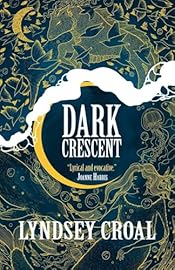
Dark Crescent by Lyndsey Croal 

Luna Press, 2025, 176 p including Author’s note on Finding Inspiration in Scottish Folklore. Reviewed for ParSec 14.
This is a collection of one novella and 22 short stories – some very short; the title story is barely three pages long, a couple are only two, with the longest, The Frittening, just twelve – all taking inspiration from Scotland’s folklore, superstitions, or landscape.

The short pieces are loosely bunched under headings for the four seasons with each section’s stories prefaced with a wood- (or lino-)cut engraving of one of the Moon’s principal phases and a scene illustrative of a story within it. A ‘Bonus Section’ at the end outlines those particular tales and legends which sparked Croal’s imagination.

An individual story here can contain relatively familiar apparitions or hauntings – selkies, kelpies, hagstones, seer stones, magpies, omens and shape shifting, Will-o’-the-Wisp, the Otherworld, Changelings – but others like the Sluagh, the Frittening or the Boneless, the Cat-Sith, the Ghillie-Dhugh, Baobhan Sith and the Fiddlers of Tomnahurich Hill, the Cailleach, the Nuckelavee, the Marool, the Ceasg, Bee-telling, the Sea-Mither, Each Uisge, the Wulver, the Bride and Angus, may be less so. Some are set in depopulated post-disaster worlds and border on Science Fiction; others touch on gothic, weird horror, dark fantasy, and solarpunk. Many draw stimulus from nature, climate, and the environment, with feminist and eco themes prominent. Croal’s Author’s Note informs us three of her tales do not have a specific derivation but are original to her.

Hence, among others, we have omens in the sky, tappings on windows, a strange puddle emerging on a doorstep, pebbles appearing in a nest in the night, a will-o’-the-wisp manifesting more strongly each day, a fiddler finding his muse in a painting whose scene gradually changes, the green man as a malevolent influence, the thoughts of the last surviving whale as it roams the deserted seas. Except for a common thread of the sea there is little beyond the Gaelic names of the various phantasms to mark these stories out as specifically Scottish.

The novella, Daughter of Fire and Water, with its intermingling of gods/goddesses and mortals in fact reads more like a Greek, or perhaps Norse, myth – except for the prince in it being named Angus.

Taken individually the stories here are perfectly fine but the cumulative effect of Croal’s general style tends to the dry. She has a fondness for italicized paragraphs, especially in throat-clearing beginnings, and there is the occasional odd choice of verb, which can be jarring. There tends to be a kind of distance between the tale and the reader and the stories are too often told rather than shown while some are not really given enough room to breathe fully. There is not much emotion evoked in these tales but then stories of weird creatures and the whole apparatus of fairy tale have always been admonitory in intent.

This is a collection to be sipped rather than quaffed. (Not really an option available to a reviewer.)

Curiously, a few lines on Content Notes and Warnings come dead last in the book though a signal to them does lie on the publishing information page. Surely if such warnings are needed they ought to be more prominently placed?

The following did not appear in the published review.

Pedant’s corner:- focussing (focusing,) maw (more than once. A maw is not a mouth,) several USianisms (cookies, snuck, dove [for dive,] inside of, etc,) sunk (several times; sank.) “The only muscle the woman moved was her mouth” (a mouth is not a muscle,) razor—sharp (razor-sharp,) sung (x 2, sang.) “She lay the Seer’s map on the table” (She laid the Seer’s map on the table.) “She was his only companion, his confidant” (she; therefore ‘confidante’,) “Then she said with sharp cruelty, ‘no. Not if you…’” (she said with sharp cruelty, ‘No. Not if you…’,) “Everyone knelt and lay the offerings at her feet” (and laid the offerings,) “all that kept me company were layers of clouds” (all that kept me company was ….) “If I wanted so bad not to be alone” (If I wanted so badly not to be alone,) “and lay it over my chest as a pendant” (and laid it over my chest,) “and lay her in blankets” (and laid her in.) “When the sea witch, turned away and disappeared” (doesn’t need the comma, which in fact detracts from the sense,)  “that I’d wove so carefully” (woven,) “mouth scrunched up into an eclipse” (only makes sense if ‘ellipse’ was meant,) a new paragraph that was not indented, a missing full stop, “span” (spun,) “as if expecting me turn into” (to turn into.) “‘Your association with them isn’t exactly customary’” (sense expects, ‘Your association with them isn’t exactly exemplary’,) sat (seated; or; sitting.) “The fall made the landscape blur, and then a screech” (needs clarification,) “there were no sign of burns or marks” (there was no sign.) “then he swept out the room” (as written this means he cleaned the room with a brush; what was intended was ‘he swept out of the room’,) “the hot water stung into my legs” (the hot water stung my legs,) focussed (focused, annoyingly used two pages earlier.) “They looked between one another” (looked at one another,) galivanted (gallivanted.) “Much of these stories are inspired by” (Many of these stories are.) “I became fascinated in the dark, strange, and rich folklore” (became fascinated by,) “rife with unexplained phenomenon” phenomena makes more sense.) “Hagstones are stones with natural holes bored in centre are thought to be,” (the holes can’t have been bored; plus the sentence needs an ‘and’ before ‘are thought’.)
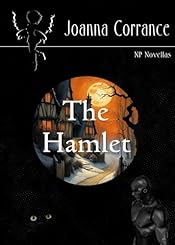
 

The Hamlet by Joanna Corrance

NewCon Press, 2025, 115 p. Reviewed for ParSec 14.

This was published as a novella but reads more like an assemblage of short stories with characters which cross over from one to the next, though outwith their own tale, usually only in brief appearances. Its background premise – something strange (but unspecified) has happened and people have been advised to remain indoors – may be a literary response to Covid. The setting is a small village in Scotland – locals call it a clachan but incomers have used the description hamlet (which I note is actually a particularly English designation) for so long that it has become more common. The village ‘spinsters,’ however, still frown upon it. Apart from the first, very short, chapter which introduces the strange event, each section is given over to the experiences of different characters, Beth, Polly, Helen, Eve, Robyn and Jeanie, with the novella ending with a sort of epilogue from the point of view someone called the Spaceman.

The stories’ time scales are not always immediately apparent as some chapters start before the strange event or more or less ignore it happening. However, there’s enough oddness going on even without it.

Responding to a voice calling to her, Beth, who has inherited her home from her mother and not improved it in any way, instead letting it run to squalor, manages to move through the pipes in her plumbing, whether by her shrinking or the pipes expanding is moot. Eventually she is drawn down to an underground chamber to chat with the spinsters about the end of the world. The chapters which follow may represent different ways in which that end happens.

Thanks to the green-suited spaceman who appears at her window one night, schoolgirl Polly travels the universe and becomes both a witch and a princess.

Helen begins to produce videos which attract internet followers but increasingly show her lack of control of her life.

To escape the locked down city Eve has come to the cottage she rents out to Matthew (known locally as the Pest.) Not a good choice.

At Helen’s request Robyn builds a doll’s house as an exact replica of Helen’s home but realizes it also needs a doll’s house inside it and then another inside that and so on down.

Jeanie begins to act strangely and eventually locks herself away from everyone. She is however revealed to be a figment, a skin the narrator wore to make her life more amenable. The implication is that all the viewpoint characters are such skins. (But this is the essence of fiction. The reader temporarily becomes – or at least empathises with – a book’s characters.)

The Spaceman is from another world.

The Hamlet has aspects of a fairy tale (but there do not seem to be any happy ever afters, except perhaps for Polly,) has some of the heightened sensibility of magic realism (with a faint echo of John Burnside’s Glister,) moments of horror, and makes a foray into Science Fiction. Whether the disparate elements necessarily cohere into a unified whole is a matter for the individual reader. Corrance can write though.

The following did not appear in the published review.

Pedant’s corner:- “The McIvor’s lived in” (the McIvors lived in,) sat (x 2, sitting, or, seated,) “Mums washing machine” (Mum’s,) “paper mâché” (paper mache:  if its ‘mâché’ then it’s papier mâché,) “it sloped passed me” (past me,) airplane (aeroplane,) “the High-lands” (the Highlands,) curb (kerb.) “‘So where did you learn to cook?’ She asked.” (‘So where did you learn to cook?’ she asked,) “when they played drafts” (draughts,) dollhouse (doll’s house,) “most Saturday’s” (most Saturdays,) “and come pick me up” (come to pick me up,) miniscule (minuscule,) “the little girls’ eyes” (it was only one girl; ‘little girl’s eyes’.)

Orphan Planet by Madeehah Reza  

Luna Press, 2025, 187 p. Reviewed for ParSec 14.

At the start of this novella Elif is the sole inhabitant of the apparently desert planet Maoira-I. At twelve years old she has hitherto known only the companionship of the AI, VAS-H, her Vital Auxiliary Support: H-unit, and her knowledge of other humans is derived solely from the films and shows available to her on screen.

Contact from Commander Isabel Aremu of the Interplanetary Mission, based on Polaris, who addresses Elif as Warden, comes to her out of the blue, as does the task she is assigned of growing, or attempting to grow, plants to see if Maoira-I might be a suitable future home for humanity. The Mission is on an indefinite space flight fleeing something unspecified back on Earth. VAS-H retrieves the seeds Elif will need, seeds she had not known were there, from the base’s storage freezer.

Part One centres on Elif via both a third person narrative tightly focused on her unfolding experiences and the log entries VAS-H asks her to compile. While these are not the reflections of an unreliable narrator they are those of one without knowledge of the full picture. Helping to fill in those gaps for the reader there are also two italicised sections dealing mainly with the consequences for Commander Aremu on Polaris of the Mission having to admit that Elif exists and its failures regarding her. This leads to Aremu’s replacement as contact by the much less sympathetic Lieutenant, later Commander, Julian Bishop.

In the meantime Elif uncovers a buried Transporter vehicle on the surface and learns to drive it while Maoira-I’s long-term climatic variations begin to manifest themselves.

Part Two makes a step change. Mission operative Rokeya Khan, whose grandfather Latif was on the original team to land on Maoira-I, has set off on her own to get to the planet and find out what happened. Her arrival shocks Elif but they learn to work together.

Rokeya’s presence is the catalyst for the discovery of what became of the original crew, one of whom, naturally, but against all protocol, must have been pregnant.

It also crystallises Elif’s feelings towards the rest of humanity and towards the only home she has ever known.

There are some caveats to this. The premise does stretch credibility a bit. Could an infant human really thrive under only the influence of an AI and old videos? Could she retain sanity even? Could the original expedition genuinely have been forgotten by the Mission for twelve years?

But Reza has written this well. She captures Elif’s initial ingenuousness and growing confidence. The claustrophobic atmosphere of an isolated environment comes across, as does the slightly sinister sway of an AI companion.

This is an impressive long form debut.


The following did not appear in the published review.

Pedant’s corner:-  shrunk (x3, shrank,) CO2 (several times. It’s CO2,) “wherever the fleet of ships were” (wherever the fleet … was,) fit (fitted,) “than several millions” (than several million,) “about to reach a crescendo” (you don’t reach a crescendo, you reach its end,) sunk (sank.) “Rokeya’s opened her mouth in shock” (Rokeya opened her mouth.)


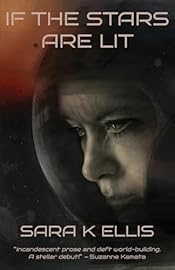
If the Stars are Lit by Sara K Ellis

Luna Press, 2025, 198 p. Reviewed for ParSec 14.

Well. They do say you should start with a bang – and this novel does begin with a sentence reminiscent of the first in Iain Banks’s The Crow Road, though what unfolds is neither a bildungsroman nor (quite) a murder mystery but a decent enough piece of Science Fiction.

Viewpoint character Jocelyn Carsten (Joss,) is a hostage negotiator on the way home from managing a crisis on the planet Haitch when her passenger ship Tiktaalik suffers an explosion. She is still alive, just, but is injured, and is the sole survivor. All contact with the ship’s Central Hub – and the outside world – is lost. Only Harbour, the controlling intelligence of passenger mod Petal 4, is available to aid her.

After a trip to the med bay and an EVA to survey the damage to the ship, Harbour advises her to rest. When she wakes up there is another presence in the mod, a gemel; a holographic copy of Joss’s personality, but this has the physical appearance of her ex-wife, Alice Dray.

“A gemel” (the plural is also gemel) “is a sentient being generated from an individual’s psyche,” usually, but not always, taking on the appearance of their sires, “fuzzy copies of their progenitors, interpolated from memories and neurocircuitry, and can resemble their users to a disturbing degree,” but can be “warped by narcissists with fat wallets and the desire for more intimate personal assistants,” as had been the case with Gabrielle Vecher, on-site CEO for Haxen Mining Corps, and his gemel Malachi. Narcissus and Echo in the same package, thinks Joss. Gemel were not allowed physical bodies but, with safeguards, could patch into systems and control them from the inside. They “drew force from external sources, running off the excess electricity in the machines around them.”

This Not-Alice becomes a psychological prop for Joss and a device for the author to run Joss’s backstory past the reader, in instalments. Indeed, at times our access to Joss’s thoughts shifts between the present and her past memories with little or no signalling.

Joss’s rescue from isolation – when it comes (rather abruptly it must be said) – is by a military force co-commanded by none other than Alice Dray: the real one. Its mission is to investigate both why Tiktaalik and the tunnels on Haitch were blown up and to try to obtain the release of the humans still there held by gemel, an endeavour where Joss’s negotiating skills come to the fore. But Alice Dray’s co-commander – something of a loose cannon of the gung-ho military type – threatens to undermine Joss’s steps towards a solution of the situation.

It turns out Vecher had constructed a highly dangerous device deriving from mysterious markings on the tunnels on Haitch. And time is running out. “‘That thing Vecher made tore a hole in the fabric of the universe or whatever the hell you want to call it, and it’s growing, becoming less stable by the hour,’” says Joss during the negotiations.

Given her initial circumstances, Joss is unsurprisingly prone to periods of introspection and questioning both of herself and others.

Despite some problems with structure and pacing this is an engaging read and will push enough familiar buttons for SF readers to emerge satisfied.

The following did not appear in the published review.

Pedant’s corner:- Written in USian but with some British spellings. The planet Ross128 H’s nickname of Haitch is an egregious mispronunciation of that letter of the alphabet, “on a round-a-bout route” (roundabout – which was used elsewhere in the text for a meander -) once there was a single quotation mark where double ones are employed elsewhere, shlock (schlock,) back-peddling (back-pedalling,) hostage takers “174 million miles away” morphs to “140 million mile silences” during the communications gap, “sliding the stack of credits Joss had won back from her back across the table” (Joss was playing her opponent for the first time, so just ‘had won from her’.) “This is ….. based on …..?” (wasn’t a question so full stop, not question mark,) C02 (It’s not C zero two as was printed in the text, and the 2 ought to be a subscript,) “wracking your brain” (racking,) “sending some part of her ex’s upper-class snobbery would revolt” (sensing some part.) “‘Tell and I send you outside to repaint the serial number.’” (No clue. Who is Tell?) “what she can offer them are options” (I read ‘what she can offer them’ as a singular subject to the following verb; so ‘what she can offer them is options’,) “is different thing” (is a different thing.) “‘Ph damage right here’” (‘pH damage’ was meant and pH always has an upper case H and a lower case p – even at the start of a sentence,) “drowns out nothing but Callen’s voice” (everything but Callen’s voice,) “‘I pretty sure’” (I was pretty sure,) “for having sunken so low” (for having sunk so low.) “She doubts its convincing” (doubts it’s convincing,) “amid glow of the launch” (amid the glow of the launch,) a missing extraneous end quotation mark, a missing comma before the quotation mark at the end of a piece of dialogue. “‘How is that that they’ve got people down there?’”  (How is it that they’ve got…,) “‘if we so much get within the distance’” (if we so much as get within…,) “it takes her moment” (it takes her a moment.) “Alice takes her seat again and switching back to their private comm.” (and switches back to,) “the metal partition the separated them” (partition that separated them.) “A name that inferred family, and what she’d always been taught to mean trust, love and guidance” (and that she’d always been taught…,) “but do they do afford” (but they do afford,) “of the Florenz’ cargo bay” (the Florenz’s,) “breathing apparatuses” (the plural of apparatus is apparatus,) “nothing but the judder of the engine and the clatter of equipment as rattles against the bulkheads” (could be rewritten more clearly,) “‘I can’t let you can’t do this’” (either, ‘I can’t let you do this’ or, ‘You can’t do this.)

City of All Seasons

Recently arrived from ParSec magazine and now on my sidebar, a new book to read and review; to wit City of All Seasons by Oliver K Langmead and Aliya Whiteley.

I haven’t read any Langmead up till now but have read a couple of Whiteley’s books. She writes well.

The deadline for ParSec 14 is probably a bit too imminent for the review to make that issue but there will be ParSec 15 to come.


free hit counter script