Posted in History, Trips at 12:00 on 12 February 2025
Bannockburn is the site of the Scottish nation’s birth. Had it not been for the victory Robert the Bruce won over the forces of the English King Edward II in 1314 Scotland would almost certainly have been absorbed into England, as Wales was under the previous King Edward – Edward I, known as Longshanks and also as the Hammer of the Scots. (Not that the intervening 700+ years have eroded Welsh identity entirely away nor the three hundred since the Union of the Parliaments diluted the sense of Scottishness.) But Scotland as we know it would not exist, its separate legal and educational system not even a fleeting thought.
While the fact of the battle is undeniable there is no archæological evidence of the actual battle site, most of the soldiers’ accoutrements being perishable, its exact location is now a matter of conjecture informed by historical sources and topography.
We visited the Visitor Centre in April. This is the major information board:-

There was also this tableau of the battle site constructed from historical references:-

The tour guide (a genial Englishman) was very informative and there were some cartoonish films no doubt intended to appeal to children filling in some of the background to the battle.
On the small hill outside the Visitor Centre there is a huge flagpole flying the Saltire of Scotland. It is situated within a rotunda:-


Inside the rotunda is a cairn which bears the inscription “For God and St Andrew Robert the Bruce King of Scots planted his flag near this spot when the Scottish patriots under his command vanquished the armies of Edward of England at the Battle of Bannockburn, 24th June 1314.” Below that is a quote from the Declaration of Arbroath, the assertion of Scottish nationhood sent to the Pope in 1320. “We fight not for glory nor for wealth nor honour but only and alone we fight for freedom which no good man surrenders but with his life.”

In the background above can be seen the statue of King Robert seated on a horse which dominates the area beyond the rotunda:-


Rotunda and flagpole seen from the path to the statue:-

View down to suggested battlefield site:-

No Comments »
Posted in Fife, Scotland, War Memorials at 19:19 on 21 August 2016
Ceres is a village in central Fife.
The monument was erected on the six-hundredth anniversary of Scotland’s most famous victory in battle, at Bannockburn in 1314, to commemorate the men of Ceres who fought in it. It’s situated by the side of the “Bow Butts” as Ceres’s village green is called.
Ceres holds a Highland Games every year. It is said to have hosted a games every year since 1314 after Robert the Bruce granted permission in commemoration of the village men’s contribution to his victory.
Bannockburn Monument, Ceres:-

Inscription:-

No Comments »
Posted in History, War Memorials at 15:00 on 25 June 2015
As at Edinburgh Castle there are War Memorials on the esplanade of Stirling Castle.
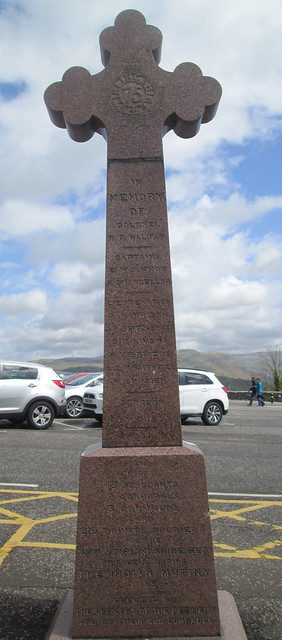
Again there is one to the Indian Mutiny, this one dedicated to the men of the 75th Stirlingshire Regiment who died at Seringapatam, Delhi and in the Relief of Lucknow.

The other side of the memorial names the officers (1 colonel, 2 captains, 6 lieutenants and 1 surgeon) but only gives the total numbers of other ranks (13 sergeants, 9 corporals, 3 drummers and 216 privates) – all of the 75th Stirlingshire Regiment – who died in the mutiny, 1857-8.
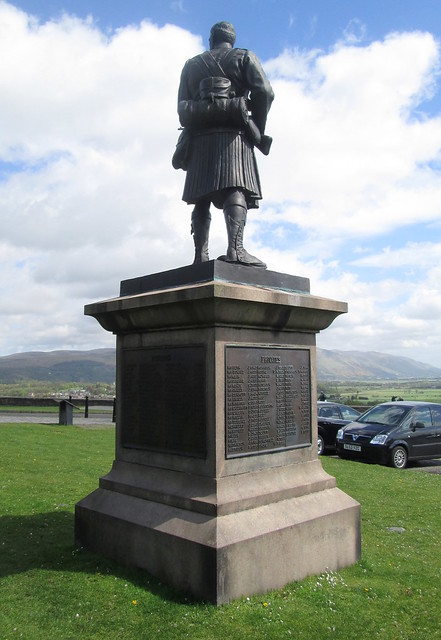
Again too there is a Memorial to the South African War (Second Boer War) dedicated to the men of the 1st Battalion (Princess Louise’s) Argyll and Sutherland Highlanders

The plaque here gives the names of the officers and non-commissioned officers who died:-
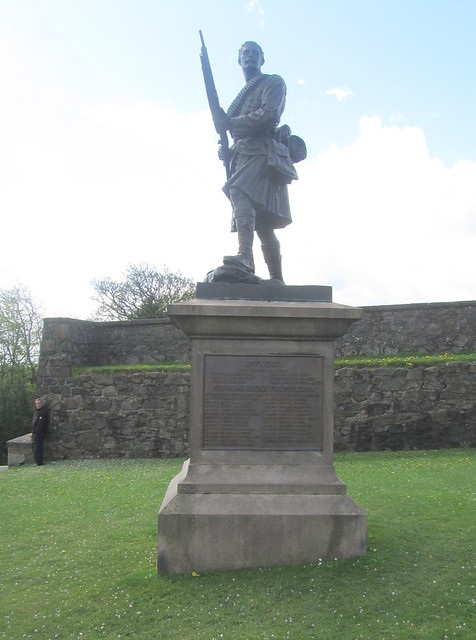
The plaques on these two sides give the names of the privates:-
Staring out towards the scene of his great victory at Bannockburn is a statue of Robert Bruce.

No Comments »
Posted in Dunfermline, History at 12:00 on 3 May 2015
I visited Dunfermline Abbey and Palace back in January. At that time the Abbey Church was closed for the winter and consequently I couldn’t photograph the tomb of Robert the Bruce, King of Scots, hero of Bannockburn and he of the spider. In mid April I was able to rectify that omission. The tomb is situated below the Abbey Church’s pulpit.

The pulpit surmounting the tomb of Robert I (as he was known) is rather ornate.

A rather macabre exhibit in Dunfermline Abbey Church contains a cast of Bruce’s skull.

No Comments »
