Dream Count by Chimamanda Ngozi Adichie
Posted in Other fiction, Reading Reviewed at 12:00 on 15 November 2026
4th Estate, 2025, 401 p, including 5 p Author’s Note.
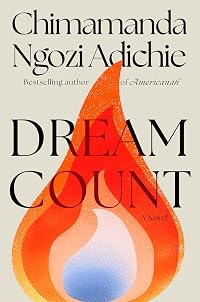
The novel is told from the viewpoints of four African women, Nigerians Chiamaka, Zikora, and Omelogor and Chiamaka’s housekeeper Kadiatou, who is from Guinea. In it Adichie takes the opportunity to contrast African ways of thinking with those in the US. Incidentally she also enumerates the various ways in which men are lacking in their behaviours towards women.
Chiamaka is a travel writer who rails against the expectations of her editors to write in the way they believe she should rather than about the world as she sees it. Her best friend Zikora is a successful lawyer knocked off kilter by the betrayal of the man she thought loved her. Kadiatou is the subject of a shocking incident (whose real life inspiration would not have been hard to decipher even if Adichie had not explicitly outlined it in her Author’s Note.) Chiamaka’s cousin Omelogor is a player in Nigerian financial circles not averse to leveraging her position.
Chiamaka feels the pressure from her mother to find a man to settle with. As time goes by and Chiamaka remains unmarried the stipulations change. At first he had to be Igbo, then Nigerian, then merely a man. Finally her mother tells her just to have a child no matter if there will be a man around or not.
Expectations differ according to cultural background. Chijioke, brought up in London but gone back to Nigeria, was shocked when a colleague lied to him. Omelogor tells him, “When Nigerians talk of moral issues they really mean sex, and some of the more high-minded mean corruption. But there’s a kind of amorality in everyday hypocrisies and pretences, because they are just survival tools.”
“We don’t admire principle or purpose. Even people who can afford to take ideas and ideals seriously don’t. We don’t live with grandeur.”
Of the four main characters it is Omelogor who has the more trenchant viewpoints. “Money is an armour, but it is a porous armour. No, money is an armour and it is a porous armour. It shields you, feeds you the potent drug of independence, grants you time and choices …. Yet money deceives in how much it cannot prevent, and in what it cannot protect you from.”
She has a blog in which she insists she is not against men but addresses the misconceptions which men may have. “Abusing women and abusing alcohol actually just means you’re weak, not that you’re strong and angry. Men, you ARE strong. … So step up and show it. Being strong means having self-control.”
She pinpoints the narrow outlook of most US citizens, with special distaste for the ideologically blinkered. “Perfect righteous American liberals. As long as you board their ideology train, your evilness will be overlooked. Champion an approved cause and you win the right to be cruel.”
“Their hearts are blind. They are so dead to human foibles, these Americans of the pious class. And they don’t laugh. I mean actual laughter, that sound nature made to lighten our hearts and calm our blood pressure.”
She tells them, but this applies to most USians, “You Americans need to grow out of your cribs. You think the world is American; you don’t realise that only America is American. To be so provincial and not even know that you are.”
I recognise that in choosing these examples to quote it perhaps highlights my own cultural specificities and prejudices.
Pedant’s corner:- a missing comma before a piece of direct speech, “tortuously slow” (it wasn’t bendy; ‘torturously slow’,) djamougol (x 2; is spelled djamougal apparently,) “as if to shake away his distraught” (is this Nigerian English? ‘his distraughtness’ or ‘his distress’.)
Tags: Chimamanda Ngozi Adichie, Dream Count, Literary Fiction, Nigerian Fiction
