Archives » Vietnamese Fiction

Ru by Kim Thúy

The Clerkenwell Press, 2012, 157 p. Translated from the French Ru (Éditions Libre Expression, Montreal, 2009,) by Sheila Fischman.
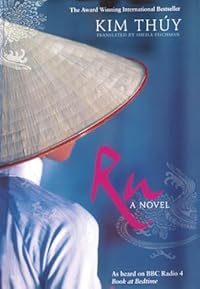
It seems from the epigraph page that Thúy chose her title because it is a word in both French and Vietnamese – but with different meanings; respectively a small stream (and figuratively, a flow, a discharge – of tears, of blood, of money,) and a lullaby or to lull.

The story is told in a series of vignettes, jumping about in time from narrator Nguyễn An Tịnh’s cosseted childhood in Saigon before its fall, to the degradations of her time in a refugee camp in Malaysia after a hazardous trip as one of the Boat People, and her eventual life in North America but also taking in her return to Vietnam. There a waiter is surprised she can speak Vietnamese as she “looks too fat.” Nguyễn reflects that it was her Americanised, more confident demeanour to which he was responding. “Once it’s achieved, the American dream never leaves us, like a graft or an excrescence.” But the incident made her realise she “couldn’t have everything,” that she no longer had the right to call herself Vietnamese “because I no longer had their fragility, their uncertainty, their fears.” And that the waiter was right to remind her of this.

A course in History that she took was “a privilege only countries at peace can afford. Elsewhere, people are too preoccupied by their day-to-day survival to take the time to write their collective history.”

She also reflects on the human toll of long wars. “We often forget about the existence of all those women who carried Vietnam on their backs while their husbands and sons carried weapons on theirs.”

It would be tempting to assume that this is all autobiographical, fragments of the author’s real life laid down on the page, but that would be an error. The book is novelistically organised and structured. It is a creation.

Perhaps due to her uprooting from her secure childhood life Nguyễn has a restless adult existence. She never travels except with only one suitcase. She is a woman for whom men are always replaced or replaceable, or, if they are not, her feelings for them are. She prefers relationships with married men because it keeps her “remote, aloof, in the shadows.”

Not that she hasn’t experienced love; but for her the blessing is not unalloyed. “It’s my children, though, who have taught me the verb to love, who have defined it. If I had known what it meant to love, I wouldn’t have had children, because once we love we love for ever.” Which isn’t a bad epitaph when you think of it.

Pedant’s corner:- chilies (chilis.)

The Sorrow of War by Bảo Ninh

Secker & Warburg, 1994, 218 p. Translated from the Vietnamese Thân Phân Cua Tinh Yêu, (originally published by Nhà Xuät Ban Hoi Nha Van [Writers’ Association Publishing House], Hanoi, 1991. English version by Frank Palmos based on the translations from the Vietnamese by Vo Bang Thanh and Phan Thanh Hao, with Katherine Pierce.

The vast majority of writing about the Vietnam War published in the West has been from a US perspective. This book acts as a kind of corrective as, here, the US, along with the South Vietnamese ARVN, is the enemy. The novel’s viewpoint character is a North Vietnamese soldier, Kien, whom we first meet in his post-war duty of collecting for burial the remains of corpses left over from the war. This is in an eerie place the soldiers named the Jungle of Screaming Souls. One corpse is discovered in a colourless plastic bag and the body seems immaculate. Then it discolours, something seems to escape, and it deflates. The platoon takes this apparition to be a soul departing. This scene is emblematic as, while the memories of combat are no doubt authentic, so much of what Binh describes here is surreal. Many descriptions of war are.

The novel is disjointed, fragmented, as if reflecting the uncanny nature of such experiences. Ninh tells us the sorrow of war is like the sorrow of love, “a kind of nostalgia,” a “sadness, a missing, a pain which could send one soaring back into the past.” The novel is a patchwork of such pain, of things unforgettable, surfacing unbidden from memory. “His fighting life was being revived in flashbacks, or in slowly unfolding scenes as heart-rending as a funeral march.” War as an experience is perhaps best encapsulated when Kien remembers trying to dissuade his comrade Can from deserting as it would be shameful. Can replied, “‘In all my time as a soldier I’ve yet to see anything honourable.’”

While combat and its horrors – the blood and entrails carried on the tracks of tanks so that they have to be driven through a river to clean them, Kien’s friend killed when his tank is all-but vapourised by a shell, the dreamlike quality of being on the receiving end of a US air-raid, the self-sacrifice of an inexperienced female guide named Hua who distracted a platoon of US soldiers away from a group of wounded NVA personnel whom she had put in danger of discovery – The Sorrow of War is not merely a story of firefights and military life. The story flits between those and his pre-Army life in Hanoi with Kien’s golden memories of his girlfriend Phuong and of life after the war where it is not only Kien who has been changed utterly but also Phuong, forever scarred by her travails when she accompanied him south to his first posting and her subsequent struggles to subsist in Hanoi.

The end of the war brought to the soldiers no soaring, brilliant happiness such as Kien saw later on film, only memories and nightmares. “Those who had died and those who lived on shared a common fate in this war.” As to the future, “Losses can be made good, damage can be repaired and wounds will heal in time. But the psychological scars of the war will remain forever.” The survivors “had lost not only the capacity to live happily with others but also the capacity to be in love.”

Since Kien later sets out to write about his impressions of the war the novel also contains observations on writing. Binh tells us the author wrote “because he had to write, not because he had to publish.” This is of course the way round the process ought to be.

Despite all its gruesome content and incident, its record of man’s inhumanity to man – and woman – The Sorrow of War is not difficult to read, a testament to both Binh and his translators.

Pedant’s corner:- mosquito repellant (repellent,) “his beard was well shaven and tidy” (if it was shaven it wasn’t a beard, well trimmed perhaps?) “Who’s to know.” (is a question; therefore ‘Who’s to know?’) “All that remained of his mother were some photographs.” (‘All’ is singular, hence ‘was,’) a missing comma at the end of a piece of direct speech, “Sue repeated eagerly” (she repeated eagerly,) curriculum vitae (there was more than one; curriculum vitae means ‘course of life’ so its plural – courses of life – is ‘curricula vitae’ in Latin and English – but in English some might say ‘curriculums vitae’. If interpreted as ‘courses of lives’ the Latin plural would be ‘curricula vitarum’, which is a step too far in English.)

free hit counter script