Archives » US fiction

Dark Green, Bright Red by Gore Vidal

Granada, 1980, 138 p

In an unspecified Central American country, a group of men are planning a revolution to restore General Jorge Alvarez to the Presidency. He had been allowed back in to the country after his successor, a mathematics professor named Ospina, decided to curry favour with the US and so promised elections.

The main conspirators are the General, his son José, his friend Peter Nelson, not long ago court-martialled from the US Army (a fact he doesn’t wish to conceal but also doesn’t advertise,) a Frenchman called Charles de Cluny, Colonel Aranha, and priest Father Miguel. They have the backing of the Company of Mr Green, a US citizen whose son George is engaged to the General’s daughter, Elena. Without that support and the implicit promise of US approval the revolution would not be possible.

Elena attracts Nelson’s interest. She decries his description of her father as a former dictator, saying he did good things for the country and the people. She in turn takes a fancy to Nelson, who contemplates sex with Elena thus, “The beast with two backs had still two brains and two identities and it was neither possible nor desirable to fuse them, to lose identity. The act made a momentary union, an instant of sharing, of identification, but this passed in a single second to be recalled later as pleasure and little more. The religion of union was a female doctrine, a false dream, possible only at the risk of sanity: a hypnotic state where reality was replaced for a time by a destructive vision.” (I did wonder if this line of thought was occasioned by the author’s homosexuality.)

Nelson is charged with the training of General Alavarez’s army (rudimentary training at best.) The revolution goes ahead in the country’s second city and Nelson is involved in the fighting. While that goes well enough news from the capital is not so good, with betrayal on top of betrayal and the influence of the Company not what the conspirators had hoped.

Vidal is here explicitly critiquing the US Government’s tendency to interfere in other countries’ affairs; not necessarily to their benefit.

Pedant’s corner:- “General Jorge Alvarez Asturias’ house (General Jorge Alvarez Asturias’s house; or maybe even ‘General Jorge Alvarez’s Asturias house’,) “‘You can see if from the street’” (‘see it from’,) a missing comma – or full stop – before a piece of direct speech, gulley (gully; as it was spelled later,) “(I’d even been in school with them, danced with some of them!).” (an exclamation mark doesn’t need a full stop following it,) a gap between a colon and the preceding word (x 2.) “José unbuttoned his shirt and lay in the sun, eyes shut. A small scapula glittered on the dark pink chest” (how can a shoulder blade lie on a chest?) “Aristophanes’ The Birds” (Aristophanes’s,) an end quotation mark follows a paragraph of speech which is carried on on the next line. The convention is no such mark is required in those circumstances.) “‘Then what do you think about our chances.’” (is a question and so requires a question mark,) two lines of the text were transposed. “‘They wanted to get back him’” (wanted to get him back.) “She shut here eyes” (her eyes,) de rigeur (de rigueur,) “sounded strange on his own ears” (in his own ears.)


The Locked Room by Paul Auster  

In The New York Trilogy, faber and faber, 2004. [The Locked Room, 1987, 116 p.]

The third in Auster’s New York trilogy, this is as awkward a read as the previous two. There is something distanced about the narration; too much is told and little is shown. It is the tale of a man effectively haunted by his childhood friend Fanshawe, who suddenly left his wife but also left behind several manuscripts and instructions to have the narrator sift through them to see if they were worth publishing, and, if so, to try to accomplish this.

That word Fanshawe is a problem, embodying the sense that what we are reading is a construct. Surely nobody ever refers to their childhood best friend by their surname? (Outside the bounds of fiction it would be unusual in any situation where referring to an acquaintance is required.) We readers know perfectly well that any short story or novel is a construct – but we don’t need our faces rubbed in it.

Though the connection seems tenuous – apart from the fact that I was reading these between the same covers – characters from the previous two books in the trilogy like Quinn and Stillman, reappear here. And the narrator mentions City of Glass and Ghosts as if he is the same as the person who wrote those. (Of course he is. He’s Paul Auster. And we know that. But to be reminded of it is annoying.)

There are some sentences where Auster’s writing climbs into wider relevance, “No one can cross the boundary into another – for the simple reason that no one can gain access to himself” explores the impossibility of ever truly knowing anyone else – or even oneself. We are told “The story is not in the words; it’s in the struggle” (to say goodbye to something.) If the story isn’t in the words why are we wasting our time? More problematically, one encounter leads the narrator to the thought that “Sexual desire can also be the desire to kill.”

Sensitivity note; Fanshawe’s manuscripts are said to contain “an instance of nigger-baiting.”

Pedant’s corner:- kudos, though, for no entries here.

Ghosts by Paul Auster

In The New York Trilogy, faber and faber, 2004. [Ghosts, 1986, 64 p.]

I read Ghosts, the second part of Auster’s New York trilogy, in September and thought I had published my review here but I was seeking to link to it in my review of the third in his sequence and couldn’t find it when I searched the blog; so it seems I didn’t. So here it is, four months late.

In 1947 New York a man called Blue is employed by a man named White to spy on a man called Black, and write regular reports on him. Blue cancels his date with the future Mrs Blue to undertake the commission – a commission which will keep him going for months. (To the understandable frustration of his intended who when they next meet on the street berates him for the lack of contact. But by then she has moved on. Not that Blue can, though he had pondered getting in touch but decided against it on the grounds that “The man must always be the stronger one.”)

Everything has been set up for Blue with an apartment across the street from which he can monitor Black’s activities. All Black appears to do though is write. And read.

It is a curious and distancing feature of the book that except for the real life people mentioned, such as Washington Roebling and Jackie Robinson, every character’s name is a colour. As well as Blue, White and Black we also have Gray, a bartender named Red, another called Green. The only woman who is given a name here (the future Mrs Blue isn’t) is called Violet. I note that that is a first name whereas the men’s in this story are not.

Blue becomes so bogged down in his task that he wonders if White and Black are one and the same and if he himself is being followed. The paranoia of a man who is so focused on what he is doing that he loses touch with reality? This has echoes of the previous book in Auster’s trilogy, City of Glass. Eventually Blue goes beyond his remit, contacts Black and tries to find out who White is.

In a discussion of Hawthorne, Black says to Blue, “Writing is a solitary business. It takes over your life. In some sense, a writer has no life of his own. Even when he’s there, he’s not really there.” Blue replies, “Another ghost.”

The narrative is peppered with references to magazine stories, Henry David Thoreau’s Walden, and to the stories of Nathaniel Hawthorne, especially where a man took off on a whim and only years later (after being presumed dead) returned to his house and wife and knocked on the door. Whereupon the story ends. In that sense Ghosts reflects it. It doesn’t end so much as stop, albeit with being seen from a perspective of thirty years later.

What is Auster trying to do here? Is he subverting the detective story? Demonstrating the inexplicability of existence?

Ghosts is easy enough to read, and short at only 64 pages, but it all seems a bit pointless.

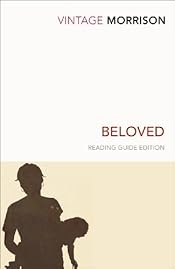
Beloved by Toni Morrison 

Vintage, 2010, 330 p, plus 5p Foreword.

124, the house where Sethe lives with her daughter Denver, is haunted, by her unnamed baby and by the slavery which caused the child’s death. That other daughter, who was unnamed but whose gravestone bears the description ‘Beloved’ – Sethe could not afford the extra money to have ‘Dearly’ inscribed as well – was killed by Sethe herself to prevent her being taken back to Sweet Home, the plantation from where she had escaped enslavement. Perhaps an extreme reaction but also an expression of the horrors of slavery. Sethe has the image of a tree on her back from the whippings she received in that part of her life.

The ghost is banished after Paul D, another former slave from Sweet Home, arrives at the house and takes up with Sethe. Denver resents this as she had considered the ghost as a kind of companion.

Later, a child who calls herself Beloved arrives at 124 and draws close to Sethe who comes to see her as a reincarnation of the child she killed.

There is a surreal quality to the writing here, verging on but not quite corresponding to magical realism. It is as if the fact of slavery, though not evaded, is too consuming to be confronted head on and must be approached obliquely, its legacy equally as terrible as its existence. Sethe’s act of violence is an extremity in response to an enormity, with its own repercussions on the lives of herself and her children.

Sensitivity note: a book like this, and a subject like this, cannot avoid use of the word ‘nigger’ as when the posse seeking to recapture Sethe discusses their slaves or Paul D asks Stamp Paid, “‘How much is a nigger supposed to take? Tell me. How much?’”

‘All he can,’ said Stamp Paid. ‘All he can.’

To which Paul D says, ‘Why? Why? Why? Why? Why?’”

“Why? Why? Why? Why? Why?” is as good a question to ask of slavery as there can be. Indeed, it’s the only one.

Beloved is not an easy novel to read: but it is perhaps a necessary one.


Pedant’s corner:- “the repellant landscape” (repellent,) “Baby Suggs’ place” (Baby Suggs’s,) “had shook the house” (‘had shaken’; but ‘had shook’ may have been slave usage,) “Lady Jones’ house-school” (Jones’s.)

City of Glass by Paul Auster

In The New York Trilogy, faber and faber, 2004. [City of Glass, 1985, 133 p.]

Well this is an odd one. A writer called Daniel Quinn using the pen-name of William Wilson to publish detective novels about an investigator named Max Work (make of that moniker what you will) receives a telephone call asking if he is Paul Auster; of the Auster Detective Agency. At first he demurs saying there is no-one of that name at that address but on a second phone call agrees to meet the caller, who is a man calling himself Peter Stillman (though he says that is not his real name) looked after by his wife, a woman at pains to point out their relationship is not sexual. Stillman moves with a certain stuntedness, like a puppet.

His story is weird; raised by his father without being spoken to to try to discover, when he does speak, what the primordial language was. The elder Stillman is about to be released from prison and the younger is convinced that when he is, he will kill his son, or at least attempt to. Quinn’s task – as Auster – will be to try to prevent this.

Noting the movements down in a red notebook, Quinn follows the older “Stillman” around the city while imagining himself to be the detective Paul Auster in order to fit the part, over paths that, when graphed, seem to trace out the outlines of letters of the alphabet: letters which Quinn eventually realises spell out “Tower of Babel”. This is after a discussion of a book about the Tower written by one Henry Dark. City of Glass displays a fascination with language then. Quinn becomes obsessed with following Stillman while slowly being immersed in the character of “Paul Auster” who is, though, in effect a nullity. “To be Auster meant being a man with no interior, a man with no thoughts.”

Where are we meant to go with all this? A book written by a man called Paul Auster with an imagined Paul Auster who doesn’t actually exist?

But there’s more. Quinn eventually meets the “real” Paul Auster and they engage in a discussion about Henry Dark and what the initials HD might stand for. Which is when we come to Humpty Dumpty; a character whose best known philosophy relates to words as meaning what he wanted them to, as if he could force them into that meaning by will alone.

They then progress into a conversation about the origins of The Adventures of Don Quixote which Cervantes claimed to have translated from Arabic to Spanish but, according to the “real” Paul Auster of the book, was made up by his friends to illuminate his delusions, then translated into Arabic, the manuscript to be found by Cervantes, in order that this reflection would cure him of his madness. But this book’s “Auster” says Cervantes wasn’t mad, only pretended to be.

In his growing obsession with “Stillman” Quinn descends into a degraded state, staying up all night in order not to avoid seeing when “Stillman” will leave his apartment and eventually losing all sense of proportion and personal hygiene.

At the end of all this I’m still not sure whether there is something relevant about City of Glass or if, instead, it’s a pile of self-indulgent tosh.

Pedant’s corner:- “Quinn could not image himself addressing a word to this person” (could not imagine himself?)

Go Tell it on the Mountain by James Baldwin

Penguin Modern Classics, 2001, 255 p, plus xi p Introduction by Andrew O’Hagan. First published 1954.

This is the acclaimed US author Baldwin’s first novel, a laying out of the black experience in the US in the early to mid-twentieth century. It is told in three parts, The Seventh Day, The Prayers of the Saints, and The Threshing Floor; the first and last of which relate to the life of John Grimes, stepson of Gabriel, who attends the Temple of the Fire Baptised, where his stepfather is head deacon – not the biggest nor the smallest church in Harlem, “but John had been brought up to believe it the holiest and the best.” The Saints referred to above are the three of the church’s congregation closest to John; his stepfather’s sister Florence, his mother Elizabeth and Gabriel himself: the Prayers outline their life stories. At the same time as being rooted in the conditions and culture of blacks in the US Go Tell it on the Mountain is also an examination of a kind of claustrophobic family dynamic which may well be of a wider commonality but for novelistic purposes must be rooted in the particular.

As the book’s title would suggest, the text is saturated with religious references and demonstrations of that over-the-top type of ceremonial – all hell-fire, ‘Praise the Lord’ and ‘Hallelujah’! – which is sometimes referred to as charismatic but to which that word surely does not fit at all well. While superficially allowing adherents to give vent to their passions such observances are also, like those families, claustrophobic and restricted – and intended to be so. Straying from the path is neither encouraged nor condoned. Indeed, it is to be condemned.

Gabriel is on his second marriage, his first was contracted in the South when he was a firebrand preacher, a calling he took up despite his leanings towards the pleasures of the flesh, perhaps to counteract their allure. But his wife died and he moved north, where his first son, by another woman, had also led a dissolute life before ending up being stabbed.

Gabriel treats his children with a harsh hand. It is not too stark to say cruel. Add the charge of hypocrisy to his list, then. Or is that stern forbidding attitude to the sins (even potential sins) of others more a manifestation of fear? Fear that others may be exactly like you, as tempted as you, as flawed as you? (In the religious zealot’s worldview, as sinful as you?)

He once told John that, “all white people were wicked, and that God was going to bring them low. They were never to be trusted, they told nothing but lies and none of them had ever loved a nigger.”

That last word encapsulates its times better than any other – as well as highlighting the enduring legacy of slavery and racism, the internalisation of bigotry, the lack of feeling of worth engendered by being treated, over generations, as worthless, or less than worthless.

The consolations of religion no doubt helped. In the travails of everyday existence the promise of a better life after death must have appeared compelling. Yet there is a bitter irony here. Such a religion may be attractive to the underdog but it serves to keep those underdogs – those slaves – in their place. In its early days Christianity was derided as a slave religion, beneath the dignity of the Roman citizen. In more recent times there may have been a benign missionary motive for inculcating it in the minds of people whose bodies were held as property. But it also functioned as an instrument of control. In that sense it is curious how much so-called fundamentalists concentrate on their god’s vengeful aspects (in the Christian context an Old Testament idea whose prominence is probably due to the influence of Paul of Tarsus on the religion’s early development – there is an argument that the religion ought really to be called Paulinity – but not an intrinsic part of Jesus Christ’s teachings.) Such people rarely mention peace, love and understanding.

It is left to Florence’s Prayer to voice another indictment, “All women had been cursed from the cradle; all, in one fashion or another, being given the same cruel destiny, born to suffer the weight of men.” If life for black men was tough how much more unfair must it have been for black women?

Aside: I assume the plates used for this edition were from the book’s earliest UK printings. Those were the days when British publishers rendered USian text into British English. Huzzah!

Pedant’s corner:- In the Introduction; “and the pulse of remembering and the ache of old news, makes for the beat of his early writing” (that second ‘and’ renders the subject of the verb plural; hence ‘make for the beat’,) an omitted comma before a piece of direct speech. Otherwise: “and a mighty work he begun throughout the city” (a mighty work be begun.) “‘She’d of dragged me down with her’” (probably a true reflection of the mode of speech portrayed but that ‘of’ always leaps out at me.)

Where the Crawdads Sing by Delia Owens

Corsair, 2019, 376 p.
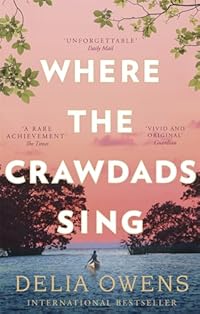
People like stories. That is why the novel as a form exists after all. So I can see why this struck a chord with so many readers. It is the tale of Catherine Danielle Clark (Kya,) growing up living in a shack in a North Carolina marsh. And it is a compelling one. Kya is abandoned first by her elder siblings, then her mother (too many blows from her wastrel drunken sot of a husband, Kya’s father) then her brother nearest in age, Jodie, and finally her father; left to bring herself up alone, with only the marsh wildlife and plants to engage her interest. Subject to prejudice, vilified as dirty and ‘trash’, she has only the local, black, seller of bait, supplies and motor-boat fuel, Jumpin’ Jackson, and his wife Mabel, to look out for her, plus later, of course, Tate Walker, a few years older, a friend of the family in the (mildly) better times when her mother was still around. It is a tale of betrayal, loneliness, love, (a bit of) sex and, since we start with the discovery of a body, death. It has things going for it then.

And yet. Perhaps I’m seeing this from a reviewing perspective or even of that of a novelist myself but as a novel I found it deeply flawed.

The body is that of Chase Andrews, quondam local quarterback and lad about town (or whatever the US equivalent is) but pillar of the establishment. He has fallen – or been pushed – from a deserted building known as the fire tower. The absence of footprints round the body (his included) make the local sheriff suspicious. Revelations of Kya’s involvement with Chase mean she becomes the prime suspect.

Given Kya is the focal character our sympathies naturally lean to her side and if she has committed murder, there is not much in Owens’s portrayal of her to lead us to believe she could have carried out the elaborate deception necessary for that. She certainly has motive, a woman scorned always has motive, but her reclusive nature as the Marsh Girl, out where the crawdads sing (Tate tells her the phrase means “Far in the bush where the critters are wild, still behaving like critters”) and her reticence as regards contact with other humans, act as counterweights.

Despite only one day of schooling – humiliated by being unable to spell ‘dog’ she never went back – she becomes a self-taught expert on the marsh fauna and flora and paints exquisite representations of its wildlife. Her friendship with Tate, the only one who understands her deep connection with the marsh, the person who taught her to read – remarkably quickly it has to be said – and encouraged her to send her paintings to a publisher and so responsible for her later financial security, is her anchor until he too leaves her behind to go to College and her loneliness eventually leads her to succumb to the doomed attraction of Chase.

This tale of early 1960s North Carolina has echoes of To Kill a Mockingbird what with the racial prejudice (there is a Colored [sic] Town separate from Barkley Cove,) the class divisions and the courtroom scenes.However, it is anything but as well written. It relies too often on coincidence and has problems with structure and sequencing along with individual sections morphing from past to present tense for no good reason. Witnesses come forward at convenient times for the narrative rather than organically as they would have done. For two of these Owens lets the reader know their testimony exists and is potentially damning but does not reveal it then and there, instead waiting a few chapters to let us see the scene concerned from Kya’s viewpoint. I suppose you could call it backshadowing (in essence the whole book from the body’s discovery in the prologue till Kya’s arrest is backshadowing) but it is really an artificial creation of tension not fair on the reader. Then there are the frequent passages of poetry, especially that of Amanda Hamilton, which strike an off-note. Owens has her reasons for these but only unfurls them at the end as a deus ex machina.

Some minor characters are less than convincing. Chase’s mother Patti Love Andrews is supposed to have thought she had a strong bond with her son but is said to be shocked to discover he had intimate dealings with Kya. This does not ring at all true. A woman like her would know exactly how a son brought up with his privileges would behave towards those he thought beneath him – especially to women, even more especially to ‘trash’.

Extracts from Kya’s reading on biological topics – for example “one article on reproductive strategies was titled ‘Sneaky Fuckers’” – feel as if they are an interpolation from a different novel entirely but ensure Kya is conversant with the varied tactics of the animal mating game. She tells Jodie, finally returned to see how she is faring, “Most men go from one female to the next. The unworthy ones strut about, pulling you in with falsehoods,” but this comes across as Owens speaking, not Kya. Often in sections relating to Kya’s state of mind, human behaviour is described in terms of biological reductionism – even in the hierarchy of the courtroom.

Some aspects of the contributions to her personality are outlined when Kya says to Jodie, “I never hated people. They hated me. They laughed at me. They left me. They harrassed me. They attacked me.”

As a defendant in her trial Kya is all but a blank to us, though. Yet the narration is from an omniscient third person, we ought to have access to her deepest thoughts. This is not unreliable as such but is profoundly disingenuous (and there are times too when Owens is a bit too eager to tell the reader how to interpret what has been read.)

Perhaps it was with an eye to the film rights (or even thoughts of To Kill a Mockingbird) that Owens chose to make the trial her focus. A trial after all has jeopardy (Owens emphasises the jeopardy,) conflict and drama. But that focus imbalances the novel. The story here is not the trial. Instead it is that of a lonely girl struggling to keep herself alive and make her way in a world to which she is ill-suited and for which she is ill-prepared. And of humans’ capacity for denigrating and despising the other. The murder aspect is incidental to this but is the hook on which Owens hangs the book. And in its dénouement I could not escape the impression that Owens was so determined to have a revelation/tying up of loose ends in her final chapter that it warped all that came before it.

There are things to appreciate in this novel but its central metaphor is laboured, almost trite. Yes, humans are the expressions of their genes. But humans are more than that. And it is the more than that that the novel, at its best, illumines and portrays. Where the Crawdads Sing does that peripherally at best.

It is by no means a bad book. In some respects it is a very good book, though without ever touching the heights. It will probably make a good film though.

Pedant’s corner:- ‘Time interval’ later/within ‘time interval’ count: 17. Otherwise; “Her overalls pockets” (that’s a possessive, hence, ‘her overalls’ pockets’,) a missing comma before a piece of direct speech, indentions (indentations,) “Kya wondered who started using the word cell instead of cage. There must have been a moment in time when humanity demanded this shift.” (Well, no. The word cell does not necessarily mean a place of incarceration. It is a single, repeatable unit, found among others of its kind, as in prisons, but also in batteries and in living things; a cage is never anything other than a place of confinement,) “the sheriff itn’t so sure” (‘itn’t?’Is that North Carolinan dialect; or a misprint for ‘isn’t?’) “bused to Barkley” (bussed.)

Philip Roth

I heard on the radio news this morning that Philip Roth has died.

I must confess I have not read much of his work, apart from the (ahem) seminal Portnoy’s Complaint – which I was moved to sample partly because of the attention it received – and My Life as a Man which covered much the same ground. Anything you ever wanted know about living as a young(ish) male Jew in the USA was here.

I do remember being intrigued by a long ago television programme about him which featured, as I recall, his creation Nathan Zuckerman fantasising about Anne Frank surviving the Holocaust and making a new anonymous life for herself in (I think) the US, which may have been another spur to reading him.

I can’t say I much took to what seemed from the evidence of those two books to be his perennial subject matter but he was obviously an important US novelist of the second half of the twentieth century whether I favoured his work or not and his ability as a writer shone through in any case.

Much later I read his Altered History novel The Plot Against America which I reviewed on this blog here. The impulse behind his decision to write it was admirable – and arguably necessary – but I felt that overall it was an opportunity missed, that the punches the book threw were somewhat pulled.

Sadly that impulse might be even more necessary in today’s political climate than it was when he published it thirteen years ago.

Philip Milton Roth: 19/3/1933 – 22/5/2018. So it goes.

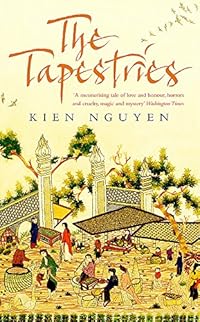
The Tapestries by Kien Nguyen

Abacus, 2004, 347 p.

 The Tapestries cover

This is a tale of Vietnam in the early to mid- years of the twentieth century when the old ways were beginning to crumble under the influence of the French. Peasant woman Ven is sold to the Nguyen family of Cam Le village as a bride for their seven year-old son, Dan. She protects him when the family’s fortunes are ruined by the local magistrate Toan and the elders of the family are killed or flee. As their faces are both unknown to the outside world they can for a while take refuge in the Toan household where he and Toan’s granddaughter, Tai May, fall in love. During a visitation from an official of the Emperor’s court to betrothe Tai May to Bui, the official’s son, they reveal their identities. In the outcome Ven is accused of the murders of the official and Bui actually carried out by Toan.

Thinking Ven dead, Dan leaves for the Imperial city and due to his skill at embroidery eventually becomes chief embroiderer to the court. (It is this ability and Dan’s handiwork, of course, which lend the book its title.) Meanwhile, the disgraced Tai May has been sent away to join a dance troupe. Their paths cross at the court but they cannot meet due to their respective obligations to the Emperor. On the deathbed of the Lady Chin, still grieving wife of the murdered official, Dan gives her food to revive her and accompanies her to Cam Le to confront the source of both their woes and achieve resolution.

Perhaps because English is not Nguyen’s first language the writing isn’t quite as fluent or crisp as in the very best fiction. There is often a resort to cliché (“with all her might”) and dialogue too frequently tips over into the melodramatic. I also found the love story supposed to be at the novel’s heart so barely outlined as to be almost invisible. We are told of it but rarely experience any of the relevant emotion. Rather, it is the relationship between Dan and Ven which dominates the book. Therein lies its tragedy and pathos. Yet even there the withholding by Ven of a nugget of information from Dan till very late on, twists the arc of the narrative.

Pedant’s corner:- “she said to the him” (she said to him,) “the plastic loop in her hand” (was a metal loop on the previous page and, in any case, plastic? In 1916?) “in the middle of night” (the night,) twenty-four karat (is karat USian? It’s carat over here,) organdy (organdie,) sprung (sprang,) “even her face seemed to have shed its usual plainness and glow with the sparkling mystical world” (glowed,) “the Indochinese Communist Party led by the socialist Ho Chi Minh” (in 1932? Ho did found the Indochinese Communist Party in 1930 but he was in jail in Hong Kong from 1931-33 and then moved to the Soviet Union, not returning to Vietnam till 1941. Would most Vietnamese have even heard of him in 1932?)

free hit counter script