Ha’penny by Jo Walton
Posted in Altered History at 12:00 on 19 December 2015
Corsair, 2014, 318 p. Borrowed from a threatened library.
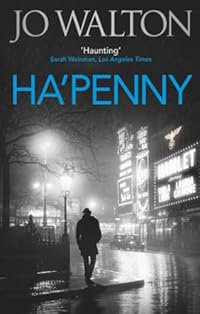
The Farthing Set responsible for the peace between Britain and the Third Reich in 1941 has parlayed the murder of Sir James Thirkie (which kick started Farthing, the first of Walton’s “Small Change” trilogy) into a takeover of the government of the UK.
As in Farthing, first person narration by a female alternates with third person chapters again concentrating on Inspector Carmichael of Scotland Yard. The woman narrator here is actress Viola Lark, one of the aristocratic Larkin sisters (who are clearly modelled on the Mitfords.) In this respect the failure to mention the British Union of Fascists or Oswald Mosley in Farthing is partly explained. In her acknowledgements Walton says she avoided the use of real names for those with speaking parts in the narrative. (There is one glaring exception to this, but in our real world he was dead by 1949 when this book is set.) In Ha’penny the attraction of fascism for one of the Lark sisters, Celia, has gone so far as for her to have married Himmler but it is another sister, Cressida, the communist one, who draws Viola into a conspiracy to murder Hitler during a visit to the theatre on his trip to Britain.
Ha’penny does not work quite as well as Farthing. Partly this is because the setting has been established and we are working through its ramifications but more importantly it is that the whodunnit element is wholly absent. We know from the first sentence that Viola has been apprehended and the plot motor, the conspiracy, is also revealed early on. Viola’s narration is also not as fresh (though less twee) as was Lucy Eversley’s in the previous book. The insidious creep of authoritarian measures, the poisoning of public attitudes, is well brought out, though. The new Prime Minister says, “‘we don’t want them to be able to say that we’re using these laws to shut people up, especially when we are.’” It was particularly salutary to read this so soon after the House of Commons debate on bombing Syria and the prior comments about those against it being “terrorist sympathisers”. The web of complicity woven around Carmichael is drawn tighter, however, as he is offered the oversight of a new law enforcement agency, The Watch, an analogue of the Gestapo.
Pedant’s corner:- Viola’s Britishness is questioned when she reveals she was born in Dublin (in 1917). Since Ireland was part of the UK then that would make her British no matter her ancestry. There were no opening quotation marks when a piece of dialogue began a chapter. “‘There’s a Joe Lyons automat on the corner of Charing Cross Road.’” (A Lyon’s Corner House I’d have accepted. I don’t think automats made it to Britain till the 1960s.*) Station wagon (OK the book has the USian text but Viola is supposed to be an English aristocrat, she’d have written “estate car”.) Was it necessary to transliterate a Spaniard’s pronunciation of the city as Barthelona? National Service. (In our time-line, yes. Would they have kept it on in this one?) “The report on the bomb and bodies were waiting for him” (the report was waiting,) Boedicea (it was generally spelled Boadicea in those days [Boudica or Boudicca now]) Canada is referred to as part of the Commonwealth (just scrapes by for 1949,) “‘He’s an ASDIC man. Radar you know.’” (ASDIC was a sonic technique, radar uses radio waves.) “There were a series” (there was a series,) the German Embassy in London is described as if “made over by some mad devotee of monumental Bauhaus” (the Nazis shut Bauhaus down,) the French for lark is rendered alouetta instead of alouette, vol-au-vents again (I still think the plural is vols-aux-vents,) come-out (the entry of a debutante to society was known as a coming out. Walton perhaps used “come-out” to avoid any inference of being gay by the modern reader.) The lower case sergeant is used for the police rank while Inspector is capitalised; they both ought to be so, “the Home Secretary’s backup were violating police tradition” (the backup was,) Inspector Jacobson from Hampstead seems to know what The Watch is but Carmichael had only just found out himself.
*Of course, it’s an altered history, maybe that’s part of Walton’s scenario.
Tags: Altered History, Alternate History, Alternative History, British Union of Fascists, Farthing, Himmler, Hitler, Mitford Sisters, Oswald Mosley, Science Fiction

Denis Cullinan
19 December 2015 at 22:14
Hello Jack,
I love the Pedant’s Corner, having been a part-time copy-editor for quite a few years. I’m pleased that you’re fighting the good fight to get Ukian (can I get away with this little new word of mine?) writers to make the subject of a sentence agree in number with that of the verb.
I’ve got a new solecism that you might keep your sharp eye out for. Here’s an example: “Ralph was displeased with his omelet, half-raw and cold, and nor was Pinkie happy to have discovered a tooth-splitting pearl in his tepid oyster stew.” (Please forgive my dopey. attempt at composing a text. I write like I eff–yes, it’s that bad.) Getting back, now. “Nor” already means “and…not,” so that “and nor is redundant.”
On my side, I won’t try to correct the bad English of my countryindividuals. They invent cacalogisms (sorry, there’s no such word) faster than anyone can shovel them into the sh**can.
jackdeighton
20 December 2015 at 20:22
Denis,
There’s nothing wrong with inventing words. Shakespeare was great at it.
I’ve also done it myself (in SF it’s almost obligatory.)
I do object to getting old ones wrong.
One of the beauties (like your “and nor” example) is “from whence”. I know it appears in Psalm 121 (“I will lift up mine eyes unto the hills”) but whence already incorporates the “from”.