Archives » Farthing

Small Change

One thing that niggled me about Jo Walton’s “Small Change” trilogy (which I read recently) was the title of the third volume. After Farthing and Ha’penny came Half a Crown.

Now, a farthing was the smallest pre-decimal British coin value – at least until it was phased out due to inflation rendering it all but useless – and a ha’penny was next up; but half a crown was a large enough sum almost not to be counted as being small change. Walton does use farthing as a pun and the “Half a Crown” is indicative of the levers of power not resting with the monarch and in any case with her being at risk in a coup d’état, but some lovely gradations were missing.

Before decimalisation the British Pound Sterling (£1) was divided up into twenty shillings (20/-) and each shilling into twelve pennies (twelve pence; written as 12d – the d I believe from the old Roman denarius.) In addition there was the halfpenny (ha’penny, ½d) and the farthing (“fourthing”, worth a quarter of a penny, ¼d.)

This seemingly odd arrangement was in fact very versatile as £1 could be divided by 2, 3, 4, 5, 6, 8 and 10 into whole values of shillings or pennies; respectively 10 shillings (10/-), six shillings and eight pence (six and eight, 6/8d), a crown (or five shillings, 5/-), three shillings and four pence (three and four, 3/4d), half a crown (two shillings and sixpence, 2/6d), two shillings (2/-).

All coins had the head of the monarch at their time of minting on the obverse. There were three types of coin known as coppers from their colour and perhaps the original metal used in their minting. The farthing was a lovely coin with a depiction of a wren on the reverse. The larger ha’penny had a ship (Drake’s the Golden Hind.) The still larger penny showed a seated Britannia and shield.

Next in value was the dodecagonal in profile and dirty-goldish coloured three pence coin (known as a thruppenny bit) with Prince of Wales feathers or a portcullis representing the Houses of Parliament on the reverse though earlier silver thruppennies were still in circulation in the 1960s.

The larger value coins were all silver. The sixpence coin was very small in circumference and called a tanner with latterly a floral design; the shilling (or “bob”) had various designs – with a Scottish version, the two shilling (a “florin” or “two bob”) similarly varied in design and the half crown (“two and six” but sometimes nicknamed half a dollar) also varied. There was – and still is – a crown worth five shillings (now 25p) but these were very rare and today’s issues are mainly for collectors but are I believe still legal tender.

The ten shilling denomination of the currency was actually a paper note (known as a ten bob note.)

Only “coppers” were likely to be considered “small” change.

Walton’s sequence, then, goes awry after ha’penny as the next price point was ¾d, three farthings, and the next coinage value was 1d, a penny.

As far as prices were concerned they followed the order:-
¼d – a farthing
½d – a ha’penny
¾d – three farthings
1d – a penny
1¼d – a penny farthing
1½d – three ha’pence (or a penny ha’penny)
1¾d – a penny three farthings
2d – tuppence
2¼d – tuppence farthing
2½d – tuppence ha’penny
2¾d – tuppence three farthings
3d – thruppence
3¼d – thruppence farthing
3½d – thruppence ha’penny, etc etc up to a shilling.

After a shilling there were usages like-
1/3d (one and three; one shilling, three pence)
2/7d (two and seven; two shillings, seven pence)
Any ha’pennies or farthings were added on as in 1/2½d (one and tuppence ha’penny) 7/4¾d (seven and fourpence three farthings.)

Nobody ever asked for a crown. It was always referred to as five shillings.

Wonderful stuff – but I believe it confused foreigners, including visitors from the US, no end.
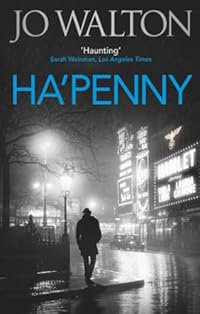
Ha’penny by Jo Walton

Corsair, 2014, 318 p. Borrowed from a threatened library.

 Ha’penny cover

The Farthing Set responsible for the peace between Britain and the Third Reich in 1941 has parlayed the murder of Sir James Thirkie (which kick started Farthing, the first of Walton’s “Small Change” trilogy) into a takeover of the government of the UK.

As in Farthing, first person narration by a female alternates with third person chapters again concentrating on Inspector Carmichael of Scotland Yard. The woman narrator here is actress Viola Lark, one of the aristocratic Larkin sisters (who are clearly modelled on the Mitfords.) In this respect the failure to mention the British Union of Fascists or Oswald Mosley in Farthing is partly explained. In her acknowledgements Walton says she avoided the use of real names for those with speaking parts in the narrative. (There is one glaring exception to this, but in our real world he was dead by 1949 when this book is set.) In Ha’penny the attraction of fascism for one of the Lark sisters, Celia, has gone so far as for her to have married Himmler but it is another sister, Cressida, the communist one, who draws Viola into a conspiracy to murder Hitler during a visit to the theatre on his trip to Britain.

Ha’penny does not work quite as well as Farthing. Partly this is because the setting has been established and we are working through its ramifications but more importantly it is that the whodunnit element is wholly absent. We know from the first sentence that Viola has been apprehended and the plot motor, the conspiracy, is also revealed early on. Viola’s narration is also not as fresh (though less twee) as was Lucy Eversley’s in the previous book. The insidious creep of authoritarian measures, the poisoning of public attitudes, is well brought out, though. The new Prime Minister says, “‘we don’t want them to be able to say that we’re using these laws to shut people up, especially when we are.’” It was particularly salutary to read this so soon after the House of Commons debate on bombing Syria and the prior comments about those against it being “terrorist sympathisers”. The web of complicity woven around Carmichael is drawn tighter, however, as he is offered the oversight of a new law enforcement agency, The Watch, an analogue of the Gestapo.

Pedant’s corner:- Viola’s Britishness is questioned when she reveals she was born in Dublin (in 1917). Since Ireland was part of the UK then that would make her British no matter her ancestry. There were no opening quotation marks when a piece of dialogue began a chapter. “‘There’s a Joe Lyons automat on the corner of Charing Cross Road.’” (A Lyon’s Corner House I’d have accepted. I don’t think automats made it to Britain till the 1960s.*) Station wagon (OK the book has the USian text but Viola is supposed to be an English aristocrat, she’d have written “estate car”.) Was it necessary to transliterate a Spaniard’s pronunciation of the city as Barthelona? National Service. (In our time-line, yes. Would they have kept it on in this one?) “The report on the bomb and bodies were waiting for him” (the report was waiting,) Boedicea (it was generally spelled Boadicea in those days [Boudica or Boudicca now]) Canada is referred to as part of the Commonwealth (just scrapes by for 1949,) “‘He’s an ASDIC man. Radar you know.’” (ASDIC was a sonic technique, radar uses radio waves.) “There were a series” (there was a series,) the German Embassy in London is described as if “made over by some mad devotee of monumental Bauhaus” (the Nazis shut Bauhaus down,) the French for lark is rendered alouetta instead of alouette, vol-au-vents again (I still think the plural is vols-aux-vents,) come-out (the entry of a debutante to society was known as a coming out. Walton perhaps used “come-out” to avoid any inference of being gay by the modern reader.) The lower case sergeant is used for the police rank while Inspector is capitalised; they both ought to be so, “the Home Secretary’s backup were violating police tradition” (the backup was,) Inspector Jacobson from Hampstead seems to know what The Watch is but Carmichael had only just found out himself.
*Of course, it’s an altered history, maybe that’s part of Walton’s scenario.

free hit counter script