ANALOG Science Fiction and Fact, Jun 2015
Posted in Reading Reviewed, Science Fiction at 12:00 on 13 August 2015
Special 1000th issue. Dell Magazines.
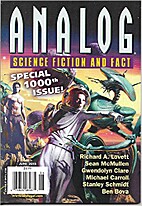
I read this as it was kindly given to me (along with the June 2015 edition of Asimov’s) by the good lady’s blog friend Peggy when she came to visit us in May.
The cover of ANALOG 1000 is apparently an adaptation of the very first cover (of Astounding Stories of Super Science, Jan 1930) and in his editorial Trevor Quachri says how much he loves both illustrations. He also notes the move under John W Campbell from unashamed action-adventure pulp to a magazine where “fleshed-out characters and realistic science are integral to what we do.” (You might still want to work a bit more on that “fleshed-out characters” thing, guys.)
In accordance with Campbell’s prescription, as well as the fiction the mag has several fact articles. This being the 1000th issue these include a look at how the magazine might evolve, a statistical comparison of Analog with other comparable magazines (genre or not) with regard to its longevity while also noting its most frequent contributors and a piece on the importance of legendary editor Campbell to the evolution of Astounding into Analog (and SF as a whole.)
The fiction is highly skewed towards the space operatic. Only two out of the featured stories were Earthbound. In The Wormhole War by Richard A Lovett, Zeke Schlachter is piloting Earth’s first exploratory wormhole (to the Earth-like planet Gaia 205c) when it suddenly explodes. Five years later so does the second. Every wormhole meets the same fate. The Gaians turn out to be sending wormholes towards Earth faster than humans can in the other direction. Something has to give.1 The very YA in tone Very Long Conversations by Gwendolyn Clare has an expedition to an alien planet being contacted by the indigenous population – through sculpture. The Kroc War by Ted Reynolds & William F Wu is told from a variety of sketched viewpoints, pro and anti the war, mostly human but one Kroc, and is the story of said war from beginning to end, and beyond. In Strategies for Optimizing Your Mobile Advertising by Brenta Blevins a man whose T-shirt runs ever-changing advertising slogans (you can’t block adverts from someone standing right in front of you) has his system hacked. The Odds by Ron Collins contemplates the chances of being the one ambassador in the history of the universe charged with lying to the only other sentient species known.2 In The Empathy Vaccine by C C Finlay a man wants to buy a treatment that will remove his empathy. (The seller has already taken done this.)3 Seth Dickinson’s Three Bodies at Mitanni relates how three people (though it is their consciousnesses only) have been charged with roaming the galaxy and deciding whether the societies derived from seedships sent out earlier “by a younger and more desperate Earth” are to be culled or not. 4 Ships in the Night by Jay Werkheiser has a high c, time-dilated interstellar trader spin a yarn at a pub on a stopover. In The Audience by Sean McMullen, humanity’s first starship arrives at the gas giant Abyss as it passes through the Oort cloud. Under the surface of its moon, Limbo, the crew finds alien life. And it finds them.5
Many of these contain the sort of stuff I loved when I was a teenager discovering SF and consuming it voraciously. While I’m glad people are still producing stories like these (they’re entertaining enough and do what they say on their tins) I’ve moved on a bit and wouldn’t seek them out. But it’s great to have the 1,000th issue of a magazine on my shelves.
Pedant’s corner:- (in one of the book reviews) “who will stop at noting” (if only such people – or indeed aliens – would!!)
1 mowed (mown,) like Damocles’ (Damocles’s,) Two year later (years.)
2 has “lay” for “lie” but this seems to be common in USian
3 he probably checked out me the way I checked out him (checked me out the way I checked him out sounds more natural to me.)
4Lachesis’ (Lachesis’s; several instances.)
5 Complimenting each others’ skills would be a fine thing for the crew to do but complementing them is actually the reason why they had been selected. Clouds do not contain water vapour (it’s colourless) but rather liquid or solid water. And a scientist ought not to use “steam” in this context either. Gasses (gases.)
Tags: Analog, Astounding, Astounding Stories of Super Science, Brenta Blevins, C C Finlay, Gwendolyn Clare, John W Campbell, Richard A Lovett, Ron Collins, Science Fiction, Sean McMullen, Seth Dickinson, Ted Reynolds, Trevor Quachri, William F Wu

Denis Cullinan
14 August 2015 at 04:22
QUOTE: “Gasses (gases.)”
The fool Merriam-Webster approves the horrid barbarism “gasses.”
jackdeighton
14 August 2015 at 09:17
Denis,
Gasses is just sooooo wrong!