Posted in Events dear boy. Events, Science Fiction at 20:30 on 8 December 2020
I see from George R R Martin’s blog that SF writer and editor Ben Bova has died.
Martin is particularly indebted to Bova as it was he as editor of Analog who helped Martin’s career (and those of many others) by accepting his stories for publication.
As a writer Bova’s style was in that USian hard SF tradition, which isn’t entirely to my taste. Looking at my records it seems I only bought two of his novels, Millenium and Kinsman.
Benjamin William (Ben) Bova: November 8/11/1932 – 29/11/2020. So it goes.
I also saw (on CNN as it happens) that legendary test pilot Chuck Yeager, first to person to fly faster than the speed of sound (in air,) yesterday passed away. (The link is to his Guardian obituary.) I read Tom Wolfe’s book The Right Stuff (and also watched the film made from it) about Yeager’s era of piloting and the early US space programme.
Charles Elwood (Chuck) Yeager; 13/2/1923 – 7/12/2020. So it goes.
Also gone from us is former golfer and TV commentator Peter Alliss. His style had gone a bit past its sell-by date in recent times but it cannot be denied that his knowledge of golf and its history was immense.
Peter Alliss; 28/2/1931 – 5/12/2020. So it goes.
No Comments »
Posted in Reading Reviewed, Robert Silverberg, Science Fiction at 12:00 on 15 August 2015
Dell Magazines.

This magazine is more weighted to fiction than Analog though there are non-fiction pieces. Kathleen Ann Goonan’s guest editorial describes SF as a literature that asks Where do we come from? What are we? Where are we going? – thus adding two additional questions to the one most literature addresses – Robert Silverberg’s Reflections goes over the history of predictions of the end of the world and of apocalyptic SF while James Patrick Kelly’s On The Net: an Optimist’s Tale argues that modern day SF is not as pessimistic as some in Project Hieroglyph present.
As to the fiction, there is less cleaving of the paper light years in Asimov’s than there was in Analog, notwithstanding the first story The End of the War by Django Wexler, wherein two remnants of humanity called Minoans and Circeans fight a proxy war on derelict spaceships left over from the main battles by means of pilot-controlled salvage/manufactory devices. The opposing pilots have conversations as they fight over the remains.1 Henry Lien’s The Ladies’ Aquatic Gardening Society has two society ladies in what seems the nineteenth century trying to find the favour of Mrs Ava Vanderbilt by means of elaborate gardens. They take it too far.2 Mutability by Ray Nayler sees a couple meet for the first time in a café – four hundred years after being photographed together. Indrapramit Das’s The Muses of Shuyedan-18 features two human women who are witnessed having sex by the huge alien of the title which reproduces them in a carving on its back.3 The titular characters in M Bennardo’s Ghosts of the Savannah are two prehistoric women hunters who don’t want to settle to a life of domesticity and child-bearing. Our Lady of the Open Road by Sarah Pinsker is the tour bus for the band Cassis Fire, who are rare hold-outs still playing real gigs in a world where entertainment has been cornered by the corporate might of StageHolo.4
Pedant’s corner:-
1 the compute power (twice!! “computing power” is so much less ugly,) to go to particular place (a particular place,) “slingshot” as the preterite of the verb (slungshot? slingshotted? But then I suppose USians use fit as a past tense,) the maze of room and corridors (this ship had corridors but only one room?)
2 hostess’ (hostess’s,) the USianism “dove” for “dived”, plus the story jumps from Chapter VII to IX with no sign of VIII.
3 chord (cord,) in a way the human brain will remind of our own architectures (will be reminded of.)
4 in the cards (on the cards.)
No Comments »
Posted in Reading Reviewed, Science Fiction at 12:00 on 13 August 2015
Special 1000th issue. Dell Magazines.
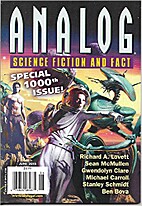
I read this as it was kindly given to me (along with the June 2015 edition of Asimov’s) by the good lady’s blog friend Peggy when she came to visit us in May.
The cover of ANALOG 1000 is apparently an adaptation of the very first cover (of Astounding Stories of Super Science, Jan 1930) and in his editorial Trevor Quachri says how much he loves both illustrations. He also notes the move under John W Campbell from unashamed action-adventure pulp to a magazine where “fleshed-out characters and realistic science are integral to what we do.” (You might still want to work a bit more on that “fleshed-out characters” thing, guys.)
In accordance with Campbell’s prescription, as well as the fiction the mag has several fact articles. This being the 1000th issue these include a look at how the magazine might evolve, a statistical comparison of Analog with other comparable magazines (genre or not) with regard to its longevity while also noting its most frequent contributors and a piece on the importance of legendary editor Campbell to the evolution of Astounding into Analog (and SF as a whole.)
The fiction is highly skewed towards the space operatic. Only two out of the featured stories were Earthbound. In The Wormhole War by Richard A Lovett, Zeke Schlachter is piloting Earth’s first exploratory wormhole (to the Earth-like planet Gaia 205c) when it suddenly explodes. Five years later so does the second. Every wormhole meets the same fate. The Gaians turn out to be sending wormholes towards Earth faster than humans can in the other direction. Something has to give.1 The very YA in tone Very Long Conversations by Gwendolyn Clare has an expedition to an alien planet being contacted by the indigenous population – through sculpture. The Kroc War by Ted Reynolds & William F Wu is told from a variety of sketched viewpoints, pro and anti the war, mostly human but one Kroc, and is the story of said war from beginning to end, and beyond. In Strategies for Optimizing Your Mobile Advertising by Brenta Blevins a man whose T-shirt runs ever-changing advertising slogans (you can’t block adverts from someone standing right in front of you) has his system hacked. The Odds by Ron Collins contemplates the chances of being the one ambassador in the history of the universe charged with lying to the only other sentient species known.2 In The Empathy Vaccine by C C Finlay a man wants to buy a treatment that will remove his empathy. (The seller has already taken done this.)3 Seth Dickinson’s Three Bodies at Mitanni relates how three people (though it is their consciousnesses only) have been charged with roaming the galaxy and deciding whether the societies derived from seedships sent out earlier “by a younger and more desperate Earth” are to be culled or not. 4 Ships in the Night by Jay Werkheiser has a high c, time-dilated interstellar trader spin a yarn at a pub on a stopover. In The Audience by Sean McMullen, humanity’s first starship arrives at the gas giant Abyss as it passes through the Oort cloud. Under the surface of its moon, Limbo, the crew finds alien life. And it finds them.5
Many of these contain the sort of stuff I loved when I was a teenager discovering SF and consuming it voraciously. While I’m glad people are still producing stories like these (they’re entertaining enough and do what they say on their tins) I’ve moved on a bit and wouldn’t seek them out. But it’s great to have the 1,000th issue of a magazine on my shelves.
Pedant’s corner:- (in one of the book reviews) “who will stop at noting” (if only such people – or indeed aliens – would!!)
1 mowed (mown,) like Damocles’ (Damocles’s,) Two year later (years.)
2 has “lay” for “lie” but this seems to be common in USian
3 he probably checked out me the way I checked out him (checked me out the way I checked him out sounds more natural to me.)
4Lachesis’ (Lachesis’s; several instances.)
5 Complimenting each others’ skills would be a fine thing for the crew to do but complementing them is actually the reason why they had been selected. Clouds do not contain water vapour (it’s colourless) but rather liquid or solid water. And a scientist ought not to use “steam” in this context either. Gasses (gases.)
No Comments »
