Farthing by Jo Walton
Posted in Altered History, Reading Reviewed, Science Fiction at 12:00 on 7 December 2015
Corsair, 2014, 318 p. Returned to a threatened library.
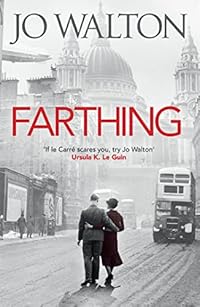
An altered history country house mystery, Farthing is not the cosy murder story you might associate with the time in which it is set. Farthing, here, is not only the smallest denomination coin of pre-decimal British currency but also the country house where the murder has taken place, whose name has also been given to a “Set” of like-minded politicians and wielders of influence. The murder victim was Sir James Thirkie – bringer back of “Peace with Honour” after Hess’s mission led to Churchill’s overthrow and talks brought about an accommodation with Germany in 1941. Thirkie’s body was left with a dagger in its chest, affixed through a yellow star, suggesting the involvement of Jewish activists.
The narrative is carried by the first person of Lucy Kahn, Eversley as was, daughter of Lord and Lady Eversley and wife of David, a Jew to whom Lady Eversley has never become reconciled, taking alternate chapters with the third person viewpoint of the investigating officer, Inspector Peter Anthony Carmichael of Scotland Yard. Lucy Kahn’s voice begins as irritating but seems well captured. It may well be a reasonable reflection of how daughters of the upper crust spoke in the 1940s.
Tightly and intricately plotted, the book is also deeply embedded in its parallel world; the crime(s) committed in it arising out of its particular circumstances. Normally it is the duty of the detective in a crime novel to put the world to rights. (Spoiler.) In this case, due directly to Walton’s setting and purposes, that isn’t possible.
To a British reader it did seem strange that a book set in such a time and place could go by without a single mention of Oswald Mosley or the British Union of Fascists (though Walton’s conspirators echo them clearly enough.) There is also a simplification of the mechanics and ramifications of a vote of no confidence in the House of Commons and no feel at all for the process by which leaders of the Conservative Party “emerged” in those times. I suspect both of these caveats would have been of little or no interest, or perhaps relevance, to Walton’s mainly USian readers. (The book is printed with the USian text – a minor irritant.) The degree of prejudice towards Jews prevalent by all levels of society in Farthing is perhaps a little at odds with the history of the Britain of our world (though such prejudice manifestly did exist) but in this respect, and substituting Muslims for Jews, the book has perhaps even more resonance now than it did when it was first published in 2006. A slide towards greater authoritarianism is all too evident in the UK at the moment and the phrase “if you’re innocent you’ve nothing to fear” is always chilling.
Another irritant was that characters refer to the country as England which is in one sense fair enough; most of them are English and would almost certainly have done so unthinkingly, but the new Prime Minister in his first PM’s speech to the House of Commons refers by that name to the whole of the country he has just taken over. I doubt even a crypto-fascist politician would have made such an error.
Nevertheless, I’ve already taken the second in Walton’s so-called Small Change trilogy, Ha’penny, out of a local library.
Pedant’s corner:- “But in the Battle of Britain, when the Heinkels were thick on his tail, I dived and strafed them to draw them off” (Heinkels were bombers and incapable of such a feat, Messerschmitts is more like it; strafing is done from air to ground, not air to air,) halftime (in a concert? That would be “the interval”,) “and all he died possessed but ten thousand pounds” (I get the gist but the phrase is missing something.) I wondered, would an English aristocrat name a horse Valley Forge? The spelling license was used for the noun (licence,) “which puts as back” (us back,) “and now he’d employed full time” (he’s employed,) taxicabs (cabs, or taxis, but not taxicabs,) no “?” at the end of a question, “I saw it during the war, looking at the way society interlocks at the bottom, talking to the other pilots (most RAF pilots in the Battle of Britain were not from the bottom of society) and either Lucy as narrator or Walton as author seems to be under the impression that the moment of conception occurs simultaneously with climax.
Tags: Altered History, Alternate History, Alternative History, British Union of Fascists, Heinkels, Jo Walton, Messerschmitts, Oswald Mosley, Science Fiction
