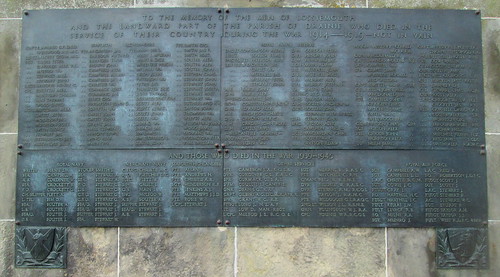
Mundford War Memorial
Posted in Trips, War Memorials at 12:00 on 3 April 2024
Posted in Trips, War Memorials at 12:00 on 16 March 2024
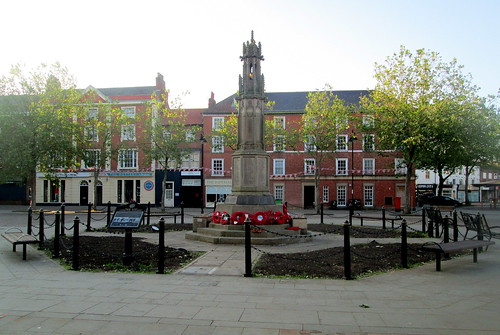
Retford’s War Memorial stands in the Market Square and takes the form of an Eleanor Cross.
Inscription:-
Names, Great War above, World War 2 below with WW2 dedication:-
Names
More names:-
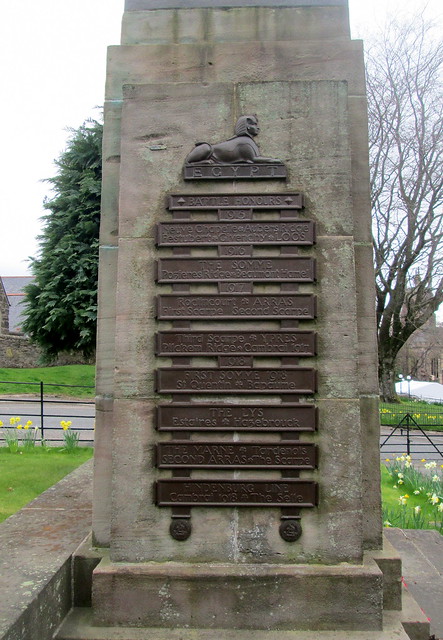
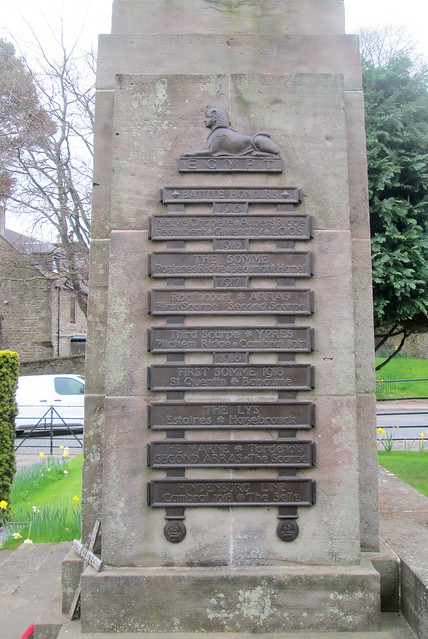
Areas/towns fought over:-
Great War dedication:-
Korean War name:-
Crosses and wreaths:-
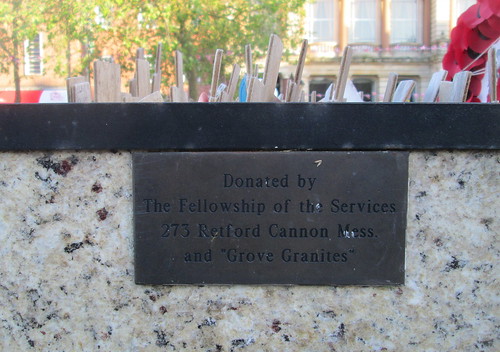
Donation and presentation plaques:-
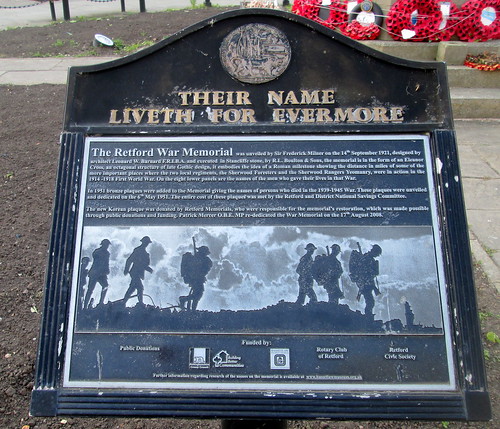
Information board by Memorial:-
Posted in Edinburgh at 12:00 on 6 March 2024
Several gravestones in Edinburgh’s Dean Cemetery contain dedications to those who died on active service.
Anthony Norman, Lothians and Border Horse, killed in action 20/2/1943, aged 29:-
David S C Turnbull, Lt. Black Watch and Royal Flying Corps, 1/4/1917:-
Harry Youmger, killed at St Valery, 19/6/1941, aged 41 and Laurence Younger, fell in action, Tunisia, 1943:-
Oswald Stanley Brown, 2nd Lt, 1st Black Watch, killed in action in France 22/12/1915:-
Posted in Other fiction, Reading Reviewed at 12:00 on 2 March 2024
Doubleday, 2022, 445 p.
This book diverts from Atkinson’s previous novels I have read (set either in the present day or the Second World War) to engage with the 1920s – the aftermath of another huge conflict of course. It is a kind of detective novel, a kind of historical novel, a behind-the-scenes-of-criminal-life novel, an exploration of the hopes and dreams of runaways eager to make their names on the stage, and an illustration of everyday sexism.
It starts with the release of Nellie (Ma) Coker, an almost celebrity underworld figure, from Holloway prison where she had been imprisoned for breaching the licensing laws (her on-the-take policeman, Inspector Maddox, not having informed her of a raid.) A crowd has gathered, among them Chief Inspector Frobisher, sent to Bow Street nick to clean the place up and anxious to nail Nellie for her other criminal activities. To this end he has recruited Gwendolen Kelling, in the Great War a nurse and so used to the harsher side of life but more recently a librarian. She is down in London on behalf of her friend Cissy to see if she can locate Cissy’s runaway half-sister Freda Murgatroyd and her friend Florence Ingram.
Frobisher’s main concern, though, is the disappearances of girls (ie young women) some of whom end up in the River Thames; disappearances he suspects may be connected to the Coker empire.
Ma Coker’s enterprises are under threat; Maddox wants to take them over and a man calling himself Azzopardi is out for revenge for past wrongs done to him. Maddox’s companion in corruption, Sergeant Oakes, dubbed the Laughing Policeman because of the song, is anything but comedic.
This is by no means vintage Atkinson. (But did I have this reaction because the subject matter wasn’t as serious as World Wars? See the quote, “People always take war novels seriously,” from the same author’s A God in Ruins, in the third last paragraph of my review.)
Particularly in the early chapters here there is a feeling of writing by numbers. Frobisher has an unsatisfactory marriage and is unable to relate to people. Ma Coker is a familiar relatively unbending matriarch (though her hallucinations of a dripping wet Maud whom only she can see are an unusual touch; however, not enough is made of them.) Her daughters Betty and Shirley are no more than background presences but Edith provides some jeopardy through her affair with Maddox. 11-year-old Kitty seems absurdly naïve for a scion of such a family. Ma’s son Ramsay is a drug addict, a homosexual and entirely ineffective. Her other son Niven, a war veteran, is made of sterner stuff but finds himself strangely attracted to Gwendolen who in turn is perhaps a little too hands-on and gung-ho for the times – though her war-nursing background would have hardened her – and she seems to forget her primary reason for coming to London. There are too many viewpoint characters and an excess of flashback scenes.
It’s all entertaining enough though.
Pedant’s corner:- “open maw” (a maw is a stomach; an open stomach would be potentially catastrophic,) “an unnecessarily argumentative Glaswegian” (unnecessarily? Argumentativeness is in the job description,) Nicolaides’ (Nicolaides’s,) “was trying to her frighten her” (no need for that first ‘her’,) “a five shilling note” (I had never heard of these. They were withdrawn in 1928, but there was an emergency wartime issue in 1940,) elevator (in Britain it’s a lift. And this was in a boarding house, which would, most likely, in the1920s not have contained such a device.) “‘She not family’” (She’s not family.) “The desk sergeant had been at Verdun” (as far as I know the Allied troops at Verdun were exclusively French but I suppose there may have been British members of the Foreign Legion there,) “on the strait and narrow” (heretofore I had only ever seen this as ‘straight and narrow’ but both forms seem to be acceptable,) rooves (usually ‘roofs’ but it was in dialogue,) a missing end quote mark after a piece of dialogue, “comforter” (in Britain this is usually called a [baby’s] dummy,) uneducable (usually spelled ‘ineducable’.)
Posted in Trips, War Memorials at 12:00 on 17 February 2024
Just behind Keith War Memorial, a little further up the small hill on which it stands, is a memorial to the 6th Battalion Gordon Highlanders, a figure of a kilted soldier with rifle at the ready:-
Dedications:-
The battalion’s battle honours are listed on either side of the memorial:-
Posted in Dumbarton FC, Events dear boy. Events, Football at 20:30 on 16 February 2024
One of the finest Scottish footballers of the post-Second World War era, Ian McMillan, has died, at the age of 92.
He started his senior career at Airdrieonians (the original Airdrieonians) for whom he played for ten years before being transferred to Rangers (the original Rangers.)
In his time at Ibrox he was nicknamed “The Wee Prime Minister” for his performances (and also in recognition of the actual Prime Minister at the time) and was part of that semi-legendary forward line Scott, McMillan, Millar, Brand and Wilson (Later Henderson, McMillan, Millar, Brand and Wilson.) He won six caps for Scotland, four Scottish League titles, three Scottish Cup finals, and two Scottish League Cups and played in the 1961 European Cup Winners’ Cup final a year after playing in the European Cup semi-final.
It’s lost in the mists of time but I believe I may have seen him play for Rangers in a League Cup game against Hibs in the early 1960s. (I was very young at the time.)
McMillan returned to Airdrie for one season before retiring but later became manager of the club.
He has a connection to the Sons of the Rock in that his grandson Iain Russell played for Dumbarton FC in two spells.
John Livingstone “Ian” McMillan: 18/3/1931 – /2/2024. So it goes.
Posted in Trips, War Memorials at 12:00 on 12 February 2024
Keith is a town in the former Banffshire, now a part of Moray, about eight miles south-east of Fochabers. Its War Memorial is a sarcophagus-like cenotaph in the grand municipal style just off the main A 96 road through the town:-
Great War dedication and names:-
Second World War names and dedications are to either side on the walls behind the earlier memorial stone:-
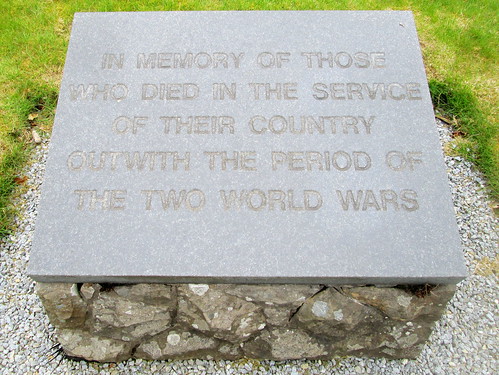
On a piece of grass to the side is a stone laid in memory of the dead of other conflicts:-
Posted in Trips, War Memorials at 12:00 on 10 February 2024
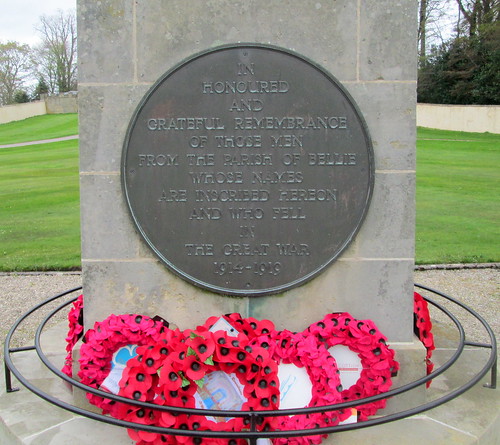
Fochabers is a village in the parish of Bellie in Moray, just off the A 96 road which acts as its bypass. It’s about ten miles east of Elgin.
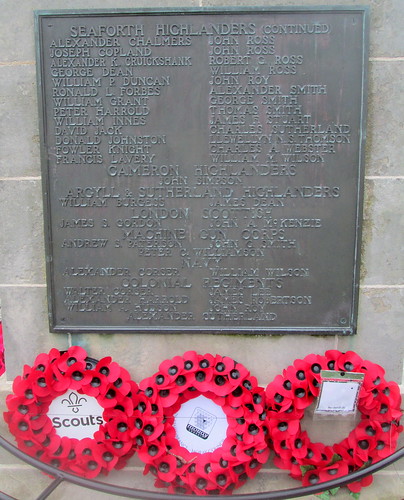
Its War Memorial is a stone column in a triangle of land in front of the entrance gate to Gordon Castle.
Great War dedication, “To the men of the parish of Bellie.”:-
Great War names:-
Second World War Roll of Honour, Fochabers District:-
Posted in Other fiction, Reading Reviewed at 12:00 on 3 February 2024
Myrmidon, 2007, 508 p, including 2 p maps of Penang and Malaya.
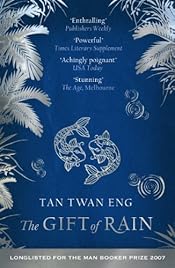
Fifty years after the end of the Second World War a Japanese woman, Michiko Murakami, comes to visit Philip Hutton at his home in Penang, bringing with her the katana which his sensei, Hayato Endo, a follower of Morihei Ueshiba, had had made for him. Endo is buried on a small island just off Hutton’s land and Michiko was once his inamorata before circumstances meant they could not be together. Over a few nights Hutton relates the course of his relationship with Endo-san, being taught the martial art of aikijujutsu, and his unwitting participation in the preparations for the Japanese invasion of Malaya in 1941.
Philip was the last child of Noel Hutton, owner of a large trading company. Philip’s mother was his father’s second wife, a Chinese woman, but who died. He grew up a misfit, not quite belonging to the British set but yet not Chinese either. He is doubly estranged since his mother’s family did not approve of the match and he has had little contact with them. In a weak moment his father does let slip that the pair had been very much in love.
The rest of his family, father and half-siblings William, Edward and Isabel, are away on a visit to England in 1941 when Endo-san, to whom the small island had been let, befriends Philip and decides to induct him in the way of aikijujutsu. This not only involves combat training – even though the emphasis is on defence and never killing – but requires that they trust each other fully. This trust will, of course, be stretched to breaking point by world events.
In the course of their friendship Endo-san asks Philip to take him on trips round the island. It is here the reader gets somewhat ahead of the narrative with the suspicion that Endo-san is a Japanese spy. He does admit that he is serving the Japanese government because his father had implicitly criticised the Emperor and his service is to prevent harm coming to his father.
The invasion when it comes still seems sudden and shocking, the British response shamefully inadequate. In its aftermath Philip is plunged into a quandary: loyalty to Endo-san or to his family (and its prospects) and to his friend who has joined the British resistance movement, Force 136. His acquiescence to the Japanese authorities, his acceptance of a translating job with them is seen as a betrayal by some but in other respects allows him to soften some of its harshness; albeit only in a small way.
There is much more nuance to this novel than the above might imply. Philip makes a relationship with his Chinese grandfather, colludes with the resistance while maintaining cooperation with the Japanese authorities but in the end, despite Endo-san’s shielding, is unable to safeguard everything that he would wish. The brutality of some Japanese actions contrasts vividly with the non-violent aspects of Endo-san’s instruction.
One thing that struck me as odd was that there seemed to be a large Japanese presence in pre-war Penang; not just Endo-san but also consular officials – and soldiers, who still seemed to roam free unarrested after the invasion of Malaya had begun but before the invading forces had reached Penang itself. Eng is more likely to be on top of these details than I am though.
This is a very good novel indeed, aspects of the writing are exemplary, the characters agreeably shaded (apart from the out and out cruelty of some Japanese soldiers; which is of course a matter of historical fact) the examination of aikijujutsu philosophy illuminating, but it fell from the absolute highest drawer of literature when it tumbled over into the spying aspect. Moreover, it was unreasonable for Philip to have provided (even if unwittingly) just about all the information about the Malayan peninsula which informed the tactical elements of the Japanese invasion. Yet without that Eng’s story would have been different.
Its core is the relationship between Philip and Endo-san. But is this a meeting of minds or an example of a kind of grooming? Endo-san is older and (apparently) wiser but there is a strand – which is not overly stressed – where the relationship between Philip and Endo-san apparently goes much deeper than mere friendship as their fates have seemingly been entwined through various incarnations in history.
Pedant’s corner:- “was roused out his stupor” (out of his stupor,) “and and” (only one ‘and’ was needed,) “gave smile” (gave a smile,) whiskey (whisky?) a missing end quote mark, “Kon make a move” (made a move,) “round the bend was hidden spot” (was a hidden spot.)
Posted in Trips, War Memorials at 12:00 on 24 January 2024
Lossiemouth is a town in Moray, situated where the River Lossie enters the Moray Firth. It’s about six miles north of Elgin.
It has an unusual wall mounted Memorial, hard by the River Lossie just before it reaches the Moray Firth. On Pitgaveny Street.
Dedications and names:-
The Memorial is surmounted by a figure of Victory and Peace:-