The Second Cut by Louise Welsh
Posted in Other fiction, Reading Reviewed, Scottish Fiction, Scottish Literature at 12:00 on 13 March 2024
Canongate, 2022, 373 p, including 3 p Afterword.
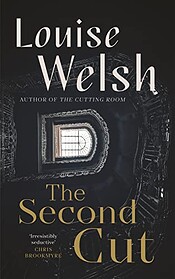 This one was published twenty years after Welsh’s first novel The Cutting Room and in it she returns to the central character of that book, Rilke, an auctioneer for the financially troubled Bowery Auctions. Rilke is gay and the intervening years gives Welsh, through Rilke, the opportunity to comment on the evolution in attitudes towards homosexuality that has taken place in that time. (Some prejudice still appears here but on the whole the other characters – even those he is meeting for the first time – by and large accept who and what he is.)
This starts from the first scene where Rilke is attending the wedding of the two Bobbys, where the parents of one of the two grooms were never to be mentioned. Rilke has to escort one of the guests, Jojo, out of the reception to avoid the possibility of a scene. Jojo gives Rilke a tip about the wind-up of an estate at Ballantyne House in Dumfries and Galloway whose owners are looking to sell off the house contents, a commission which might save Bowery Auctions’ somewhat failing fortunes. The next day Jojo is found dead in an alley.
As Rilke delves into the circumstances of the death via Jojo’s lodger, an art student calling himself Sands, he gets embroiled with gangster Jamie Mitchell and encounters a strange situation regarding the affairs at Ballantyne House and farm, where there was a car crash a week or so before and the auction crew rescue a frightened Vietnamese refugee, Phan, on a nearby road.
Welsh is always on top of her material here and interweaves her plot intricately. We are almost incidentally given glimpses of the more outré aspects of Glasgow’s gay scene.
Her talent for characterisation is illustrated by the on-off relationship between the auction house’s owner, Rose, and police Inspector Jim Anderson. There was the neat observation, “He had slicked his wet hair back from his face, like Brian Ferry before the cardigans set in.”
This doesn’t quite reach the levels which The Cutting Room did, but it is still a very good piece of crime fiction. A cut above you might say.
Pedant’s corner:- Burns’ (Burns’s,) “the frail women’s exit” (frail woman’s,) “a pair of storm doors” (on the top floor of a tenement? Storm doors are external. I think Welsh meant ‘vestibule doors’,) Sands’ (many times; Sands’s,) “black surplice” (on a minister at a funeral. Surplices are traditionally white and can be worn at funerals. If they’re black they’re most likely not a surplice but an ecclesiastical gown.) “Rose looked out of place the lady of the house” (needs a comma between ‘place’ and ‘the lady’,) “aren’t I?” (The speaker was a Scot. We say ‘amn’t I?’) “a group of youths were huddled” (a group … was huddled,) “people who never had no luck at all” (the sense demands ‘people who never had luck at all’,) “Sand’s said” (Sands said,) “some bullets” (these were for a shotgun, which traditionally is loaded with cartridges, not bullets. As indeed this shotgun was, later,) “let off three quick shots” ([again traditionally] shotguns can fire only twice before needing reloaded,) distributer (distributor.)