Archives » Shroud

Nina Allan’s List

This is Nina Allan’s response to the BBC’s list of 100 Books that shaped our world.

As usual the ones in bold I have read. (18. 19 if John Banville’s Shroud and Eclipse count as two.) Some others are on my tbr pile.

Borka: the Adventures of a Goose with No Feathers by John Burningham

Charlie and the Chocolate Factory by Roald Dahl

Stig of the Dump by Clive King

Charlotte Sometimes by Penelope Farmer

Thursday’s Child by Noel Streatfield

‘Adventure’ series by Willard Price

The Ogre Downstairs by Diana Wynne Jones

Carrie’s War by Nina Bawden

Jane Eyre by Charlotte Bronte

The Time Machine by H. G. Wells

‘UNEXA’ series by Hugh Walters

Wuthering Heights by Emily Bronte

‘Changes’ trilogy by Peter Dickinson

‘Tripods’ trilogy by John Christopher

The Dolls’ House by Rumer Godden

The Chrysalids by John Wyndham

Watership Down by Richard Adams

The Magician’s Nephew by C. S. Lewis

My Cousin Rachel by Daphne Du Maurier

All Quiet on the Western Front by Erich Maria Remarque

A Passage to India by E. M. Forster

The Old Wives’ Tale by Arnold Bennett

Nineteen Eighty-Four by George Orwell

Jude the Obscure by Thomas Hardy

Pavane by Keith Roberts

Roadside Picnic by Arkady and Boris Strugatsky

The Waste Land by T. S. Eliot

Ariel by Sylvia Plath

The Grass is Singing by Doris Lessing

Wide Sargasso Sea by Jean Rhys

The Drought by J. G. Ballard

Doctor Zhivago by Boris Pasternak

Anna Karenina by Leo Tolstoy

The Search for Christa T. by Christa Wolf

The Idiot by Fyodor Dostoevsky

Doktor Faustus by Thomas Mann

Ada by Vladimir Nabokov

The Turn of the Screw by Henry James

Picnic at Hanging Rock by Joan Lindsay

The Book and the Brotherhood by Iris Murdoch

Strangers on a Train by Patricia Highsmith

The Affirmation by Christopher Priest

Midnight Sun by Ramsey Campbell

Ghost Story by Peter Straub

The Brimstone Wedding by Barbara Vine

The Course of the Heart by M. John Harrison

Enduring Love by Ian McEwan

The Blind Assassin by Margaret Atwood

Personality by Andrew O’Hagan

House of Leaves by Mark Z. Danielewski

The Gunslinger by Stephen King

The Iron Dragon’s Daughter by Michael Swanwick

The Fifth Head of Cerberus by Gene Wolfe

Shroud/Eclipse by John Banville

My Tango with Barbara Strozzi by Russell Hoban

The Green Man by Kingsley Amis

The Sheltering Sky by Paul Bowles

Cloud Atlas by David Mitchell

Beyond Black by Hilary Mantel

Shriek: an afterword by Jeff VanderMeer

Austerlitz by W. G. Sebald

Darkmans by Nicola Barker

Glister by John Burnside

The Good Soldier by Ford Madox Ford

The Kills by Richard House

A Russian Novel by Emmanuel Carrère

The Third Reich by Roberto Bolano

The Dry Salvages by Caitlin R. Kiernan

In the Shape of a Boar by Lawrence Norfolk

The Lazarus Project by Aleksandar Hemon

The Accidental by Ali Smith

Happy Like Murderers by Gordon Burn

F by Daniel Kehlmann

Straggletaggle by J. M. McDermott

The Lost Daughter by Elena Ferrante

What is Not Yours is Not Yours by Helen Oyeyemi

The Loser by Thomas Bernhard

The Peppered Moth by Margaret Drabble

All Those Vanished Engines by Paul Park

Sorcerer of the Wildeeps by Kai Ashante Wilson

The Infatuations by Javier Marias

Outline by Rachel Cusk

A Separation by Katie Kitamura

Satin Island by Tom McCarthy

Carthage by Joyce Carol Oates

This is Memorial Device by David Keenan

The Sellout by Paul Beatty

Death of a Murderer by Rupert Thomson

Lanark by Alasdair Gray

Falling Man by Don DeLillo

Dept of Speculation by Jenny Offill

Reservoir 13 by Jon McGregor

Attrib. by Eley Williams

Berg by Ann Quin

When I Hit You by Meena Kandasamy

Munich Airport by Greg Baxter

Caroline’s Bikini by Kirsty Gunn

Die, My Love by Ariana Harwicz

The Sing of the Shore by Lucy Wood

Flights by Olga Tokarczuk

Eclipse by John Banville

Picador, 2010, 218 p. First published in 2000.

Eclipse cover

Actor Alexander Cleave (the same Cleave who would reappear in Banville’s later Shroud and Ancient Light, it seems I have read this sequence of Banville books out of publication order) has retired from the stage and gone back to his childhood home. It is somewhat rundown, but holds memories in nearly every room. In it Cleave hears faint sounds and imagines it might be haunted – in fact sees his father one day in a doorway. But it turns out Quirke, the solicitor charged with its care, and his fifteen year-old daughter, Lily, who has been taken on ostensibly as a housekeeper, are living in some of the vacant rooms.

The narrative is almost all Cleave’s musings and remembrances – there is very little dialogue in the novel – yet despite there not being much in the way of plot (the only significant occurrence in the book occurs off the page) Banville readily manages to hold the attention. There is something almost liquid in his sentences, each is perfectly constructed and the word choices are usually immaculate.

The eclipse of the title is both actual (that of 1999 takes place during the course of the novel) but also metaphorical. That significant occurrence is, though, foreshadowed when Cleave says, ‘I have the feeling, the conviction, I can’t rid myself of it, that something has happened, something dreadful, and I haven’t taken sufficient notice, haven’t paid due regard, because I don’t know what it is.’

This is a portrait of a man who has glided through life apparently without it really touching him or he it, only approaching animation when pretending, on the stage, to be someone else, but in the end faced with that “something dreadful” about which nothing can be done. Most lives have at least one of those.

Pedant’s corner:- “outside of me” (outside me ,) “door hinges squeak tinily” (tinily? In a small way? I don’t think so. Tinnily makes more sense,) duffel coat (duffle coat is the British spelling) “carrying in one hand that seemed a trident” (what seemed a trident,) accordeon (accordion, several instances,) slips-ons (slip-ons,) “and Quirke he came forward” (doesn’t need the “he”.)

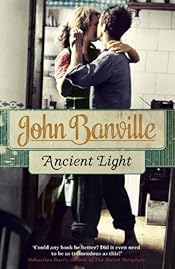
Ancient Light by John Banville

Viking, 2012, 253 p. Borrowed from a threatened library.

 Ancient Light cover

Ten years after the suicide of his daughter Cass, Alex Cleave is looking back over his life and especially at his first love – and first sexual partner – the twenty years senior to him mother of his childhood friend, Billy. Apart from one mention towards the book’s end the woman concerned, since Alex failed to discover (or else to remember) her name, is only ever described in the narrative as Mrs Gray. This tends to give the relationship, which is otherwise described in the most intimate terms, a certain distance, though it was intensively felt by the young Alex, and in the older’s remembrance. The worldliness of ageing, the weariness, is, however, reflected in the sentence, “what is a life but a gradual shipwreck?” but nevertheless, for Cleave, “Other people’s motives, their desiderata and anathemas, are a mystery to me. My own are too.”

As always Banville’s writing is exquisite and the unusual affair would certainly have been enough to sustain a novel on its own but things take an odd turn when Cleave, a retired stage actor, is offered the lead part in a film portraying the life of Axel Vander, whom readers of Banville’s earlier book Shroud will know was the man with whom Cass spent the last weeks before her suicide. This authorial knowingness is emphasised by the casual dropping of names of now all but forgotten writers or film stars – most of whom I had to look up (Walter Pater? Betty Hutton?) – in which context the thought, “If I were to believe that a certain confluence of events was a special and unique phenomenon outside the ordinary flow of happenstance I would have to accept – as I do not – that there is a transcendent process at work above, or behind, or within, commonplace reality,” a metafictional statement which lays bare the artificiality of what we are reading. Yet it all feels visceral, real. Banville’s interest in things scientific (early works of his focused on Copernicus, Kepler and Newton) is demonstrated by a chance encounter with a stranger in a hotel bar which leads to Cleave being told, “light…. takes time… to reach your eyes, and so it is that everywhere we look, everywhere, we are looking into the past,” an endeavour in which our narrator is all too involved.

Yet the past is not all it seems. Mrs Gray’s motives for the affair, Cleave’s recollections of it – memories are, after all, constructions as much as anything – are seen in a new light when towards the novel’s end Cleave once more meets her daughter.

A puff on the book’s front cover says, “Did it even need to be as tremendous as this?” Well, no. It didn’t need to be. But it is.

Pedant’s corner:- ‘at first I could not make head or tail of it’ (head nor tail,) wiling away the empty hours (whiling,) glary? “I had never been thus close up” (this,) “every aurate woman” (an aurate is a salt of auric acid!! I presume Banville meant golden or “having an aura”.) “Why does anyone do anything.” (is missing a “?” at the sentence end,) “Cass’s presence in Liguria [- paragraph break -] Cass’s presence in Liguria was the first link…” (I merely note this cæsura,) “had no hat, or umbrella” (nor umbrella,) “I had to leap up, like a leaping salmon” (do we need that “leaping”?)

free hit counter script