Archives » Schrodinger’s Cat

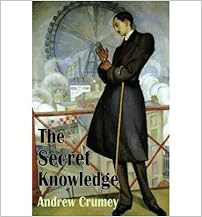
The Secret Knowledge by Andrew Crumey

Dedalus, 2013, 234 p.

The Secret Knowledge cover

In The Secret Knowledge Andrew Crumey has done something out of the ordinary. He has illustrated a corollary of the Schrödinger’s cat scenario – the possibility of multiple worlds – in a piece of fiction written in realistic terms. His characters discuss the possibilities but in the text it is never really spelled out that different scenes take place in different worlds. We must infer it from the narrative. Utilising the concepts of quantum physics in a literary form has always been one of Crumey’s concerns, though, and here he also returns to another of his familiar themes, music.

The chapters alternate between the historical and the present day starting in Paris in 1913 where composer Pierre Klauer has just completed a piano piece (entitled Le Savoir Secret, hence – in part – our novel’s title,) has also just proposed to his girlfriend Yvette but kills himself (off-stage) moments later. In our time, Paige, a student of piano, has just been assigned the tutelage of part-time concert performer David Conroy after giving up a course in English because she loves music more. Conroy gives to her to play a manuscript that has just come into his possession. A manuscript written by an unknown French composer and entitled The Secret Knowledge.

We then go back to 1919 just prior to the “Battle of George Square” in Glasgow where a newly arrived young French man befriends socialist John Quinn outside an Engineering Works. The Frenchman stirs up a meeting and is of course named Pierre Klauer. So. Did Klauer actually die in 1913, or not? (According to one Schrödinger outcome it can be both – or neither.) There follows a narrative which skips between the doings of Conroy and Paige, Yvette (who marries Klauer’s friend Louis Carreau,) to 1924 where Theodor Adorno meets a man who introduces himself as Klauer, Spain in 1940 where Carreau – who had stolen Klauer’s manuscript for Yvette – has an encounter with the philosopher Walter Benjamin who then kills himself in the belief he will be returned to France and the Nazis, and 1941 where Adorno meets Hannah Arendt. During these the same scene may be returned to but is shown to be subtly different.

But as Conroy says, “Art is always inconsistent,” and, “Truth is not something we discover consciously; it discovers us.” He also muses on his disappeared wife, “It’s only when they surprise you that you find out your ignorance. We expect continuity, not paradox.” About a part of Le Savoir Secret he feels, “this section is the dream of how things might otherwise have been, a path denied.”

In a passage which could be all about the writer’s art we have, “‘A performer knows all about the tricks of persuasion. Yes, the game was rigged, you were always meant to lose, but go on, take a card, see what you get.’” One of the characters conceives a future project, “a book of fragments, epigrammatic, or even surreal in character, apparent irrelevancies serving to create new, unintended meaning,” a book which, presumably, Crumey intended us to be reading in The Secret Knowledge.

Other notable pieces of dialogue include, “Lenin has” (succeeded) “in Russia. Make everyone think it’s a popular revolution when really it’s a coup: that’s genius.” Mention is made too of Louis Auguste Blanqui and the Mechanical Turk – which has seemed to crop up a lot recently in the books I have read.

Not the simplest of narratives then but immensely readable just the same. The actual secret of Klauer’s manuscript is not quite the tremendous revelation we might have hoped for though. Crumey here hasn’t quite achieved the heights he did in previous novels but The Secret Knowledge is still a remarkable rendering of quantum physics in the form of an accessible piece of fiction.

Pedant’s corner:- “he no longer tours, or records” (nor records,) Louis’ (Louis’s,) “the roll of a dice” (one of them is a die.) “The family she saw are gliding over the top” (the family is gliding.) Crumey is a serial offender here – “the family were” (the family was,) “around its upper balcony stand a crowd” (stands a crowd,) “a young couple huddle in one corner” (a couple huddles.)
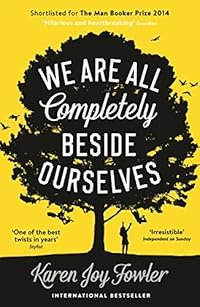
We Are All Completely Beside Ourselves by Karen Joy Fowler

Serpent’s Tail, 2014, 341 p. Borrowed from a threatened library.

 We Are All Completely Beside Ourselves cover

Firstly, this is a very good book indeed; and a consciously literary endeavour. Fowler’s first person narrator, Rosemary Cooke, frequently addresses the reader, digresses, makes asides, approaches her story obliquely, moves it forward and backward in time. She tells us in the prologue what she is about to do. Start in the middle. And later, in a cell, awaiting interrogation by the FBI she reflects on what she will say, “I would not only tell the tale but also comment on it.” Quite. By the end, though, she has decided that stories can begin and end anywhere.

When she was young Rosemary never stopped speaking. The reasons why, and why she gradually stopped doing so, are revealed over the course of the novel. Up until she was five years old Rose had lived with her mother, father, brother and sister. On returning from what she perceived as a banishment to her grandparents’ house she discovers her own family has moved house but it is her sister who has been sent away. This central circumstance is so essential to the novel that any discussion of it beyond generalities would reveal too much but it is its ramifications, the nature of her sister, Fern, and the effects both of these have on Rosemary and her brother, Lowell, which drive Fowler’s story.

Unsurprisingly, tensions abound. Rose tells us, “Antagonism in my family comes wrapped in layers of code, sideways feints, full deniability. I believe the same can be said of many families.” This is most likely a nod to Tolstoy’s similar phraseology. Through Rosemary, Fowler tells us elsewhere, “In most families, there is a favourite child. Parents deny it and maybe they truly don’t see it, but it’s obvious to the children. Unfairness bothers children greatly.” Incidentally, the Cooke family had a dog called Tamara Press. Quite why Fowler chose the name of a 1960s Russian shot-putter for this is obscure (to me at least.)

Much play is made of the unreliability of memory. Rose recalls an incident from her childhood where she remembers her father deliberately driving over a cat but he was not the sort of person to do such a thing. She both believes it happened and also that it didn’t and refers to it as her own personal Schrödinger’s cat. She also says that language “simplifies, solidifies, codifies, mummifies” memories and remembers her father telling Lowell that language and communication are two different things. In a neat line connecting Rose’s use of contact lenses with her sister’s disappearance she says, “It’s what you do with disposables; you get rid of them.”

Rose twice emphasises her experience that, “Where you succeed will never matter so much as where you fail” and refers to the rift in the family as “A monkey on my back….” but in what seems an authorial interpolation, “When I run the world, librarians will be exempt from tragedy.” Her father was a researcher into animal behaviour and the book is run through with references to such research. “‘You can train any animal into any behaviour on cue if it’s a natural behaviour to begin with. Racism, sexism, speciesism – all natural human behaviours… triggered any time by any unscrupulous yahoo with a pulpit… Mobbing…Bullying. Empathy.’” The book is very much Rose’s story, her umwelt (the world as it is experienced by a particular organism.) Humans it seems are much more imitative than other apes.

For various (and different) reasons I was reminded of both William Boyd’s Brazzaville Beach and Kate Atkinson’s Behind the Scenes at the Museum.

There are not many novels which go into detail on the concept of theory of mind or discourse on embedded mental states and imputation. Yet these discursions seem a natural part of the narrative making for a tremendously well worked out and impressively rendered novel.

Pedant’s corner:- A flock of seagulls were grazing (a flock was grazing,) hieroglyphic (hieroglyph.) Fowler does, however, receive plus points for culs-de-sac.

Buffalo Gals And Other Animal Presences by Ursula Le Guin

Plume, 1988. 196p.

In her preamble to this collection of stories and poems which feature animals Le Guin refers to the denigration talking-animal tales receive at the hands of “grown-up” critics and theorists. They are seen as children’s fare and not worth serious consideration. But of course it is in pointing up the differences and similarities between species and their use in morality tales that their usefulness lies. And that usefulness is no small thing. It is to the credit of fantastic fiction – perhaps its glory – that only in its area can such things be fully explored. To know what it is to be truly human we must contemplate the non-human.

Le Guin has of course investigated the many different ways in which humans can be human beings, and in particular altered in sexuality, throughout her career, so this is no departure.

The lead tale here, the award winning novelette Buffalo Gals Won’t You Come Out Tonight, is I suppose a fantasy wherein a human girl, never named throughout, the sole survivor of a plane crash, is taken in by a community of animals. The animals appear to her to live as humans – and they talk of course – but have animal behaviours, especially in terms of waste disposal and sex. Their attitudes and behaviour are the norm here though and it is this simple transference that highlights the peculiarities of our species, our detachment from nature, our oddness. The strangeness of the milieu, the fact of the animals being animals, their kindness and the child’s simple acceptance of things is essential to the story’s success. It is, in the original sense of the word, fabulous.

The Wife’s Story and Mazes are stories of transference in which we get almost to the end before the true natures of the protagonists are revealed. The Direction Of The Road has an unusual narrator, a tree, and is a fine exemplar of the working through of an initial premise.

Trees are something of a Le Guin theme. There was of course The Word For World Is Forest and in (Hugo Award nominee) Vaster Than Empires And More Slow – in this collection – there are arboriforms which turn out to be part of a planet wide intelligence.

The White Donkey and Horse Camp are slighter tales which are nevertheless effective. Schrödinger’s Cat considers a third outcome to the famous thought experiment beyond the either/or that quantum theory appears to suggest. The Author of the Acacia Seeds and other extracts from the Journal of Therolingiustics is an amusing dissection of the academic style as well as a thorough exploration of the possibilities of language in the non-human world. May’s Lion is presented first as a true story then as fiction while She Unnames Them is a strange piece about the power of names to circumscribe, or provoke, thoughts and actions.

Included in the nineteen poems by Le Guin is one which is her own translation of one of Rilke‘s.

free hit counter script